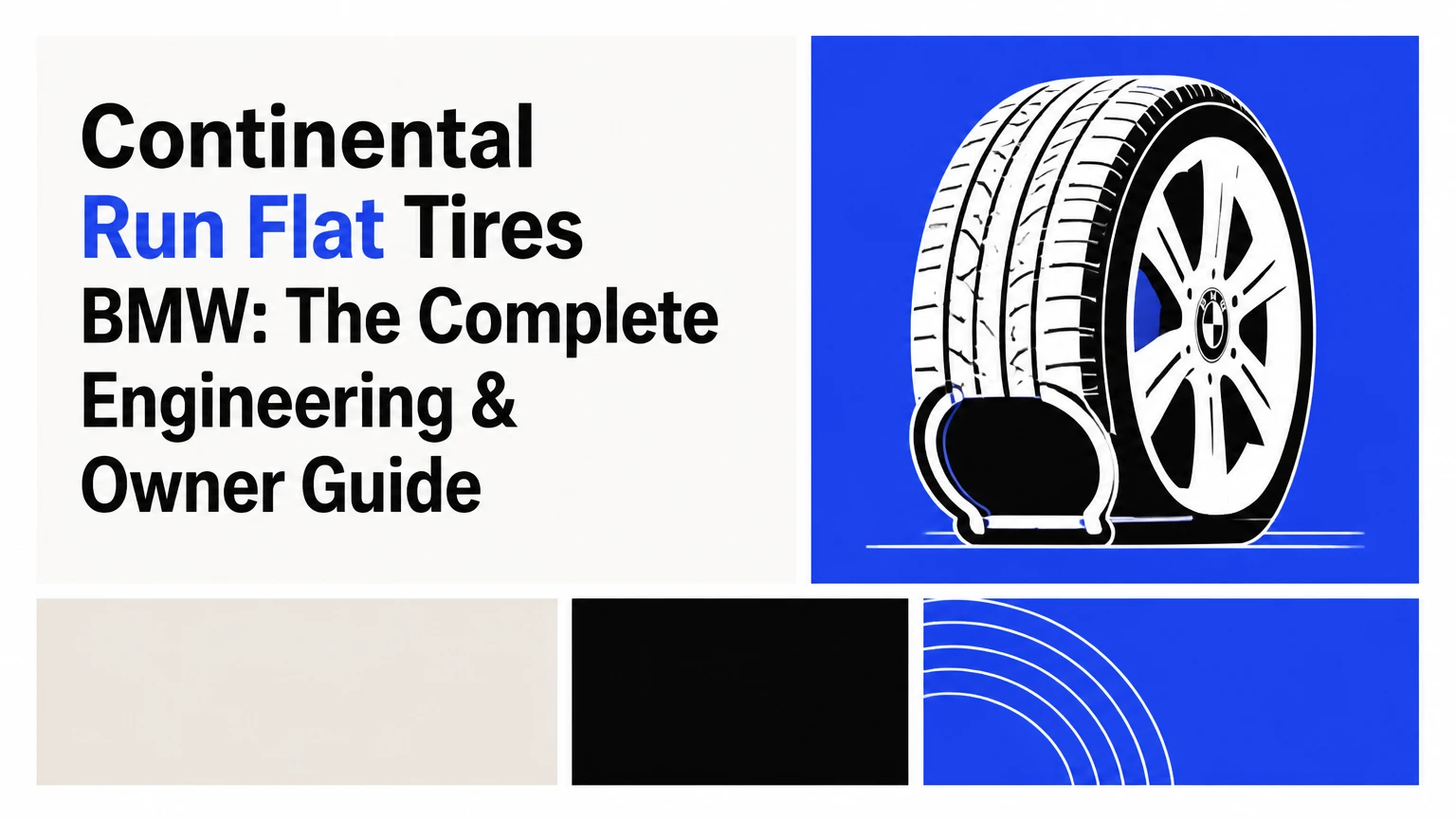
Continental run flat tires for BMW vehicles feature Self-Supporting Runflat (SSR) technology co-engineered with BMW to maintain vehicle stability and drivability for 50 miles at up to 50 mph following a complete loss of inflation pressure. These tires use reinforced, heat-resistant sidewall inserts and specialized bead seats to prevent rim contact and tyre detachment, eliminating the need for an immediate roadside tire change or a trunk-mounted spare.
Key Facts: Continental SSR Tires on BMW
- Core Technology: Continental Self-Supporting Runflat (SSR) uses a 3/4-inch reinforced inner sidewall rubber core to support the vehicle weight without air.
- Homologation Symbol: Original equipment (OE) variants designed specifically for BMW suspension geometry feature a Star Mark (
*) stamped on the sidewall.- Operational Limits: Maximum zero-pressure driving distance is 50 miles (80 km) at a top speed of 50 mph (80 km/h) under normal load conditions.
- Trunk Capacity: Factory implementation eliminates the spare tire, jack, and lug wrench, freeing up to 80 liters of usable under-floor cargo space.
- System Requirement: SSR tires MUST be paired with an active Tire Pressure Monitoring System (TPMS) because uninflated tires retain their physical shape.
How Do Continental SSR Run Flat Tires Work on a BMW?
Continental SSR run flat tires work by substituting internal air pressure support with a heavy-duty, self-supporting sidewall structure embedded directly into the tire carcass. Standard pneumatic tires rely on pressurized air to support the chassis; when punctured, air escapes, causing the sidewall to fold under the vehicle’s weight and allowing the wheel rim to crush the tread rubber against the road.
Standard Pneumatic Tire (Deflated)        Continental SSR Run-Flat Tire (Deflated)
┌─────────────────────────────────┐       ┌─────────────────────────────────┐
│        [ Wheel Rim ]            │       │        [ Wheel Rim ]            │
│              │                  │       │              │                  │
│       (Collapses Down)          │       │   [Reinforced Core Sidewall]    │
│              │                  │       │   (Bears Full Vehicle Weight)   │
│   ▼▼▼▼▼▼▼▼▼▼▼▼▼▼▼▼▼▼▼▼▼▼▼       │       │              │                  │
│   ═══════════════════════       │       │   ═══════════════════════       │
│   (Flattens Against Road)       │       │   (Retains Structural Shape)    │
└─────────────────────────────────┘       └─────────────────────────────────┘
Continental’s SSR architectural design relies on three structural components:
- Reinforced Core Sidewalls: The internal sidewalls integrate high-durometer rubber inserts approximately 3/4-inch thick—compared to standard tire sidewalls measuring roughly 1/8-inch. These specialized filler compounds carry the physical axle load of the BMW chassis when pneumatic pressure drops to zero.
- Advanced Bead Seat Wire: A high-tensile, widened bead wire anchors the tire bead tightly inside the wheel rim lip. This mechanical lock prevents the tire from bead-unseating or slipping off the wheel under lateral cornering forces during zero-pressure operation.
- Molecular Heat Mitigation Compounds: Flexing a deflated rubber matrix creates intense internal heat through hysteresis. Continental uses sulfur-crosslinked, low-hysteresis polymers in the sidewall compound to dissipate heat buildup, preventing structural carcass degradation during run-flat operation.
What Happens During a Puncture? (The 5-Step Emergency Sequence)
When a sharp object punctures the tread of a Continental SSR tire on a BMW, the vehicle manages the air-loss event through a predictable structural and electronic sequence.
1.Tread Penetration & Pneumatic Discharge:Immediate loss of compressed air pressure.
A sharp object (such as a nail or screw) breaches the inner liner. Compressed air escapes through the breach. While a standard tire would collapse within seconds, the thick Continental SSR sidewall inserts immediately engage to take on the vehicle load.
2.Electronic TPMS Trigger & iDrive Alert:Wheel speed and pressure sensor calculation.
Because the SSR tire retains its vertical profile, there is virtually zero visible tire sag. The BMW active Tire Pressure Monitoring System (TPMS) calculates either direct pressure drops via wheel-mounted sensors or rotational speed variances via ABS wheel speed sensors, triggering a red tire symbol and notification on the BMW iDrive screen.
3.Structural Weight Transfer:Axle load shifts from air column to sidewall inserts.
As internal pressure hits zero, 100% of the corner weight transfers onto the reinforced rubber sidewall inserts. The rigid construction prevents the wheel rim from pinching or cutting through the tire rubber.
4.Vehicle Stability Control Maintenance:Preservation of steering, braking, and xDrive dynamics.
The stiffened SSR sidewall preserves lateral rigidity. Steering response, braking feedback, and Dynamic Stability Control (DSC) calibration remain 80% to 90% normal, preventing sudden vehicle pull or loss of path control.
5.Safe Transit to Service Facility:50 miles at 50 mph operational window.
The driver navigates directly to a tire center or safe destination without stopping on a hazardous road shoulder to mount a temporary spare.
What Does the BMW Star Mark (*) Mean on Continental Tires?
The BMW Star Mark (*) stamped on the sidewall of a Continental tire indicates that the tire is an Original Equipment (OE) specification co-engineered and homologated specifically for BMW chassis geometry, steering feedback, and xDrive drivetrain requirements.
┌─────────────────────────────────────────────────────────────────────────┐
│                 CONTINENTAL SSR SIDEWALL MARKING MATRIX                 │
├───────────────────┬─────────────────────────────────────────────────────┤
│ Marking           │ Engineering Purpose                                 │
├───────────────────┼─────────────────────────────────────────────────────┤
│ SSR               │ Continental Self-Supporting Runflat technology      │
│ Star Mark (*)     │ BMW OE Homologation (custom compound & tread depth) │
│ ContiSilent       │ Integrated inner polyurethane foam layer (-9 dB noise)│
│ Extra Load (XL)   │ Reinforced carcass for higher load rating           │
└───────────────────┴─────────────────────────────────────────────────────┘
A standard aftermarket Continental SSR tire and a BMW Star-Marked (*) Continental SSR tire may share the same model name and dimension (e.g., 225/45R18), but their internal construction differs:
- Suspension Damping Alignment: BMW tunes its shock absorbers, spring rates, and bushings to match the specific spring rate of Star-Marked tires. Non-star tires can produce harsh compliance or unsettled high-speed damping.
- xDrive Transfer Case Tolerance: BMW xDrive all-wheel-drive systems require less than a 1% rolling circumference differential between all four wheels. Star-Marked tires maintain strict outer-diameter manufacturing tolerances to prevent binding, overheating, and failure of the central xDrive multi-plate clutch transfer case.
- Acoustic and Handling Balance: Star-Marked tires feature modified belt angles and specialized rubber block sequencing to suppress high-frequency road vibrations from entering the luxury cabin.
What Is the Difference Between SSR, ContiSeal, and ContiSilent?
Continental produces several tire technologies that are frequently confused. They perform distinct functions and are engineered differently:
| Technology | Symbol | Primary Function | Structural Sidewall Reinforcement? | Can it drive on 0 PSI? |
| Self-Supporting Runflat | SSR | Extended mobility after puncture | Yes (Thick rubber inserts) | Yes (50 mi @ 50 mph) |
| ContiSeal | ContiSeal | Viscous inner polymer seals punctures up to 5mm | No (Standard sidewall construction) | No (Requires air pressure) |
| ContiSilent | ContiSilent | Internal polyurethane foam absorbs cavity noise | No (Standard sidewall construction) | No (Requires air pressure) |
Critical Note: ContiSeal tires cannot replace SSR tires on BMW vehicles that lack a spare tire. If a ContiSeal tire suffers a sidewall pinch or large puncture over 5mm, it deflates completely and collapses like a standard tire.
What Are the Top Continental SSR Tire Models for BMW Vehicles?
Continental offers SSR run flat models tailored to specific vehicle trims, driving conditions, and performance goals:
1. Continental ProContact TX SSR / ProContact GX SSR — Best Grand Touring All-Season
- Category: Grand Touring All-Season
- BMW Factory Fitment: 2 Series, 3 Series, 4 Series, 5 Series, X1, X3
- UTQG Treadwear: 400 – 500 A A
- Description: Designed as primary original equipment for luxury BMW sedans and crossovers. Features specialized multidirectional tread siping and acoustic block sequencing to counteract pattern hum.
- Pros: Smooth ride compliance for a run-flat, durable 35,000–45,000 mile treadwear life, confident wet and light-snow traction.
- Cons: Reduced ultimate lateral cornering grip compared to summer UHP models.
- Buy this model if: You use your BMW as a daily commuter and want balanced all-season comfort and puncture protection.
2. Continental SportContact 6 / SportContact 7 SSR — Best Ultra-High-Performance (UHP) Summer
- Category: UHP Summer
- BMW Factory Fitment: M Sport trims, 4 Series Gran Coupe, 8 Series, X5, X6 (staggered setups)
- UTQG Treadwear: 240 – 300 AA A
- Description: Engineered for maximum longitudinal grip, braking response, and cornering stability on dry and wet asphalt.
- Pros: Exceptional dry steering precision, sticky compound for high-torque BMW engines, high resistance to tread squirm under heavy braking.
- Cons: Firm ride over expansion joints; rubber hardens below 45°F (7°C) and cannot be used in winter conditions.
- Buy this model if: You drive aggressively on winding roads or track days and require maximum summer traction.
3. Continental WinterContact TS 860 S SSR / TS 850P SSR — Best Cold Weather & Snow
- Category: Dedicated Winter / Snow
- BMW Factory Fitment: Approved winter wheel packages across all BMW series
- UTQG Treadwear: Winter rating (Three-Peak Mountain Snowflake – 3PMSF)
- Description: Built with flexible silane-rich rubber compounds and high-density 3D siping engineered to perform in sub-freezing temperatures, slush, and packed snow.
- Pros: Superior winter traction that interfaces seamlessly with BMW xDrive AWD software; keeps run-flat capability in remote winter conditions.
- Cons: Accelerates tread wear if driven in temperatures above 50°F (10°C).
- Buy this model if: You experience severe cold winters, ice, or deep snow and want to maintain factory mobility without carrying a winter spare.
Comparison: Continental SSR Run-Flats vs. Standard Performance Tires
Replacing Continental SSR run-flats with standard “go-flat” tires is a common debate among BMW owners. Below is a head-to-head comparison:
| Metric / Attribute | Continental SSR Run-Flat Tires | Standard Performance Tires |
| Blowout Handling | Superior: Retains chassis control and directional steering. | Moderate/Poor: Immediate drop in corner rim height; risk of pulling. |
| Uninflated Range | 50 Miles at 50 MPH | 0 Miles (Immediate stop required to prevent rim damage). |
| Impact Absorption | Firm: Stiff sidewalls transmit small road bumps directly to chassis. | Supple: Flexible sidewalls absorb sharp asphalt impacts. |
| Unsprung Weight | Heavier: +20% to +30% weight per corner due to rubber inserts. | Lighter: Reduced rotational mass improves suspension rebound response. |
| Repair Restrictions | Strictly Limited: Replacement mandated if driven zero-pressure. | Standard: Vulcanized patch/plug allowed within tread crown. |
| Trunk Space Impact | Zero: No spare tire or jack required (+80L boot space). | Negative: Requires carrying a spare tire or emergency mobility kit. |
| Average Price | $180 – $380 per tire | $140 – $290 per tire |
Can You Repair a Punctured Continental SSR Run Flat Tire?
As a general rule, Continental does not recommend repairing an SSR run flat tire that has been driven in a completely deflated or severely underinflated state (under 15 PSI).
When driven without air, the vehicle’s entire corner weight rests directly on the inner rubber reinforcement plies. This continuous flexing under weight generates intense friction and heat, causing invisible structural fatigue, cord separation, and interior carcass ply degradation (“marble formation” or shadow ring lines inside the tire lining).
┌──────────────────────────────────────────────────────────────────────────┐
│                   SSR TIRE REPAIR DECISION FLOWCHART                     │
├──────────────────────────────────────────────────────────────────────────┤
│ Was the SSR tire driven at < 15 PSI for any distance?                    │
│   ├── YES  ──► REPLACE TIRE IMMEDIATELY. Structural integrity compromised.│
│   └── NO   ──► Was puncture in the central 80% tread area & < 1/4 inch?  │
│                 ├── NO  ──► REPLACE TIRE. Sidewall/shoulder non-repairable.│
│                 └── YES ──► Internal inspection required by qualified tech.│
└──────────────────────────────────────────────────────────────────────────┘
Conditions for Replacement:
- If the TPMS light was ignored and the tire was driven beyond 50 miles or above 50 mph.
- If the puncture occurs in the shoulder or sidewall area.
- If internal visual inspection shows rubber shavings, blistering, or inner liner scorching.
3 Critical Owner Mistakes to Avoid with BMW Run Flat Tires
- Mixing SSR and Non-SSR Tires Across Axles:Never mount standard tires on one axle and SSR run-flats on the other. Standard and SSR tires exhibit vastly different sidewall compliance and spring rates. Mixing them confuses BMW’s Dynamic Stability Control (DSC) and xDrive systems, leading to unpredictable handling during sudden evasive maneuvers.
- Ignoring a TPMS Warning Due to Normal Tire Appearance:SSR tires hold their physical shape even at zero pressure. Driving at high speeds simply because the tire “looks round” causes extreme internal heat buildup, resulting in catastrophic carcass disintegration on the highway.
- Changing to Standard Tires Without Adjusting Inflation Pressures or Carrying a Mobility Kit:If you replace factory SSR tires with standard tires, your BMW will lack both a spare wheel and run-flat capability. You must carry a 12V air compressor and tire sealant kit, and you may need to increase cold inflation pressure by 2–3 PSI to compensate for the softer sidewall handling.
Troubleshooting Common BMW Continental SSR Issues
Symptom 1: TPMS Warning Light On, But All Four Tires Look Fully Inflated
- Root Cause: A puncture has occurred, causing pressure drop, but the stiff SSR sidewall is successfully holding up the vehicle.
- Action: Check iDrive tire pressure readings. Limit speed to under 50 mph and drive to a service station within a 50-mile radius. Do not inflate without inspecting for punctures.
Symptom 2: Rapid Inner or Outer Shoulder Treadwear
- Root Cause: Incorrect wheel camber or toe alignment. SSR tires have rigid shoulders that concentrate ground pressure if suspension angles are out of factory specification.
- Action: Perform a complete KDS multi-link laser wheel alignment calibrated specifically for your BMW model and wheel diameter.
Symptom 3: Harsh Ride Quality or Excessive Cabin Thumping over Bumps
- Root Cause: Over-inflation or extreme cold temperatures hardening the sidewall rubber compound.
- Action: Verify cold tire pressures using a digital gauge against the door jamb placard (B-pillar) values—not the maximum pressure printed on the tire sidewall.
Which Tire Strategy Matches Your Driving Profile?
- The Daily Commuter & Family Driver: Stick with Continental ProContact TX SSR / GX SSR. The security of driving home safely during bad weather or high-traffic commutes without stopping on a dangerous shoulder outweighs minor ride stiffness.
- The Performance & Track Enthusiast: Consider transitioning to non-run-flat summer UHP tires (such as Continental ExtremeContact DWS06 Plus or SportContact 7 non-SSR) only if you equip your trunk with a 12V inflator and repair kit. Non-run-flat tires offer sharper breakaway feel, reduced unsprung weight, and improved ride compliance over rough pavement.
- The Long-Distance Tourer: Maintain the factory-spec Continental SSR configuration with Star Mark (
*) certification. This preserves your under-floor trunk space for luggage and ensures remote tire issues do not leave you stranded far from a service shop.
Frequently Asked Questions
Can I replace just one Continental SSR run flat tire on my BMW?
You can replace a single Continental SSR tire only if the remaining tire on the same axle has less than 2/32″ of tread wear difference. For BMW xDrive models, all four tires should be within a 1% rolling circumference tolerance to prevent transfer case damage.
Do Continental SSR run flat tires wear out faster than standard tires?
Continental SSR run flat tires typically last 30,000 to 40,000 miles, similar to standard grand touring tires. However, because their stiff sidewalls are less forgiving of suspension misalignment, neglecting toe or camber angles can lead to accelerated shoulder wear.
Why don’t BMW M cars (M3, M4, M5) come with Continental run flat tires?
BMW M vehicles feature custom-tuned non-run-flat performance tires to minimize unsprung weight and maximize high-speed feedback and sidewall compliance on tracks. Instead of run-flats, BMW M cars include an onboard M Mobility tire repair compressor kit in the trunk.
Will mounting non-run-flat Continental tires void my BMW warranty?
Mounting non-run-flat Continental tires does not void your BMW vehicle warranty. However, any damage caused directly by non-approved tire fitment—such as xDrive transfer case mechanical strain or suspension damage—will not be covered under factory warranty terms.
How do I check if my current Continental tires are run-flats?
Look at the raised lettering on the tire sidewall. Continental run flat tires feature the stamp SSR (Self-Supporting Runflat) near the size and model branding. Original BMW factory tires will also display a small Star Mark (*) symbol