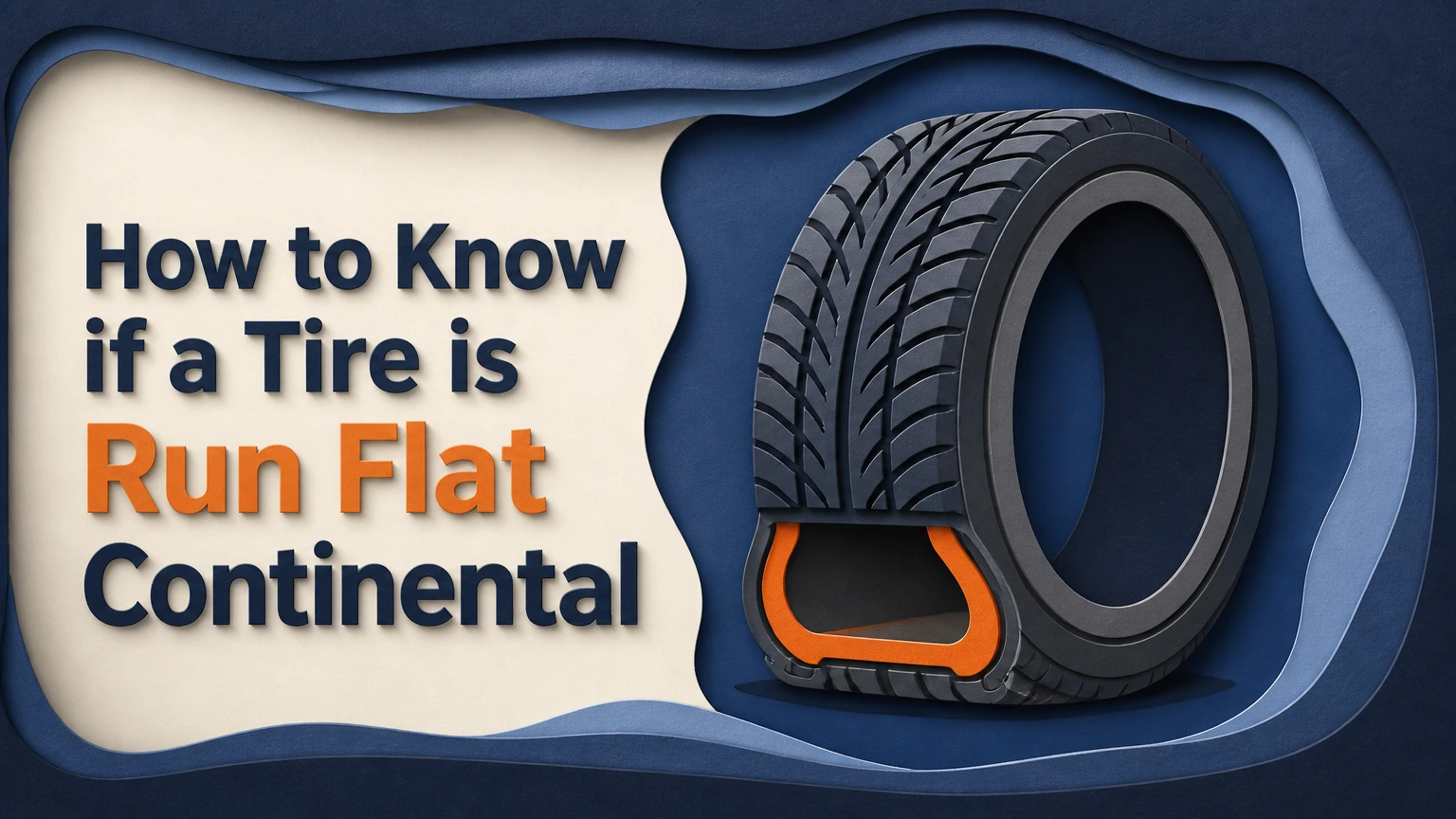
Determining if your Continental tire is a run-flat model requires a quick visual inspection of the outer sidewall for specific Continental brand markings. You can complete this check in less than 2 minutes without mechanical tools, jacks, or tire pressure gauges by locating the “SSR” stamp or identifying Continental’s alternative extended mobility codes.
Before You Start
- Time Required: 2 minutes total.
- Difficulty Level: Beginner (no prior mechanical knowledge needed).
- Expected Cost: $0.
- Tools & Materials Required:
- Bright flashlight or smartphone light (Quantity: 1).
- Clean microfiber rag or towel (Quantity: 1).
- Prerequisite Conditions: Vehicle parked safely on a flat surface with the engine off and parking brake fully engaged.
5-Step Process to Identify a Continental Run-Flat Tire
Step 1: Position the Vehicle to Expose the Sidewall Text
Park your vehicle on a level surface, engage the electronic parking brake, and turn the steering wheel fully to the left or right to rotate the front tire outward.
To inspect the front tires efficiently, turn the steering wheel all the way to lock before turning off the ignition. This rotates the outer edge of the front tire outward by roughly 30 to 45 degrees, exposing the full profile of the sidewall away from the wheel well. For rear tires, which do not rotate via steering input, roll the vehicle forward or backward slightly if the tire brand text is positioned at the very bottom contact patch against the pavement.
Success Checkpoint: You can clearly read the embossed lettering on the tire sidewall without crouching under the fender or obstruction from the wheel well.
Common Mistake: Leaving the front wheels pointed straight ahead. This forces you to view the sidewall at an awkward angle, making small stamped codes easy to miss under dark wheel arch shadows.
Step 2: Clean the Outer Sidewall Inspection Zone
Wipe down the outer vertical wall of the tire using your rag to remove brake dust, road tar, and dirt mud accumulation.
Apply firm pressure with your rag along the upper band of the sidewall where the brand name “Continental” and the model name (e.g., ProContact, ContiSportContact, or WinterContact) are stamped. Pay special attention to the region immediately adjacent to the tire size alphanumeric string (e.g., 225/45 R 18).
Success Checkpoint: The raised rubber lettering and surrounding symbols are clean, distinct, and visible under direct lighting.
Common Mistake: Skipping cleaning on dirty tires. Caked-on road grime often fills the fine lines of small Continental symbols, obscuring critical identification stamps.
Step 3: Scan the Sidewall for the “SSR” Marking
Locate the primary model branding and scan the surrounding text string specifically for the letters SSR.
Continental strictly uses the acronym SSR, which stands for Self Supporting Runflat, to designate standard run-flat construction. Look for “SSR” in two primary locations on the sidewall:
- Immediately following the tire size code (e.g., 205/55 R 16 91V SSR).
- Stamped inside a small oval or raised circular outline located near the bead (the inner edge near the metal rim).
+-------------------------------------------------------------+
|                                                             |
|   CONTINENTAL   ProContact GX   225/45 R 18 95H  [ SSR ]    |
|                                                    (Oval)   |
+-------------------------------------------------------------+
Success Checkpoint: You locate the distinct, standalone letters “SSR” printed clearly on the sidewall. If “SSR” is present, the tire is definitively a run-flat.
Common Mistake: Searching for generic industry terms like “RFT”, “R-F”, or “ZP”. These are trademarked codes used by other tire manufacturers (Bridgestone, Pirelli, Michelin). Continental never prints “RFT” on its tires.
Step 4: Differentiate Extended Mobility Markings from True Run-Flats
Scan the sidewall for alternative mobility acronyms or manufacturer-specific (OEM) approval codes if the letters “SSR” are absent.
Continental produces specialized non-SSR tires that offer extended mobility or noise cancellation, which are frequently confused with standard run-flats. Examine the text for these specific codes:
- ContiSeal: Denoted by the word ContiSeal or a small nail/punctured tire icon. This indicates a self-sealing viscous liner inside the tire that seals tread punctures up to 5mm. It is NOT a structural run-flat tire.
- ContiSilent: Denoted by the word ContiSilent or a speaker symbol with a slash through it. This indicates an internal polyether-based foam ring designed to reduce cabin noise. It provides zero run-flat structural support.
- MOE (Mercedes-Benz Original Extended): Denoted by the letters MOE. This is a special OEM designation found on Mercedes vehicles. MOE tires feature reinforced sidewalls similar to SSR, but offer a slightly softer ride and a reduced run-flat range (typically up to 30 miles / 50 km).
Success Checkpoint: You can distinguish whether your tire relies on self-supporting sidewall inserts (SSR / MOE), sealant technology (ContiSeal), or interior soundproofing (ContiSilent).
Step 5: Verify All Four Tires and Perform Inner Sidewall Checks
Inspect the remaining three tires individually to confirm that all wheels on the vehicle use matching tire construction types.
Walk around the vehicle and repeat Steps 2 through 4 for each wheel. If an outer sidewall is severely scuffed from curb contact and rendered illegible, shine your flashlight onto the inner sidewall (facing toward the brake rotor and suspension components). Tire manufacturers mold identical branding and security codes on both the interior and exterior sidewalls of symmetrical and asymmetrical tires.
Success Checkpoint: You have verified all four tires independently and confirmed whether the entire vehicle is equipped with SSR run-flats or standard tires.
Common Mistake: Checking only one tire and assuming the rest are identical. Pre-owned vehicles frequently have mismatched tires installed by prior owners, mixing standard and run-flat tires across axles.
Common Mistakes and How to Fix Them
1. Confusing Radial Construction “R” for Run-Flat
- The Error: Reading a tire size designation such as
245/40 R 19and assuming the “R” stands for “Run-flat.” - The Fix: The “R” in any standard tire sizing sequence stands strictly for Radial construction (referring to the internal ply cords running 90 degrees to the direction of travel). Ignore the “R” in the size specification and continue scanning for the standalone “SSR” code.
2. Assuming a Car Without a Spare Tire Automatically Has Run-Flats
- The Error: Believing your Continental tires are run-flats simply because your vehicle trunk lacks a physical spare tire and jack kit.
- The Fix: Many modern car manufacturers ship vehicles with standard pneumatic tires paired with an electronic tire inflator pump and a bottle of liquid sealant (a tire repair kit) instead of run-flats. Always visually confirm the “SSR” marking on the tire sidewall rather than relying on trunk contents.
3. Mixing SSR Run-Flats with Standard Pneumatic Tires
- The Error: Replacing two damaged SSR run-flat tires with standard pneumatic Continental tires on the same vehicle.
- The Fix: Never mix run-flat and non-run-flat tires on the same axle or vehicle, especially on All-Wheel-Drive (AWD) configurations. SSR tires possess significantly stiffer spring rates due to sidewall reinforcement inserts; mixing them causes unequal tire compliance, unpredictable handling under extreme cornering, and potential strain on AWD differential sensors.
4. Relying on an Outer Sidewall That Has Been Scuffed Off by Curbs
- The Error: Assuming a tire is non-run-flat because curb rash has wiped away the exterior branding text.
- The Fix: Turn the steering wheel to full lock, reach behind the tire with your flashlight, and read the interior sidewall mold. The inner face contains identical regulatory, size, and SSR markings.
Variations in Identification Methods
| Inspection Scenario | Tool Required | Identification Method |
|---|---|---|
| Mounted on Car (Clean) | None (Visual) | Scan outer sidewall directly for the SSR text string or oval stamp. |
| Mounted on Car (Heavily Scuffed) | Flashlight | Inspect the inner sidewall facing the suspension strut for duplicate SSR moldings. |
| Unmounted / Loose Tire (Off Rim) | Physical Pressure | Perform the Thumb-Press Test: Push hard against the middle sidewall with both thumbs. Standard tires flex easily under hand pressure; unmounted SSR tires remain rigid and unyielding due to rubber core inserts. |
| Faded or illegible Text | Smartphone / Browser | Locate the 12-digit DOT Code (e.g., DOT H234 ABC1234) near the rim bead, and query the code in Continental’s online product catalog database to review factory construction specs. |
Operational Limits and Replacement Costs
How Long Can You Drive on a Punctured Continental SSR Tire?
If your Tyre Pressure Monitoring System (TPMS) alerts you to a total loss of inflation pressure in a Continental SSR tire:
- Maximum Speed: Do not exceed 50 mph (80 km/h).
- Maximum Distance: Do not exceed 50 miles (80 km) under light to moderate vehicle load.
- Operational Guidelines: Drive smoothly, avoid high-speed cornering, and proceed immediately to a certified service center.
Cost Differences: Continental SSR vs. Standard Continental Tires
Continental SSR run-flat tires typically cost 15% to 30% more than equivalent standard pneumatic Continental models of identical dimensions due to extra synthetic rubber reinforcement and internal engineering.
| Continental Tire Category | Average Price Range (Per Tire) | Repairability |
|---|---|---|
| Standard Continental | $120 – $280 | Punctures in the tread area are standardly repairable per USTMA guidelines. |
| Continental ContiSeal | $150 – $320 | Self-sealing for tread punctures up to 5mm; professional repair possible. |
| Continental SSR (Run-Flat) | $180 – $420 | Generally non-repairable after being driven with zero air pressure (sidewall structural degradation cannot be visually evaluated). |
Frequently Asked Questions
What does Continental SSR stand for?
Continental SSR stands for Self Supporting Runflat. It identifies tires constructed with reinforced, rigid rubber sidewall inserts that support the weight of the vehicle during a complete loss of air pressure.
Can a Continental ContiSeal tire run without air?
No. A ContiSeal tire contains a sticky inner sealant layer that seals small tread punctures automatically, but it lacks structural sidewall reinforcements. If a ContiSeal tire suffers a blowout or major pressure loss, it will collapse like a standard tire and cannot be driven without inflation.
How do I know if my tire is run flat Continental by looking at the DOT code?
Locate the string starting with “DOT” on the lower sidewall near the rim flange. The first few characters identify the manufacturing plant and size, while the final four digits indicate the build week and year. You can enter this complete string into Continental’s tire lookup tool to retrieve exact factory engineering specifications, including SSR status.
Is Continental MOE a full run-flat tire?
Continental MOE (Mercedes-Benz Original Extended) is a run-flat variant designed specifically for Mercedes vehicles. It uses modified sidewall reinforcements to improve ride comfort, but offers a reduced run-flat range of 30 miles (50 km) at zero pressure compared to the standard 50-mile (80 km) range of full SSR tires.
Can you repair a flat Continental SSR run-flat tire?
Continental generally advises against repairing an SSR tire that has been driven under low or zero inflation pressure. Operating on an uninflated SSR tire subjects the internal sidewall rubber to extreme flex and heat build-up, weakening the internal structure in ways that cannot be safely evaluated from the outside.