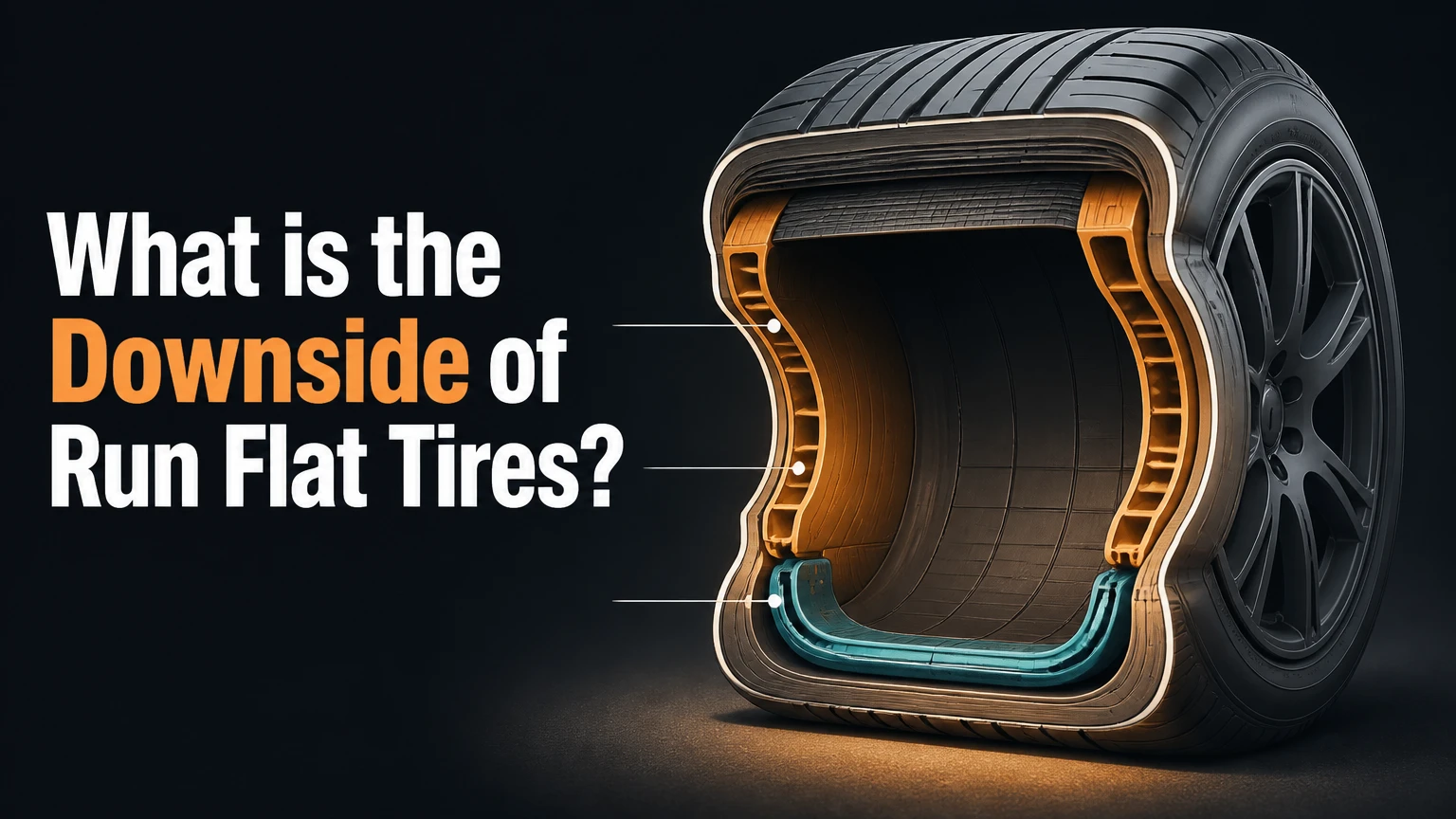
The primary downsides of run-flat tires (RFTs) are higher replacement costs, a harsher ride quality, accelerated tread wear, and strict repair limitations. Because run-flat tires rely on rigid, reinforced sidewalls to support vehicle weight during air loss, they cost 30% to 50% more than standard tires, wear out up to 30% faster, and are frequently refused for repair by tire shops.
Run-Flat Tire Trade-Offs at a Glance
- Financial Premium: Run-flats cost $200 to $500+ per tire, generating a 30% to 50% price premium over standard equivalents.
- Accelerated Wear: Harder rubber compounds and stiff construction reduce tread life, often forcing replacement by 20,000 to 30,000 miles.
- Degraded Comfort: Rigid sidewalls transmit road impacts directly into the cabin, creating a noticeably firmer, louder ride.
- Severe Repair Limits: Most tire manufacturers and service centers mandate full replacement rather than repairing tread punctures due to hidden sidewall heat damage.
- No Protection Against Blowouts: Major sidewall tears, deep pothole impacts, or wheel rim damage instantly render run-flats unusable, leaving driver stranded without a spare.
How Much More Expensive Are Run-Flat Tires Than Regular Tires?
Run-flat tires cost 30% to 50% more than standard tires of equivalent size and performance ratings. While a premium standard tire typically costs between $120 and $250, a matching run-flat tire ranges from $200 to $500+ per tire.
Over a 60,000-mile vehicle ownership cycle, replacing run-flat tires twice can cost between $1,600 and $4,000 in tire hardware alone—roughly double the lifetime tire expenditure of a vehicle riding on standard rubber. Additionally, because run-flats are rarely discounted in sales events and local tire shops keep limited inventory, emergency replacements often require paying full MSRP plus expedited freight charges.
How Do Run-Flat Tires Affect Ride Quality and Noise Levels?
Run-flat tires noticeably degrade ride comfort and increase cabin noise because their sidewalls contain extra rubber and steel reinforcement to support the vehicle without air.
+-------------------------------------------------------------------+
|                        SIDEWALL STIFFNESS                         |
| Standard Tire:  [ Flexes to absorb impacts ]  --> Smooth Ride     |
| Run-Flat Tire:  [ Stiff reinforced structure ] --> Firm / Loud    |
+-------------------------------------------------------------------+
Standard tire sidewalls flex when hitting bumps, expansion joints, or potholes, allowing the tire to act as the primary shock absorber. Run-flat sidewalls are exceptionally stiff, transmitting vertical impact forces directly through the wheel, suspension components, and chassis into the passenger cabin. This rigidity creates a harsh, jittery ride over uneven pavement and generates higher ambient road hum at highway speeds.
Why Do Run-Flat Tires Wear Out Faster Than Standard Tires?
Run-flat tires wear out approximately 20% to 30% faster than standard tires, frequently requiring replacement between 20,000 and 30,000 miles.
Automotive engineers must use softer, higher-grip tread compounds to compensate for the harsh ride caused by ultra-stiff sidewalls. While this softer rubber helps restore cornering traction and baseline ride compliance, it wears down significantly faster under daily friction. Furthermore, the rigid structure prevents the tire from conforming evenly across the road patch, causing accelerated shoulder wear if wheel alignment or tire pressures deviate even slightly from factory specification.
How Much Extra Weight Do Run-Flat Tires Add to a Vehicle?
Run-flat tires weigh between 2 and 4 pounds more per tire than standard tires of the same dimension, adding 8 to 16 pounds of total unsprung weight to the vehicle.
Unsprung mass—the weight of components not supported by the vehicle’s suspension springs—directly affects suspension response and dynamic handling. Added unsprung weight forces shock absorbers to work harder to keep the tire in contact with uneven roads, slightly blunting steering agility. Additionally, rotating heavier mass requires more engine energy to accelerate and stop, reducing overall vehicle fuel economy by approximately 1% to 2%.
What is the Maximum Speed and Distance You Can Drive on a Flat Run-Flat Tire?
After complete air loss, a run-flat tire allows you to drive a maximum distance of 50 miles (80 km) at a maximum speed of 50 mph (80 km/h).
| Metric | Operational Limit | Consequence of Exceeding Limit |
| Max Speed | 50 mph (80 km/h) | Extreme heat buildup causing sidewall disintegration |
| Max Distance | 50 miles (80 km) | Internal rubber breakdown leading to rim damage |
| Vehicle Load | Unloaded rating | Accelerated structural collapse of the tire core |
These operational limits apply strictly under moderate driving conditions and normal vehicle loads. Exceeding 50 mph or driving beyond the 50-mile threshold generates intense friction and heat within the zero-pressure sidewall, causing the internal structure to shred and potentially damaging the aluminum wheel rim or wheel well.
Do Run-Flat Tires Protect Against Sidewall Blowouts and Pothole Damage?
No, run-flat tires do not protect against severe sidewall tears, deep pothole pinch-flats, or catastrophic highway blowouts.
Run-flat technology only functions when the tire tread suffers a puncture while the structural ring of the tire remains intact. If a deep pothole pinches the stiff sidewall against the metal rim edge—a common occurrence due to the tire’s lack of flex—the sidewall can tear open instantly. When a sidewall structural failure occurs, a run-flat loses its self-supporting capability entirely, leaving the vehicle immobilized without a spare tire.
Can Run-Flat Tires Be Repaired After a Nail Puncture?
Most major tire manufacturers and retail tire shops refuse to repair run-flat tires after they have been driven underinflated, mandating complete replacement.
Puncture Occurs ---> Driving on 0 PSI ---> Internal Heat Buildup
                                                   |
                                                   v
Technician Refuses Repair <--- Undetectable Sidewall Structural Degradation
While brands like Bridgestone permit puncture repairs under strict, limited conditions, shops enforce “no-repair” policies for liability reasons. When a run-flat tire carries a vehicle’s weight with zero air pressure, internal friction generates immense thermal stress that degrades the inner rubber liner and structural cords. Because technicians cannot visually verify whether internal heat damage has compromised the sidewall integrity, repairing the tread creates a severe blowout risk.
How Do Run-Flat Tires Impact Vehicle Suspension Wear Over Time?
Run-flat tires accelerate wear on suspension bushings, ball joints, wheel bearings, and shock absorbers due to their stiff sidewall construction.
Because run-flat tires transfer high-frequency road impacts directly into the chassis rather than flexing to absorb them, the surrounding mechanical components bear the excess kinetic energy. Over tens of thousands of miles, this extra vibration degrades rubber control arm bushings faster, increases shock absorber fatigue, and can lead to premature wheel bearing play or alignment shifts.
What Happens If a Run-Flat Tire Loses Air in a Remote Area?
If a run-flat tire loses air in a rural or remote location, the 50-mile safety radius often falls short of the nearest service station stocking matching replacement tires.
Most small-town repair shops, gas stations, and general tire retailers do not keep specialized run-flat tire sizes or load-indexed RFT models in stock. Drivers stranded in remote areas frequently face multi-day delays while a specialized replacement tire is shipped from a regional distribution hub, turning a minor flat tire into an extended logistical delay.
Can a Delayed TPMS Alert Cause a Run-Flat Tire to Fail Catastrophically?
Yes, a faulty or delayed Tire Pressure Monitoring System (TPMS) alert can cause a driver to unknowingly exceed the 50-mile run-flat safety limit, leading to total tire disintegration.
Because run-flat sidewalls are so rigid, a flat run-flat tire looks almost identical to a fully inflated one from the outside and shows minimal steering drag at cruising speeds. If a TPMS sensor fails, reads incorrectly, or delays its warning, a driver may continue operating the vehicle at normal highway speeds (65+ mph) for hundreds of miles, resulting in catastrophic structural breakdown of the tire casing.
Can I Replace Run-Flat Tires With Regular Tires?
Yes, you can safely replace run-flat tires with standard tires, provided all four tires are replaced simultaneously and match your vehicle’s load index and speed requirements.
Transitioning to standard tires instantly restores ride plushness, lowers cabin road noise, improves tread life, and reduces future replacement costs by up to 50%. However, because vehicles factory-equipped with run-flats do not include a physical spare tire, jack, or lug wrench in the trunk, you must purchase alternative roadside mobility gear before making the switch.
Do You Need Special Wheels or Rims to Switch to Regular Tires?
No, you do not need special wheels or rims to switch from run-flat tires to standard tires; standard tires fit directly onto original factory run-flat wheels.
Run-flat wheels utilize standard rim contours (including standard bead seats like Extended Hump / EH2 designs). Standard tires seal onto these wheel beads without modification. The only technical requirement is ensuring the replacement standard tires match the exact dimensions, load capacity ratings, and speed designations specified on your vehicle’s driver-side door jamb placard.
Do I Need to Change All 4 Tires If I Switch to Regular Tires?
Yes, you must replace all four tires at the same time when switching from run-flat to standard tires.
Mixing run-flat tires and standard tires on the same vehicle creates severe handling imbalances due to differences in sidewall stiffness, weight, and cornering compliance.
CRITICAL SAFETY WARNING: DO NOT MIX TIRE TYPES
+-----------------------+-----------------------+
| FRONT: Standard Tire  | REAR: Run-Flat Tire   |
| High sidewall flex    | Stiff sidewall flex   |
+-----------------------+-----------------------+
Result: Unpredictable handling, unexpected oversteer,
and electronic stability control (ESC) intervention errors.
If one axle flexes under cornering loads while the other stays rigid, the vehicle’s Electronic Stability Control (ESC) and Anti-lock Braking System (ABS) receive conflicting wheel speed and slip angles, causing unpredictable vehicle stability during emergency evasive maneuvers.
What Emergency Gear Do You Need If You Remove Run-Flat Tires?
When replacing run-flat tires with standard tires on a vehicle lacking a factory spare, carry one of the following roadside recovery solutions in your trunk:
- 12V Tire Inflator & Chemical Sealant Kit: A compact kit (e.g., Slime, AirMan) that injects liquid tire sealant into the valve stem and reinflates small tread punctures (nails/screws up to 1/4 inch).
- Modern Space-Saver Spare Tire Kit: An aftermarket emergency spare wheel, compact tire, scissor jack, and lug wrench kit tailored to fit your vehicle’s bolt pattern and brake clearance.
- Plug Kit & Portable Compressor: A heavy-duty tire plug kit and 12V air pump for manual roadside repairs of tread punctures without calling tow services.
Why Do Luxury Automakers Install Run-Flat Tires Despite the Downsides?
Car manufacturers—most notably BMW, Mercedes-Benz, and Lexus—install run-flat tires primarily to eliminate the physical space, weight, and manufacturing cost of a spare tire assembly.
Removing the spare tire, jack, and wheel well gives automotive designers several engineering advantages:
- Trunk Capacity: Frees up significant cargo volume and allows room for under-floor hybrid battery placement.
- Fuel Efficiency & Emissions: Saves 30 to 50 pounds of static vehicle weight, helping vehicles pass strict government fuel economy and emissions certification testing.
- Weight Distribution: Permits shifting mechanical components closer to the rear axle center to achieve ideal 50:50 vehicle weight balance.
Does Switching to Regular Tires Void a Vehicle Warranty or Insurance?
No, switching to standard tires does not void your overall vehicle warranty or car insurance policy, provided the replacement tires meet or exceed your vehicle’s factory load and speed ratings.
Under consumer protection regulations (such as the Magnuson-Moss Warranty Act in the U.S.), an automaker cannot void a vehicle warranty simply because you installed non-RFT tires unless they can prove the non-RFT tire directly caused a specific mechanical failure. However, if your vehicle is on a active dealership lease, lease-end return guidelines usually require returning the car with run-flat tires matching original OEM specifications.
The Bottom Line
Run-flat tires offer undeniable safety by preventing immediate roadside strandings during standard tread punctures, but they demand significant trade-offs in replacement cost, ride harshness, tread longevity, and repair flexibility. If you prioritize absolute convenience during minor nail punctures and accept higher maintenance expenses, keeping run-flats makes sense. However, if ride comfort, lower tire replacement costs, and repairability are your priorities, transitioning to a full set of standard tires—paired with a portable inflator kit or space-saver spare—provides a superior driving experience without compromising long-term reliability.