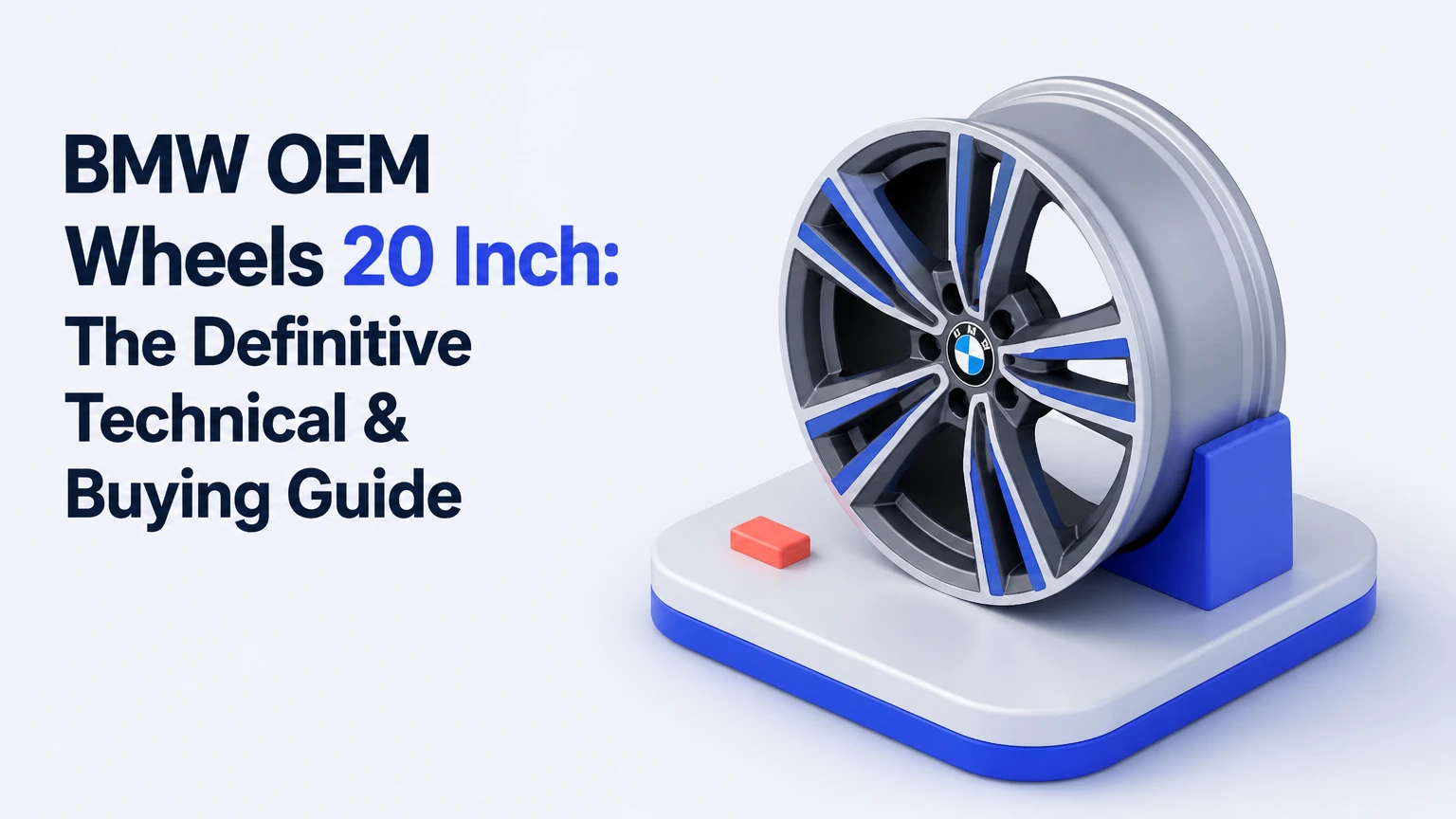
BMW OEM wheels 20 inch are genuine factory-engineered alloy wheels manufactured specifically by or for BMW to match exact vehicle axle load ratings, hub dimensions, and brake system clearances. Available across cast alloy and forged construction methods, 20-inch original equipment wheels optimize ride comfort, unsprung weight, and mechanical dynamics while maintaining full compatibility with factory Tire Pressure Monitoring Systems (TPMS) and Run-Flat Tire (RFT) bead safety humps.
Key Facts / At a Glance
- Chassis PCD Transition: Modern G-series BMWs use a 5x112mm pitch circle diameter (PCD) with a 66.6mm center bore, whereas older E/F-series chassis use 5x120mm PCD with a 72.6mm center bore.
- xDrive Tolerance Constraint: On all-wheel-drive xDrive models with staggered 20-inch wheel setups, the total rolling tire circumference difference between front and rear axles must stay strictly under 1% to prevent transfer case damage.
- Wheel Fastener Specs: Older chassis require M12x1.5 lug bolts torqued to 120 Nm (88.5 ft-lbs), while modern G-chassis vehicles mandate M14x1.25 lug bolts torqued to 140 Nm (103 ft-lbs).
- Authenticity Indicators: Genuine BMW 20-inch wheels feature deeply stamped backside markings showing the official BMW logo, 7-digit or 11-digit part numbers, offset (ET), width code (J), and country of origin (e.g., Germany, Austria, Italy).
- Construction Hierarchy: Standard and M Sport options (e.g., Style 740M, 699M) utilize gravity or low-pressure cast aluminum, while M Performance catalog options (e.g., Style 666M, 795M) feature ultra-lightweight, 10,000-ton drop-forged alloy.
What Are BMW OEM 20-Inch Wheels and How Do They Work?
BMW OEM 20-inch wheels are precision-engineered rotational components designed directly by BMW motor engineers to serve as a structural extension of a vehicle’s hub assembly. Unlike universal aftermarket rims that rely on centric adapter rings or slotted lug holes, genuine BMW 20-inch wheels utilize a hub-centric design. This means the wheel’s center bore mates perfectly with the wheel hub’s raised lip to a tolerance within fractions of a millimeter, ensuring perfect axial alignment and zero rotational runout.
When installed, the lug bolts create a uniform clamping force against the hub face. This friction layer transmits massive braking force and engine torque to the road surface without putting shearing stress directly on the bolt shanks. Inside the rim barrel, BMW engineers incorporate specific safety humps (EH2+ contour) designed to prevent the tire bead from unseating under sudden pressure loss when equipped with Run-Flat Tires (RFT). Furthermore, internal rim channels are contoured to house BMW-specific 433 MHz TPMS sensors safely out of the path of tire mounting tools.
How Are BMW 20-Inch OEM Wheels Built and Categorized?
BMW divides its 20-inch wheel catalog across distinct alloy manufacturing processes, chassis configurations, and vehicle trim lines.
Construction Methods: Cast vs. Forged Alloys
- Low-Pressure Cast Aluminum: Molten A356 aluminum alloy is drawn into a mold under low pressure. This yields a strong, cost-effective structure ideal for standard passenger sedans and SAVs (Sports Activity Vehicles) such as the X3, X5, and 5 Series. While durable against road hazards, cast wheels carry higher mass.
- Drop-Forged Aluminum: Solid billets of 6061-T6 aluminum alloy are subjected to over 10,000 tons of hydraulic pressure. This process re-aligns the alloy’s internal grain flow along the structural lines of the wheel spokes. Forged 20-inch wheels—standard on true M cars and M Performance accessory lines—achieve up to a 20% to 25% weight reduction over cast counterparts while offering significantly higher tensile strength and impact resistance.
Fitment Configurations: Square vs. Staggered Setups
- Square Setup: All four wheels measure identically in width (e.g., 20×8.5J ET27 all around). This layout is optimized for balanced wet handling, winter snow setups, and full 4-wheel tire rotation schedules.
- Staggered Setup: Rear wheels feature a wider profile and lower offset than the front wheels (e.g., 20×8.5J front with 20×9.5J or 20×10.5J rear). This enlarges the rear tire contact patch to optimize traction on rear-wheel-drive and rear-biased xDrive architectures.
BMW OEM Design Families
- Standard & Luxury Line (e.g., Style 738, Style 734): Designed with multi-spoke or double-spoke geometry prioritizing aerodynamic efficiency, quiet operation, and structural resilience for daily driving.
- M Sport Alloys (e.g., Style 740M, Style 699M): Factory equipment on M Sport option packages. These feature aggressive split-spoke profiles, pocketed spoke windows, a factory clear coat, and an indented recess for the iconic 10x18mm self-adhesive M badging logo.
- M Performance Catalog (e.g., Style 666M, Style 795M, Style 862I): High-end accessory wheels crafted via drop-forging or flow-forming techniques. They exhibit deep concave profiles, intricate mesh patterns, and signature factory hand-finished options like Bi-color Orbit Grey, Ferric Grey, or Frozen Gold.
What Are the Key Technical Specifications Across BMW Generations?
Upgrading or replacing 20-inch BMW OEM wheels requires strict adherence to chassis-specific engineering metrics. The critical turning point in BMW wheel design occurred during the transition from older E/F platforms to the modern CLAR (G-Series) platform.
| Technical Parameter | E-Series / F-Series Chassis (e.g., E70, F10, F30, F15) | Modern G-Series / CLAR Platform (e.g., G20, G30, G05, G80) | Heavy EV / SAV Line (e.g., iX, X7 G07) |
| Pitch Circle Diameter (PCD) | 5 x 120 mm | 5 x 112 mm | 5 x 112 mm |
| Center Hub Bore | 72.6 mm (E70/F15 X5 rear uses 74.1mm) | 66.6 mm | 66.6 mm |
| Wheel Width Range | 8.0J to 10.5J | 8.0J to 11.0J | 8.5J to 11.0J |
| Wheel Offset Range (ET) | ET20 to ET45 | ET20 to ET46 | ET28 to ET40 |
| Lug Fastener Specs | M12 x 1.5 Lug Bolts | M14 x 1.25 Lug Bolts | M14 x 1.25 / M15 Studs |
| Factory Torque Setting | 120 Nm (88.5 ft-lbs) | 140 Nm (103 ft-lbs) | 140 Nm (103 ft-lbs) |
Critical Fitment Rule: You cannot directly install modern G-series 5x112mm 20-inch OEM wheels onto older F-series 5x120mm hubs without using specialist aftermarket PCD conversion adapters (which alter effective offset and load distribution).
How Do You Buy and Verify Genuine 20-Inch BMW OEM Wheels?
Follow this 4-step execution workflow to select, source, and authenticate genuine 20-inch BMW wheels while preventing replica fraud.
[1] Confirm Chassis PCD & Offset ──► [2] Identify 7/11-Digit Part No. ──► [3] Select Sourcing Channel ──► [4] Verify Backside Embossed Markings
Step 1: Confirm Chassis Platform Parameters
Check your vehicle’s VIN to determine the platform code (e.g., F15 vs. G05). Verify whether the front suspension clearance accommodates 20-inch wheel offsets, particularly if your car features optional M Performance 6-piston brake calipers.
Step 2: Extract Exact Factory Part Numbers
Cross-reference your target wheel style (e.g., “Style 740M”) on official databases like RealOEM or the Alloy Wheels Direct BMW Style Guide. Note both front and rear part numbers for staggered setups, as width and ET numbers differ between axles.
Step 3: Choose a Procurement Channel
- BMW Dealership Parts Counter: Brand-new condition, guaranteed authenticity, full factory warranty, but commands highest retail price.
- Insurance-Grade Remanufacturers: Original factory wheels structurally checked, straightened, and re-powder-coated to original color specifications at roughly 40% to 50% below dealership prices.
- Private Secondary Market (Forums / Verified Marketplaces): Lowest cost tier for take-off wheel sets, but mandates physical inspection for stress fractures, repairs, or counterfeit stamps.
Step 4: Perform Backside Structural Authentication
Inspect the inner face of the wheel hub and spoke backs. Genuine BMW 20-inch OEM wheels feature crisp, raised structural castings or laser-etched stamps containing four required markings:
- Official BMW Logo / Wordmark: Cast cleanly into the metal back.
- 7-Digit or 11-Digit OEM Part Number: Must match BMW catalog database numbers (e.g.,
36118071996). - Dimensions & Offset Stamp: Explicit formatting such as
8.5Jx20 ET27. - Country of Origin & Foundry Mark: Stamped with origins such as Germany, Austria, Italy, or Turkey, alongside foundry symbols from certified manufacturers like Ronal, BBS, Fuchs, or Cromodora.
How Much Do 20-Inch BMW OEM Wheels Cost?
Real-world procurement costs depend on condition, manufacturing type (cast vs. forged), and whether the purchase includes a complete wheel-and-tire package.
| Procurement Condition / Option | Estimated Price Range (USD) | Fulfillment & Lead Time | Primary Advantage |
| Used / Take-Off Cast Rims | $350 – $600 per wheel | 1 to 5 days (local or domestic) | Budget-friendly option for single wheel damage replacement. |
| Refurbished / Remanufactured Alloys | $450 – $750 per wheel | 2 to 5 business days | Factory structural integrity with fresh protective powder coat. |
| New Dealership Cast Rims | $900 – $1,600 per wheel | Overnight to 3 days | Brand new from factory inventory. |
| New Dealership Forged M Performance Rims | $1,400 – $2,200 per wheel | 3 to 7 business days | Lowest unsprung mass and peak impact resistance. |
| Complete Turnkey Forged Wheel Package | $4,200 – $7,500+ (set of 4) | 1 to 3 weeks (if imported) | Arrives balanced with star-spec tires and pre-coded TPMS. |
How Do Genuine BMW OEM Wheels Compare to Aftermarket Alternatives?
Selecting between Genuine BMW OEM wheels, premium tier-1 aftermarket options, and low-cost replica wheels requires evaluating structural safety, performance impact, and long-term resale value.
| Evaluation Metric | Genuine BMW OEM 20″ Wheels | Tier-1 Aftermarket (e.g., BBS, HRE, Apex) | Low-Cost Replica / Knockoff Wheels |
| Hub Fitment Accuracy | Direct Hub-Centric (100% factory match) | Requires Hub-Centric Rings on universal bores | Inconsistent center bore tolerances |
| Structural Integrity | TÜV, JWL, & VIA certified safety design | Certified via TÜV / JWL engineering standards | Uncertified or fake structural stamps |
| Weight Efficiency | Medium on cast; Ultra-light on forged | Extremely low (optimized for performance) | Heavy, thick gravity-cast walls |
| Impact & Crack Resistance | High (engineered for vehicle GVWR) | High to Exceptional | Prone to catastrophic bending & cracking |
| Resale & Vehicle Value | Retains high value; protects trade-in equity | Good value among enthusiast buyers | Reduces vehicle value; flagged at trade-in |
What Are Common Fitment Pitfalls, Troubleshooting, and Maintenance Rules?
1. The xDrive 1% Rolling Circumference Limit
On all-wheel-drive xDrive platforms equipped with 20-inch staggered wheel setups, changing tire sizes improperly can destroy the central transfer case clutch pack.
$$\text{Circumference Difference \%} = \left\vert{} \frac{\text{Rear Diameter} – \text{Front Diameter}}{\text{Front Diameter}} \right\vert{} \times 100$$
If this calculation yields a variance exceeding 1.0%, the front and rear axles rotate at different speeds on dry pavement. This forces the xDrive transfer case clutch to slip continuously, generating intense thermal stress and leading to transfer case failure. Always select BMW “Star-Spec” ($\star$) tires engineered specifically to keep front and rear dynamic rolling ratios within tolerance.
2. Resolving High-Speed Steering Wheel Vibrations
If your vehicle develops a steering wheel shimmy between 50 mph and 75 mph (80 km/h – 120 km/h) immediately after mounting 20-inch wheels, execute these diagnostic steps:
- Perform Road Force Balancing: Standard dynamic balancers only measure mass distribution. A Road Force balancer applies a load roller against the spinning tire to detect internal radial force variations. Target values must remain under 15 lbs of force.
- Check for Barrel Runout: Mount a dial indicator against the inner wheel lip. If axial or radial bent runout exceeds 0.030 inches (0.76 mm), the wheel requires professional hydraulic straightening or replacement.
3. Preventing Diamond-Cut Clear Coat Corrosion
Many 20-inch OEM BMW wheels (such as Style 740M and Style 699M) feature two-tone diamond-cut finishes—machined bare aluminum face with painted spoke pockets, sealed under a clear coat.
- Avoid Automatic Car Wash Tracks: Metallic guide rails in drive-through car washes easily gouge the protruding outer edges of 20-inch wheels, breaking the clear coat seal.
- Stop Winter Salt Creep: Moisture and road salt enter micro-scratches in the clear coat, oxidizing the raw aluminum beneath and causing white “spiderweb” corrosion paths. Coat wheels with a high-temperature quartz ceramic coating to seal raw surface edges.
Frequently Asked Questions
Can I install 20-inch BMW wheels on a vehicle that came with 18-inch wheels?
Yes, provided the bolt pattern (PCD), center bore, and offset (ET) match your chassis generation. When upsizing from 18-inch to 20-inch wheels, you must lower the tire aspect ratio (e.g., from a 225/50R18 to a 245/35R20) to maintain the overall tire outer diameter, ensuring speedometers and ABS sensors function correctly.
Are 20-inch BMW OEM wheels more prone to bending than 18 or 19-inch wheels?
Because a 20-inch wheel rim leaves less sidewall distance between the road and the metal rim lip, low-profile tires absorb less impact force over sharp potholes. While cast 20-inch wheels are more vulnerable to lip bends under hard impact than 18-inch wheels, OEM forged 20-inch wheels offer significantly higher structural deflection resistance.
How do I know if a 20-inch BMW wheel can be repaired safely?
Minor cosmetic curb rash and superficial radial bends on the inner lip can be safely repaired using professional lathe machining and hydraulic straightening. However, if a cast 20-inch wheel exhibits cracking on the spoke structure or deep stress cracks across the barrel bed, it must be retired immediately, as re-welding compromises structural integrity.
Do I need special lug bolts for genuine 20-inch BMW wheels?
You must use original equipment BMW conical seat lug bolts matching your chassis thread pitch (M12x1.5 for E/F-series; M14x1.25 for G-series). Never use aftermarket ball-seat lug bolts, as mismatched seat contours prevent proper clamping force and can cause lug bolts to back out while driving.
Why do genuine 20-inch BMW wheels have small M stickers on them?
The small 10x18mm multi-colored M badge logo is an authentic factory design element featured on M Sport and M Performance wheels. It fits into a dedicated rectangular recessed pocket cast directly into the wheel face near the center hub bore. Missing recesses or misaligned stickers indicate a replica wheel.