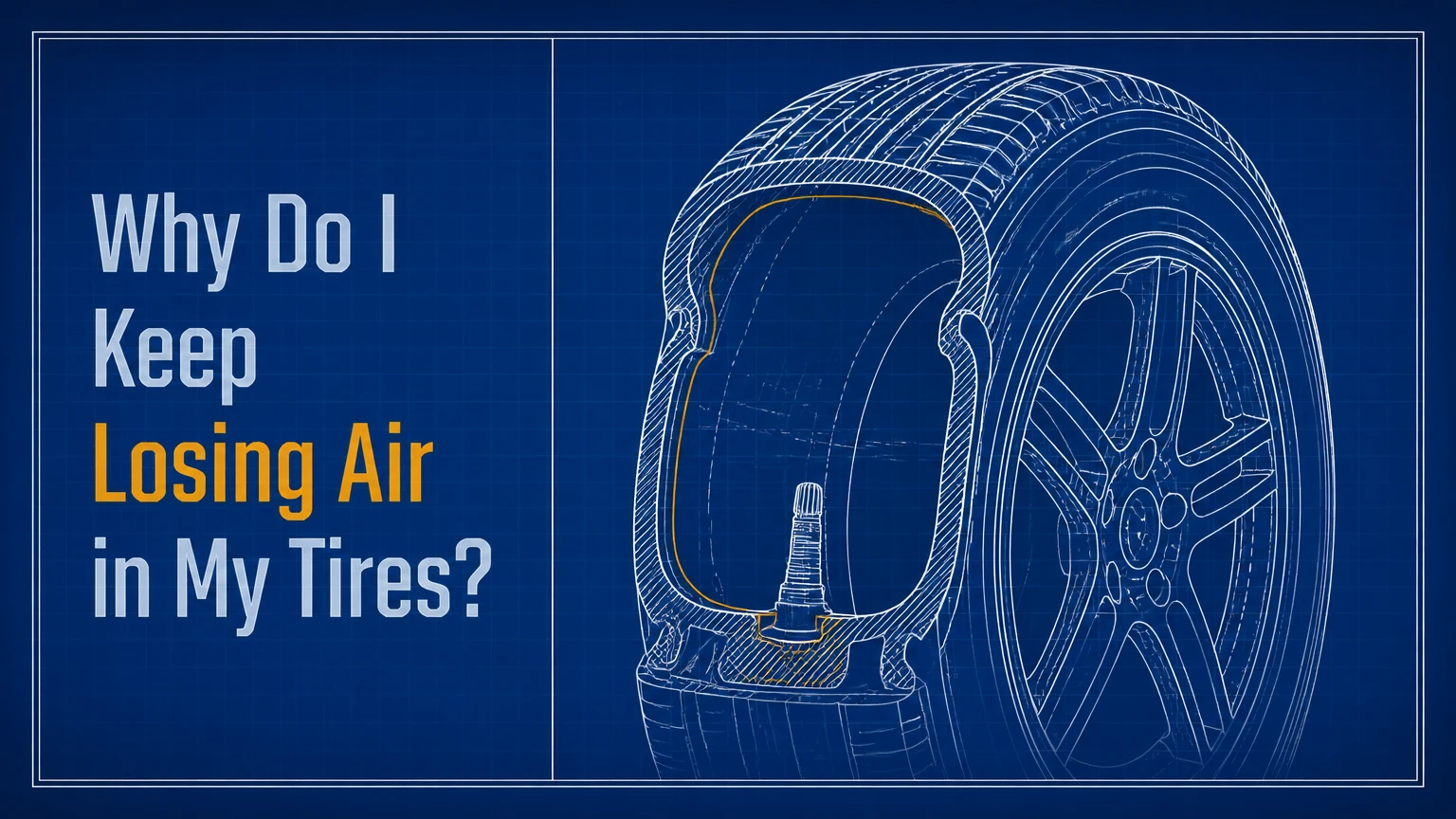
Tires keep losing air due to natural rubber permeation, ambient temperature fluctuations, unseen tread punctures, compromised valve stems, or wheel bead leaks. While healthy tires naturally lose 1 to 1.5 PSI per month through microscopic rubber pores, persistent air loss exceeding 2 PSI monthly indicates a mechanical defect or rim damage.
At a Glance
- Normal Air Loss: Healthy tires lose 1–1.5 PSI monthly via natural oxygen permeation.
- Temperature Drops: Tire pressure drops by 1 PSI for every 10°F (-12°C) drop in outside temperature.
- Slow Punctures: Nails or screws wedged in the tread bleed 5–15 PSI per week.
- Bead & Valve Leaks: Corrosion along the rim or degraded rubber valve stems drop pressure by 2–10 PSI weekly.
- Hidden Wheel Damage: Cracks in alloy wheels cause “ghost leaks” that soapy water sprays often miss.
How Much Air Pressure Do Tires Lose Naturally Every Month?
A healthy vehicle tire naturally loses 1 to 1.5 PSI (Pounds per Square Inch) per month through rubber permeation. Oxygen molecules slowly migrate through the microscopic pores of the tire’s synthetic rubber compounds even when the tire, valve stem, and wheel rim are in perfect structural condition.
| Leak Severity | Pressure Loss Rate | Primary Cause | Immediate Action Needed |
| Normal | 1–1.5 PSI / month | Natural Permeation | Check and adjust during monthly routine maintenance. |
| Slight / Seasonal | 1–3 PSI / season | Ambient Temperature Drops | Top off air as seasonal weather shifts. |
| Moderate Leak | 2–5 PSI / week | Bead Corrosion or Valve Core | Inspect valve stem and clean wheel bead rim. |
| Severe Leak | 5–15+ PSI / week | Nail / Screw Puncture or Cracked Rim | Repair puncture or replace wheel immediately; do not drive long distances. |
Permeation rate increases in warmer weather because heat expands the microscopic gaps in the tire’s rubber matrix and accelerates gas movement. If all four tires lose air evenly at a rate under 2 PSI a month, the loss is standard physical behavior rather than a mechanical failure.
How Does Cold or Warm Weather Affect Tire Pressure?
Ambient temperature changes alter tire pressure by approximately 1 PSI for every 10°F (5.6°C) change in temperature, governed by the Ideal Gas Law ($PV=nRT$). When ambient air cools, gas molecules inside the tire contract, reducing internal pressure without any actual air escaping.
Temperature Change vs. Tire Pressure Impact:
[ +30°F Rise ] ---> +3.0 PSI Internal Pressure
[ Baseline Temp ] ---> Target Manufacturer PSI (e.g., 35 PSI)
[ -10°F Drop ] ---> -1.0 PSI Internal Pressure
[ -30°F Drop ] ---> -3.0 PSI Internal Pressure (Triggers Low-Pressure Warning)
In autumn and winter, sudden cold fronts frequently cause the Tire Pressure Monitoring System (TPMS) light to illuminate. A overnight drop of 30°F (-1°C) decreases pressure by roughly 3 PSI, which can cross the sensor threshold if the tire was already slightly underinflated. Conversely, driving heats the air inside the tire through friction, temporarily raising pressure by 3 to 5 PSI during a highway trip. Always measure tire pressure when tires are “cold”—meaning the vehicle has been parked for at least three hours.
What Causes a Tire to Leak 5 to 15 PSI Per Week?
A tire losing 5 to 15 PSI per week is almost always compromised by a foreign object puncture, such as a nail, screw, or industrial staple wedged in the tread.
When a sharp object penetrates the outer rubber tread and inner liner, it acts as a partial plug. Air leaks continuously around the threads or shaft of the fastener. The exact rate of loss depends on three specific factors:
- Object Angle: Straight penetrations leak slower than angled punctures that tear the inner liner.
- Movement: Vehicle motion flexes the tread blocks, opening microscopic gaps around the object while driving.
- Fastener Tightness: A tightly wedged screw bleeds air slower (5 PSI/week) than a loose nail (15+ PSI/week).
If the object lodges within 0.5 inches of the tire shoulder or sidewall, the tire cannot be safely patched and must be replaced.
What Is a Tire Bead Leak, and What Causes It?
A tire bead leak occurs when the flexible rubber edge of the tire (the bead) fails to maintain an airtight seal against the metallic lip of the wheel rim. This failure typically causes a pressure drop of 2 to 5 PSI per week.
Bead leaks are driven by two primary mechanisms:
- Alloy Wheel Corrosion: Moisture gets trapped between aluminum rims and tire rubber, causing oxidation (white aluminum oxide powder or scale) that pushes the rubber away from the metal.
- Debris Contamination: Dirt, sand, or rust flakes become trapped in the bead seat during tire mounting.
[ Tire Bead Rubber ] <--- Debris / Oxidation Gap ---> [ Metallic Rim Lip ]
                                     |
                             (Air Bleeds Out)
In extreme cold (below 0°F / -18°C), aluminum rims and rubber tires contract at different thermal rates. This uneven contraction widens micro-gaps at the bead seat, causing rapid overnight pressure drops that disappear when weather warms.
How Does a Faulty Valve Stem or Valve Core Cause Air Loss?
A faulty valve stem bleeds 3 to 10 PSI per week due to rubber dry-rot, cracked valve bodies, or loose valve core pins inside the assembly.
The valve stem assembly contains two critical failure points:
- The Valve Core: The spring-loaded brass insert inside the stem can loosen or suffer from degraded rubber seals.
- The Stem Body: Rubber stems dry out, crack, and flex under centrifugal force when driving, opening micro-fissures at the base where the stem passes through the wheel hole.
Over-tightening aftermarket metal valve caps can also depress an improperly seated valve core pin, creating an artificial “ghost leak” that releases air constantly until the cap is removed.
Why Is My Tire Leaking Air When I Can’t Find a Puncture with Soapy Water?
When a standard soapy water spray on the tire tread yields no bubbles, the air loss is coming from hidden structural locations like a cracked alloy wheel, microscopic metal porosity, or a dynamic leak that only occurs while moving.
Unseen Leak Culprits:
1. Hairline Alloy Rim Cracks (Inner barrel lip damage from potholes)
2. Structural Rim Porosity (Manufacturing voids in cheap/aged cast wheels)
3. Dynamic Liner Leaks (Micro-fissures that open ONLY when flexed under weight)
Cast aluminum wheels hit by potholes often develop hairline fractures along the inner barrel rim lip. These cracks expand under vehicle weight but compress and hide when the wheel is unloaded. Additionally, older cast aluminum wheels can develop microscopic structural porosity right through the metal casting, allowing air to diffuse directly through the wheel body itself.
How Do You Find a Slow Tire Leak That Soapy Water Misses?
To locate an elusive slow leak that a surface soap spray misses, you must submerge the fully inflated tire assembly in a water submersion tank or perform a high-pressure rim inspection.
Follow this systematic troubleshooting diagnostic:
1.Inflate Tire to Maximum Rated Pressure:Do not exceed the MAX PSI stamped on the tire sidewall.
Increase internal pressure to the maximum safety threshold listed on the sidewall (typically 40–45 PSI). Higher pressure forces air faster through microscopic fissures, making smaller bubbles visible.
2.Perform Full Water Tank Submersion:
Dunk the entire wheel and tire assembly into a dedicated water dunk tank. Submerge one half at a time for at least two minutes, looking closely for microscopic, slow-forming bubble clusters.
3.Inspect the Wheel Barrel and Inner Lip:
Examine the metal rim itself rather than just the rubber. Look for steady streams of pinhead-sized bubbles emerging from the aluminum surface, the valve stem base, or hairline rim cracks.
4.Test Valve Core Pin Alignment and Flex Stems:
Wiggle the rubber valve stem sideways while submerged to check for base cracks, and inspect the valve opening for tiny bubbles escaping from an unseated center pin.
Why Does Only One Tire Keep Losing Air While the Other Three Stay Full?
When only one tire loses pressure while the remaining three stay full, the cause is an isolated mechanical defect rather than ambient temperature or natural gas permeation.
Isolated single-tire pressure drops stem from four unique causes:
- Localized Road Hazard: A single tire collected a nail, screw, or pinch-flat from a curb impact.
- Single Wheel Rim Damage: One specific wheel hit a pothole, bending the inner lip or cracking the alloy.
- Corrosion Isolation: Chrome or aluminum corrosion concentrated on one wheel’s bead seat.
- Faulty Valve Mechanism: A failing rubber stem or loose valve core isolated to one wheel.
If pressure loss drops faster than 2 PSI per week on a single wheel, isolated repair or component replacement is required.
Can I Drive on a Tire with a Slow Leak If I Keep Refilling It?
No, driving on a tire with a persistent slow leak is extremely unsafe. Repeatedly refilling a leaking tire without fixing the underlying defect risks catastrophic structural failure, internal overheating, and high-speed highway blowouts.
When a tire operates below its recommended PSI, the sidewalls flex excessively. This over-flexing generates intense internal friction and heat, breaking down the rubber compounds and steel belts inside the tire carcass.
Underinflation ---> Excessive Sidewall Flexing ---> Extreme Internal Heat ---> Belt Separation / Blowout
Even if you refill the tire daily, driving at highway speeds while the pressure actively bleeds out causes undetected internal degradation that can lead to sudden tread separation.
How Long Can You Safely Leave a Nail in a Tire?
You should not drive more than 50 miles or past 24 hours with a nail embedded in your tire, even if the tire appears to hold air pressure.
While a wedged nail may act as a temporary plug, vehicle weight and wheel rotation shift the metal shank with every turn. This constant movement degrades the surrounding rubber and can turn a slow 5 PSI/week leak into an instant blowout without warning. Have the tire inspected and professionally repaired with an internal patch-plug combination immediately.
Why Does My TPMS Light Only Come On in the Morning?
Your TPMS light turns on in the morning because tires reach their lowest internal temperature overnight, causing internal air pressure to drop to its lowest daily point.
Most Tire Pressure Monitoring Systems trigger a dashboard warning light when tire pressure drops 25% below the vehicle’s recommended cold pressure label (located on the driver’s door jamb).
Morning Cold Start (50°F) ---> Pressure drops to 27 PSI ---> TPMS Triggers Warning Light
                                                                   |
Driving 10 Miles (Friction) ---> Pressure rises to 31 PSI ---> TPMS Warning Light Turns Off
As you drive, tire friction heats the internal air, raising pressure back above the TPMS threshold and turning the warning light off. If your TPMS light illuminates every morning, your tires are operating right on the safety margin and require manual topping off.
Does Filling Tires with Nitrogen Prevent Air Loss?
Filling tires with nitrogen reduces natural pressure loss by 30% to 50%, but it does not prevent or fix mechanical leaks caused by nails, bead corrosion, or cracked rims.
Nitrogen molecules are physically larger than oxygen molecules ($N_2$ effective diameter is roughly 0.3 Radian nanometers larger than $O_2$), making it harder for the gas to migrate through rubber pores.
| Performance Feature | Compressed Air | Pure Nitrogen (95%+) |
| Natural Loss Rate | ~1 to 1.5 PSI / month | ~0.5 to 0.7 PSI / month |
| Thermal Stability | Moderate (contains moisture) | High (dry, consistent expansion) |
| Protection from Mechanical Leaks | None | None |
| Refill Availability | Free / Low-Cost Anywhere | Requires Specialized Station ($5–$10/tire) |
Nitrogen also lacks water vapor, reducing internal pressure fluctuations caused by humidity inside the tire. However, if a tire has a mechanical puncture or bead leak, nitrogen will escape just as quickly as standard compressed air.
How Much Does It Cost to Fix a Slow Tire Leak?
Fixing a slow tire leak typically costs between $15 and $150, depending on whether the issue is a simple tread puncture, a valve stem replacement, or rim corrosion.
- Tread Puncture Patch/Plug: $15–$45 per tire (requires removing the tire from the rim to install a combination patch-plug from the inside).
- Valve Stem Replacement: $10–$30 for standard rubber stems; $60–$150 if replacing an integrated TPMS sensor valve unit.
- Bead Corrosion Cleaning: $25–$50 per wheel (includes dismounting the tire, wire-brushing alloy corrosion, applying bead sealer, and remounting/balancing).
- Alloy Rim Crack Repair: $100–$250 (requires specialized professional TIG welding and wheel straightening).
Can a Cracked or Bent Alloy Rim Be Repaired?
Yes, most bent alloy rims and minor hairline barrel cracks can be safely repaired by a certified wheel specialist, but cracks located on the wheel spokes or structural face render the rim non-repairable.
Repairable rim damage includes:
- Hairline Barrel Cracks: Minor cracks on the inner lip or barrel rim, which can be TIG welded and ground smooth.
- Minor Radial Bends: Small bends on the inner lip caused by pothole impacts, which can be straightened using hydraulic pressing tools.
Unrepairable rim damage includes cracks extending into the wheel center hub or spokes, severe structural warping, or aluminum cracks wider than 2 millimeters. Non-repairable rims must be replaced to prevent catastrophic wheel failure.
The Bottom Line
Persistent tire air loss beyond 1.5 PSI per month stems from mechanical defects like punctures, valve degradation, bead corrosion, or wheel cracks—not simple weather shifts. Never ignore a slow leak or rely solely on daily refills, as underinflated sidewall flex causes rapid internal heat build-up that risks sudden blowouts. Have a tire professional dismount the wheel, inspect the rim barrel, and perform an internal patch-plug repair to keep your vehicle safe.