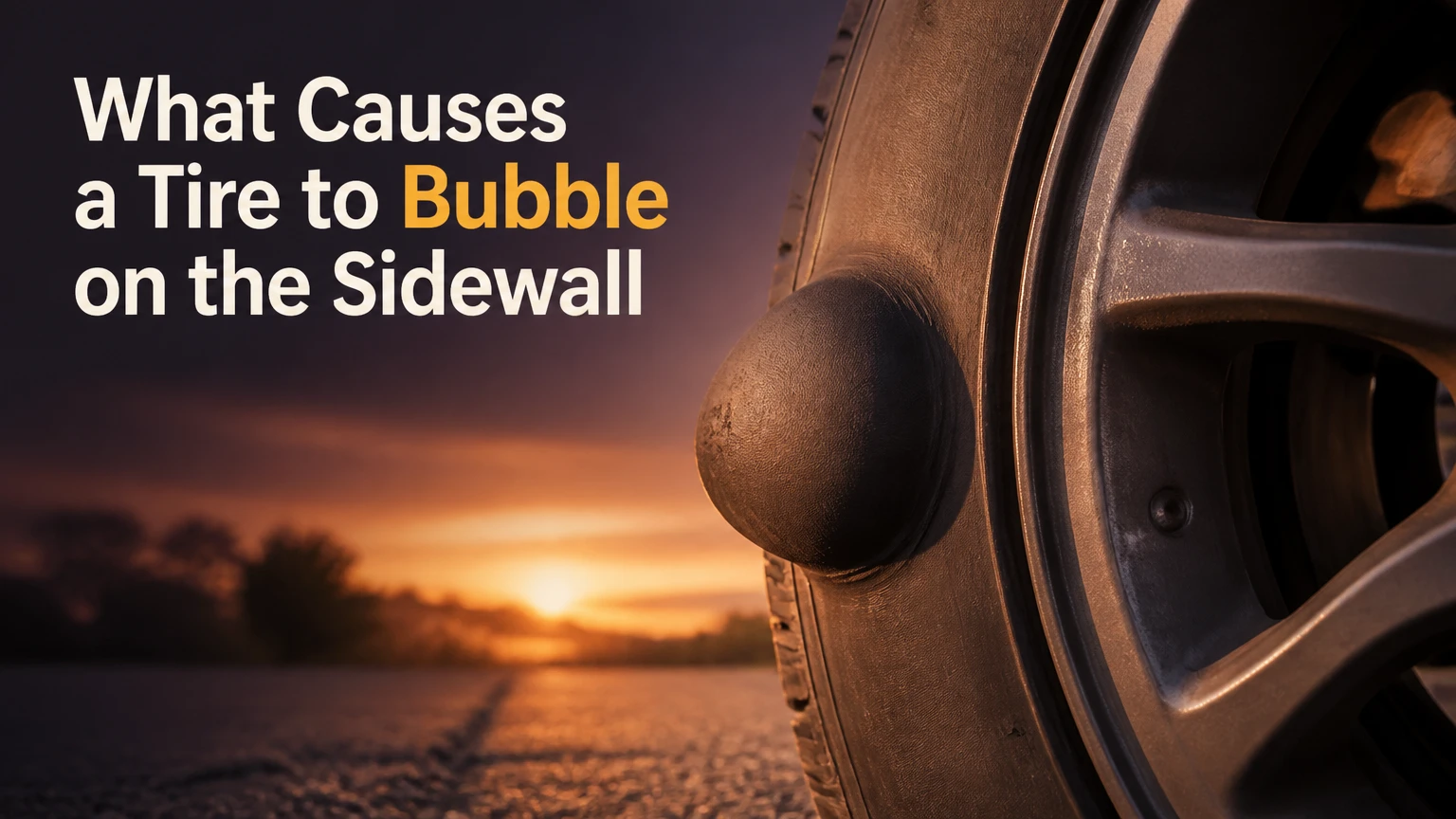
A tire sidewall bubble is caused by pressurized air escaping from the tire’s inner air-tight liner into its outer rubber layers through a tear in the internal fabric and cord plies. This structural breach occurs when hard impacts, under-inflation stress, or bead damage compromise the tire’s reinforcement layers, allowing internal pressure to push the rubber outward into an unrepairable bulge.
At a Glance
- Mechanism: Air leaks through torn internal cord plies and becomes trapped beneath the outer sidewall rubber.
- Primary Trigger: Hard impacts from potholes, curbs, or debris pinching the tire against the rim wall.
- Repairability: 0% repairable; every tire with a sidewall bulge requires 100% replacement immediately.
- Cosmetic Distinction: Inward indentations (undulations) are normal ply overlaps, while outward bulges are active structural failures.
- AWD Risk: Replacing only one bubbled tire on an AWD vehicle can destroy the center differential if tread depths do not match within 2/32 of an inch.
What Is Happening Inside the Tire Structure When a Bubble Forms?
A pneumatic tire relies on three core internal layers working together: an airtight inner butyl rubber liner, body plies composed of polyester or steel cords, and an outer protective rubber shell. Under normal operating conditions between 35 and 45 PSI, the cord plies sustain the structural tension while the inner liner contains the pressurized air.
When an external force pinches the sidewall against the metal wheel rim, the flexible outer rubber stretches, but the non-elastic internal fabric cords snap. Pressurized air immediately passes through the tear in the inner liner and fills the space beneath the outer sidewall rubber. Even low pressure down to 12 PSI generates sufficient force to expand the elastic outer rubber into a rounded protrusion. Because the sidewall lacks the thick steel belts found beneath the tread surface, this pocket of trapped air becomes the weakest point on the tire.
What Are the Main External Impacts That Cause Sidewall Bubbles?
Impact damage accounts for roughly 90% of all reported tire sidewall bulges. The primary physical triggers include:
- Pothole Impacts: Striking a pothole at high speed compresses the tire directly between the road surface and the sharp flange of the aluminum wheel.
- Curb Strikes: Clipping a curb while parallel parking or taking a sharp turn concentrates lateral force on the lower sidewall plies.
- Road Debris: Driving over severe road obstacles—such as construction debris, rocks, or speed bumps—at excessive speeds.
- Railroad Crossings: Crossing raised railroad tracks without slowing down forces sudden vertical force into the sidewall cords.
When these impacts occur, the impact energy overcomes the tensile strength of the internal body plies, tearing the cord matrix while leaving the flexible exterior rubber intact.
How Does Under-Inflation Cause Sidewall Bulges Without an Impact?
Driving on under-inflated tires forces the sidewall to flex excessively under the vehicle’s weight, generating internal friction temperatures exceeding 200°F (93°C). This extreme thermal buildup breaks down the chemical bonding agents that adhere the fabric plies to the rubber layers. Over time, the internal cords heat-age, degrade, and snap during routine turning forces, opening an internal path for air migration without any single sharp road collision.
Can Manufacturing Defects or Incorrect Tire Mounting Cause a Bubble?
Yes, manufacturing defects and improper mounting procedures cause sidewall bubbles, though these account for fewer than 10% of documented failures.
                                [Air Pressure]
                                      │
                                      ▼
               ┌─────────────────────────────────────────────┐
               │    Internal Liner / Cord Layer Failure      │
               └──────────────────────┬──────────────────────┘
                                      │
              ┌───────────────────────┴───────────────────────┐
              ▼                                               ▼
  [Manufacturing Defect]                             [Mounting Damage]
  • Ply bonding adhesive fails                       • Dry bead forced onto wheel
  • Air leaks into casing                            • Pry tool tears lower bead
  • Fails within 10-20% treadwear                    • Air bypasses inner liner
- Manufacturing Defects: A localized breakdown of ply-bonding adhesives during vulcanization creates a manufacturing defect. These defective bubbles appear almost immediately within the first 10% to 20% of treadwear without any rim damage or impact marks.
- Mounting Damage: Tire technicians who fail to apply adequate mounting lubricant or use worn pry tools on tire-changing machinery can tear the rubber bead toe at the rim flange. This tear lets inflation air bypass the inner liner and enter the sidewall casing right above the wheel flange.
What Is the Difference Between a Cosmetic Sidewall Indentation and a Dangerous Bubble?
Cosmetic sidewall indentations (undulations) are completely safe, structural characteristics, whereas sidewall bubbles represent catastrophic failures.
| Attribute | Sidewall Bubble (Dangerous) | Sidewall Indentation / Undulation (Safe) |
| Direction | Protrudes outward like a blister. | Dips inward like a slight valley or dimple. |
| Structural State | Internal cords are snapped; air is trapped in rubber. | Internal fabric cords overlap during radial tire construction. |
| Action Required | Replace the tire immediately. | No action needed; tire is fully safe to drive. |
| Origin | Impact damage, under-inflation, or bead tears. | Factory manufacturing alignment of ply splices. |
Why Are Low-Profile Tires More Prone to Sidewall Bubbles?
Low-profile tires (aspect ratios of 45 or lower) feature short sidewalls that provide minimal vertical suspension travel. When a vehicle with low-profile tires hits a pothole, there is significantly less rubber volume and air cushion to compress before the wheel rim crushes the tire casing. As a result, the impact energy transfers directly into the internal plies, causing them to tear even during low-speed impacts that would leave standard high-profile passenger tires undamaged.
Can You Drive on a Bubbled Tire Just to Get Home?
No, you should never drive on a tire with a sidewall bubble. A bubbled sidewall can suffer a catastrophic blowout at any moment without warning, particularly when driving over bumps, cornering, or traveling at highway speeds.
If you discover a sidewall bulge while away from home, immediately pull over to a safe area, install your vehicle’s compact spare tire, or call a roadside assistance tow service to transport the vehicle to a repair shop.
How Long Does It Take for a Bubble to Appear After Hitting a Pothole?
A tire bubble can appear instantly upon impact or take up to several weeks to manifest visually.
- Instant Formation: Severe impacts tear both the inner liner and fabric plies completely, allowing air to inflate the outer rubber within seconds.
- Delayed Formation: Minor impacts create microscopic tears in the inner liner. Continuous wheel rotation, heat generation, and chassis weight gradually force air through these micro-fissures over hundreds of miles until enough air accumulates to push the outer rubber outward into a visible bulge.
Can You Patch, Plug, or Repair a Tire Sidewall Bubble?
No, you cannot patch, plug, or insert an inner tube to repair a tire sidewall bubble. Tire repair patches and plugs function exclusively on the flat tread area where thick steel belts maintain rigidity. Because the sidewall flexes constantly during every wheel revolution to absorb road contours, adhesive patches cannot bond permanently, and internal cords cannot be spliced. The tire’s structural integrity is permanently destroyed.
Will Over-Inflating Tires Prevent Sidewall Bulges?
No, over-inflating tires increases the risk of sidewall bulges rather than preventing them. Excess air pressure stiffens the tire structure, reducing its ability to flex naturally when striking road hazards. When an over-inflated tire hits a pothole, the rigid cords absorb the full force instantly without yielding, snapping the plies and creating an internal air path. Vehicle owners should always inflate tires to the cold PSI specified on the driver’s door placard.
Why Does a Sidewall Bubble Force AWD Owners to Replace All Four Tires?
All-Wheel Drive (AWD) mechanical drivetrains rely on matching wheel rotation speeds across all four positions. Installing a single brand-new tire alongside three partially worn tires creates a circumference mismatch.
[New Tire: 10/32" Tread] ── (Slower Rotation Speed) ──┐
                                                     ├─► Differentials Bind & Overheat
[Worn Tire: 4/32" Tread] ── (Faster Rotation Speed) ─┘
If the tread depth difference between the new tire and the remaining tires exceeds 2/32 of an inch, the differential clutches continuously slipping to compensate for the speed delta. This continuous slippage overheats and destroys the center differential or transfer case. To protect the drivetrain, AWD owners must either replace all four tires or pay a specialty tire center to precision-shave the new tire down to match the tread depth of the existing three.
Does Manufacturer Warranty Cover Tire Sidewall Bubbles?
Standard manufacturer tread life warranties do not cover sidewall bubbles because over 90% of bulges result from external road hazards (potholes and curbs) rather than material defects. Warranties only cover factory material defects, which require proof that no wheel impact or external abrasion occurred. To obtain financial coverage for impact bubbles, vehicle owners must purchase a dedicated Road Hazard Protection policy at the time of tire purchase.
How Do You Safely Handle a Bubbled Tire When You Are Stranded?
If you spot a sidewall bubble while stranded on the roadside, execute the following step-by-step procedure:
- Park Safely: Park the vehicle on solid, level ground away from moving traffic and engage the emergency parking brake.
- Avoid Deflating or Pressing: Do not press, puncture, or attempt to bleed air from the bubble, as weakened rubber can rupture explosively under high internal pressure.
- Mount Spare Tire: Mount your vehicle’s temporary spare tire (donut) or full-size spare using the standard jack and lug wrench.
- Call Towing Service: If your vehicle lacks a spare tire or uses run-flat tires with zero air pressure, call a flatbed tow truck to transport the vehicle directly to a tire installation facility.
The Bottom Line
A tire sidewall bubble is an unrepairable structural failure caused by high impacts, improper mounting, or severe under-inflation that breaks internal fabric cords and lets pressurized air seep into the outer rubber layers. Because a bulged sidewall can suffer a blowout at any time, driving on it is unsafe under any circumstance. To maintain vehicle safety and protect your drivetrain, replace the damaged tire immediately and check that remaining tread depths match within 2/32 of an inch across the same axle or AWD system.