A tire wobbles due to dynamic imbalance, structural belt failure, bent wheel rims, worn suspension components, or loose lug nuts. The root cause usually dictates the pattern: weight discrepancies cause high-speed vibration, broken internal steel belts create a low-speed lateral waddle, and worn wheel bearings produce continuous mechanical looseness.
At a Glance: Essential Facts
- Loose Lug Nuts: Passenger car lug nuts require 80 to 100 ft-lbs of torque; heavy-duty trucks require 140+ ft-lbs.
- High-Speed Resonance: Shaking that appears specifically at 55–60 mph is caused by rotational frequency matching suspension resonance.
- Tire Sealant Risk: Pooled internal sealant forms a solid mass when parked, creating a severe balance error standard machines cannot correct.
- Tolerance Limits: Wheel bearing axial play over 0.005 inches or hub centering gaps larger than 0.5 mm trigger violent highway wobble.
- Road Force Testing: Standard spin balancers miss rigid internal hard spots; diagnosis requires a roller-applied Road Force balancer.
How Do I Tell If the Wobble Is Coming From the Front or Rear Tires?
To determine whether the front or rear tires are wobbling, monitor where the physical vibration enters the cabin. Shaking felt directly in the steering wheel indicates a front-tire issue, while vibration felt through the seat cushion, floorboard, or gas pedal points to the rear assembly.
| Symptom Location | Primary Physical Source | Common Root Cause |
| Steering Wheel Shaking | Front Tire / Wheel Hub Assembly | Wheel imbalance, loose front lug nuts, bent front rim, failing outer tie rod |
| Seat / Floorboard Shaking | Rear Axle / Rear Wheel Hub | Bent rear rim, rear belt separation, out-of-round rear drum/rotor |
| Wobble + Audible Hum in Turns | Affected Side Wheel Bearing | Radial or axial play exceeding 0.005 inches |
What Causes a Tire to Wobble at Low Speeds vs. High Speeds?
Low-speed wobble is caused by gross physical shape deformities like tread belt separation, whereas high-speed wobble is driven by dynamic weight imbalances and mechanical resonance.
- Low Speeds (5–30 mph): Internal steel belts separate from the rubber casing, causing the tread to slip laterally. This creates a noticeable side-to-side “waddle” long before high-speed vibrations kick in.
- High Speeds (50–70 mph): Dynamic weight variances as small as 0.25 ounces (7 grams) throw the wheel out of equilibrium. Centrifugal force amplifies this offset, shaking the suspension once rolling velocities rise.
Why Does My Tire Wobble Only at Exactly 55–60 mph?
A tire wobbles exclusively at 55 to 60 mph because of mechanical resonance, a state where the rotational frequency of the out-of-balance wheel matches the natural vibration frequency of the car’s suspension system.
[ Unbalanced Wheel Rotates ] ──> [ Reaches 55-60 MPH Frequency ] ──> [ Matches Suspension Resonance ] ──> [ Shaking Multiplies ]
Below 50 mph, the forces are absorbed by suspension bushings without shaking the chassis. Above 65 mph, the rotational frequency moves past the natural harmonic window, often dampening the felt vibration even though the mechanical stress remains present.
Can I Drive 50 Miles Home With a Wobbling Tire?
No, you should not drive 50 miles with a wobbling tire. Driving on a severe wobble exposes you to catastrophic tire blowouts, wheel detachment, or loss of steering control.
                  ┌──> Loose Lug Nuts ───────> Wheel Detachment / Rollover
                  │
Wobbling Tire ────┼──> Belt Separation ──────> Highway Blowout
                  │
                  └──> Failed Bearing ───────> Axle Lockup & Hub Shearing
If the wobble stems from loose lug nuts, the wheel studs can shear off within 5 to 10 miles, dropping the hub directly onto the road. If the issue is an internal steel belt separation, high-speed friction builds extreme heat, precipitating immediate tread delamination and sudden tire destruction.
How Do Loose Lug Nuts Cause Tire Wobble, and What Is the Correct Torque?
Loose lug nuts allow the wheel center bore to shift off the hub axis, creating rotational eccentricity and lateral wheel play as the vehicle moves.
                                  ┌──> Passenger Cars: 80–100 ft-lbs (108–135 Nm)
Lug Nut Torque Specifications ────┤
                                  └──> Heavy-Duty Trucks: 140+ ft-lbs (190+ Nm)
Torque values falling below these specifications allow the wheel face to move relative to the rotor face. Under braking and cornering loads, this play rapidly elongates the stud holes, bends the mounting studs, and will cause the wheel assembly to break free from the vehicle if left uncorrected.
Why Is My Tire Still Wobbling After Getting New Tires Installed?
A tire wobbles after replacement if the mounting hub face was left dirty, the installer skipped balancer calibration, or the brand-new tire contains a factory manufacturing defect.
1.Inspect the Wheel Mounting Hub Interface:Check for corrosion or debris before re-balancing.
Mechanics often balance the new assembly on a bench machine, but rust or road salt on the rotor face prevents the wheel from seating flush. A variance of 0.5 mm at the hub face translates into severe lateral runout at the tread perimeter. Wire-brush the hub face clean.
2.Check for Hub-Centric Ring Alignment:Verify aftermarket fitment parameters.
Aftermarket wheels frequently use oversized center bores designed to fit multiple car models. If the installer omitted plastic or aluminum hub-centric rings, the lug nuts alone may fail to center the wheel precisely on the hub.
3.Perform Road Force Analysis for Internal Defect:Detect radial force variation.
New tires can suffer from internal manufacturing defects, such as uneven ply overlaps or internal belt shifts. Standard spin balancers cannot detect structural stiffness variations; the tire must undergo Road Force testing.
Why Does Standard Spin Balancing Fail to Fix Some Tire Wobbles?
Standard spin balancing fails because it measures only static and dynamic weight balance, completely ignoring variations in tire wall stiffness and hub surface irregularities.
Standard Spin Balancing               Road Force Balancing (e.g., Hunter GSP9700)
───────────────────────               ──────────────────────────────────────────
• Spins tire in mid-air               • Applies up to 1,400 lbs (635 kg) roller pressure
• Measures weight imbalance only      • Measures structural hard spots & tire runout
• Misses internal belt defects        • Simulates real weight of the vehicle on road
When a tire with high internal stiffness (a “hard spot”) hits the pavement under vehicle load, it acts like a speed bump on every revolution. A Road Force balancer uses a roller to match the stiff spot of the tire to the lowest point of the rim, neutralizing structural vibration through force matching.
What Does Internal Belt Separation Feel Like Compared to Wheel Imbalance?
Internal belt separation produces a low-speed, side-to-side body sway, while wheel imbalance manifests as a high-speed, vertical up-and-down shaking motion.
Belt Separation (Structural Defect)       Wheel Imbalance (Mass Discrepancy)
───────────────────────────────────       ───────────────────────────────────
• Waddle / sway felt at 10–30 mph        • High-frequency shaking at 50–70 mph
• Noticeable side-to-side motion          • Rhythmic vertical (up-and-down) hop
• Tread shows visible wavy distortion     • Tread surface appears visually normal
Replacing weights will not repair a tire with separated internal steel belts. The structural integrity of the carcass has failed, requiring immediate replacement regardless of remaining tread depth.
Can Parking Too Long Cause a Wobbling Tire, and Will Flat-Spotting Go Away?
Yes, parking a vehicle for extended periods can cause temporary flat-spotting, resulting in a distinct tire wobble when resumed. Flat-spotting occurs when nylon-reinforced tires sit on cold surfaces under vehicle weight for over 30 consecutive days, flat-spotting the bottom tread area.
[ Car Parked 30+ Days ] ──> [ Flat Spot Forms ] ──> [ Drive 5-10 Miles ] ──> [ Heat Softens Rubber ] ──> [ Round Shape Restored ]
Flat spots warm up, flex, and round out after 5 to 10 miles (8 to 16 km) of highway driving. However, if a vehicle sits on flat tires for several months, severe flat spots can permanently deform the internal steel belts, making the wobble irreversible and requiring tire replacement.
How Does Liquid Tire Sealant (Fix-a-Flat) Cause High-Speed Tire Wobble?
Liquid tire sealant causes a wobbling tire when excess chemical liquid pools into a solid mass on one side of the tire liner while the car is parked.
                                      ┌──> Liquid pools at the bottom while parked
Liquid Tire Sealant Application ──────┤
                                      └──> Hardens into dense, solid mass on one side
                                                        │
                                                        ▼
                                      Huge Dynamic Imbalance (Uncorrectable by Spin Balancer)
Standard spin balancers cannot adjust for this dense, dynamic mass because the liquid shifts unpredictably inside the carcass during rotation. Mechanics must unmount the tire from the rim, thoroughly wash out the hardened chemical residue, dry the internal casing, and perform a fresh balance.
How Do I Test If a Bad Wheel Bearing Is Causing the Wobble?
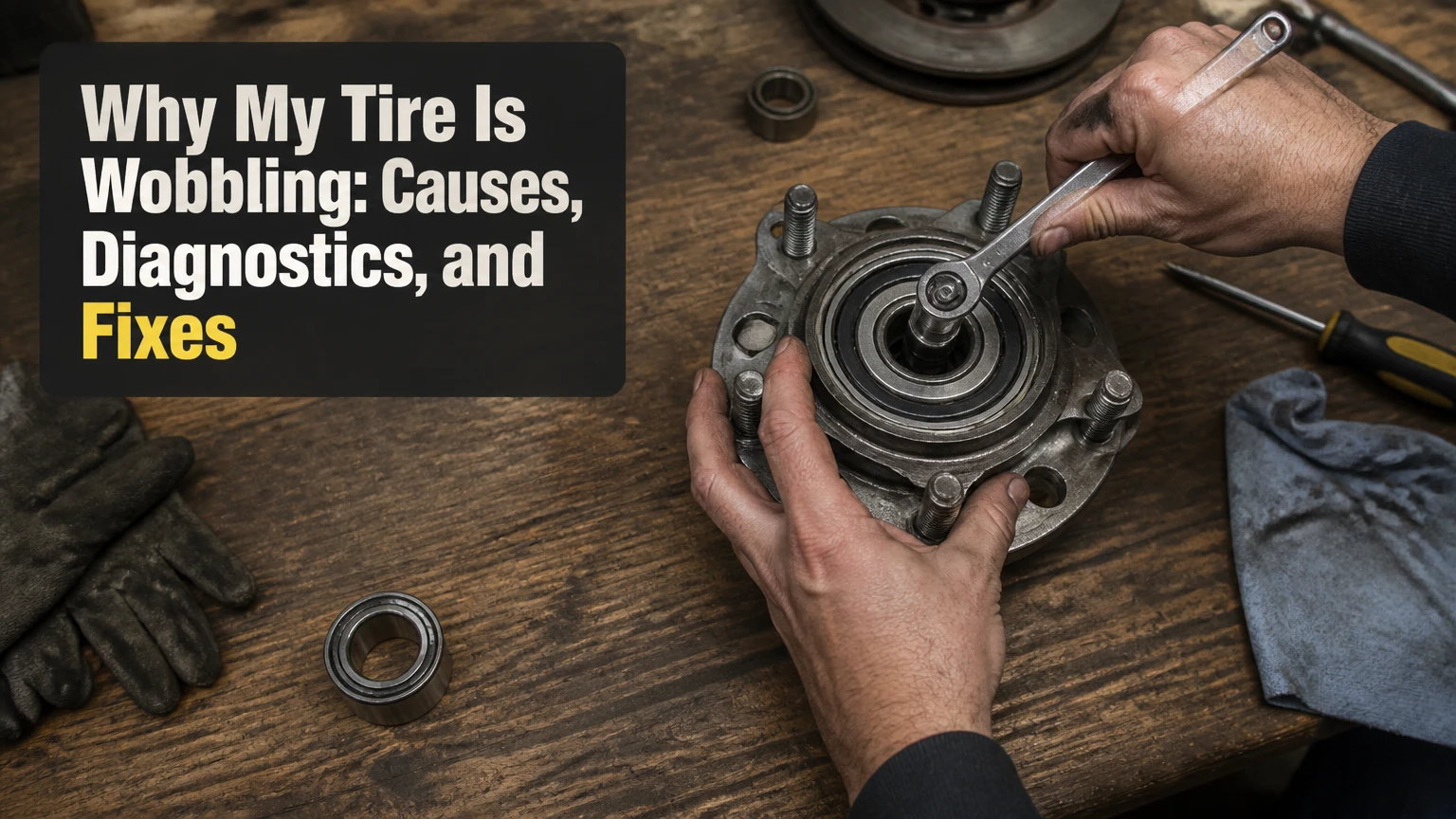
To test for a failing wheel bearing, elevate the vehicle on a jack stand and physically shake the tire by grabbing the outer edges at the 12 o’clock and 6 o’clock positions.
                             [ Elevate Car on Jack Stand ]
                                          │
                        [ Grip Tire at 12 & 6 o'Clock Positions ]
                                          │
                                          ▼
                      ┌───────────────────────────────────────┐
                      │ Push In & Pull Out with Firm Pressure │
                      └───────────────────────────────────────┘
                                          │
                 ┌────────────────────────┴────────────────────────┐
                 ▼                                                 ▼
        [ Movement / Play Present ]                     [ Zero Movement / Solid ]
                 │                                                 │
                 ▼                                                 ▼
   Check Axial Play Tolerance Limit                      Wheel Bearing Intact
     (Exceeds 0.005 in / 0.127 mm)                        (Investigate Wheel Balance
                 │                                         or Bent Rim Issues)
                 ▼
    REPLACE WHEEL BEARING IMMEDIATELY
Any clunking or mechanical play indicates worn internal ball bearings or hub races. Additionally, failing wheel bearings produce a low-pitched roaring or grinding noise that increases in volume when swerving or shifting vehicle weight onto the affected side.
How Much Does It Cost to Fix a Wobbling Tire?
The cost to fix a wobbling tire ranges from $20 to $50 for simple rebalancing up to $150 to $600 for component replacements.
| Repair Service | Average Cost Range (USD) | What Is Covered |
| Standard Spin Balancing | $20 – $50 (set of 4) | Correcting weight distribution on undamaged wheels |
| Road Force Balancing | $80 – $150 (set of 4) | Diagnostic load testing and force-matching tires to rims |
| Lug Nut Replacement & Retorque | $10 – $40 | Replacing damaged studs and torquing to specification |
| Wheel Rim Straightening | $75 – $200 per wheel | Hydraulic repair of bent aluminum or steel rims |
| Wheel Bearing Replacement | $200 – $600 per hub | Removing failed hub assemblies and pressing in new bearings |
| New Tire Replacement | $100 – $300+ per tire | Replacing tires with separated internal steel belts |
The Bottom Line
A wobbling tire is a critical mechanical issue rooted in weight distribution errors, mechanical wear, or structural tire failure. Minor vibrations at highway speeds typically point to dynamic balance errors or hub centering gaps, while low-speed wobble indicates dangerous internal belt separation or loose lug nuts.
Do not rely on standard spin balancing if high-speed shaking persists—insist on a Road Force balance test to detect structural hard spots and check that hub faces are free of corrosion. Addressing small wobbles early prevents premature suspension damage, uneven tread wear, and wheel detachment risks.