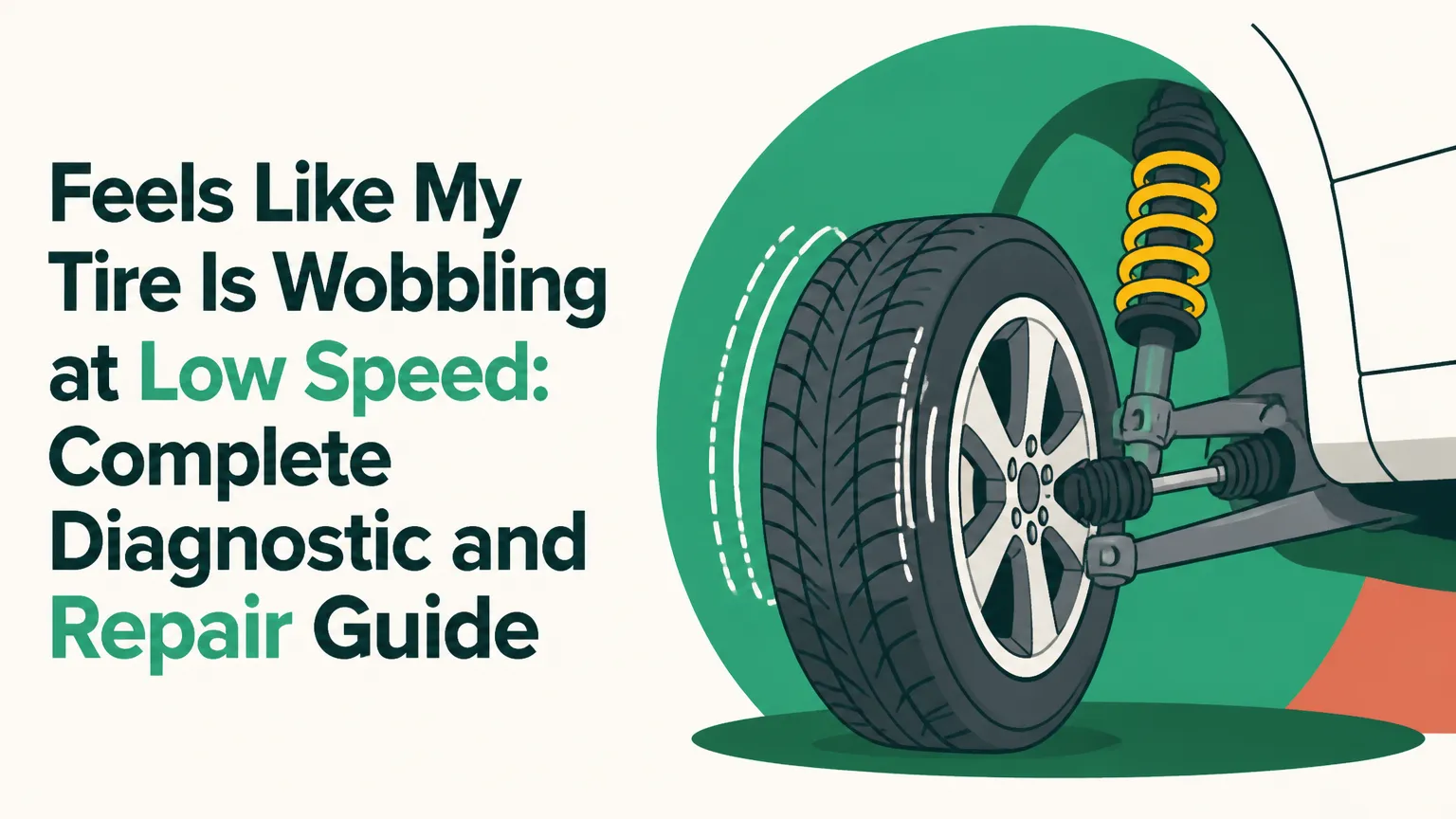
A low-speed tire wobble—typically felt under 30 mph (50 km/h)—is a rhythmic side-to-side oscillation, shaking, or shimmying caused by a structural defect in the wheel assembly or severe play in the steering and suspension components. Unlike high-speed vibrations caused by minor wheel weight imbalances, a low-speed wobble indicates an immediate mechanical or structural failure that will not self-correct and requires swift inspection.
Key Facts: Low-Speed Wobble At A Glance
- Primary Root Causes: Internal tire belt separation, bent wheel rim, worn wheel bearing, loose lug nuts, or failing steering linkage (tie rods/ball joints).
- Symptom Location Indicator: Shaking in the steering wheel points to front axle components; shaking felt in the floorboard or seat pan points to rear axle issues.
- Critical Tolerance: Radial or lateral tire runout exceeding 0.060 inches (1.5 mm) or rim runout exceeding 0.030 inches (0.76 mm) requires immediate replacement or repair.
- The High-Speed Illusion: A wobble that seems to disappear above 30–40 mph has not resolved; the increased rotational speed merely bypasses the suspension system’s natural resonant frequency.
- Safety Level: High to Critical. Driving on a structural tire failure or loose wheel hardware risks catastrophic tire blowout or wheel detachment.
Why Does a Tire Wobble at Low Speeds? The Rotational Mechanics
At low vehicle speeds (5–30 mph), centrifugal force is insufficient to stiffen or mask physical deformities in a rotating tire. The vehicle’s weight sits directly on the mechanical structure of the wheel, spindle, and tire casing.
[Tire Tread Deformation / Slipped Belt]
                    │
                    ▼ (Rolls over contact patch)
[Uneven Radial Distance Forces Spindle Up/Out]
                    │
                    ▼ (Low kinetic frequency bypasses shocks)
[Kinetic Energy Travels Unmitigated Through Linkage]
                    │
                    ▼
[Palpable Wobble at Steering Wheel or Floorboard]
When an uneven spot—such as a bulged tread block, broken steel belt, or flat-spotted rim lip—strikes the pavement, it creates a momentary disruption in the rolling radius. Because the wheel is turning slowly, suspension dampers (shocks and struts) cannot dissipate these low-frequency kinetic pulses. Instead, the force transfers unmitigated through the wheel hub, axle, control arms, and steering column directly into the vehicle chassis.
Symptom-to-Cause Diagnostic Matrix
Use this matrix to cross-reference where and how you feel the oscillation with its most probable mechanical failure point.
| Symptom Manifestation | Primary Root Cause | Severity & Risk Level | Estimated Repair Cost |
| Wobble felt strictly in steering wheel | Front tire belt separation, bent front rim, loose tie rod end | 🔴 High — Steering loss potential | $90 – $350 |
| Wobble felt in seat or vehicle floorboard | Rear tire tread separation, bent rear rim, failing rear wheel bearing | 🟡 Medium-High — Blowout risk | $90 – $450 |
| Wobble occurs under 30 mph, smooths out faster | Slipped internal steel belt, out-of-round tire tread | 🟡 Medium — Accelerates component wear | $90 – $250 / tire |
| Wobble worsens during light or heavy braking | Severely warped brake rotor, loose caliper mounting bolt | 🔴 High — Reduced braking performance | $150 – $400 / axle |
| Rhythmic clunking or clicking alongside wobble | Loose wheel lug nuts, worn outer CV joint | 🚨 Critical — Sudden wheel separation risk | $0 (Torque) to $350 |
| Side-to-side front axle shimmy on rough surfaces | Loose track bar, worn pitman/idler arm, bad ball joint | 🔴 High — Uncontrolled axle sway | $150 – $500 |
Before You Start: Diagnostic Requirements
- Estimated Diagnostics Time: 30–45 minutes
- Difficulty Level: Beginner to Intermediate
- Tools Required:
- Hydraulic floor jack and safety jack stands
- Lug wrench or calibrated torque wrench (lb-ft)
- Heavy-duty wheel chocks
- Dial indicator with magnetic base (or rigid straightedge/block of wood)
- Protective work gloves
Step-by-Step Diagnostic Procedure
Follow this 5-step sequence to pinpoint whether your low-speed wobble stems from a tire, wheel rim, hub bearing, or steering linkage.
Step 1: Secure the Vehicle and Inspect Lug Nuts
- Park the vehicle on a level, concrete surface and fully engage the parking brake. Place wheel chocks in front of and behind the tires on the opposite end being tested.
- Before lifting the wheels, set a calibrated torque wrench to your vehicle’s factory specification (typically 80–100 lb-ft for passenger cars; 120–150 lb-ft for trucks and large SUVs).
- Check every lug nut in a criss-cross (star) pattern to confirm none are loose or undertorqued.
Success Checkpoint: All lug nuts click firmly at factory torque specs without turning further.
🛑 Common Mistake: Torquing lug nuts while the wheel is fully suspended in the air without a helper holding the brake pedal, which prevents proper torque application.
Step 2: Perform a Visual and Tactile Tread Inspection
- Clean off mud, road debris, or packed gravel from the tire surface.
- Run your gloved hand slowly across the entire circumference of the tread face and inner/outer sidewalls.
- Inspect for raised bubbles, localized humps, exposed steel belts, or an “S-curve” wave across the tread blocks.
Success Checkpoint: The tread face is completely flat across its cross-section with uniform tread depth.
🛑 Common Mistake: Inspecting only the outer sidewall while ignoring the inner sidewall where belt separations frequently hide.
Step 3: Conduct the “12-and-6” and “9-and-3” Play Test
- Position the floor jack under the factory jacking point, lift the suspect tire 2–3 inches off the ground, and lower the vehicle onto a safety jack stand.
- Grab the tire firmly at the 12 o’clock and 6 o’clock positions and rock it inward and outward.
- Grab the tire at the 9 o’clock and 3 o’clock positions and repeat the rocking motion.
       [12 o'clock]
            ▲
    ┌──────────────┐
    │              │
◄───│  WHEEL HUB   │───►
[9] │              │ [3]
    └──────────────┘
            ▼
        [6 o'clock]

Play at 12 & 6 = Wheel Bearing / Ball Joint
Play at 9 & 3  = Tie Rod / Steering Linkage
- Play at 12 and 6: Indicates a failing wheel bearing unit or worn upper/lower ball joints.
- Play at 9 and 3: Indicates a worn inner/outer tie rod end or steering rack play.
Success Checkpoint: The wheel assembly remains solid with zero mechanical slop or clicking noises during rocking.
Step 4: Measure Radial and Lateral Runout
- Mount a dial indicator on a heavy magnetic stand attached to the brake caliper or lower control arm. Place the indicator tip against the center tread block, then against the outer aluminum/steel rim lip.
- Slowly rotate the tire by hand through 360 degrees while monitoring the gauge dial.
- Alternatively, place a fixed block of wood 1 millimeter away from the spinning tread face and observe if the gap narrows and widens.
RADIAL RUNOUT (Up/Down Deformity)     LATERAL RUNOUT (Side-to-Side Wobble)
      ┌─────────┐                            ┌─────────┐
      │  Tread  │  ▲                         │  Tread  │
      ├─────────┤  │ Max Tolerance:          ├─────────┤ ◄───► Max Tolerance:
      │   Rim   │  ▼ 0.060" (1.5mm)          │   Rim   │       0.030" (0.76mm)
      └─────────┘                            └─────────┘
- Maximum Radial Runout (Out-of-Round): Must not exceed 0.060 inches (1.5 mm) on the tire or 0.030 inches (0.76 mm) on the rim lip.
- Maximum Lateral Runout (Side Wobble): Must not exceed 0.045 inches (1.14 mm) on the tire or 0.030 inches (0.76 mm) on the rim lip.
Success Checkpoint: The variance across a full rotation stays strictly within factory runout thresholds.
Step 5: Check Hub-Centric Flushness and Brake Components
- Unbolt the wheel and visually inspect the mounting face between the wheel hub and the rim back.
- Look for corrosion buildup, rust flakes, or incorrect aftermarket hub-centric rings that prevent the wheel from mounting flat against the brake rotor.
- Rotate the brake rotor by hand to verify it turns freely without catching or binding on unevenly worn brake pads.
Detailed Breakdown of 6 Primary Failure Modes
1. Internal Tire Slipped Belt or Tread Separation
- Mechanism: Overheating, manufacturing defects, age, or pothole impacts cause the internal steel belts to delaminate from the rubber matrix. The pressurized air forces the tread outward into a distorted “S” pattern.
- Key Metric: Tread surface runout > 0.060 inches (1.5 mm).
- Part Cost: $90 – $250 per tire.
- Labor Time: 0.5 hours.
2. Bent or Structurally Warped Wheel Rim
- Mechanism: Impact forces from deep potholes, curbs, or debris bend the soft aluminum or steel rim lip, altering the wheel’s true circumference.
- Key Metric: Rim flange runout > 0.030 inches (0.76 mm).
- Part Cost: $75 – $150 (Straightening repair) or $120 – $450 (New OEM/Aftermarket rim).
- Labor Time: 0.5 – 1.0 hour.
3. Worn or Failing Wheel Hub Bearing
- Mechanism: Moisture intrusion or breakdown of bearing grease causes pitting on the internal steel rollers, creating physical axial play inside the hub assembly.
- Key Metric: Any detectable endplay (> 0.005 inches) during the 12-and-6 shake test.
- Part Cost: $110 – $320 per unit.
- Labor Time: 1.0 – 2.5 hours.
4. Loose or Damaged Steering Linkage (Tie Rods, Ball Joints)
- Mechanism: Rubber dust boots tear, allowing dirt to erode the ball-and-socket joints in tie rod ends or control arm ball joints. The resulting mechanical clearance lets the wheel flutter at low speeds.
- Key Metric: Joint movement > 1.0 mm under manual lever pressure.
- Part Cost: $45 – $180 per component.
- Labor Time: 1.0 – 2.0 hours (plus compulsory 4-wheel alignment).
5. Binding CV Axle Inner Joint
- Mechanism: The internal tripod or plunge joint of an axle shaft develops wear grooves. Under light acceleration at low speeds, the joint binds during rotation, shaking the engine cradle and front suspension.
- Key Metric: Wobble occurs specifically under light throttle under 25 mph and disappears when shifting to neutral.
- Part Cost: $120 – $300 per axle.
- Labor Time: 1.5 – 2.5 hours.
6. Solid-Axle Track Bar / Steering Geometry Wear (“Death Wobble”)
- Mechanism: Common on solid front axle vehicles (Jeep Wrangler, Ford Super Duty). Worn track bar bushings allow the entire front axle to shift laterally relative to the frame when triggered by road bumps at lower speeds.
- Key Metric: Lateral frame-to-axle shift visible during steering wheel cycling.
- Part Cost: $120 – $350.
- Labor Time: 1.0 – 2.0 hours.
Component Repair vs. Replacement Strategy Matrix
When addressing a low-speed wobble, choose the appropriate resolution pathway based on component structural integrity:
| Failure Type | Recommended Action | Pros | Cons | Ideal Scenario |
| Slipped Belt / Separated Tread | Full Tire Replacement | Restores complete structural casing integrity; maximum road safety. | Cannot be repaired; requires replacing at least the axle pair to match tread depths. | Any tire exhibiting internal belt separation or sidewall bulges. |
| Bent Alloy Wheel Rim | Professional Rim Straightening | Saves cost of purchasing expensive OEM factory wheels; preserves matching set. | Cannot repair cracked alloy or severe barrel twists; slight reduction in metal temper. | Minor lip bends on expensive factory alloy rims without structural cracks. |
| Bent Steel Wheel Rim | Wheel Replacement | Steel rims are inexpensive; replacement guarantees factory runout specs. | Requires dismounting and remounting the existing tire. | Stamped steel wheels on commuter vehicles or light trucks. |
| Worn Steering / Bearing Component | Assembly Replacement | Eliminates all mechanical play; restores sharp steering precision. | Requires subsequent 4-wheel alignment ($100–$150). | Any joint or bearing exhibiting physical movement during hands-on testing. |
Critical Errors to Avoid
- Mistake 1: Attempting a standard dynamic wheel balance to resolve a low-speed wobble. Standard spin balancers apply lead counterweights to balance mass distribution. They cannot correct a tire that is physically out-of-round or has an internal belt separation.
- Mistake 2: Assuming the issue is fixed because the wobble disappears above 35 mph. At higher speeds, the rotational frequency of the wheel bypasses the natural resonant frequency of the suspension springs. The mechanical force is still present and actively accelerating wear on your wheel bearings, tie rods, and steering rack.
- Mistake 3: Over-torquing lug nuts with an uncalibrated air impact wrench. Excess or uneven lug nut torque distorts the thin metal of brake rotor hats and hub faces, inducing artificial lateral brake runout and wheel wobble.
- Mistake 4: Injecting tire sealant to fix a structural wobble. Liquid tire sealants are designed solely for small tread punctures. Adding fluid inside a tire with a slipped belt worsens the weight imbalance and creates a severe safety hazard.
Persona-Specific Action Plans
The Daily Commuter / Family Driver
- Primary Concern: Safety, reliability, and minimal downtime.
- Action: Do not drive at highway speeds. Perform a quick lug nut check. If lug nuts are tight, drive directly at low speeds (<20 mph) to a certified shop. Replace separated tires in matching pairs across the axle to maintain balanced traction control and ABS sensor readings.
The DIY Mechanic
- Primary Concern: Accurate root-cause isolation and self-repair efficiency.
- Action: Use a dial indicator to measure radial runout on both the tire tread center and the inner/outer rim flanges. If suspension components (tie rods, ball joints) require replacement, always replace them in bilateral pairs (left and right sides simultaneously) and perform a precision toe alignment upon reassembly.
The Off-Road & Heavy-Duty Truck Enthusiast
- Primary Concern: Large tire fitment, trail durability, and solid-axle dynamics.
- Action: Before replacing parts, check for packed mud, rocks, or trail ice frozen inside the deep drop-center of wide rims. Verify that low-pressure beadlock tires haven’t spun on the rim lip. Inspect the track bar bolt torque (often 150–200+ lb-ft on heavy-duty trucks) before assuming a tire is defective.
Frequently Asked Questions
Can a bad wheel alignment cause a low-speed tire wobble?
No. Incorrect alignment parameters (such as excessive toe-in or out-of-spec camber) cause uneven tread wear, steering pull, or high-speed instability, but they do not physically cause a rhythmic low-speed oscillation. A low-speed wobble requires a rotational deformity (tire/rim) or mechanical play (bearing/linkage).
How do I tell if the wobble is caused by a tire or a wheel bearing?
A deformed tire produces a rhythmic side-to-side wobble or up-and-down hopping motion that corresponds directly with vehicle speed, without changing in pitch during turns. A failing wheel bearing typically produces a low-frequency hum, growl, or grinding noise that alters significantly in volume when you swerve lightly to shift vehicle weight onto or off the affected side.
Is it safe to drive with a low-speed tire wobble?
No. Driving with a low-speed wobble is unsafe. A low-speed wobble indicates severe mechanical looseness or internal tire casing failure. Driving on a separated tire can lead to sudden tread delamination or blowout, while driving on loose lug nuts or bad bearings risks full wheel detachment. Limit driving strictly to low speeds to reach a repair facility.
Why does my low-speed wobble get worse when I step on the brakes?
If the wobble intensifies specifically when applying the brakes, the primary culprit is severe lateral runout in the brake rotors (warped rotors) or a sticking brake caliper slide pin that forces the pad against an uneven rotor surface.
What does a slipped tire belt feel like at 15 to 20 mph?
A slipped internal steel belt feels like a distinct, rolling shimmy or “duck waddle” motion. The vehicle sways gently from side to side at very low speeds, and the driver will feel the steering wheel tug rhythmically back and forth even on completely flat pavement.
Can flat-spotting cause a low-speed wobble after a car sits for a long time?
Yes. Vehicles parked for extended periods (especially in cold weather) can develop temporary flat spots on the tire contact patch. This creates a low-speed radial hop for the first 5–10 miles of driving until the tire rubber warms up and regains its natural round shape. If the wobble persists after 15 miles, the deformation is permanent or structural.