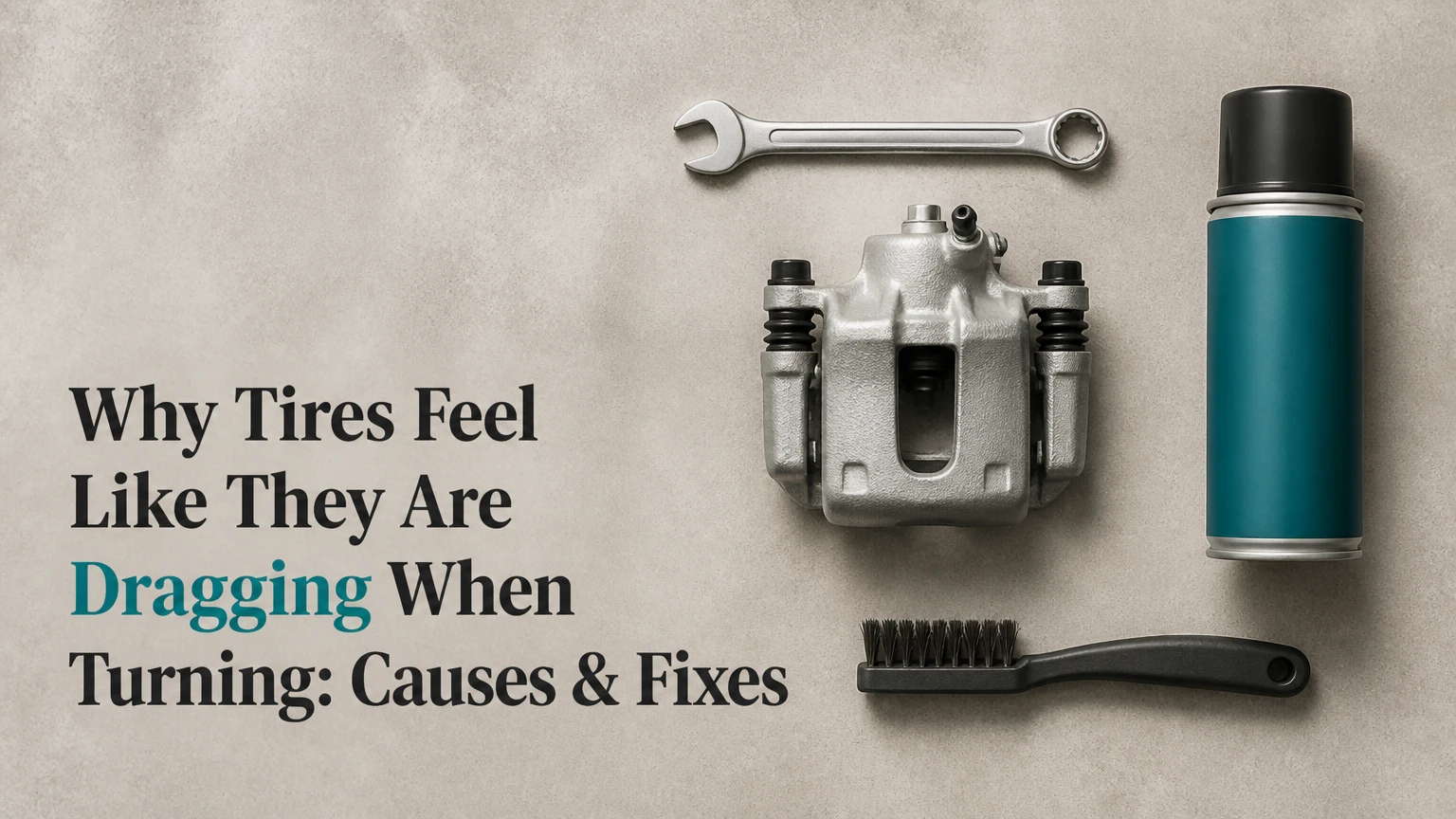
When tires feel like they are dragging, hopping, or plowing when turning, your vehicle is experiencing mechanical binding caused by drivetrain wind-up in 4WD/AWD systems, severe Ackermann steering geometry errors, or a seized brake caliper. This sensation occurs because the mechanical system prevents the wheels from rotating at their required independent speeds, forcing the tires to physically slide, scrub, or hop across the road surface.
At a Glance: Core Facts
- Drivetrain Binding (“Crow-Hop”): Engaging part-time 4WD on dry pavement locks front and rear axle speeds, forcing tires to scrub during low-speed turns.
- Ackermann Steering Failure: Damaged suspension components prevent the inside wheel from turning at a steeper angle than the outside wheel, pushing the tire sideways.
- Brake Caliper Hose Collapse: Internal delamination of a flexible brake hose creates a one-way hydraulic check valve, keeping the brake pad locked against the rotor during steering wheel articulation.
- Tire Mismatch on AWD: Tread depth differences greater than 2/32 of an inch between tires confuse AWD differentials, inducing continuous driveline strain and cornering drag.
- Immediate Safety Risk: Ignoring cornering drag risks transfer case gear failure, severely accelerated tire tread destruction, and loss of steering control.
Why Do Tires Drag or Hop During a Turn?
Tires drag during a turn because the four wheels of a vehicle must travel along four distinct rotational paths with different radii. The wheel on the outside of the turn travels along a wider arc and must rotate faster than the wheel on the inside of the turn. Simultaneously, the front wheels travel a longer distance than the rear wheels.
               [ Outside Front Wheel ]  <-- Travels longest arc (Rotates Fastest)
                         /
                        /  Ackermann Angle Difference
                       /
 [ Inside Front Wheel ]                 [ Outside Rear Wheel ]
         \                                       |
          \                                      |
           \____[ Turning Center Point ]________|
                                                 |
                                        [ Inside Rear Wheel ] <-- Travels shortest arc (Rotates Slowest)
To maintain smooth motion, three mechanical subsystems must work in harmony:
- The Drivetrain Differential: Allows left/right and front/rear wheels to rotate at unequal speeds.
- The Steering Linkage (Ackermann Principle): Turns the inside wheel at a sharper angle than the outside wheel.
- The Braking System: Fully releases clamping pressure on all brake rotors regardless of suspension movement or steering angle.
If any of these systems lock, bind, or apply unintended drag, one or more tires lose traction and scuff laterally across the asphalt.
Drivetrain Binding: Why Does 4WD or AWD Cause Tire Dragging?
Drivetrain binding—frequently referred to as “crow-hopping” or “driveline wind-up”—occurs when a vehicle’s front and rear axles, or left and right wheels, are mechanically locked together and forced to rotate at identical speeds during a turn.
[ Front Axle Locked ] === (Transfer Case Bound) === [ Rear Axle Locked ]
         │                                                   │
   Inside Wheel (Needs 10 RPM)                         Inside Wheel (Needs 8 RPM)
   Outside Wheel (Needs 15 RPM)                        Outside Wheel (Needs 12 RPM)
         └──────────────────[ FORCED EQUAL SPEED ]───────────┘
                                     │
                             Tire Slip / Hop / Drag
Part-Time 4WD Engaged on Dry Pavement
Part-time four-wheel-drive (4WD) systems lack a center differential. When engaged in 4HI or 4LO, the transfer case mechanically locks the front and rear driveshafts together at a 50:50 speed ratio.
On loose surfaces like mud, snow, or gravel, the tires slip slightly to relieve rotational tension. On dry asphalt, high friction prevents tire slippage, trapping rotational energy inside the driveshafts, axles, and transfer case gears. This rotational tension forces the tires to violently bind, chirp, and hop off the pavement.
Failed AWD Viscous Coupling or Center Differential Lock
Full-time All-Wheel Drive (AWD) vehicles utilize a center differential, viscous coupling, or electronically controlled multi-plate clutch pack to transfer power while accommodating wheel speed differences.
If the fluid inside a viscous coupling breaks down due to overheating, the unit can lock up permanently. Similarly, if an electronic AWD transfer case actuator fails in its locked position, the vehicle behaves like a locked 4WD truck, dragging the tires during low-speed parking lot turns.
Over-Tight Limited-Slip Differential (LSD) Clutch Packs
Rear or front limited-slip differentials use friction plates and springs to prevent a single wheel from spinning uselessly on ice or mud. If the clutch friction modifier additive in the differential fluid degrades, or if the internal clutch packs are shimmed too tightly, the differential cannot slip during sharp turns. The inside wheel gets dragged along the pavement, causing a chattering or shuddering feeling from the rear axle.
Steering Geometry Failure: How Does Ackermann Error Scrub Tires?
Ackermann steering geometry is an engineering principle ensuring that when a vehicle turns, the inside front wheel turns at a sharper angle than the outside front wheel because it follows a smaller radius curve.
Incorrect (Parallel Alignment)          Correct (Ackermann Geometry)
      ║               ║                       /               ║
      ║               ║                      /                ║
   [Left]          [Right]                [Left]           [Right]
  (Sharper Radius) (Wider Radius)       (Sharper Angle)  (Shallower Angle)
  Tire Forced to Drag Sideways!          Both Tires Roll Smoothly Along Arcs
What Is Ackermann Steering Error?
When Ackermann steering geometry fails, both front wheels turn at parallel or conflicting angles. The inside tire is forced to roll at an angle that does not align with its natural turn radius, forcing the tread compound to drag sideways across the road.
What Suspension and Steering Components Cause Geometry Errors?
- Bent Tie Rods or Steering Knuckles: Impacting a curb or severe pothole bends the steering arms, throwing off toe angles and altering the dynamic steering geometry during turns.
- Worn Control Arm Bushings: Deteriorated rubber bushings allow the lower or upper control arms to shift under cornering loads, changing toe-in and camber dynamically when the steering wheel is turned.
- Incorrect Suspension Lift Kits: Installing an aftermarket suspension lift without installing drop pitman arms or corrected steering knuckles destroys the factory Ackermann steering calibration, causing bump steer and tire scrubbing.
Brake Caliper Seizure: How Can Braking Systems Cause Dragging When Turning?
A sticky brake caliper or collapsing brake line can allow a vehicle to drive straight without issue, only to drag heavily as soon as the steering wheel is turned.
[ Steering Wheel Turned ]
          │
          ▼
Flex Brake Hose Twisted/Stretched
          │
          ▼
Internal Delamination Acts as 1-Way Valve
          │
          ▼
Fluid Pressure Trapped Behind Caliper Piston
          │
          ▼
Brake Pads Lock Rotor Under Turning Load
Why Does Brake Dragging Worse During Turns?
- Collapsing Flexible Brake Hoses: Over time, the inner rubber lining of a flexible brake hose breaks down and delaminates. When the front wheel turns, the hose twists slightly, causing the inner flap of rubber to close like a one-way check valve. Hydraulic pressure pushes fluid into the caliper when you brake, but the trapped pressure cannot return to the master cylinder when turning, clamping the brake pads against the rotor.
- Corroded Caliper Slider Pins: Caliper slider pins allow floating calipers to center themselves over the brake rotor. If moisture enters the pin boots, rust locks the pins in place. Cornering places lateral flexing loads on the wheel bearing and hub assembly, pushing the rotor against the frozen brake pad and generating a drag sensation.
- Stuck Internal Caliper Piston: Brake fluid absorbs moisture over time, rusting the steel piston inside the caliper bore. The piston fails to retract, creating continuous friction that intensifies when lateral forces are applied during a turn.
Additional Hidden Causes of Turning Drag
Beyond the primary mechanical culprits, several secondary issues can simulate or directly cause tire dragging when turning:
1. Mismatched Tire Diameters on AWD Vehicles
If an AWD vehicle has three tires with 8/32″ tread depth and one replacement tire with 10/32″ tread depth, the individual wheel speed sensors detect a constant rotational variance. The AWD computer continuously attempts to engage and disengage the center transfer clutch, creating a dragging or shuddering feeling during turns.
2. Damaged Constant Velocity (CV) Axle Joints
A worn outer CV joint with pitted ball bearings or cracked cages binds under extreme articulation angles. When turning the wheel to full lock, the joint resists smooth rotation, transferring a rhythmic tugging or dragging torque back through the steering wheel.
3. Worn Wheel Bearings
A failing wheel bearing allows excessive hub play (knockback). When turning, lateral forces cause the entire brake rotor to tilt out of alignment with the brake caliper, creating physical contact between the rotor face and pad bracket.
Step-by-Step Diagnostic Protocol: Isolating the Root Cause
Follow this systematic diagnostic workflow to isolate the exact source of tire dragging on your vehicle.
                      [ Experience Tire Dragging When Turning ]
                                          │
                                          ▼
                         Is vehicle in 4WD / AWD Mode?
                                   │            │
                         YES ──────┘            └────── NO
                          │                             │
                          ▼                             ▼
                 Shift to 2WD Mode             Perform Drive Test & Touch
            Does Dragging Persist?             Wheel Hub / Brake Temps
             │                  │               │                   │
   YES ──────┘                  └─ NO         ONE HOT ────────── ALL COOL
    │                              │            │                   │
    ▼                              ▼            ▼                   ▼
Stuck Transfer Case       Normal 4WD Behavior   Stuck Caliper /   Check Tire Wear &
Actuator / Center Diff   (Do Not Use on Asphalt) Bad Bearing      Suspension Bushings
Step 1: Drivetrain Mode Verification
- Drive the vehicle to a flat asphalt surface (such as a empty parking lot).
- Verify if the vehicle is equipped with 4WD or AWD.
- If equipped with selectable 4WD, ensure the selector dial or lever is set to 2WD High.
- Perform a tight, slow turn in a circle.
- If the dragging stops: The system was in advertently engaged in 4WD on dry pavement.
- If the dragging continues in 2WD: The transfer case actuator, vacuum shift fork, or center differential is mechanically stuck in 4WD mode.
Step 2: Infrared Heat Inspection (Brake vs. Bearing Check)
- Drive the vehicle for 10 minutes, making several low-speed turns.
- Stop the vehicle safely on a level surface without applying heavy braking pressure.
- Aim an non-contact infrared pyrometer thermometer directly at each wheel hub and brake rotor assembly (or carefully feel near the wheel face for radiant heat).
- If one wheel is significantly hotter (>50°F / 28°C higher than others): You have a seized brake caliper, collapsed brake hose, or severely worn wheel bearing on that corner.
- If all wheels show uniform heat: Proceed to Step 3.
Step 3: Jack-and-Spin Isolation Test
- Safely raise the front axle off the ground using a floor jack and support the frame securely on jack stands.
- Place the transmission in Neutral and release the parking brake.
- With the wheels pointed straight, spin each front wheel by hand to establish baseline resistance.
- Have an assistant turn the steering wheel fully to the left lock, then attempt to spin the wheels again by hand. Repeat for right lock.
- If a wheel spins freely straight, but locks up at full turn lock: Inspect for a collapsed flexible brake line or binding outer CV axle joint.
- If both wheels refuse to spin independently in Neutral: Inspect the front differential or transfer case for binding.
Step 4: Alignment and Tread Pattern Visual Inspection
- Inspect the front tire treads for abnormal wear patterns:
- Feathered Wear (Smooth in one direction, sharp in the other): Severe toe misalignment or Ackermann geometry failure.
- Cupped / Scalloped Wear: Worn shocks, struts, or control arm bushings allowing wheel hop.
- Outside Edge Baldness: Excessive positive camber or hard dynamic cornering wear due to bad alignment.
- Measure tread depth across all four tires using a tread depth gauge. Verify that total diameter variance across AWD wheels is less than 2/32 of an inch (1.6 mm).
Comprehensive Repair Comparison: Solutions, Costs, and Labor
| Repair Procedure | Target Problem | Parts Cost (USD) | Labor Cost (USD) | Total Cost Range | Est. Repair Time | Recommended DIY Level |
| Four-Wheel Alignment | Ackermann Error / Toe Misalignment | N/A | $100 – $200 | $100 – $200 | 1.0 Hour | Professional Only |
| Brake Caliper Replacement | Frozen Caliper Piston or Slider Pins | $60 – $180 | $150 – $250 | $210 – $430 | 1.5 Hours | Intermediate DIY |
| Flexible Brake Line Replacement | Internal Hose Delamination | $25 – $65 | $120 – $200 | $145 – $265 | 1.0 Hour | Intermediate DIY |
| Differential Fluid Change + Additive | LSD Clutch Chatter / AWD Viscous Bind | $30 – $70 | $100 – $180 | $130 – $250 | 0.75 Hours | Beginner DIY |
| Transfer Case Shift Actuator | Vehicle Stuck in 4WD Mode | $150 – $450 | $200 – $400 | $350 – $850 | 2.5 Hours | Intermediate DIY |
| CV Axle Shaft Replacement | Binding CV Joint at Turning Angles | $90 – $220 | $180 – $320 | $270 – $540 | 2.0 Hours | Intermediate DIY |
| Tie Rod / Control Arm Bushings | Worn Steering / Suspension Linkage | $80 – $250 | $200 – $450 | $280 – $700 | 3.0 Hours | Advanced DIY |
Critical Mistakes to Avoid
- Driving 4WD on Dry Asphalt: Operating a traditional part-time 4WD system on dry pavement forces the transfer case gears to absorb driveline wind-up. This can snap transfer case chains, shatter gear teeth, or crack aluminum housing cases within a few miles.
- Replacing Tires Without Fixing Mechanical Issues: Installing new tires when you experience tire dragging will temporarily soften the vibration due to flexible, tall tread blocks. However, the underlying mechanical issue will scrub off thousands of miles of tread life within weeks.
- Ignoring a Hot Wheel Hub: Continuing to drive with a dragging, seized brake caliper generates extreme temperatures exceeding 600°F (315°C). This heat boils brake fluid (leading to complete pedal loss), melts wheel bearing grease, and distorts steel brake rotors.
- Mixing Tire Brands or Tread Depths on AWD: Replacing only one worn tire on an AWD system forces the center differential to run constantly at high speed, overheating the fluid and burning out viscous couplings or electronic clutch packs.
Persona Recommendations: What Should You Do Next?
The DIY Mechanic
- Raise the front axle on jack stands and perform the jack-and-spin test at full lock positions to isolate brake hose collapse versus CV axle binding.
- Check fluid conditions: pull the fill plug on your front differential and transfer case. Metallic glitter or burnt fluid points directly to internal mechanical binding.
- Apply fresh high-temperature silicone grease to brake caliper slider pins and bleed old brake fluid to flush out moisture.
The Daily Commuter / Fleet Operator
- If your vehicle drags only during tight parking maneuvers, immediately verify your dashboard drive mode selector. Ensure 4WD Auto or 4WD Lock is disabled.
- If the drive mode is correct, take your vehicle to a certified tire and alignment facility. Ask for a full alignment printout showing individual toe angles and steering axis inclination (SAI).
The Off-Road / Performance Enthusiast
- If you operate aftermarket mechanical lockers (such as a spool or automatic lunchbox locker), low-speed tire dragging, chirping, and steering feedback during tight turns on pavement is normal.
- For vehicles with factory Limited-Slip Differentials (LSD), perform a fluid flush and add friction modifier to eliminate clutch chatter during slow cornering.
Frequently Asked Questions
Can low power steering fluid cause tires to drag when turning?
No, low power steering fluid does not cause physical tire dragging or tread scrubbing. Low power steering fluid increases resistance inside the steering wheel gear assembly, making the steering wheel difficult for the driver to physically turn, but it does not alter wheel rotational speeds or force the tires to scuff against the road.
Why do my tires feel like they are hopping or skipping at low speeds in parking lots?
Tires hop or skip at low speeds in parking lots because your vehicle’s front and rear axles are locked together—usually due to an engaged 4WD system or locked center differential. On high-friction asphalt, the tires cannot adjust their rotational speeds independently during sharp turns, forcing them to slip and hop to release mechanical tension.
Is it safe to drive my car if the tires feel like they are dragging when I turn?
No, driving with tire drag is unsafe and leads to mechanical failure. Drivetrain binding can damage transfer cases and differentials, while a seized brake caliper can boil brake fluid, leading to total brake failure. Additionally, tire dragging severely degrades cornering traction and destroys tire tread quickly.
How do I know if my wheel alignment or a stuck brake is causing tire drag?
Check the temperature of your wheels after driving. A stuck brake caliper or failing wheel bearing generates intense friction, making one wheel hub noticeably hotter to the touch than the others. In contrast, alignment errors (such as Ackermann geometry issues) leave the wheels at normal operating temperatures but cause visible feathering or uneven wear across the tire tread.
Why does my AWD car feel like it drags when turning after buying one new tire?
Buying a single new tire creates an outer diameter mismatch compared to the three older, worn tires. The AWD computer interprets the differing wheel rotational speeds as slip, continuously engaging the center clutch pack or viscous coupling. This creates driveline bind and a dragging sensation during turns. Always replace AWD tires in complete sets of four or have the single new tire shaved to match the existing tread depth.