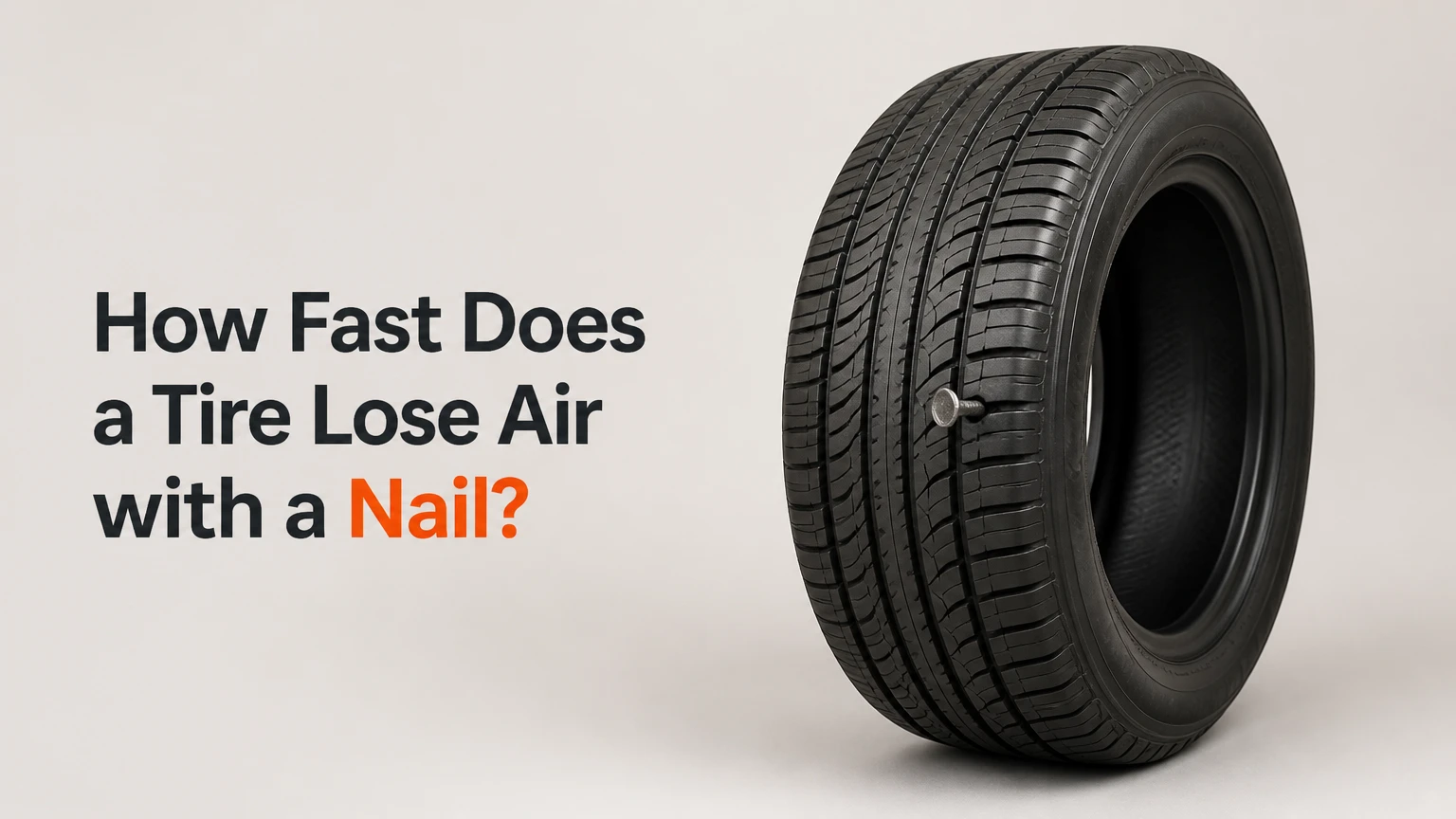
A tire with an embedded nail loses air at rates ranging from a micro-leak of 1 to 3 PSI per week to complete deflation within seconds. In a standard tread puncture, a tire typically loses 1 to 5 PSI per day because the nail acts as an incomplete plug inside the rubber.
At a Glance
- Standard slow leaks drop 1 to 5 PSI daily when the nail penetrates the tread perpendicularly.
- Driving speeds accelerate air loss to 1 to 10 PSI per hour due to tire flexing and centrifugal force.
- Sidewall or shoulder punctures cannot be repaired and carry an immediate risk of a tire blowout.
- Driving below 20 PSI destroys the tire’s inner rubber liner, requiring complete replacement.
- Never pull the nail out at the roadside, as it serves as a temporary barrier holding air inside.
What Factors Determine How Quickly a Nail-Punctured Tire Deflates?
The rate at which a nail-punctured tire loses air depends on four physical variables: puncture angle, movement, tire pressure, and object shape. Clean 90-degree tread punctures leak slowest because surrounding rubber compresses around the shank.
| Leak Scenario | Air Loss Rate | Mechanical Cause | Immediate Risk Level |
| Micro-Leak | 1–3 PSI / week | Straight puncture; nail head flush with tread | Low (Monitored) |
| Standard Slow Leak | 1–5 PSI / day | Straight tread puncture; partial seal | Moderate |
| Dynamic Driving Leak | 1–10 PSI / hour | Highway speed centrifugal force breaking the seal | High |
| Catastrophic Blowout | 30+ PSI / seconds | Sidewall tear or shank ejection leaving an open hole | Severe / Immediate |
Angular punctures create elongated, irregular tears that rubber cannot seal, causing rapid air loss. Smooth finishing nails leak faster than threaded deck screws, which bite into steel belts and hold air longer.
How Far Can You Drive on a Tire with a Nail in It?
You can safely drive 0 to 20 miles on a tire with a nail, provided the pressure remains above 25 PSI and the puncture is located strictly in the central tread. If pressure drops below 20 PSI, stop immediately to avoid permanent wheel and sidewall damage.
+-----------------------------------------------------------------------+
|                       SAFE DRIVING PROTOCOL                           |
+-----------------------------------------------------------------------+
|  [Step 1] Check Pressure -> If above 25 PSI, proceed to nearest shop. |
|  [Step 2] Keep Speed Low -> Stay under 45 MPH to minimize flexing.     |
|  [Step 3] Check Location -> If in sidewall/shoulder, DO NOT DRIVE.    |
+-----------------------------------------------------------------------+
- Measure baseline pressure using a digital tire gauge before moving the vehicle.
- Inspect puncture location to verify the nail is at least 0.5 inches inside the outermost tread groove.
- Drive directly to a service station at speeds under 45 MPH to prevent centrifugal forces from dislodging the object.
Why Does a Tire Lose Air Faster on the Highway Than When Parked?
Tires lose air faster on the highway because centrifugal force and continuous carcass flexing pull the rubber away from the nail shank. While a stationary tire keeps static pressure against the metal, dynamic wheel rotation breaks this temporary mechanical seal.
Every road impact shifts the embedded object slightly within the tread block. At 65 MPH, a tire rotates roughly 800 times per minute, working the puncture open and releasing air up to ten times faster than when parked.
How Much Faster Does a Tire Leak with a Nail in Cold Weather?
Cold weather accelerates air loss by adding an environmental drop of 1 PSI for every 10°F (5.6°C) decline in ambient temperature on top of the physical puncture leak. Cold weather also hardens tire rubber compound, reducing its elastic grip around the nail shank.
Ambient Temperature Drops 20°F
  ├── Physical Leak Rate:  -3 PSI (Overnight escape through puncture)
  └── Thermal Contraction: -2 PSI (Gas volume reduction at lower temp)
  ===================================================================
  Total Overnight Loss:   -5 PSI (Sufficient to trigger low-pressure alerts)
This dual-action reduction causes tires with minor slow leaks to go flat overnight during sudden cold snaps.
At What PSI Is It Unsafe to Drive on a Tire with a Nail?
It is unsafe to drive on any tire once the inflation pressure drops below 20 PSI (or 25% below the vehicle manufacturer’s cold PSI recommendation). Driving below this threshold destroys the internal rubber liner through thermal friction.
When pressure drops too low, the tire’s sidewalls collapse and scrub against themselves. This internal friction generates intense heat, shredding the rubber into a fine black dust and causing structural failure within a few miles.
How Do You Find a Slow Nail Leak in a Tire?
To locate an elusive nail leak, apply a mixture of water and liquid dish soap over the inflated tread surface using a spray bottle or sponge.
[Mix Soap & Water] ──> [Spray Tire Tread] ──> [Watch for Growing Soap Bubbles]
- Mix 1 part dish soap to 4 parts water in a clean spray bottle.
- Inflate the tire to its recommended PSI (printed on the driver’s door jamb placard).
- Coat the entire tread pattern surface, including the inner and outer shoulder zones.
- Observe for expanding foam bubbles, which pinpoint escaping air within 30 to 60 seconds.
Should You Pull a Nail Out of a Tire?
No, you should never pull a nail out of a tire while on the road or away from a repair facility. Leaving the nail in place preserves the partial seal, allowing you enough time to drive safely to a repair shop or stage a controlled tire swap.
Removing the object converts a slow leak into an unsealed hole, causing instant deflation that can leave you stranded within seconds.
Why Didn’t the TPMS Warning Light Turn On Immediately?
Indirect Tire Pressure Monitoring Systems (TPMS) do not turn on immediately because they measure relative wheel speed via ABS sensors rather than air pressure, requiring a 20% to 25% drop in overall pressure across several miles to trigger an alert.
[Physical Air Leak Starts] ──> [Tire Drops 10-15%] ──> [TPMS Remains OFF]
                                                              │
[TPMS Light Triggers]  <─── [Tire Drops 25% Threshold] <──────┘
Direct TPMS systems using valve-stem pressure sensors update more quickly, but they often require several minutes of continuous driving above 15 MPH to transmit updated pressure telemetry to the dashboard computer.
Can a Tire with a Nail in the Shoulder or Sidewall Be Repaired?
No, a tire with a nail in the shoulder or sidewall cannot be safely or legally repaired. Industry guidelines strictly forbid repairs anywhere within the outer tread ribs or sidewall zones.
+-----------------------------------------------------------------------+
|                  TIRE TREAD REPAIRABILITY ZONES                       |
+-----------------------------------------------------------------------+
|  [SIDEWALL]  |  [SHOULDER]  |    REPAIRABLE CENTER TREAD    | [SIDEWALL]  |
|  UNREPAIRABLE|  UNREPAIRABLE|    (Patch + Plug Approved)    | UNREPAIRABLE|
|  DO NOT FIX  |  DO NOT FIX  |   Max Puncture Diameter:1/4"  | DO NOT FIX  |
+-----------------------------------------------------------------------+
The sidewall and shoulder experience extreme flex during cornering and load transfers. Patches installed in these high-flex zones fail quickly, creating a high risk of sudden sidewall failure at high speeds.
What Happens if You Keep Driving with a Nail in Your Tire?
Driving on an embedded nail gradually grinds down the outer metal head, converts the puncture into a wide hole, and causes internal carcass degradation.
[Phase 1: Head Wears Off] ──> [Phase 2: Shank Pushed Inside] ──> [Phase 3: Catastrophic Loss]
Nail head grinds away        Smooth pin falls into tire       Open hole causes instant
against road surface         cavity while driving              pressure collapse
- Nail head destruction: Friction wears off the outer retaining head, allowing the remaining smooth shank to slip inside the tire cavity and leave an open hole.
- Belts rust and break: Steel belts corrode as moisture enters the inner construction layers through the open puncture channel.
- Internal liner grinding: Low pressure causes the inner sidewall layers to rub together, destroying the tire’s structural integrity.
Do Run-Flat Tires Lose Air at the Same Rate as Standard Tires When Punctured?
Run-flat tires lose air at the exact same rate as standard tires when punctured, but their reinforced sidewalls support the vehicle’s weight even at 0 PSI.
STANDARD TIRE (0 PSI):   [ Rim ] ──> ( Flattened Rubber Scrubbing Road )
RUN-FLAT TIRE (0 PSI):   [ Rim ] ──> [ Insert/Reinforced Sidewall ] ──> ( Road Surface )
While a standard tire collapses onto the wheel rim when deflated, run-flat tires allow driver control for up to 50 miles at 50 MPH following complete pressure loss. However, driving on a deflated run-flat usually destroys its internal support structure, making replacement necessary.
What Is the Difference Between a Tire Plug and a Tire Patch?
A tire plug is an external temporary fix, whereas an industry-standard repair requires a combination patch-plug unit installed from inside the unmounted tire.
EXTERNAL STRING PLUG (Temporary)        COMBINATION PATCH-PLUG (Permanent)
  [Outside Rubber Tread]                  [Tread Outer Layer]
          │                                        │
    ==============                           ==============
    | String Plug|                           | Vulcanized | <--- Rubber Patch
    ==============                           |   Stem     | <--- Seals Channel
          │                                  ==============
  [Inserted from Outside]                 [Installed from Inside]
- String Plug (Temporary): Rubberized cord pushed into the puncture from the outside without removing the tire. It acts as an emergency fix to reach a service station.
- Combination Patch-Plug (Permanent): The tire is unmounted to inspect for internal damage. A vulcanized rubber stem seals the puncture channel while an internal patch seals the inner liner.
The Bottom Line
A tire with a nail can lose air as slowly as 1 PSI per day or deflate in seconds if the object shifts at high speeds. Never remove an embedded nail on the road, monitor pressure closely to keep it above 20 PSI, and replace any tire punctured in the sidewall or shoulder zone. For safe long-term operation, always choose an internal combination patch-plug over an external string plug.