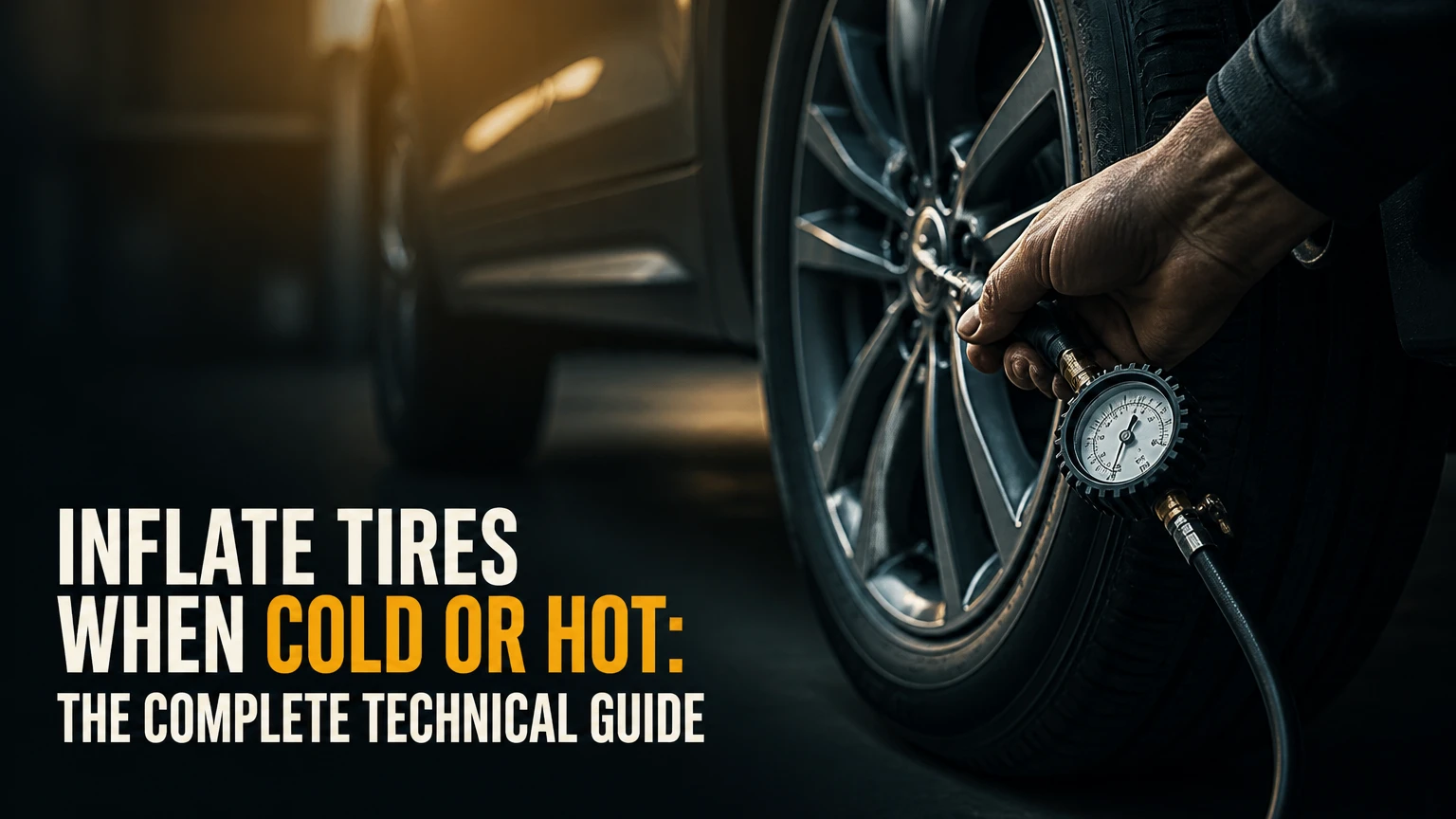
You should always inflate tires when cold because manufacturer specification placards are calculated strictly for Cold Inflation Pressure (CIP). Checking or inflating tires after the vehicle has rested for at least three hours guarantees accurate pressure, optimal contact patch geometry, maximum fuel efficiency, and even tread wear.
Key Facts at a Glance
- Cold Definition: A tire is defined as “cold” when the vehicle has been parked for at least 3 hours or driven less than 1 mile (1.6 km) at low speed.
- The Golden Rule: Always set baseline tire pressure according to the door jamb placard, never the maximum PSI stamped on the tire sidewall.
- Thermal Expansion Rate: Internal tire pressure increases or decreases by approximately $1\text{ psi}$ ($0.07\text{ bar}$) for every $10^\circ\text{F}$ ($5.6^\circ\text{C}$) shift in ambient temperature.
- Driving Heat Buildup: Highway driving heats the internal air, temporarily raising tire pressure by $3\text{ to }5\text{ psi}$ above cold baseline.
- Never Bleed Hot Tires: Bleeding air from a hot tire lowers its pressure below safety thresholds once the air cools down, causing severe underinflation.
What Is the Difference Between Cold and Hot Tire Pressure?
Cold tire pressure is the internal air pressure measured before driving heat or solar radiation alters the gas volume inside the tire cavity. Hot tire pressure is the elevated pressure reading taken after driving, caused by friction between the tread rubber and the road surface, as well as sidewall flexing.
       +-------------------------------------------------------+
       |                COLD TIRE STATE                        |
       |  • Stationary > 3 hours or driven < 1 mile            |
       |  • Air molecules at ambient baseline temperature      |
       |  • Matches Vehicle Placard Target (e.g., 33 PSI)      |
       +-------------------------------------------------------+
                                   │
                                   ▼ [ Driving Friction & Sidewall Flex ]
                                   │
       +-------------------------------------------------------+
       |                HOT TIRE STATE                         |
       |  • Driven at speed for > 10–15 minutes                |
       |  • Kinetic energy increases internal temperature      |
       |  • Pressure elevates naturally by +3 to +5 PSI        |
       +-------------------------------------------------------+
Automotive engineers design vehicle suspension, braking limits, and load capacity around Cold Inflation Pressure. When a car sits stationary overnight, the internal air temperature normalizes to the ambient environment.
Driving even 1 to 2 miles generates friction between the rubber compound and asphalt while continuously flexing the sidewalls. This friction transfers thermal energy into the trapped air, forcing air molecules to expand and raising pressure readings above the true cold baseline.
Why Does Tire Pressure Increase as You Drive?
Tire pressure increases during operation due to the thermodynamic law governing gas behavior in closed, constant-volume containers, known as Gay-Lussac’s Law.
The mathematical relationship dictates that absolute pressure ($P$) is directly proportional to absolute temperature ($T$) when volume ($V$) remains constant:
$$\frac{P_1}{T_1} = \frac{P_2}{T_2}$$
Where:
- $P_1$ = Baseline cold tire pressure (Absolute Pressure in $\text{PSI}_a$ or $\text{kPa}$)
- $T_1$ = Baseline ambient temperature (Absolute Temperature in Kelvin or Rankine)
- $P_2$ = Hot operating tire pressure
- $T_2$ = Operating air temperature inside the tire cavity
As the tire rolls, three primary heat sources raise internal cavity temperature:
- Mechanical Flexing: Continuous deformation and recovery of the tire rubber structural plies (hysteresis energy loss).
- Road Surface Friction: Shear forces between the tread blocks and road pavement.
- Brake Rotor Thermal Radiation: Heat transferred from the braking assembly through the metal wheel rim to the internal air cavity.
As $T_2$ rises, the air kinetic energy increases, pushing air molecules against the tire carcass with greater force and causing a predictable rise in pressure ($P_2$).
What Is the 10-Degree Rule for Tire Pressure?
The 10-Degree Rule states that for every $10^\circ\text{F}$ ($5.6^\circ\text{C}$) change in ambient temperature, tire pressure changes by approximately $1\text{ psi}$ ($0.07\text{ bar}$).
This thermal rule operates in both directions:
- Temperature Drops: A $20^\circ\text{F}$ sudden drop in outdoor ambient temperature reduces cold tire pressure by roughly $2\text{ psi}$.
- Temperature Rises: A $20^\circ\text{F}$ summer heat wave increases ambient tire pressure by roughly $2\text{ psi}$.
Natural pressure leakage through microscopic pores in the butyl rubber liner occurs at a rate of approximately $1\text{ psi}$ per month. Seasonal shifts combined with natural permeation can leave tires underinflated by $4\text{ to }6\text{ psi}$ within a single season if unmonitored.
How Do You Inflate Tires When They Are Cold?
Inflating tires when cold requires taking baseline measurements before driving and adjusting pressure to match the manufacturer’s vehicle door placard.
1.Locate Vehicle Pressure Specifications:Check the driver door pillar before checking the tire sidewall.
Open the driver side door and inspect the B-pillar vehicle placard. Record the exact Cold Inflation Pressure specified for both front and rear axles (e.g., $33\text{ psi}$ front, $35\text{ psi}$ rear).
2.Verify Cold Stationary Status:Vehicle must be parked.
3 hours”>
Confirm the vehicle has been stationary for at least three hours or driven less than 1 mile at residential speeds.
3.Measure Baseline Pressure:Use a calibrated digital or dial gauge.
Remove the valve stem cap, press your tire pressure gauge firmly onto the valve, and record the resting pressure.
4.Add or Release Air:Inflate in short bursts.
Connect your air compressor nozzle to the valve stem. Fill in short 5-second bursts, stopping to verify pressure with your gauge until the reading matches the placard value.
5.Re-check and Seal:Prevent slow valve leaks.
Confirm the pressure match across all four tires and securely reinstall the valve stem caps to prevent dust and debris from contaminating the valve core.
How Do You Inflate Tires When They Are Hot in an Emergency?
If your TPMS light triggers during a highway trip, you must adjust tire pressure immediately without bleeding air out of the hot tires.
1.Measure Current Hot Pressure:Take gauge reading immediately at service station.
Attach your gauge to the warm tire valve stem and record the current hot reading (e.g., $29\text{ psi}$).
2.Calculate Thermal Deficit:Compare to recommended cold placard value.
Subtract your measured hot pressure from the target cold placard value. For example, if target cold is $34\text{ psi}$ and current hot reads $29\text{ psi}$, the tire is underinflated by $5\text{ psi}$.
3.Apply Hot Compensating Offset:Add target deficit plus 3 to 5 PSI thermal buffer.
Because a healthy hot tire should naturally read $3\text{ to }5\text{ psi}$ above cold baseline, add air until the hot pressure reaches $37\text{ to }39\text{ psi}$ ($34\text{ target cold} + 3\text{ to }5\text{ thermal offset}$).
4.Verify Cold Baseline Next Morning:Final verification step.
Re-check and fine-tune tire pressure the following morning after the vehicle has rested for over three hours, adjusting precisely to the placard spec.
What Tools Are Best for Maintaining Tire Pressure?
Selecting the right tire inflator depends on your balance between inflation speed, portability, power source, and budget.
| Equipment Type | Price Range (USD) | Inflation Time (Per Tire) | Target User | Key Advantages | Primary Disadvantages |
| 12V Portable Inflator | $20 – $60 | 4 – 8 min | Everyday Commuter | Plugs into car outlet; automatic digital shutoff; easy storage | Can overheat during continuous multi-vehicle use |
| Cordless Lithium Inflator | $40 – $100 | 3 – 6 min | Urban & Road Trip Drivers | Ultra-portable; no cables; digital preset stop | Battery depletes; reduced power in freezing temperatures |
| Garage Workshop Compressor | $100 – $300 | < 1 min | DIY Home Mechanics | Instantaneous high airflow; heavy duty duty cycle | Bulky; heavy; requires AC wall outlet power |
| Gas Station Public Compressor | $1.50 – $3.00 / use | 1 – 3 min | Emergency roadside fill | High flow rate; fast pumping speed | Built-in gauges are frequently dropped and inaccurate |
What Mistakes Occur When Inflating Cold vs. Hot Tires?
Reading the Max Pressure on the Sidewall
The pressure listed on the tire sidewall (e.g., “Max Press. 44 PSI”) represents the structural safety ceiling of the tire casing at its maximum load capacity. It is not the recommended inflation pressure for your vehicle. Inflating to sidewall maximum causes harsh ride quality, decreased stopping grip, and premature center tread wear.
                  UNDERINFLATION                  CORRECT (PLACARD)                 OVERINFLATION
             [ Soft Tread / Cupping ]             [ Flat Patch Contact ]          [ Bulging Center Wear ]
                  ┌───────────┐                        ┌───────────┐                   ┌───────────┐
                  │ █       █ │                        │ █ █ █ █ █ │                   │   █ █ █   │
                  └───────────┘                        └───────────┘                   └───────────┘
              Shoulder Wear Focus                   Even Load Distribution               Center Wear Focus
Bleeding Air Out of Hot Tires
Lowering tire pressure when a gauge reads high after sustained driving is a dangerous mistake. That pressure rise is thermal expansion anticipated by chassis engineers. Bleeding hot air back down to placard levels leaves the tire severely underinflated once it cools down, causing heat buildup, tread separation risks, and blowout potential.
Parking in Direct Sunlight Before Checking Pressure
Parking a vehicle with one side exposed to direct radiant sunlight heats the tires on that side, raising cavity air temperature independently of ambient conditions. Sunlight exposure can inflate reading values by $2\text{ to }4\text{ psi}$ compared to tires shaded on the opposite side.
How Should You Adjust Tire Pressure in Unique Scenarios?
The Extreme Winter / Heated Garage Dilemma
If you park your car inside a heated garage at $68^\circ\text{F}$ ($20^\circ\text{C}$) and drive out into $18^\circ\text{F}$ ($-8^\circ\text{C}$) winter weather, the ambient temperature drop inside the tire will reduce pressure by roughly $5\text{ psi}$ once outside. To compensate, set your cold pressure $5\text{ psi}$ above placard specification while inside the warm garage.
Towing Heavy Loads or Carrying Max Payload
When hauling heavy trailers or carrying full passenger payloads, increase rear axle cold tire pressure to the vehicle manufacturer’s maximum load specification found on the door jamb placard or owner manual. This extra pressure stiffens the sidewalls, reducing lateral sway and heat generation under heavy load.
Track Day and High-Performance Driving
Unlike daily driving, performance drivers actively track hot pressures immediately upon exiting a circuit session. Race tires operate within narrow target thermal windows (e.g., $32\text{ to }34\text{ psi}$ hot). Drivers start with low cold baselines (e.g., $24\text{ to }26\text{ psi}$) to allow aggressive track friction to bring tires up to optimal hot pressure without overinflating.
Frequently Asked Questions
Can driving 1 mile heat up tires enough to alter pressure readings?
Yes, driving 1 mile at speeds over 30 mph generates sufficient sidewall flex and tread friction to raise internal air temperature, altering pressure readings by 1 to 2 PSI above true cold baseline.
Is nitrogen better than regular air for preventing hot pressure gains?
Nitrogen expands at the same rate as oxygen under dry conditions, but dry nitrogen contains zero moisture. Water vapor present in standard compressed air vaporizes when heated, causing larger, unpredictable pressure spikes when hot compared to pure dry nitrogen.
Why does my TPMS light turn on cold mornings and turn off later?
Cold morning air reduces internal tire pressure below your vehicle’s TPMS trigger threshold (typically 20–25% below placard target). As you drive, tire friction heats the internal air, raising pressure back above the warning threshold and turning off the light.
How long does it take for hot tires to cool down completely?
It takes approximately three hours for tire rubber, wheel rims, and internal air cavity temperatures to fully re-equilibrate with ambient air temperature after highway driving.