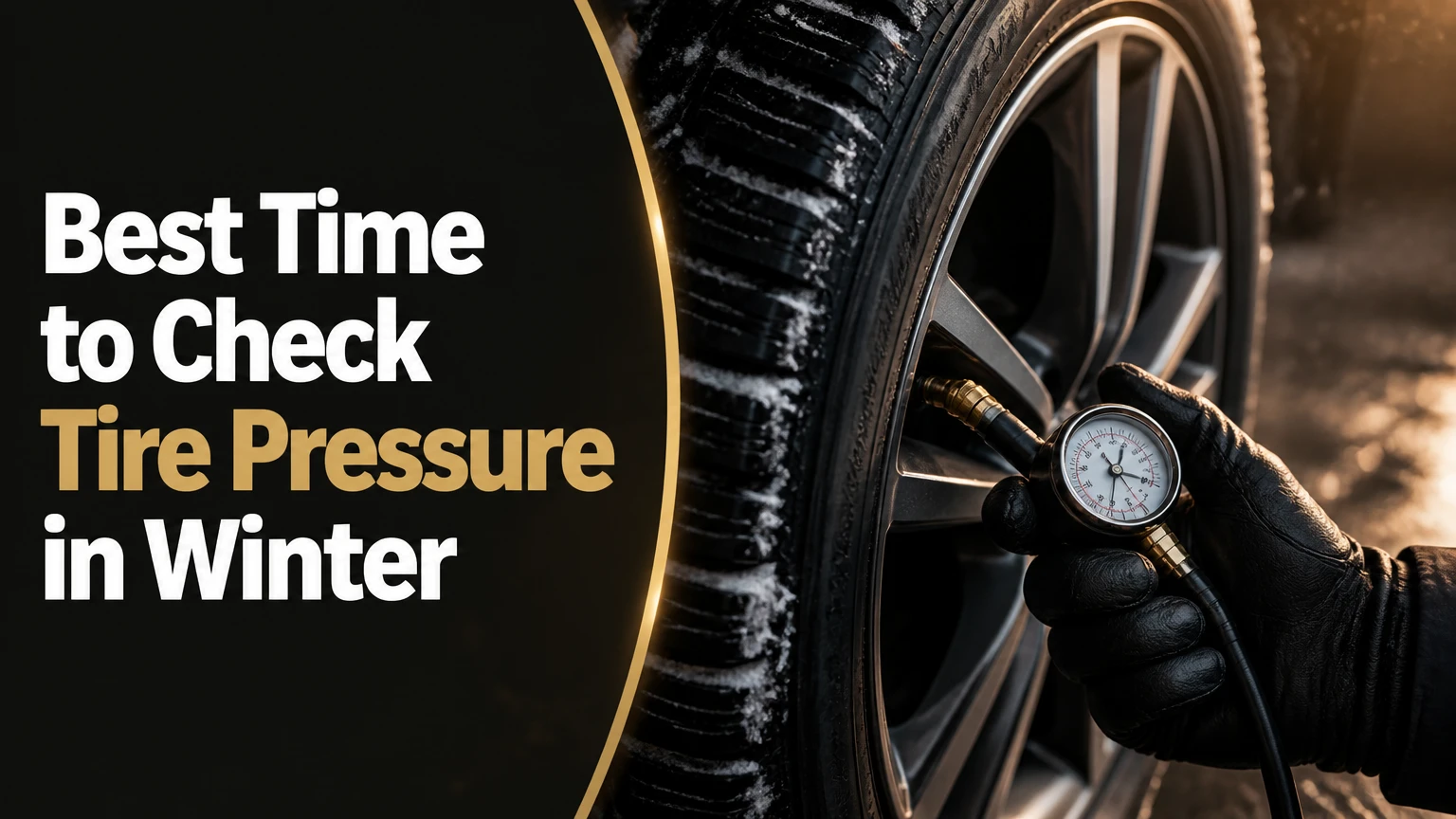
The best time to check your tire pressure in winter is early in the morning before driving the vehicle, or at least three hours after it has been parked in ambient outdoor temperatures. Checking at this time measures true “cold inflation pressure,” preventing friction-generated tire heat and ambient daytime warming from skewing your pressure readings high.
+------------------------------------------------------------------------------------+
|                                KEY FACTS AT A GLANCE                               |
+------------------------------------------------------------------------------------+
| * Thermal Loss Ratio : Pressure drops 1 PSI for every 10 deg F (5.6 deg C) drop.   |
| * Cold Definition  : Rest vehicle for 3+ hours or drive under 1 mile before check. |
| * Plaque Target    : Always fill to the PSI on the driver-side B-pillar door jamb. |
| * Permeation Rate  : Tires naturally lose 1 to 3 PSI monthly in sub-freezing weather.|
| * TPMS Threshold   : Warning lights trigger only after a severe 20-25% pressure loss. |
+------------------------------------------------------------------------------------+
Why Does Cold Weather Cause Tire Pressure to Drop?
Tire pressure drops in cold weather because low ambient temperatures reduce the kinetic energy of gas molecules inside the tire, causing them to slow down, contract, and exert less force against the inner tire wall. This physical behavior is governed by Gay-Lussac’s Law (a derivative of the Ideal Gas Law, $PV = nRT$), which dictates that gas pressure ($P$) is directly proportional to absolute temperature ($T$) when volume ($V$) remains constant.
                       COLD AIR MOLECULAR CONTRACTION

       WARM TIRE (High Kinetic Energy)       COLD TIRE (Low Kinetic Energy)
      +-------------------------------+     +-------------------------------+
      |   o     ->       <-    o      |     |                               |
      |       ^             ^         |     |        o    o    o            |
      |  <-   o    (35 PSI) o   ->    |     |      o   (30 PSI)   o         |
      |       v             v         |     |        o    o    o            |
      |   o     <-       ->    o      |     |                               |
      +-------------------------------+     +-------------------------------+
      Molecules bounce rapidly against      Molecules slow down & crowd,
      walls = Higher pressure reading.      exerting less force = Pressure drop.
The $1\text{ PSI}$ per $10^\circ\text{F}$ Temperature Rule
For every $10^\circ\text{F}$ ($5.6^\circ\text{C}$) drop in ambient air temperature, pneumatic tire pressure decreases by approximately $1\text{ PSI}$ ($0.07\text{ bar}$).
This thermal contraction occurs without any structural leak or puncture. When winter seasonal shifts cause a $30^\circ\text{F}$ ($16.7^\circ\text{C}$) overnight drop, your tires will experience an immediate passive drop of roughly $3\text{ PSI}$. Combined with standard monthly natural rubber permeation ($1\text{ to }1.5\text{ PSI}$ per month), your tires can easily become severely underinflated overnight.
| Outdoor Temperature Change | Thermal Pressure Loss | Natural Monthly Permeation | Total Expected PSI Drop |
| $-10^\circ\text{F}$ Drop ($5.6^\circ\text{C}$) | $1.0\text{ PSI}$ | $1.0\text{ PSI}$ | $2.0\text{ PSI}$ |
| $-20^\circ\text{F}$ Drop ($11.1^\circ\text{C}$) | $2.0\text{ PSI}$ | $1.0\text{ PSI}$ | $3.0\text{ PSI}$ |
| $-30^\circ\text{F}$ Drop ($16.7^\circ\text{C}$) | $3.0\text{ PSI}$ | $1.0\text{ PSI}$ | $4.0\text{ PSI}$ |
| $-40^\circ\text{F}$ Drop ($22.2^\circ\text{C}$) | $4.0\text{ PSI}$ | $1.0\text{ PSI}$ | $5.0\text{ PSI}$ |
What Happens When You Drive on Underinflated Winter Tires?
Driving on underinflated winter tires severely compromises vehicle safety by degrading road grip, increasing stopping distances on slush and ice, accelerating shoulder tread wear, and increasing the risk of structural tire failure.
                         TIRE TREAD FOOTPRINT COMPARISON

      UNDERINFLATED                 CORRECT COLD PSI               OVERINFLATED
   Heavy Shoulder Contact          Even Contact Patch          Heavy Center Contact
   +---------------------+        +---------------------+     +---------------------+
   | |x|             |x| |        | |x|  |x|  |x|  |x| |     |     |x|  |x|     |
   | |x|  (HOLLOW)   |x| |        | |x|  |x|  |x|  |x| |     |     |x|  |x|     |
   | |x|             |x| |        | |x|  |x|  |x|  |x| |     |     |x|  |x|     |
   +---------------------+        +---------------------+     +---------------------+
   Poor snow evacuation,          Maximum winter grip,        Reduced contact patch,
   flex heat, bead unseating.     optimal tire life.          harsh ride, damage risk.
- Reduced Hydroplaning and Snow Traction: An underinflated tire sags in the center of its tread patch. This prevents the sipes and lateral grooves from efficiently clearing slush, water, and packed snow, leading to loss of control.
- Internal Flex Heat and Blowouts: As an underinflated tire rolls, its sidewalls flex excessively. This flexing generates extreme internal heat. In sub-zero conditions, this localized heat cycle destabilizes the rubber compounds and internal steel belts, leading to sudden sidewall separation or blowouts.
- Rim Damage and Bead Unseating: Low pressure combined with cold, stiffened rubber reduces the clamping force of the tire bead against the wheel rim. Hitting a winter pothole with low PSI can unseat the bead, causing immediate air loss or bending the alloy wheel rim.
- Increased Fuel Consumption: Underinflation increases rolling resistance. Driving on tires that are low by just $5\text{ PSI}$ can increase fuel consumption by up to 2% to 3%, while accelerating tread wear along the outer tire shoulders.
How to Accurately Check and Inflate Tires in Winter
+------------------------------------------------------------------------------------+
|                                 BEFORE YOU START                                   |
+------------------------------------------------------------------------------------+
| * Execution Time : 10-15 minutes total.                                            |
| * Difficulty     : Beginner level.                                                 |
| * Cost Range     : $5 - $30 (Tire gauge + portable air pump or gas station air).   |
| * Tools Required : Calibrated gauge (digital/dial), 12V air compressor, rag.       |
| * Prerequisites  : Vehicle parked in outdoor ambient air for 3+ consecutive hours.  |
+------------------------------------------------------------------------------------+
1.Park and Cold-Stabilize the Vehicle:Crucial for accurate baseline readings.
Ensure the vehicle has sat idle in outdoor ambient temperatures for at least 3 hours, or has been driven less than 1 mile at low speeds. Driving further generates internal friction that heats tire gas, temporarily raising pressure by 3 to 5 PSI and masking dangerous underinflation.
2.Locate the Vehicle Target Cold PSI:Do not use the sidewall max pressure.
Open the driver-side door and read the vehicle manufacturer’s Tire and Loading Information placard located on the B-pillar (door jamb). Note the specific cold inflation pressure for both front and rear tires (typically 30–36 PSI). Never use the “Max Inflation Pressure” stamped on the tire sidewall, which indicates structural limits rather than operating target pressure.
3.Clean and Clear the Valve Stem:Prevents moisture intake into internal valve core.
Unscrew the valve stem cap. Use a clean cloth to wipe away snow, road salt, or ice surrounding the valve tip. Ensure no water droplets remain on top of the valve core pin before attaching your pressure gauge.
4.Measure Baseline Pressure:Press straight onto the stem to avoid air leakage.
Press your tire pressure gauge firmly and straight onto the valve stem until the seal is completely tight and all hissing stops. Record the reading. If using a digital gauge in sub-freezing weather, allow 2–3 seconds for the sensor to stabilize.
5.Inflate or Deflate to Target Specification:Account for outdoor temperature conditions.
Connect your air compressor nozzle securely to the valve. Add air in 5-second bursts, re-checking pressure between each burst. If you accidentally overinflate, press the brass center pin inside the valve stem using the nipple on the back of your gauge to bleed off excess pressure until the exact target PSI is reached.
6.Inspect and Secure Valve Caps:Essential barrier against core freezing.
Check the rubber O-ring seal inside your valve stem cap. Screw the cap back onto the stem firmly by hand. The cap serves as the primary seal keeping road moisture and snow melt out of the Schrader valve core.
How to Adjust Pressure When Parking in a Heated Garage
Adjusting tire pressure inside a warm garage requires adding extra air to compensate for the temperature drop the vehicle experiences when driven into the freezing outdoor air. If you adjust pressure inside a $60^\circ\text{F}$ ($15.6^\circ\text{C}$) garage and then park the car outside in $0^\circ\text{F}$ ($-17.8^\circ\text{C}$) weather, the tires will drop by approximately $6\text{ PSI}$ outdoors due to thermal contraction.
To maintain correct cold inflation pressure on the road, use the Garage Temperature Delta Formula:
$$\text{Target Garage PSI} = \text{Placard PSI} + \left( \frac{T_{\text{garage}} – T_{\text{outdoor}}}{10} \right)$$
Step-by-Step Garage Adjustment Example
- Door Placard Target: $32\text{ PSI}$
- Garage Temperature ($T_{\text{garage}}$): $60^\circ\text{F}$
- Outdoor Ambient Temperature ($T_{\text{outdoor}}$): $10^\circ\text{F}$
- Temperature Difference: $60^\circ\text{F} – 10^\circ\text{F} = 50^\circ\text{F}$ delta
- Compensation Calculation: $50 / 10 = +5\text{ PSI}$
- Action: Inflate the tires to $37\text{ PSI}$ while inside the garage. Once the car sits in the $10^\circ\text{F}$ outdoor air, the pressure will settle to the ideal $32\text{ PSI}$.
Which Type of Tire Pressure Gauge Works Best in Winter?
Choosing the right tire pressure gauge for freezing conditions requires balancing reading precision with extreme-cold mechanical reliability. Battery failure and seal hardening are the primary points of failure for gauges in winter.
| Feature / Metric | Mechanical Pencil (Stick) Gauge | Digital Backlit Gauge | Analog Dial Gauge |
| Typical Price | $3 – $8 | $12 – $25 | $20 – $45 |
| Accuracy Rating | $\pm 2.0\text{ to }3.0\text{ PSI}$ | $\pm 0.5\text{ PSI}$ | $\pm 1.0\text{ PSI}$ |
| Sub-Zero Reliability | Moderate (Internal spring stiffens) | Low to High (Depends on battery type) | High (Bourdon tube system) |
| Dark Morning Visibility | Poor (Requires flashlight) | Excellent (Backlit LCD screen) | Moderate (Phosphorescent face) |
| Cold Battery Vulnerability | None (Fully mechanical) | Severe if using Alkaline; Immune if Lithium | None (Fully mechanical) |
| Best Use Case | Emergency glove box backup | Quick morning commuter checks | Enthusiast garage & precision setup |
1. Digital Gauges — Best for Accuracy and Visibility
- Verdict: Excellent for fast, precise morning checks, provided you store the device in the warm cabin of your home rather than leaving it in an unheated glovebox overnight.
- Cold Weather Mechanics: Alkaline batteries (AAA/AA) undergo internal chemical slowdown below $32^\circ\text{F}$ ($0^\circ\text{C}$), resulting in dim displays or total power failure. Units powered by Lithium CR2032 or CR2025 button cells handle cold better, down to $-4^\circ\text{F}$ ($-20^\circ\text{C}$).
- Choose This If: You need quick, clear numbers on dark winter mornings without reading small analog tick marks.
- Skip This If: You plan to store the gauge permanently in an unheated vehicle during deep winter cold snaps.
2. Dial Gauges — Best for Reliability and Durability
- Verdict: The most reliable overall tool for harsh winter conditions. Uses a mechanical Bourdon tube mechanism that operates independently of battery power or outdoor temperatures.
- Cold Weather Mechanics: Features a flexible rubber hose that keeps hands away from cold, wet wheels. Higher-end models incorporate a continuous air-bleed button to easily release excess pressure.
- Choose This If: You want shop-grade accuracy ($\pm 1\text{ PSI}$) and zero reliance on batteries.
- Skip This If: You need a compact tool to store in a small motorcycle pouch or tight glovebox.
3. Pencil (Stick) Gauges — Best Compact Emergency Backup
- Verdict: Useful as a low-cost backup, but prone to mechanical errors in sub-freezing temperatures.
- Cold Weather Mechanics: Moisture trapped inside the metal sleeve can freeze, causing the internal plastic indicator bar to bind or stick, yielding false readings.
- Choose This If: You need an inexpensive backup tool stored in your emergency safety kit.
- Skip This If: You require precise readings for modern low-profile or performance winter tires.
What Are the Most Common Winter Tire Pressure Mistakes?
                      COMMON WINTER TIRE MISTAKES & RECOVERIES

   MISTAKE                           CAUSE                             CORRECTIVE ACTION
  +--------------------------------+ +-------------------------------+ +-------------------------------+
  | Trusting TPMS Blindly          | | Light triggers only after     | | Check manually every 2 weeks  |
  |                                | | 20-25% pressure loss.         | | with a dedicated cold gauge.  |
  +--------------------------------+ +-------------------------------+ +-------------------------------+
  | Filling to Sidewall Max PSI    | | Confusing max tire rating     | | Always follow B-pillar door   |
  |                                | | with car target inflation.    | | jamb manufacturer placard.  |
  +--------------------------------+ +-------------------------------+ +-------------------------------+
  | Leaving Plastic Caps Off       | | Exposing valve pin to moisture| | Screw rubber-sealed caps      |
  |                                | | which freezes valve open.     | | onto every stem immediately.  |
  +--------------------------------+ +-------------------------------+ +-------------------------------+
1. Trusting the Dashboard TPMS Light Blindly
Direct and indirect Tire Pressure Monitoring Systems (TPMS) are safety warning systems, not maintenance tools. Federal standards (FMVSS 138) dictate that the TPMS warning light triggers only after a tire drops 20% to 25% below the factory recommended inflation pressure.
If your placard target is $32\text{ PSI}$, the light may not illuminate until pressure drops to $24\text{ to }25\text{ PSI}$. By that point, tire traction, fuel economy, and tread life are already compromised.
2. Confusing Sidewall Maximum Pressure with Placard Target Pressure
The number molded into the outer rubber sidewall (e.g., “Max Press 50 PSI”) represents the absolute maximum pressure the tire structural carcass can safely contain under maximum load. Filling a tire to this number causes severe center tread wear, a harsh ride, reduced contact area on icy roads, and increased vulnerability to pothole impacts.
3. Checking Tires Immediately After Driving
Driving generates friction between the tire tread and the road surface, causing internal tire air temperatures to rise rapidly. Driving just 2 to 3 miles can elevate tire pressure by $3\text{ to }5\text{ PSI}$ above its true cold state. Adjusting pressure when tires are warm leads to underinflation once the vehicle cools down.
4. Leaving Valve Caps Off in Freezing Weather
Riding without valve stem caps exposes the internal Schrader valve pin to road spray, slush, and snow melt. Moisture settles inside the core and freezes solid. When you subsequently attach a pressure gauge, the ice forces the valve pin down, causing the valve core to stick open and leak air rapidly.
Troubleshooting Frozen Valves and Winter TPMS Issues
How to Fix a Frozen Valve Stem
If a valve stem freezes open when checking pressure, air will leak continuously from the core.
- Do NOT force or strike the pin with metal tools, as this can snap the brass internal seal.
- Apply direct heat transfer: Hold your thumb and fingers firmly around the metal stem casing for 60 seconds to transfer body heat and thaw internal ice.
- Use Isopropyl Alcohol Spray: Spray a small amount of 90%+ isopropyl rubbing alcohol directly into the stem tip to dissolve ice without damaging internal synthetic rubber seals.
- Apply warm air: Direct your vehicle’s defroster or portable warm air towards the stem if available.
Why Does the TPMS Light Turn On in the Morning and Turn Off Later?
This issue occurs when cold outdoor morning temperatures drop tire pressure just below the TPMS warning threshold (e.g., $24.8\text{ PSI}$).
As you drive down the highway, tire flex and friction warm the internal air, raising the pressure by $3\text{ to }4\text{ PSI}$ (up to $28\text{ PSI}$) and pushing it back above the threshold, which turns off the warning light. While the light disappears, your cold tire pressure is still underinflated. You must add air to bring the cold morning baseline back to your placard specification.
Frequently Asked Questions
Should you put more air in your tires in the winter?
You should inflate your tires to match the vehicle manufacturer’s cold recommended PSI listed on the driver-side door jamb. You do not overinflate past this recommended rating, but you must add air regularly during winter to offset the natural $1\text{ PSI}$ drop for every $10^\circ\text{F}$ drop in ambient temperature.
How long must a car sit before checking cold tire pressure?
A car must sit parked in ambient outdoor air for at least 3 hours to get an accurate cold tire pressure reading. Alternatively, you can check the pressure early in the morning before driving more than 1 mile at low speeds.
Can you use nitrogen in tires to prevent winter pressure loss?
Nitrogen gas still expands and contracts with temperature shifts according to ideal gas laws, losing roughly $1\text{ PSI}$ per $10^\circ\text{F}$. However, dry nitrogen lacks water vapor, which reduces internal moisture condensation and helps prevent valve core freezing and rim corrosion in sub-zero climates.
What should you do if your tires freeze to the driveway ice?
If tires freeze to driveway ice, avoid spinning the wheels rapidly, which can strip tread rubber. Pour warm (never boiling) water or spread non-corrosive sand/traction grit around the base of the tire footprint, then gently rock the vehicle between Reverse and Drive to break the ice bond.