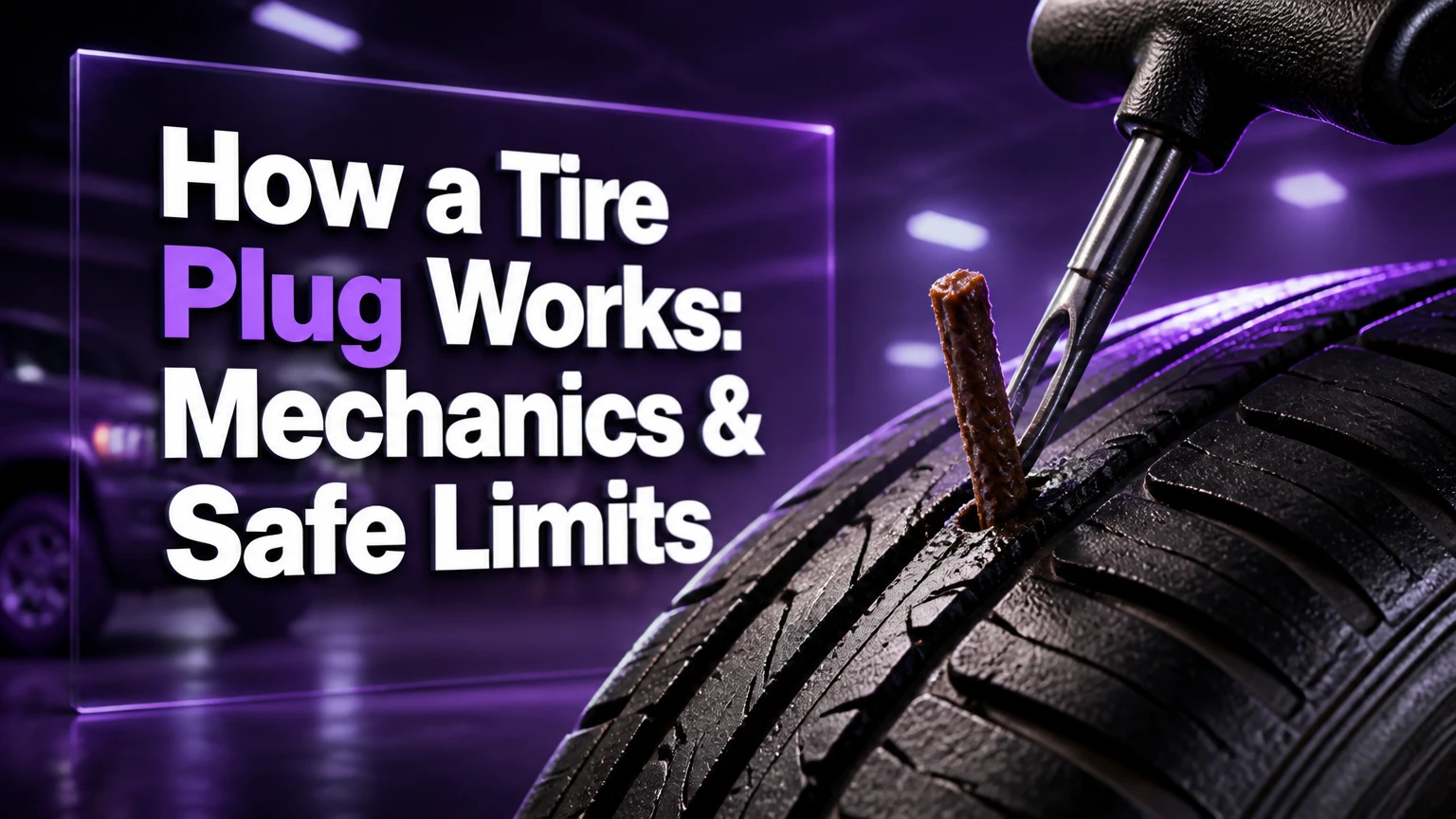
A tire plug works by forcing a sticky, unvulcanized rubber strip into a tread puncture, creating an airtight seal through physical compression and chemical vulcanization. As the vehicle is driven, friction generates heat that cures the plug material, bonding it directly to the tire’s inner rubber and internal steel belts.
At a Glance: Tire Plug Core Facts
- Primary Mechanism: Dual-strand butyl rubber insertion held under mechanical compression and activated by friction heat ($100^\circ\text{F}\text{–}140^\circ\text{F}$).
- Maximum Hole Size: Exactly $1/4\text{ inch}$ ($6\text{ mm}$) in diameter; larger punctures cause structural cord degradation.
- Safe Tread Zone: Limited to the central tread area, at least $1/2\text{ inch}$ ($13\text{ mm}$) away from the outer shoulder.
- Operational Limit: Engineered as a temporary emergency fix rated for under $100\text{ miles}$ at speeds below $85\text{ mph}$.
- Industry Standard: The USTMA and TIA mandate a combination internal plug-patch for a legally permanent repair.
How Does a Tire Plug Seal a Puncture Step-by-Step?
A tire plug seals a puncture through a three-stage mechanical process involving hole preparation, dual-strand insertion, and flush trimming. The process transforms a narrow, irregular puncture into a uniform, compression-sealed channel.
1.Ream the Puncture Hole:Prerequisite: Remove puncturing debris completely.
A spiraled T-handle reamer is inserted into the hole and rotated continuously. This clears out jagged wire ends from the steel belts, removes rubber debris, and expands the opening to a uniform $1/4\text{ inch}$ ($6\text{ mm}$) diameter.
2.Thread and Coat the Plug Strip:
A pliable butyl rubber strip is threaded through the eyelet of an insertion needle tool until centered. Chemical vulcanizing cement (rubber fluid) is applied liberally across the plug strip to act as an initial insertion lubricant and chemical bonding agent.
3.Insert the Folded Plug:Depth target: Push 1 to 1.5 inches deep into the carcass.
The insertion needle forces the folded strip directly into the reamed hole. Because the strip is folded in half, two complete strands of thick rubber material are compressed into the $1/4\text{ inch}$ opening. Approximately $1/2\text{ inch}$ of the plug tails must remain exposed above the tread face.
4.Withdraw the Tool and Trim Flush:
The needle tool is pulled straight out without twisting; its split eyelet releases the folded plug inside the internal tire cavity. The exposed outer tails are trimmed flush with the tread block using a razor blade to prevent road friction from pulling the plug out.
What Materials and Tools Make Up a Tire Plug Kit?
A standard tire plug kit relies on four primary components engineered specifically to handle high internal air pressures ($30\text{–}50\text{ PSI}$).
- T-Handle Rasp/Reamer: A hardened steel file tool designed to clean and dimension the puncture hole.
- T-Handle Eyelet Needle: An insertion tool featuring a split-end eyelet that pushes the plug through the tire plies and releases upon retraction.
- Unvulcanized Rubber Strips (String Plugs): Thick woven yarn cords heavily saturated with pliable, tacky butyl rubber.
- Vulcanizing Fluid (Rubber Cement): A solvent-based chemical activator containing sulfur compounds that break down and recombine rubber polymers upon contact.
How Does Friction and Heat Activate a Tire Plug?
A tire plug chemically bonds to the surrounding rubber through heat-induced vulcanization generated by normal driving friction. While mechanical compression holds the plug immediately after installation, chemical bonding creates the long-term airtight seal.
When a vehicle moves, tire flexing and road contact raise the internal rubber temperature to operational ranges between $100^\circ\text{F}$ and $140^\circ\text{F}$ ($38^\circ\text{C}\text{–}60^\circ\text{C}$). This thermal energy softens the unvulcanized butyl compound on the string plug. The active chemical agents in the vulcanizing cement cause the softened plug compound to cross-link its polymer chains with the surrounding tire tread rubber and internal inner liner. The plug expands into micro-crevices along the inner steel belts, forming a single fused rubber mass rather than a simple friction-fit insert.
How Long Can You Safely Drive on a Plugged Tire?
A standard string-plugged tire should be driven for no more than $100\text{ miles}$ ($160\text{ km}$) at speeds strictly under $85\text{ mph}$ ($137\text{ km/h}$). It is designed purely as an emergency solution to transport the vehicle safely to a certified tire repair facility.
Driving long distances on a standalone string plug exposes the internal steel belts to moisture and road debris. Water entering the raw puncture channel causes the steel cords to rust, leading to internal belt delamination and sudden tread separation over time. While many string plugs successfully retain air pressure for thousands of miles, the absence of an internal patch leaves the tire structural integrity continuously unmonitored and compromised.
How Long Does a Tire Plug Take to Cure Before Driving?
A tire plug with vulcanizing cement requires approximately $5\text{ to }10\text{ minutes}$ of static cure time before inflating and driving. Immediate driving is possible in emergency scenarios, but allowing a short setup window yields a far superior chemical bond.
The chemical solvent inside the vulcanizing fluid must flash off (evaporate) to initiate polymer cross-linking. Once the tire is re-inflated to its specified $30\text{–}35\text{ PSI}$, driving the vehicle introduces moderate heat, which completes the heat-activation phase within the first $5\text{ to }10\text{ miles}$ of operation.
What Is the Safe Repair Zone for Plugging a Tire?
The safe repair zone for plugging a tire is strictly limited to the high-flex crown—the central region covering the main tread grooves, situated at least $1/2\text{ inch}$ ($13\text{ mm}$) inward from the outer tread shoulders.
+-----------------------------------------------------------------------+
|                         UNSAFE SHOULDER ZONE                          |
|  +-----------------------------------------------------------------+  |
|  |                       SAFE TREAD REPAIR ZONE                    |  |
|  |   Max Puncture Diameter: <= 1/4 inch (6 mm)                     |  |
|  |   Min Distance Between Repairs: >= 16 inches (40 cm)            |  |
|  +-----------------------------------------------------------------+  |
|                         UNSAFE SHOULDER ZONE                          |
+-----------------------------------------------------------------------+
|                           UNSAFE SIDEWALL                             |
+-----------------------------------------------------------------------+
Punctures outside this central belt area experience extreme cornering stress and continuous sidewall flexing. Inserting a plug outside the safe zone guarantees rapid structural failure or premature ejection of the plug.
| Metric / Parameter | Safe Structural Threshold | Unsafe / Replacement Required |
| Max Puncture Size | $\le 1/4\text{ inch}$ ($6\text{ mm}$) | $> 1/4\text{ inch}$ ($6\text{ mm}$) or slice |
| Location Margin | $\ge 1/2\text{ inch}$ ($13\text{ mm}$) inside tread shoulder | Shoulder, flex zone, or sidewall |
| Repair Spacing | $\ge 16\text{ inches}$ ($40\text{ cm}$) apart | $< 16\text{ inches}$ ($40\text{ cm}$) separation |
| Puncture Angle | $\le 15^\circ$ relative to perpendicular | $> 15^\circ\text{–}20^\circ$ entry angle |
| Speed Rating Loss | Downgraded to T-rating ($118\text{ mph}$) | High-performance (V, W, Y) voided |
Why Can’t You Plug a Tire Sidewall or Shoulder?
A tire sidewall or shoulder cannot be plugged because these zones experience severe structural flexing during driving and lack the thick, steel-belted backing required to retain a plug under compression.
The sidewall is the thinnest section of the tire carcass, engineered to flex constantly to absorb road impacts and cornering loads. A plug relies on rigid, thick surround-rubber and static compression to remain locked in place. The continuous cycle of compression and extension in the sidewall pinches the soft plug material, works the chemical bond loose, and eventually ejects the plug at high speeds, triggering a sudden blowout.
Can You Plug a Tire with an Angled Puncture?
A tire with a puncture angle greater than $15^\circ\text{ to }20^\circ$ relative to a perpendicular line cannot be safely sealed with a standard straight tire plug.
Forcing a rigid insertion tool at an angle across the internal plies creates secondary tear paths within the rubber layers. This tears the internal steel cords away from their surrounding rubber matrix, allowing pressurized air to migrate between the tire’s plies. Air trapped inside the plies leads to tread separation at highway speeds. Angled punctures require a specialized two-piece stem-and-patch internal repair performed from the inside out.
Can You Plug a Run-Flat or High-Performance Tire?
Run-flat and high-performance tires generally cannot be safely repaired with an external string plug due to strict structural limitations and heat tolerances.
- Run-Flat Tires: Most manufacturers (including Bridgestone, Michelin, and Pirelli) forbid plugging run-flat tires. Driving on a run-flat tire at zero pressure shreds its internal reinforced sidewall structure. Because an external plug is installed without unmounting the tire, a technician cannot inspect the inner liner for catastrophic structural breakdown or rubber dust accumulation.
- High-Performance Tires: Plugging a speed-rated tire (ratings V, W, or Y, rated for $149\text{–}186+\text{ mph}$) permanently voids its speed rating. The insertion reamer severs internal belt cords, permanently downgrading the tire’s maximum safe operating capability to a standard T-rating ($118\text{ mph}$ maximum).
Is a Tire Patch Better Than a Tire Plug?
A combination plug-patch unit is vastly superior to either a standalone plug or a standalone internal patch. Industry organizations like the U.S. Tire Manufacturers Association (USTMA) consider combination repairs the only legal, permanent tire fix.
STANDALONE PLUG                      STANDALONE PATCH                   COMBO PLUG-PATCH
(Fills hole, leaves inside exposed)  (Seals inside, leaves hole open)   (Complete permanent repair)

       | Plug Strip |                       | Tire Rubber |                   | Rubber Stem |
    ===|============|===                 ===|=============|===             ===|=============|===
    ===|============|===                 =================                 ===|=============|===
       | Exposed Tail |                     [ Inner Patch ]                   [ Internal Patch ]
- Standalone Plug: Fills the tread path to prevent water entry, but fails to seal the internal inner liner. Compressed air constantly pushes past the plug, leading to micro-leaks.
- Standalone Patch: Covers the internal inner liner air seal, but leaves the outer tread hole open. Road water and salt enter the unsealed puncture hole from the outside, rusting the steel belts.
- Combination Plug-Patch: Combines a rubber stem with an integrated inner patch flange. The stem fills and seals the tread hole to keep moisture out, while the patch vulcanizes to the inner liner to guarantee a $100\%$ airtight seal.
Can You Plug a Tire Twice in the Same Tread Area?
A tire can be plugged a maximum of two times across its entire lifespan, provided the two repairs are located at least $16\text{ inches}$ ($40\text{ cm}$) apart along the circumference.
You can never insert a second plug into a hole where a previous plug failed. Re-reaming a failed puncture hole expands the structural opening beyond the safe $1/4\text{ inch}$ ($6\text{ mm}$) limit, damaging additional steel cords. If two punctures occur closer than $16\text{ inches}$ apart, the internal stress fields generated by the belt tensions overlap, destroying the structural integrity of the tire carcass and requiring immediate replacement.
Why Is a Plugged Tire Still Leaking Air?
A plugged tire continues to leak air if the original puncture exceeded $1/4\text{ inch}$, the reaming phase was insufficient, or the inner liner suffered severe invisible damage prior to repair.
- Uncleaned Steel Belts: If the puncture reamer failed to smooth jagged steel belt ends, the sharp wire edges cut through the soft butyl rubber strip, creating micro-channels for air escape.
- Inner Liner Shredding: If the vehicle was driven underinflated ($<15\text{ PSI}$) prior to repair, the wheel rim shears the inner butyl liner inside the tire. The plug may seal the outer hole, but air migrates laterally through the shredded internal liner and leaks out through tread seams.
- Improper Plug Fold: If the insertion needle was twisted during withdrawal, the plug tails cross over inside the tire cavity instead of forming a clean double-strand bulb, preventing proper mechanical compression.
Does Plugging a Tire Void the Manufacturer Warranty?
Plugging a tire with an external string plug instantly voids the manufacturer’s treadwear and structural hazard warranty.
Tire manufacturers including Goodyear, Continental, and Michelin explicitly mandate that repairs adhere strictly to USTMA guidelines: the tire must be unmounted, inspected internally, and repaired using a full combination plug-patch. Installing an external string plug without unmounting the tire forfeits all remaining warranty coverage for that tire, as manufacturers cannot guarantee structural safety on a tire whose internal condition was never visually verified.
The Bottom Line
A tire plug works by combining mechanical compression, sticky butyl material, and heat-activated vulcanization to seal tread punctures up to $1/4\text{ inch}$ in diameter. However, an external string plug is strictly an emergency, short-term repair rated for under $100\text{ miles}$. For complete long-term safety, preserve your tire’s structural rating by having a certified technician unmount the tire and install a legal combination plug-patch from the inside out.