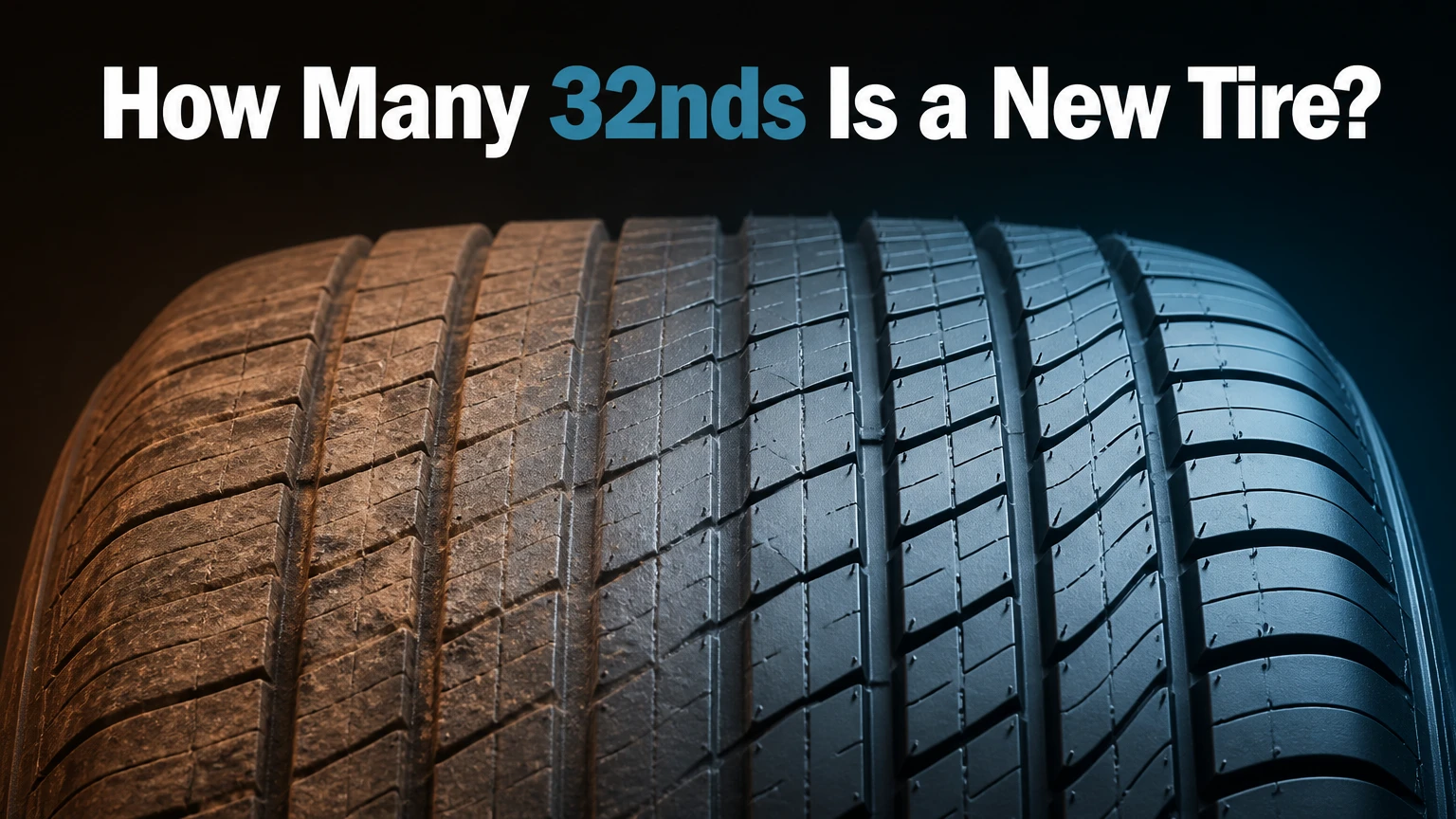
A brand-new passenger car tire typically has a tread depth of 10/32nds to 11/32nds of an inch. Specific starting depths vary depending on the vehicle type, tire category, and intended application. Truck and winter tires feature deeper treads, while performance track tires start noticeably shallower.
At a Glance
- Passenger car and minivan tires start between 10/32 and 11/32 of an inch.
- Winter tires feature deeper grooves ranging from 11/32 to 13/32 of an inch.
- The legal minimum tread depth in most jurisdictions sits at exactly 2/32 of an inch.
- Wet weather traction drops significantly once a tire reaches 4/32 of an inch.
- All-wheel drive vehicles typically require replacing all four tires simultaneously to prevent drivetrain damage.
What is the starting tread depth for different vehicle types?
The starting tread depth for different vehicle types ranges from 9/32 of an inch for sports cars up to 19/32 of an inch for heavy off-road trucks. Manufacturers engineer these specific depths to balance physical traction, heat dissipation, and fuel economy for each distinct vehicle class. A deeper tread provides better grip in loose materials but generates more heat and rolling resistance on smooth pavement.
To achieve optimal performance, tire engineers assign different tread volumes based on the exact job the vehicle performs. Passenger cars need quiet operation and high fuel efficiency. Commercial trucks need massive rubber volume to endure extreme mileage under heavy loads. Winter tires require deep voids to pack and hold snow.
| Vehicle Category | Typical Starting Tread Depth | Primary Engineering Focus |
|---|---|---|
| Sports Cars / High Performance | 9/32 to 10/32 inch | Cornering stability and heat reduction |
| Passenger Cars & Minivans | 10/32 to 11/32 inch | Fuel economy and quiet highway operation |
| Winter / Dedicated Snow Tires | 11/32 to 13/32 inch | Trapping snow to generate snow-on-snow friction |
| SUVs & Light Trucks | 12/32 to 14/32 inch | Load carrying capacity and mild off-road grip |
| Off-Road / Mud-Terrain Trucks | 15/32 to 19/32 inch | Physical evacuation of heavy mud and rocks |
Why do off-road mud-terrain tires have deeper starting treads?
Off-road mud-terrain tires have deeper starting treads (measuring up to 19/32 of an inch) to aggressively dig into loose dirt and physically eject thick mud from the tire grooves. The massive open spaces between the rubber blocks act like tiny rotating shovels.
When a truck drives through thick mud, a standard 10/32 passenger tire quickly packs full of debris. Once the grooves fill up, the tire essentially becomes a smooth cylinder, resulting in a total loss of traction. Mud-terrain tires utilize their extreme 19/32 depth to grab large chunks of earth. As the tire rotates out of the mud bog, centrifugal force throws the trapped mud outward. This self-cleaning mechanism requires massive void volume to function properly. Driving these heavy, deep-treaded tires on standard pavement results in loud road noise and significantly reduced fuel economy.
What are the exceptions to standard 10/32nds tire treads?
Track racing tires, heavy-duty commercial truck tires, and temporary spare tires are the primary exceptions to the standard 10/32nds passenger tire rule. These specialized applications require entirely different tread volumes to function safely in their specific operating environments. Applying passenger car standards to these outliers creates severe safety risks.
Heavy-duty commercial semi-trucks operate under extreme weight limits. The front steer tires on a semi-truck typically start between 18/32 and 22/32 of an inch to handle steering forces. The rear drive tires often start at an incredible 30/32 of an inch to maximize mileage before replacement. Conversely, the temporary “donut” spare tire sitting in your car trunk usually starts with a very shallow 5/32 to 7/32 of an inch. Manufacturers build spare tires with minimal rubber simply to save space and reduce vehicle weight, expecting you to drive on them for fewer than 50 miles.
Why do track drivers shave brand new tires?
Track drivers physically shave brand new tires down to 4/32 or 6/32 of an inch to eliminate tread block squirm and prevent catastrophic heat buildup at high racing speeds. Standard deep treads flex too much under extreme cornering loads. This mechanical flexing generates intense friction.
Certain grassroots racing classes require competitors to use Department of Transportation approved street tires rather than smooth racing slicks. A driver will purchase a brand new high-performance tire measuring 10/32 of an inch and immediately pay a specialized shop to slice off half the rubber on a tire lathe. While throwing away brand new rubber sounds counterintuitive, a full-depth street tire driven at maximum track speeds will overheat, chunk apart, and fail within a few laps. The shaved tire runs dramatically cooler, provides sharper steering response, and actually outlasts the full-tread version in a high-performance racing environment.
How do you measure tire tread depth accurately with a gauge?
You measure tire tread depth accurately by inserting a calibrated mechanical or digital tread depth gauge into the lowest point of the main circumferential tire grooves. Press the base of the gauge flat against the top of the tread block and push the measuring pin down until it hits the valley floor of the groove.
To get an accurate assessment of the entire tire, you must take measurements in multiple locations. Park the vehicle on flat ground and turn the steering wheel completely to one side to expose the front tires. Measure the depth in the center groove, the inside groove, and the outside groove. Tires rarely wear perfectly evenly across their entire surface. A severe alignment issue might leave the outside edge reading a healthy 8/32 of an inch while the inside edge sits completely bald at 0/32. The lowest number you record dictates the actual remaining life of the tire.
How do you measure tread depth without a gauge?
You can measure tread depth without a gauge by using the classic Penny Test or the Quarter Test in the United States. Insert a US penny into the main tire groove with Abraham Lincoln facing upside down. If the top of Lincoln’s head remains completely visible above the rubber block, the tire has reached the legal minimum of 2/32 of an inch.
For a safer modern standard, use the Quarter Test. Insert a US quarter upside down into the groove. If George Washington’s head sits entirely above the rubber, your tire measures below 4/32 of an inch. At this depth, wet weather traction becomes severely compromised. While coins offer a fast visual check in a parking lot, they lack the precision necessary to diagnose subtle suspension issues or uneven wear patterns. A dedicated gauge costing less than five dollars provides vastly superior data.
What is the legal minimum tread depth for passenger cars?
The legal minimum tread depth for passenger cars in the majority of United States jurisdictions and international territories is exactly 2/32 of an inch. Driving on tires worn below this specific threshold violates Department of Transportation safety regulations and can result in failed vehicle inspections or traffic citations.
At 2/32 of an inch, the tire has consumed its entire functional life cycle. The minimal remaining grooves cannot process water, dirt, or debris. In the event of an accident, insurance adjusters frequently measure tire tread depth during their investigation. Operating a vehicle on tires worn below the 2/32 legal limit can lead an insurance provider to assign fault to the driver for failing to maintain basic mechanical safety standards.
What are tire wear bars and how do they work?
Tire wear bars are elevated strips of smooth rubber molded horizontally across the bottom of the main longitudinal tire grooves. They sit exactly 2/32 of an inch above the base of the groove valley. These visual indicators provide an immediate, tool-free method to determine if a tire is legally bald.
When a tire is brand new, these bars hide deep inside the grooves, largely invisible to a casual glance. As the surrounding tread wears away over thousands of miles, the top surface of the tire gets closer to the wear bars. Once the active tread wears down completely flush with these horizontal strips, the tire has reached its legal limit and requires immediate replacement. If you run your finger along the groove and feel a continuous smooth surface bridging the gap between tread blocks, the tire is unsafe for road use.
At what tread depth does wet traction significantly decrease?
Wet traction significantly decreases once a passenger car tire wears down to 4/32 of an inch. At this specific measurement, the grooves lack the physical volume required to channel water away from the contact patch rapidly enough to prevent the tire from hydroplaning over standing water.
The difference in safety between legal tires and safe tires is substantial. A comprehensive 2018 study conducted by the American Automobile Association (AAA) demonstrated the danger of driving on worn tires. The AAA testing showed that a passenger car traveling at 60 miles per hour on wet pavement required an average of 87 additional feet to stop when using tires worn to 4/32 compared to brand new tires. As veteran tire technicians often advise customers: you buy the first 6/32nds of tread for dry roads, and you buy the last 4/32nds specifically to survive the rain. Waiting until the 2/32 legal limit dramatically increases collision risk in wet weather.
At what tread depth do winter tires lose snow traction?
Winter tires lose their specialized snow-biting capabilities when the tread depth reaches 6/32 of an inch. While the tire remains technically legal for dry road operation, it becomes completely ineffective for severe winter driving conditions at this specific threshold.
Unlike summer tires that rely on sticky rubber contacting bare pavement, winter tires generate grip through snow-on-snow friction. The deep, aggressive voids in a winter tire are designed to pack full of snow. This trapped snow then bites into the fresh snow on the roadway. When the tread depth drops below 6/32 of an inch, the grooves become too shallow to trap and hold a sufficient volume of snow. The tire loses its mechanical advantage. Many premium winter tire manufacturers mold a specialized “snow wear indicator” into the tread at exactly 6/32 of an inch to warn drivers when the tire transitions from a winter performer to a standard cold-weather tire.
How does tire age affect safety regardless of tread depth?
Tire age severely compromises safety regardless of remaining tread depth because the structural rubber compounds oxidize, harden, and degrade over time. A six-year-old tire with a full 11/32 of an inch of tread can still experience a catastrophic blowout due to hidden dry rot and structural separation.
Rubber is a natural product that breaks down when exposed to ultraviolet light, extreme temperatures, and atmospheric ozone. As the tire ages, the chemical bonds weaken, causing the rubber to become brittle. This degradation happens even if the vehicle sits perfectly still in a climate-controlled garage. Most automotive manufacturers recommend replacing any tire that is six years old, regardless of how many miles it has traveled. The National Highway Traffic Safety Administration advises consumers to check the four-digit DOT code printed on the sidewall to determine the exact week and year the tire was manufactured.
How many miles does 1/32 inch of tread typically last?
One thirty-second (1/32) of an inch of passenger tire tread typically lasts between 6,000 and 8,000 miles under normal driving conditions. A standard tire starting at 10/32 of an inch will generally provide between 40,000 and 50,000 miles of usable life before reaching the 2/32 replacement marker.
To calculate the expected lifespan of a tire, you must look at the usable tread rather than the total tread. A new passenger tire starting at 10/32 has exactly 8/32 of usable rubber before hitting the 2/32 legal limit. Actual mileage varies wildly based on wheel alignment, inflation pressure, vehicle weight, and driver behavior. An aggressive driver commanding a heavy electric vehicle might burn through 1/32 of an inch every 3,000 miles.
| Starting Tread Depth | Usable Tread (to 2/32) | Estimated Total Miles (Average) | Estimated Total Miles (Aggressive) |
|---|---|---|---|
| 10/32 inch | 8/32 inch | 48,000 – 64,000 miles | 24,000 – 32,000 miles |
| 11/32 inch | 9/32 inch | 54,000 – 72,000 miles | 27,000 – 36,000 miles |
| 12/32 inch | 10/32 inch | 60,000 – 80,000 miles | 30,000 – 40,000 miles |
Do you need to replace all four tires if only one is damaged?
You must replace all four tires if one is damaged on an all-wheel drive (AWD) vehicle to maintain identical rolling diameters and prevent mechanical binding. For a standard two-wheel drive vehicle, you can typically replace tires in pairs across the same axle to maintain balanced handling.
All-wheel drive systems mandate extreme precision. A new tire measuring 10/32 of an inch has a larger circumference than a worn tire measuring 5/32 of an inch. The new tire travels further with every single rotation. If you mix worn tires with one new tire on an AWD vehicle, the vehicle’s center differential must constantly work to reconcile the differing wheel speeds. This continuous stress rapidly overheats the drivetrain, leading to mechanical failures that cost thousands of dollars to repair. Some specialized tire shops offer a service to shave a single brand new tire down to match the exact tread depth of the three remaining worn tires, saving the owner from purchasing a full set.
The Bottom Line
A new passenger car tire consistently starts its life with a tread depth measuring between 10/32 and 11/32 of an inch. Knowing this baseline allows you to accurately track your tire wear over time and predict necessary maintenance schedules.
While the legal limit across most jurisdictions rests firmly at 2/32 of an inch, physics dictates a different safety standard for wet conditions. Replacing your tires when they reach 4/32 of an inch provides the mechanical void space necessary to prevent hydroplaning and reduce stopping distances in heavy rain. Always measure multiple grooves across the face of the tire, monitor the age of the rubber compounds, and replace AWD tires in complete sets to guarantee optimal vehicle safety.