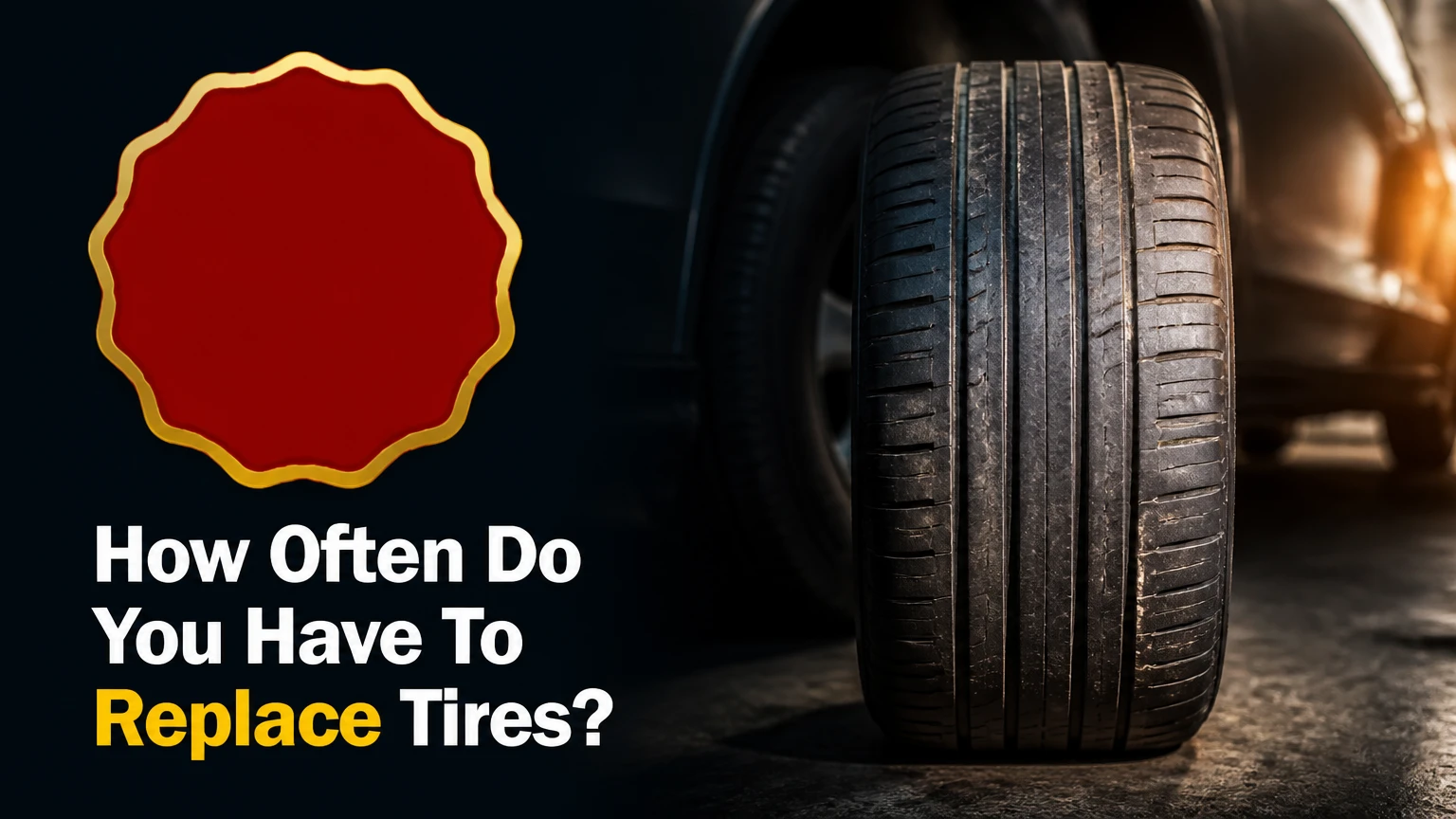
Passenger vehicle tires must be replaced every 50,000 to 60,000 miles or every three to five years of active use. Drivers must also replace any tire that reaches 10 years of age from the manufacture date. Chemical degradation ruins the rubber regardless of visible tread depth.
At a Glance
- The absolute legal minimum tread depth is 2/32 of an inch (1.6 mm).
- Wet weather traction drops drastically at 4/32 of an inch (3.2 mm).
- Professionals must inspect tires annually once the rubber reaches six years old.
- Electric vehicle tires wear out 20% to 30% faster than standard combustion vehicle tires.
- A spare tire sitting in a trunk requires replacement after 10 years due to dry rot.
What Tread Depth Requires Immediate Tire Replacement?
You must replace a tire immediately when the tread depth reaches 2/32 of an inch (1.6 mm). This measurement represents the absolute legal limit for road safety in most jurisdictions. At this shallow depth, the tire loses its ability to channel water away from the contact patch. The vehicle will hydroplane easily during rainstorms.
The National Highway Traffic Safety Administration recommends replacing rubber long before it hits the legal minimum. The U.S. Tire Manufacturers Association (USTMA) advises drivers to start shopping for replacements when tread depth hits 4/32 of an inch. Stopping distance on wet asphalt increases by up to 50% between 4/32 and 2/32 of an inch. A vehicle moving at 70 miles per hour needs that extra grip to avoid catastrophic rear-end collisions.
Driving on bald tires transfers all braking force directly to a smooth surface. Water cannot escape the footprint of the tire. The water builds up under the rubber and lifts the vehicle off the pavement entirely.
| Tread Depth Measurement | Metric Equivalent | Required Driver Action | Wet Traction Level |
|---|---|---|---|
| 6/32 of an inch or more | 4.7 mm or more | None required | Excellent |
| 4/32 of an inch | 3.2 mm | Start shopping for replacements | Marginal |
| 2/32 of an inch | 1.6 mm | Replace immediately | Dangerously Low |
What Are The Signs Of Tire Failure Before Tread Wears Out?
Visible cracks, sidewall bulges, and steering wheel vibrations indicate impending tire failure long before the tread disappears. Age and environmental damage destroy the structural integrity of the rubber. You must inspect the sidewalls monthly for deep spiderweb cracking along the circumference.
Impact damage causes immediate internal destruction. Hitting a large pothole or scraping a curb can snap the internal steel cords. This broken internal structure pushes outward and creates a visible sidewall bubble. A tire with a sidewall bubble will blow out randomly and requires immediate replacement.
Furthermore, extreme heat baking the rubber over several summers causes dry rot. The rubber becomes brittle and loses its grip on the pavement. A perfectly deep tread means nothing if the underlying casing cannot contain the pressurized air. Drivers often feel a rhythmic thumping in the floorboards when internal belts begin to separate.
How Do You Find The Exact Age Of A Tire?
You find the exact age of a tire by checking the final four digits of the DOT number stamped on the outer sidewall. The first two digits represent the week of manufacture. The final two digits represent the year.
- Locate the letters “DOT” near the wheel rim on the outer sidewall of the tire.
- Scan the sequence of letters and numbers following the DOT stamp to find the manufacturing plant code.
- Find the final four digits enclosed in a slightly recessed oval at the end of the sequence.
- Read the first two digits to determine the week of the year (01 through 52).
- Read the last two digits to determine the exact year of production.
For example, a tire with the code 3122 was manufactured during the 31st week of the year 2022. Every tire degrades constantly from the moment it leaves the factory floor. The 10-year absolute maximum lifespan begins on this specific manufacture date.
Do You Need To Replace All Four Tires At Once?
Yes, you should ideally replace all four tires at once to maintain balanced handling and predictable braking. Replacing all four is absolutely mandatory for All-Wheel Drive (AWD) vehicles.
Differing tire diameters on an AWD system force the differentials to work constantly to compensate for the size mismatch. This continuous mechanical strain will destroy the vehicle drivetrain. You will face repair bills costing thousands of dollars to replace a blown transfer case.
On front-wheel-drive or rear-wheel-drive cars, you can replace just two tires if financial constraints require it. The mechanic must install the two new tires on the rear axle. Placing the deepest tread on the rear axle prevents the vehicle from fishtailing during heavy rain or emergency evasive maneuvers. Mixing different brands or tread patterns across a single axle is strictly prohibited by automotive safety standards.
How Much Does A Full Set Of Replacement Tires Cost?
A standard set of four replacement tires costs between $600 and $1,200 for a typical passenger sedan or crossover. Pricing varies heavily based on the vehicle size, tire type, and brand tier.
Economy brands offer budget-friendly options starting around $100 per tire. Premium brands charge $200 to $300 per tire for superior tread life and advanced rubber compounds. Heavy-duty trucks and large SUVs require reinforced light truck tires. These heavier tires require more raw materials and cost significantly more to manufacture.
| Vehicle Category | Typical Cost Per Tire | Estimated Total (Set of 4) |
|---|---|---|
| Economy Compact Sedan | $90 – $130 | $360 – $520 |
| Midsize Crossover (CUV) | $150 – $225 | $600 – $900 |
| Heavy-Duty Pickup Truck | $250 – $400 | $1,000 – $1,600 |
| High-Performance Sports Car | $300 – $500 | $1,200 – $2,000 |
How Does Driving An Electric Vehicle Affect Tire Life?
Driving an electric vehicle reduces tire lifespan by 20% to 30% compared to a similar gasoline-powered car. The massive weight of the battery packs and the instant torque delivery of electric motors shred rubber much faster.
An electric vehicle applies maximum turning force to the wheels the millisecond you press the accelerator. This aggressive launch capability acts like coarse sandpaper on the tread blocks. A Tesla Model 3 weighs significantly more than a Honda Civic. This extra mass pushes the tires into the pavement with greater force during acceleration and braking.
EV owners often need a new set of tires every 30,000 to 40,000 miles. Tire manufacturers now design EV-specific tires featuring harder internal compounds to handle the extra weight. These specialized tires cost more upfront but prevent the rapid wear associated with standard touring tires bolted onto heavy electric platforms.
How Long Do Performance And Sports Car Tires Last?
Ultra-high-performance tires typically last only 15,000 to 25,000 miles. Manufacturers build these tires using very soft rubber compounds designed to stick aggressively to the pavement during high-speed maneuvers.
This extreme grip comes at a direct cost to longevity. The soft rubber wears down rapidly during normal street driving and fast cornering. A Porsche 911 or Chevrolet Corvette uses a staggered wheel setup with massive rear tires that cannot be rotated to the front axle. This inability to rotate further shortens the usable life of the rear tires.
Summer performance tires also lack the deep siping required for winter weather or heavy rain. The large blocks of solid rubber provide maximum surface contact on dry pavement. If you drive a high-horsepower sports car as a daily commuter, expect to purchase replacement tires every 18 to 24 months.
When Should You Replace A Spare Tire?
You must replace a spare tire after 10 years even if it has never touched the pavement. The rubber compounds break down over time due to oxygen exposure and drastic temperature fluctuations inside a dark trunk.
A decade-old spare tire looks brand new to the naked eye. The tread depth measures a full 10/32 of an inch. However, the internal chemical bonds have dried out completely. Mounting a 12-year-old compact spare tire and driving at highway speeds frequently results in a catastrophic tread separation. The old rubber simply tears apart under the stress of vehicle weight.
Mechanics strongly advise checking the DOT date code on your hidden spare tire during your annual vehicle inspection. Replacing a deteriorated spare tire costs less than $100 and guarantees you have a safe backup during a roadside emergency.
How Do Extreme Climates Impact Tire Longevity?
Extreme heat and intense ultraviolet sunlight bake the rubber compounds and reduce tire lifespan by several years. Tires driven in harsh desert climates like Phoenix or Las Vegas often rot and crack in just three to four years.
The constant exposure to 110-degree pavement accelerates chemical oxidation. The rubber loses its natural conditioning oils and elasticity. Small cracks form between the tread blocks and along the sidewall. Cold climates present a different challenge entirely. Freezing temperatures cause summer and all-season tires to harden like plastic blocks.
This stiffening damages the internal casing over time when the tire hits frozen potholes. Drivers living in extreme environments must replace their tires based on chronological age and visual condition rather than mileage accumulated on the odometer. A tire with 20,000 miles of use in extreme heat is often more dangerous than a tire with 50,000 miles in a mild climate.
How Does Improper Wheel Alignment Destroy Tires?
A misaligned suspension forces the vehicle to drag the tires sideways down the road at a microscopic level. This constant dragging action can wear a brand-new tire down to the metal wires in less than 5,000 miles.
The most common symptom of poor alignment is severe uneven wear on a single edge of the tread. The inner shoulder might look completely bald while the outer shoulder retains deep rubber. Potholes and curbs knock the steering geometry out of factory specifications. Negative camber pushes the top of the tire inward. This angle concentrates the entire weight of the vehicle onto a two-inch strip of rubber on the inside edge.
You should request a computerized alignment check every time you purchase a new set of tires. Spending $100 on an alignment protects a $1,000 tire investment from premature destruction.
Does Under-Inflation Cause Irreversible Tire Damage?
Yes, driving on under-inflated tires creates massive internal friction that permanently destroys the structural integrity of the tire. The internal steel belts and nylon cords separate long before the outside tread actually wears down.
A tire missing just a few pounds of air pressure flexes excessively with every rotation. This rapid bending generates extreme heat buildup inside the sidewall. According to tire engineering principles, this heat degrades the chemical adhesion between the rubber and the internal steel plies. A severely under-inflated tire can suffer a structural blowout on the highway even if it has 50,000 miles of tread life remaining.
You cannot fix structural separation. The damage happens internally where visual inspections cannot reach. You must check your cold tire pressure once a month with a highly accurate digital gauge.
Does Rotating Tires Extend Their Lifespan?
Yes, rotating your tires every 5,000 to 7,500 miles evens out the tread wear and extends the total lifespan of the set by thousands of miles. Front tires handle the majority of steering and braking forces.
Because the front axle manages these heavy loads, front tires scrub against the pavement aggressively. Rear tires simply trail behind in a straight line on most passenger cars. By moving the rear tires to the front axle periodically, you ensure all four tires degrade at the exact same rate over the years.
Skipping tire rotations forces you to buy replacement pairs prematurely. The front tires will go bald while the rear tires remain perfectly fine. A consistent rotation schedule keeps the vehicle safe and maximizes the financial value of the entire set.
Which Tire Brands Offer The Longest Treadwear Warranties?
Premium manufacturers like Michelin, Goodyear, and Pirelli consistently offer the longest treadwear warranties on the market. Certain specialized touring tires from these brands carry warranties lasting up to 85,000 miles.
Tire warranties cover premature tread depletion under normal driving conditions. The manufacturer guarantees the rubber will last a specific distance. If the tire wears out faster than the advertised mileage, the warranty provides a financial safety net for the consumer.
| Tire Category | Typical Mileage Warranty | Example Premium Warranty Rating |
|---|---|---|
| Standard All-Season | 40,000 – 60,000 miles | Michelin Defender (80,000 miles) |
| High-Performance Summer | 20,000 – 30,000 miles | Goodyear Eagle F1 (45,000 miles) |
| All-Terrain Truck | 50,000 – 65,000 miles | BFGoodrich KO2 (50,000 miles) |
| Dedicated Winter / Snow | No Mileage Warranty | Michelin X-Ice (40,000 miles) |
Does Insurance Or Warranty Cover Worn Tires?
Standard automotive insurance policies do not cover normal wear and tear on your tires. However, the manufacturer’s treadwear warranty will provide a prorated credit if the tire wears out faster than advertised.
If you purchase a 60,000-mile tire and it wears down to 2/32 of an inch at 30,000 miles, the manufacturer owes you compensation. You must provide documented proof of regular tire rotations and proper inflation to claim this credit. The tire shop will calculate the unused percentage of the warranty and apply that exact dollar amount toward the purchase of a replacement tire.
Insurance only covers tire replacement if the physical damage results from a collision or vandalism. Hitting a pothole and blowing out a tire rarely meets the deductible threshold for an insurance claim.
Can You Repair A Tire Instead Of Replacing It?
You can safely repair a tire only if the puncture measures less than 1/4 of an inch in diameter and sits squarely in the central tread area. Punctures located on the shoulder or the sidewall require immediate tire replacement.
A proper repair involves both a rubber plug and an interior patch applied by a professional mechanic. The sidewall bends and flexes constantly while the vehicle moves down the highway. A patch applied to the sidewall will eventually peel off and cause a rapid loss of air pressure.
Do not attempt to plug a massive gash caused by metal debris or torn steel. A structurally compromised tire cannot be salvaged safely. If the tire loses pressure rapidly and you drive on it while flat for even a few hundred feet, the internal structure is ruined and requires replacement.
The Bottom Line
Most drivers have to replace their passenger vehicle tires every 50,000 to 60,000 miles or every three to five years of daily driving. You must discard any tire that reaches 10 years of age regardless of how thick the remaining tread appears. Special circumstances like driving a heavy electric vehicle or living in an extremely hot climate will drastically shorten this timeline. Always monitor your tread depth with a gauge and inspect the sidewalls monthly for signs of dangerous cracking.