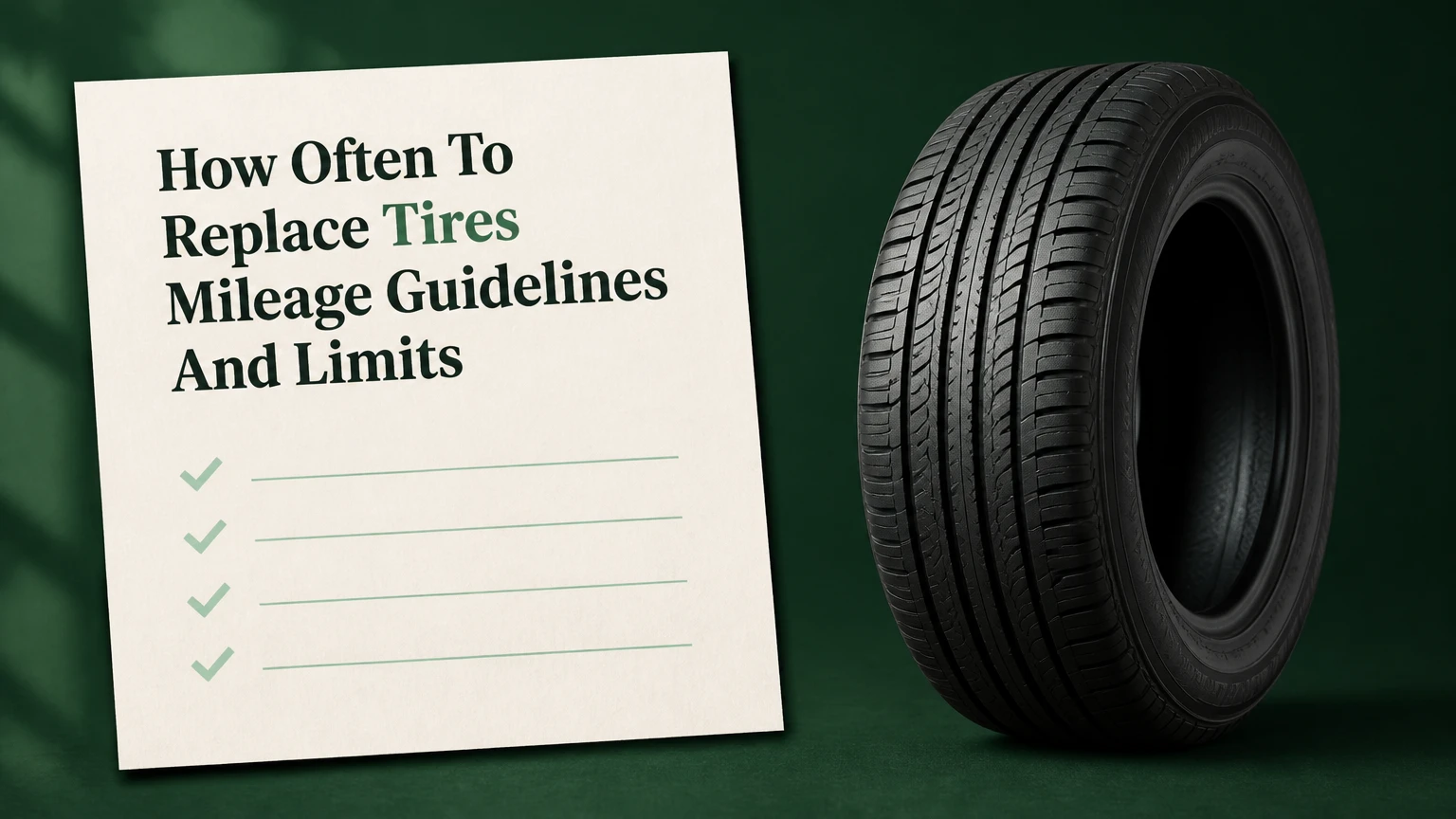
Standard passenger car tires need replacement every 40,000 to 60,000 miles or every four to six years. You must swap out the rubber immediately if tread depth falls below 2/32 of an inch. Ten years from the manufacture date is the absolute maximum lifespan regardless of driven miles.
Knowing how often to replace tires mileage limits dictate requires understanding your specific driving habits and vehicle type. Rubber degrades continuously. Your driving environment dictates whether your tires will reach their theoretical maximum lifespan.
At a Glance: Core Tire Replacement Rules
- The Mileage Rule: Standard all-season tires typically last 40,000 to 60,000 miles under normal driving conditions.
- The Age Rule: All tires strictly expire ten years after their manufacturing date due to chemical oxidation.
- The Tread Rule: Legal minimum tread depth is 2/32 of an inch, but wet weather traction degrades severely at 4/32 of an inch.
- The AWD Rule: All-wheel-drive vehicles usually require replacing all four tires simultaneously to prevent differential damage.
- The EV Rule: Electric vehicle tires wear out 20% to 30% faster than standard combustion vehicle tires.
What are the specific mileage limits by tire type?
Different vehicle tires last between 20,000 and 80,000 miles based on their engineered rubber compounds. Tire manufacturers formulate unique rubber mixtures for specific driving applications. Softer compounds provide superior grip but sacrifice long-term durability. Harder compounds resist wear but offer less traction in extreme conditions.
All-season tires use balanced rubber compounds designed for moderate climates. Performance tires use incredibly soft rubber to grip the asphalt at high speeds. Winter tires feature specialized polymers that remain flexible below freezing temperatures. Driving winter tires on warm summer asphalt will destroy the tread in just a few thousand miles. All-terrain tires feature deep, chunky treads that resist off-road punctures but wear unevenly on smooth highways.
| Tire Type | Average Lifespan (Miles) | Rubber Compound Type | Ideal Climate Usage |
|---|---|---|---|
| All-Season | 40,000 – 80,000 | Balanced / Medium | Moderate, year-round |
| Performance (Summer) | 20,000 – 40,000 | Soft / High Grip | Warm weather, dry/wet |
| Winter (Snow) | 20,000 – 35,000 | Pliable cold-weather | Below 45°F (7°C) |
| All-Terrain (Off-Road) | 30,000 – 50,000 | Stiff / Puncture Resistant | Mixed highway and dirt |
Does tire rubber expire even with low mileage?
Yes, tire rubber degrades chemically over time and strictly expires ten years after the manufacturing date. Age degrades tires just as much as highway mileage. Rubber undergoes constant oxidation from the moment it leaves the curing press. Oxygen breaks down the internal bonds of the polymers.
“Rubber oxidation is an invisible clock ticking from the moment the tire leaves the factory,” states the U.S. Tire Manufacturers Association (2022). Environmental factors like ultraviolet light and ozone exposure accelerate this chemical breakdown. A tire that sits in a garage for a decade might look brand new. The tread might measure at maximum depth. However, the internal structure is dangerously compromised. The rubber becomes brittle and loses its ability to flex under load.
Where is the manufacture date located on the sidewall?
The manufacture date sits on the outer tire sidewall at the end of the Department of Transportation (DOT) serial code. You can locate this information by searching for the letters “DOT” near the wheel rim.
- Inspect the outer sidewall of the tire near the metal rim.
- Locate the letters “DOT” which indicate compliance with safety standards.
- Read the string of numbers and letters immediately following the DOT stamp.
- Identify the final four digits of this sequence.
- Read the first two digits as the week of manufacture.
- Read the final two digits as the year of manufacture.
For example, a tire with the code ending in 3224 was manufactured during the 32nd week of the year 2024. If your DOT code only has three numbers at the end, the tire was manufactured before the year 2000 and is exceptionally dangerous to drive on.
Do seasonal temperature changes accelerate tire degradation?
Extreme heat bakes the rubber compounds on hot asphalt, while freezing temperatures turn summer tires brittle. Temperature fluctuations drastically alter the molecular structure of tire rubber. Southern climates with prolonged summer heat waves accelerate the vulcanization process. This bakes the tires and causes the rubber to harden prematurely.
Conversely, northern climates present a different hazard. Dropping temperatures cause tire pressure to decrease rapidly. Driving on underinflated tires generates massive internal friction. This friction destroys the tire from the inside out. Furthermore, exposing summer performance tires to freezing temperatures can cause the tread blocks to crack wide open. You must match your tire compound to your local climate to achieve the maximum possible mileage.
What physical signs indicate immediate tire failure?
Bubbles, sidewall cracks, deep bulges, and punctures larger than one-quarter inch dictate immediate tire disposal. You cannot repair structural damage to the sidewall under any circumstances. A bulge indicates that the internal structural cords have snapped. Air is now leaking into the outer rubber layers.
Standard mileage rules do not apply when physical damage occurs. Driving over a deep pothole can destroy a brand-new tire instantly. You should inspect your tires monthly for dry rot. Dry rot appears as a network of tiny spiderweb cracks along the sidewall. These cracks indicate severe chemical breakdown. Additionally, any puncture located on the shoulder or sidewall of the tire renders the tire completely unrepairable. Tire shops are legally prohibited from patching a sidewall puncture.
How can a driver check tread depth accurately?
You can measure tread depth by inserting a Lincoln penny upside down into the tire grooves. This mechanical test provides an instant visual indicator of remaining tread life. A new passenger car tire typically starts with 10/32 to 11/32 of an inch of tread.
- Park the vehicle on a flat surface and turn the steering wheel entirely to one side. This exposes the full face of the front tire.
- Hold a standard US penny with President Lincoln’s head facing you.
- Turn the coin upside down so Lincoln’s head points toward the ground.
- Insert the top of the coin directly into the deepest part of the tread groove.
- Evaluate the visibility of Lincoln’s head. If you can see the very top of his head, your tread depth is below 2/32 of an inch.
- Repeat this measurement across three different points on the tire (outer edge, center, inner edge) to check for uneven wear.
How can regular maintenance extend tire longevity?
Consistent air pressure monitoring and regular wheel alignments extend tire life by tens of thousands of miles. Neglecting fundamental maintenance destroys tires long before their designated mileage limit. Underinflation is the leading cause of premature tire failure. An underinflated tire sags under the vehicle’s weight. This forces the outer edges of the tread to handle the entire load.
Proper alignment ensures the tires roll perfectly parallel to each other. Hitting a curb or a deep pothole can knock a vehicle’s suspension out of alignment. When this happens, the tires drag sideways slightly as the vehicle moves forward. This dragging motion files down the rubber aggressively. Drivers who check their tire pressure monthly and align their wheels annually often reach the 60,000-mile mark easily.
How does improper rotation cause premature tire balding?
Failing to rotate tires every 5,000 miles forces the front tires to handle all steering and engine weight continuously. Vehicles do not distribute weight evenly across all four corners. The front axle carries the heavy engine block and transmission. The front tires also handle all steering forces and bear the brunt of weight transfer during heavy braking.
If you leave the same tires on the front axle indefinitely, they will wear out twice as fast as the rear tires. Rotating the tires moves the worn front tires to the lighter rear axle. This gives the front rubber a chance to recover. A standard front-wheel-drive vehicle requires a cross-rotation pattern. The front tires move straight back, and the rear tires cross over to opposite sides on the front. Skipping this simple procedure guarantees you will buy new tires at half the expected mileage.
Why do electric vehicles require faster tire replacement?
Electric vehicles consume tires 20% to 30% faster than internal combustion cars due to immense instant torque and heavy battery packs. Standard mileage expectations do not apply to the electric vehicle market. A J.D. Power 2023 study found that EV owners are frequently shocked to need new tires at just 30,000 miles.
Electric motors deliver maximum torque the millisecond the driver presses the accelerator. This instant rotational force shreds rubber against the pavement. Furthermore, lithium-ion battery packs make electric vehicles substantially heavier than gas cars of the same size. A typical EV weighs 1,000 to 1,500 pounds more than its combustion counterpart. This extra mass presses the tires harder into the road surface. The combination of heavy weight and massive torque creates extreme friction that dramatically shortens the tire’s lifespan.
Can a vehicle owner replace just two tires instead of four?
Yes, owners of front-wheel or rear-wheel-drive cars can safely replace only two tires at a time. You do not always need to buy a full set if two tires are still in excellent condition. However, you must install the two brand-new tires on the rear axle. This rule applies regardless of whether the car is front-wheel or rear-wheel drive.
Putting new tires on the front axle while leaving worn tires on the rear creates a dangerous handling dynamic. Deep treads channel water effectively. Bald treads hydroplane. If you put the bald tires on the rear, the back of the car will lose traction on wet roads before the front does. This causes the vehicle to fishtail and spin out of control. Placing the new tires on the rear axle ensures the vehicle maintains stability during emergency maneuvers.
Is it mandatory to change all four tires on AWD systems?
All-wheel-drive vehicles almost always require replacing all four tires simultaneously to prevent severe drivetrain damage. The AWD system constantly monitors the rotational speed of every wheel. It sends power to the wheels with the most traction.
A brand-new tire has a larger physical circumference than a worn tire. If you install one new tire alongside three old tires, the new tire will rotate slightly slower than the others. The vehicle’s computer interprets this speed difference as a loss of traction. The AWD system will engage continuously to correct a slipping wheel that is not actually slipping. This constant engagement overheats the differential and destroys the transfer case.
| Drive Type | Replacement Rule | Rear Axle Priority | Differential Risk Level |
|---|---|---|---|
| Front-Wheel Drive (FWD) | Can replace in pairs | New tires go on rear | Zero risk |
| Rear-Wheel Drive (RWD) | Can replace in pairs | New tires go on rear | Zero risk |
| All-Wheel Drive (AWD) | Must replace all four | N/A (Full set required) | Extreme risk of damage |
| Four-Wheel Drive (4WD) | Must replace all four | N/A (Full set required) | High risk of damage |
Does a spare tire need replacing if never used?
Yes, spare tires expire after ten years of sitting in a trunk or under a truck bed. Many drivers incorrectly assume a spare tire lasts forever because it never touches the pavement. The chemical breakdown of rubber occurs regardless of physical use.
Spare tires actually endure harsher conditions than mounted tires. A space-saver donut tire locked inside a dark trunk bakes in extreme heat during the summer months. Trunk temperatures can easily exceed 140 degrees Fahrenheit. This intense ambient heat accelerates rubber oxidation. When you finally need the spare tire during a highway blowout, the aged rubber will likely fail within a few miles. You should check the DOT manufacture code on your spare tire every year and discard it precisely at the ten-year mark.
How often to replace tires mileage warranties actually guarantee?
High mileage warranty tires are financially worthwhile only for drivers who commute more than 15,000 miles annually. Premium tire manufacturers frequently advertise warranties promising 70,000 or even 80,000 miles of tread life. These warranties sound impressive on paper. The reality of redeeming them is highly complex.
To keep a mileage warranty valid, you must present documented proof of strict maintenance. You need receipts proving you rotated the tires every 5,000 miles. You need alignment records. If the tire wears out early due to poor alignment, the manufacturer will void the warranty instantly. Furthermore, warranties are prorated. If an 80,000-mile tire wears out at 60,000 miles, you do not receive a free tire. You receive a 25% discount on your next purchase from that exact same brand.
| Warranty Tier | Expected Lifespan | Premium Cost Addition | Ideal Annual Commute |
|---|---|---|---|
| Standard (No Warranty) | 30,000 – 40,000 miles | Base Price | Under 8,000 miles |
| Mid-Tier (50k Warranty) | 40,000 – 50,000 miles | +15% over base | 8,000 – 12,000 miles |
| Premium (80k Warranty) | 60,000 – 70,000 miles | +35% over base | Over 15,000 miles |
What happens if a driver ignores the ten year age limit?
Driving on ten-year-old tires risks catastrophic tread separation and high-speed blowouts. The National Highway Traffic Safety Administration (NHTSA) 2021 report on aging tires explicitly links rubber degradation to fatal highway accidents. As the internal polymers dry out, the chemical bond holding the steel belts to the rubber tread weakens.
When you drive at highway speeds, centrifugal force pulls the tread outward. Heat builds up inside the tire casing. On a new tire, the flexible rubber absorbs this stress easily. On an expired tire, the brittle glue fails. The entire outer tread can peel off the tire casing in a single violent motion. This event destroys the vehicle’s wheel well and often causes the driver to lose total control of the steering wheel. Saving money by driving on expired rubber is a life-threatening decision.
The Bottom Line
Mileage tells only half the story of a tire’s useful life. You must evaluate the chemical age of the rubber alongside the physical depth of the tread. Replace your tires when they hit 50,000 miles, when they reach ten years of age, or when the tread drops below 2/32 of an inch. Prioritize regular rotations and proper air pressure to maximize your investment and ensure your vehicle remains safe in unpredictable weather.