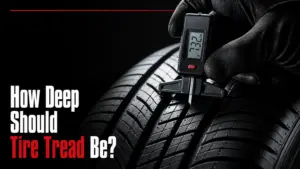
To check if tires are truly new, buyers must examine the four-digit Department of Transportation date code on the sidewall, measure the factory tread depth using a digital gauge, and inspect the rubber for intact vent spews. Shady dealers frequently clean, paint, or polish old inventory to disguise wear. Evaluating these physical indicators prevents purchasing unsafe, aged rubber.
At a Glance
- The last four digits of the DOT code indicate the manufacturing week and year.
- Standard passenger car new tires feature 10/32″ to 11/32″ of initial tread depth.
- Vent spews, or tire whiskers, wear off within the first 50 to 100 miles of driving.
- Static storage in hot warehouses degrades rubber chemically even without road use.
- Retailers may legally sell unmounted tires aged up to five years as brand-new inventory.
Where Is the DOT Date Code Located and How Do You Decode It?
Every legal tire features a Department of Transportation code on the sidewall that reveals the exact production timeline. Buyers must locate the letters DOT followed by a serial string, where the final four numbers establish the age. The first two digits represent the manufacturing week, and the final two digits represent the production year. For example, a code ending in 2225 indicates the tire rolled out of the factory during the 22nd week of 2025. According to the U.S. National Highway Traffic Safety Administration (NHTSA) guidelines, retail tires should be under two years old and never exceed five years from the production date. Rubber compounds degrade slowly through oxidation even when sitting idle on a display rack.
| Tire Component | What to Look For | What It Indicates |
|---|---|---|
| DOT Serial Number | Last 4 digits (e.g., 1524) | Manufactured in the 15th week of 2024 |
| Tread Whiskers | Tiny rubber strings on surface | Factory-fresh state with zero road friction |
| Colored Stripes | Red, blue, or yellow lines | Circumferential factory quality control markers |
| Barcode Label | Paper sticker on tread face | Unsold inventory status directly from plant |
What Is the Standard Factory Tread Depth for Different Vehicle Tire Classes?
New passenger car tires leave the factory with precise, class-specific tread depths that provide a baseline for freshness verification. Summer and all-season passenger tires typically measure between 10/32″ and 11/32″ of initial tread depth, which translates to approximately 8 millimeters. Winter performance tires feature deeper blocks ranging from 11/32″ to 13/32″ to bite into snow and slush. Heavy-duty truck and SUV off-road tires start significantly higher, often measuring between 13/32″ and 17/32″. Mechanics use a digital tread depth gauge to check these metrics. If a standard passenger tire measures 8/32″ right off the rack, the tire has experienced previous road contact or severe wear.
How Do You Test Tire Age Versus Tread Wear During a Private Purchase?
Evaluating a private tire purchase requires cross-referencing physical tread measurements with the sidewall production stamp to uncover hidden discrepancies. Sellers often present tires with deep tread while ignoring age-related hardening. Buyers must measure the tread across three distinct points of the circumference using a digital depth gauge. If the outer ribs show significantly lower depth than the center, alignment wear has occurred on a vehicle. Combining a tread depth below factory specs with a DOT date code older than three years signals that the merchandise is used.
Can Tire Whiskers and Factory Strips Be Artificially Replicated by Sellers?
Shrewd used tire vendors occasionally use rubber shaving tools or specialized sandpaper to remove surface imperfections, inadvertently erasing telltale wear signs. Conversely, a tire driven for 200 miles on a smooth highway might retain its outer shoulder whiskers, creating a false impression of zero mileage. Factory painted lines running around the circumference help expose this deception. These colored markers wash away or wear off quickly during actual vehicle operation. The presence of intact factory barcode stickers glued directly to the tread face remains the most reliable indicator of an untouched product.
| Verification Method | Reliability Level | Common Deception Tactic |
|---|---|---|
| DOT Date Stamp | High | Counterfeit stamping or scraping |
| Tread Whiskers | Moderate | Trimming or preservation on highway-only runs |
| Factory Barcode Sticker | High | Relabeling used inventory with fake barcodes |
| Colored Tread Stripes | High | Paint spraying to mimic factory application |
What Are Take-Off Tires and How Do You Distinguish Them From Factory-Fresh Stock?
Take-off tires are units removed from brand-new vehicles at dealerships immediately after purchase because the original owner upgraded to custom aftermarket wheels. These tires typically carry between 20 and 50 miles of transport distance from the factory to the dealership lot. They feature full tread depth, clean sidewalls, and intact vent whiskers, making them visually indistinguishable from virgin retail stock. Distinguishing take-offs from brand-new inventory requires inspecting the bead area for mounting scuffs or examining the inner wheel contact surface for residual balancing weight adhesive. While functional, take-off tires are technically second-hand goods.
How Do High-Performance Track Tires Differ in Initial Tread Depth From Standard Passenger Variants?
Extreme performance and track-ready tires arrive from the manufacturing plant with shallower tread depths than standard highway options. Specialized track compounds often start with only 6/32″ or 7/32″ of initial tread depth to minimize block squirm and maximize cornering stability at high speeds. Uninformed buyers frequently mistake these low numbers for severe wear, assuming the product is used. Verifying these specialized tires requires checking the exact model specifications on the manufacturer website before evaluation. Ignoring this distinction leads buyers to reject factory-fresh competition tires incorrectly.
What Is the Difference Between New Old Stock and a Freshly Manufactured Tire?
New Old Stock refers to tires that possess maximum tread depth, factory barcode labels, and zero miles, but have sat idle in storage for extended periods. According to Michelin tire aging data, static tires degrade chemically through ozone exposure and ambient heat build-up without ever touching asphalt. Chemical anti-ozonants embedded within the rubber compound require physical flexing during driving to migrate to the surface and protect the structure. A tire that sat in a hot warehouse for seven years is chemically compromised even if the tread looks pristine. Freshly manufactured inventory undergoes continuous rotation and active use shortly after production.
How Does Static Warehouse Storage Degrade Rubber Compared to Active Road Use?
Environmental factors inside uncontrolled storage facilities accelerate rubber degradation much faster than normal driving conditions. Ultraviolet light exposure, high humidity, and temperature fluctuations break down polymer chains within the sidewall structure, causing micro-cracks. When a tire remains stationary under vehicle weight, constant stress concentrates on the contact patch, creating flat spots and internal carcass strain. Active road use actually stimulates internal oils and anti-aging agents through constant flexing. Static warehouse storage without temperature control destroys structural integrity while leaving the outer appearance deceptively clean.
Is It Legal for a Retailer to Sell a Five-Year-Old Tire Labeled as Brand New?
In most jurisdictions, federal laws do not explicitly regulate the sale age of unmounted passenger car tires, leaving retailers free to market aged stock as new. Industry advisory boards, including the Rubber Manufacturers Association, state that tires should be inspected annually after five years and discarded entirely at ten years regardless of tread depth. When local shops attempt to sell a six-year-old tire as new, consumers should demand a newer date code or a substantial markdown. Purchasing aged inventory severely curtails the usable lifespan of the product on the road.
| Tire Age Range | Recommended Action | Safety Status |
|---|---|---|
| 0 to 2 Years | Ideal retail purchase window | Fully compliant with safety margins |
| 3 to 5 Years | Acceptable with thorough inspection | Monitor for micro-cracking |
| 6 to 10 Years | Professional annual inspection required | Degraded chemical composition |
| Over 10 Years | Mandatory replacement | Unsafe for highway operation |
What Are the Structural Signs of Professional Tire Regrooving Scams?
Tire regrooving involves carving deeper channels into a worn, bald tread pattern to fake a brand-new appearance for unsuspecting buyers. This practice is strictly illegal for passenger car tires due to the catastrophic risk of tread separation at high speeds. Inspecting the bottom of the tread grooves reveals this dangerous fraud. If the groove floor features jagged knife marks, exposed nylon fabric cords, or uneven depth profiles, the tire is a dangerously altered hazard. Genuine manufacturing molds produce smooth, uniform groove floors with rounded molded contours.
Why Do Colored Dots Appear on Sidewalls and Do They Indicate Tire Age?
Colored dots painted on tire sidewalls serve as factory uniformity and balancing markers rather than indicators of manufacturing freshness. A yellow dot signifies the lightest point of the tire structure, which mechanics align directly with the heavy valve stem on the wheel rim during mounting. A red dot indicates the radial runout high point, representing the stiffest structural area of the tire carcass. These paint marks assist technicians in achieving optimal wheel balance during installation. They fade over time and provide zero correlation to the production date or age of the rubber.
What Should You Do If the Four-Digit DOT Code Is Missing From the Outer Sidewalk?
Asymmetrical manufacturing processes sometimes cause factories to print the four-digit DOT date code exclusively on the inner sidewall facing the vehicle chassis. If a tire is mounted inside-out on the wheel rim, the date code becomes completely hidden from external view. Mechanics must hoist the vehicle or crawl underneath to inspect the interior sidewall surface. If a tire lacks a date code entirely on both sidewalls, it represents a non-compliant or defective product that should never be purchased or installed. Legitimate manufacturers stamp the full code on at least one side of every regulated tire.
The Bottom Line
Verifying new tires requires looking past deceptive cosmetic enhancements like silicone shine and focusing entirely on verifiable structural data. Checking the four-digit DOT date code, measuring tread depth with a digital gauge, and confirming the presence of vent spews ensures complete safety. Buyers must prioritize manufacture dates over external appearance to prevent purchasing degraded inventory.