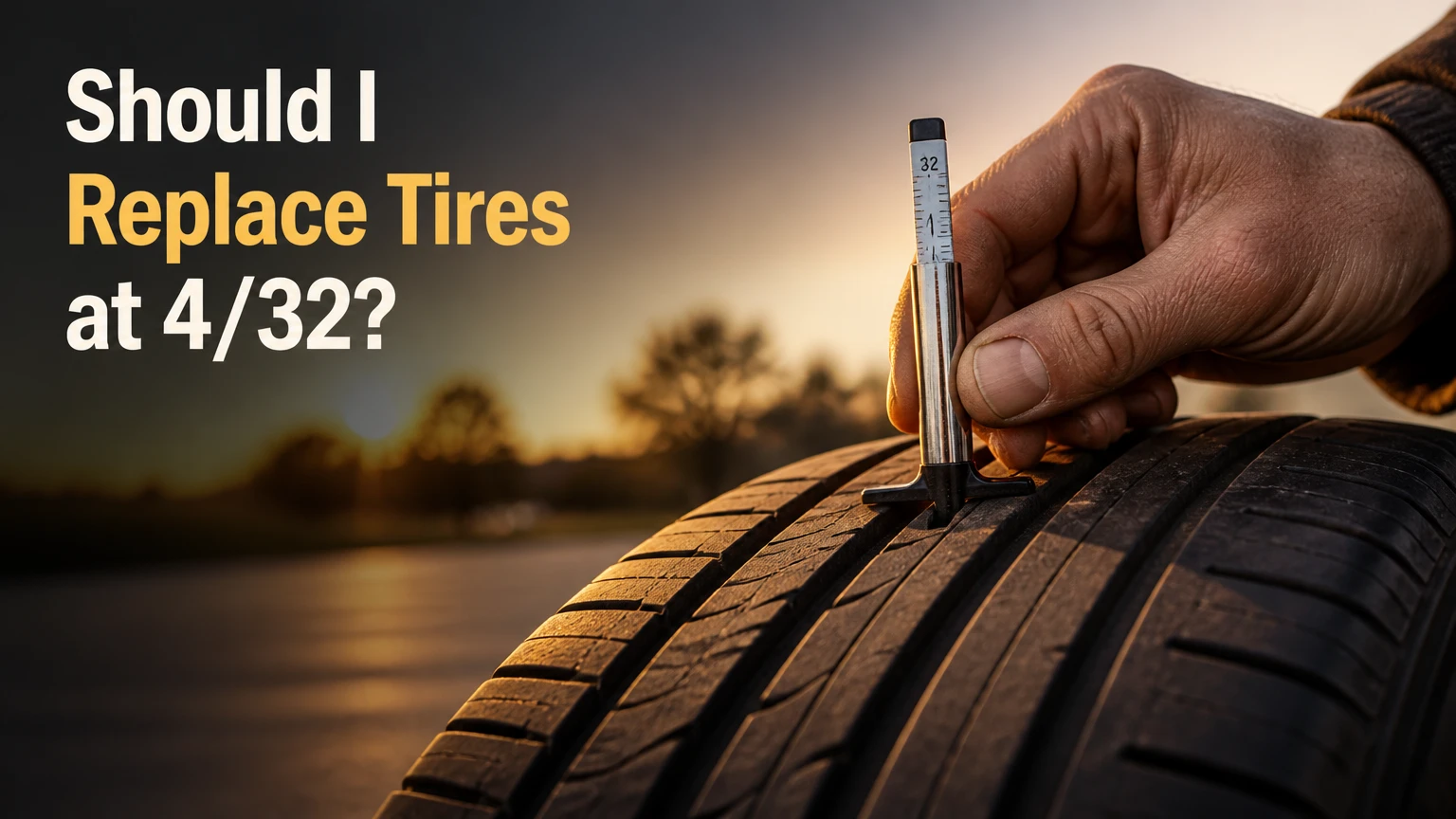
Yes, you should generally replace tires at 4/32 inch when you regularly drive in rain, standing water, snow, or highway traffic. Although 2/32 inch is the commonly recognized minimum replacement point, independent testing shows that wet braking and handling can deteriorate substantially by 4/32 inch.
Key Facts at a Glance
- A tire with 4/32 inch of tread is worn but may remain legally usable.
- AAA recommends replacement at 4/32 inch because wet-road performance has already declined significantly.
- AAA testing found that 4/32-inch tires needed an average of 87 additional feet to stop a passenger car on wet pavement from 60 mph.
- Tire Rack recommends considering replacement at 4/32 inch for wet conditions and around 5/32 inch for snow-covered roads.
- A tread-depth gauge is more accurate than relying only on a penny or quarter.
- Bulges, exposed cords, deep cracks, vibration, or irregular wear can require replacement before tread reaches 4/32 inch.
Should I Replace Tires at 4/32 Right Away?
Replace tires at 4/32 inch now when frequent rain, highway travel, snow, standing water, or heavy vehicle loads are part of your normal driving. In a mostly dry climate, limited short-term use may be reasonable, but 4/32 inch should still begin your replacement window rather than become a long-term target.
AAA’s wet-pavement testing compared new all-season tires with tires worn to 4/32 inch. The worn passenger-car tires required an average of 87 additional feet to stop, while light-truck tires required 86 additional feet. Passenger-car handling performance declined by an average of 33 percent.
The practical verdict is straightforward. Four thirty-seconds is not the same as bald, but the tire has passed the point where a safety-conscious driver should ignore replacement planning.
| Driving situation | Recommendation at 4/32 | Main reason |
| Frequent rain or coastal storms | Replace now | Reduced water evacuation and longer wet stops |
| Snow, slush, or winter travel | Replace now | Snow traction is already substantially reduced |
| Regular 65-75 mph highway travel | Replace soon or now | Less margin during emergency braking |
| Mostly dry, low-speed city driving | Schedule replacement soon | Legal tread may remain, but safety reserve is limited |
| Vehicle carries tools or heavy loads | Replace now | Greater stopping demand and heat generation |
| Tire has cracks, bulges, cords, or vibration | Replace immediately | Structural condition overrides tread depth |
What Does 4/32 Tire Tread Mean?
A reading of 4/32 inch means the deepest measured groove contains one-eighth inch of remaining tread. It is approximately 3.2 millimeters, although tire gauges sold in the United States usually display thirty-seconds of an inch.
Many new passenger tires start near 10/32 or 11/32 inch. Some performance tires begin with less, while truck, all-terrain, and winter tires may begin with more.
A 10/32-inch tire at 4/32 is not simply “60 percent worn” in practical service terms. The final 2/32 inch is already considered worn out, so the tire started with 8/32 inch of usable tread. At 4/32 remaining, it has used 6/32 of that 8/32, or approximately 75 percent of its usable tread.
| Measured depth | Approximate metric depth | Practical interpretation |
| 10/32 inch | 7.9 mm | Typical new passenger-tire depth |
| 8/32 inch | 6.4 mm | Light to moderate wear |
| 6/32 inch | 4.8 mm | Usable, but winter performance may begin declining |
| 5/32 inch | 4.0 mm | Common snow-traction replacement threshold |
| 4/32 inch | 3.2 mm | Wet-weather replacement threshold |
| 3/32 inch | 2.4 mm | Critically limited wet-weather margin |
| 2/32 inch | 1.6 mm | Worn-out threshold in most U.S. guidance |
Tire Rack classifies 4/32 inch as reduced wet traction and recommends considering replacement at that point when wet roads are expected. It identifies about 5/32 inch as the stage at which useful snow performance begins diminishing.
Why Does Wet Traction Decline at 4/32?
Wet traction declines because shallower grooves have less capacity to move water away from the contact patch. When water enters the area between the tread and pavement faster than the grooves can discharge it, the tire’s direct contact with the road decreases.
The exact result depends on water depth, speed, tire width, tread design, compound, inflation pressure, pavement texture, vehicle weight, and wheel load. Therefore, no universal hydroplaning speed applies to every tire at 4/32 inch.
The direction of the evidence is clear. AAA found a 43 percent increase in average wet stopping distance for the worn tires in its test. At the point where the new-tire vehicle had stopped, the vehicle on 4/32-inch tires was reportedly still moving at approximately 40 mph.
Greg Brannon, AAA’s director of Automotive Engineering, explained the underlying limitation: “Even the most advanced safety systems rely on a tire’s basic ability to maintain traction.”
Antilock brakes, stability control, traction control, and all-wheel drive can manage the traction available. They cannot create grip that the tire has lost.
Is 4/32 Inch Still Legal?
A 4/32-inch tire is generally above the 2/32-inch minimum recognized by U.S. safety guidance, but legality varies by jurisdiction, vehicle class, tire position, and operating conditions. Drivers should check their applicable state or local requirements rather than treating one national figure as a complete legal answer.
NHTSA instructs drivers to replace tires when the tread reaches 2/32 inch and notes that built-in treadwear bars become flush with the tread at the replacement point.
The difference between legal minimum and prudent replacement matters:
| Standard | Tread depth | Meaning |
| New-tire baseline | Usually 10/32-11/32 | Strongest water-channel capacity |
| Wet-weather planning point | 4/32 | Begin or complete replacement |
| Common wear-bar height | 2/32 | Tire is worn out |
| Damage-based threshold | Any depth | Replace if the structure is unsafe |
A legal minimum defines the point beyond which continued use is not accepted. It does not promise new-tire braking, cornering, snow grip, or hydroplaning resistance up to that point.
How Much Wet Stopping Distance Is Lost?
AAA’s 2018 test measured an average 87-foot increase for passenger cars and an 86-foot increase for light trucks using tires worn to 4/32 inch, compared with new all-season tires. Testing occurred on wet pavement at highway speed.
Eighty-seven feet is approximately five average passenger-car lengths. The increase can determine whether a driver stops behind a queue or enters the intersection while still moving quickly.
The AAA results should not be treated as an exact prediction for every vehicle. Different tires, brake systems, road surfaces, temperatures, water depths, and loads will produce different distances. The test demonstrates the scale of the lost safety margin, not a universal stopping-distance formula.
Does Tire Price Prevent the Performance Loss?
A higher purchase price does not prevent the effects of tread wear. AAA reported that performance deteriorated significantly across the tested tires, including higher-priced products, and cautioned against selecting a replacement based on price alone.
Tread design, wet-traction testing, correct fitment, compound, load rating, speed rating, and condition matter more than price by itself.
Is 4/32 Safe in Snow?
Four thirty-seconds is usually too shallow for dependable snow performance, even when the tire remains legally usable. Snow traction requires grooves and tread blocks deep enough to collect, compress, and release snow as the tire rotates.
Tire Rack recommends considering replacement around 5/32 inch when drivers expect snow-covered roads. Its guidance explains that the tire’s useful snow mobility passes a point of diminishing returns near that depth.
A winter tire at 4/32 inch may still have a cold-weather compound, but its reduced groove depth limits the tread pattern’s ability to work in snow and slush. It should not be treated as equivalent to a newer winter tire.
| Condition | Suggested action | Planning depth |
| Dry pavement | Inspect and plan | 4/32 |
| Regular rain | Replace | 4/32 |
| Standing water | Replace | 4/32 or earlier |
| Light seasonal snow | Replace before winter | About 5/32 |
| Frequent snow and slush | Replace before the season | 5/32-6/32 |
| Ice | Use appropriate winter tires | Depth alone cannot guarantee grip |
How Do I Measure 4/32 Accurately?
Use a mechanical or digital tread-depth gauge and measure every main circumferential groove at the inner shoulder, center, and outer shoulder. The lowest valid reading determines the tire’s condition because one dangerously worn area cannot be averaged away by deeper tread elsewhere.
Follow this process:
- Park on level ground and apply the parking brake.
- Turn the steering wheel to expose the front tread.
- Remove stones or compacted debris from the grooves.
- Press the gauge base flat against the tread blocks.
- Extend the probe to the groove floor.
- Record inner, center, and outer readings.
- Repeat at three positions around the tire.
- Measure all four road tires.
- Recheck any reading that differs sharply from the others.
A nine-point pattern per tire can reveal alignment or inflation wear that a single center-groove measurement misses.
NHTSA recommends checking tread at least monthly when checking pressure. It also notes that treadwear indicators and the penny test identify the 2/32-inch replacement point.
Does the Quarter Test Measure 4/32?
The quarter test is a useful screening method, not a precision measurement. Insert a U.S. quarter into a main groove with Washington’s head pointing downward. When the top of Washington’s head remains covered, the groove generally has at least about 4/32 inch.
When the full head is visible, begin replacement planning. AAA uses the quarter test as a consumer-friendly signal for the 4/32-inch point.
What Does the Penny Test Show?
The penny test checks the lower 2/32-inch threshold. Insert a penny with Lincoln’s head downward. When the top of the head is visible, the tread has reached approximately 2/32 inch or less.
The penny test is unsuitable for deciding whether a tire still provides strong wet-weather performance. It identifies a worn-out tire, not an optimal replacement point.
What If Only One Part Measures 4/32?
Use the lowest tread reading and inspect the cause of the difference. A tire measuring 6/32 in the center but 4/32 on the inner edge should be treated as a 4/32 tire, especially because inner-edge wear can remain hidden beneath the vehicle.
| Wear pattern | Most likely causes | Required action |
| Center worn fastest | Excess inflation over time | Correct pressure and inspect tire |
| Both shoulders worn | Underinflation or overloading | Check for leakage and placard pressure |
| One shoulder worn | Toe or camber misalignment | Alignment and suspension inspection |
| Feathered tread blocks | Incorrect toe setting | Alignment diagnosis |
| Cupped or scalloped areas | Worn shocks, imbalance, or looseness | Suspension and balancing inspection |
| Isolated bald spot | Lockup, defect, or internal issue | Professional tire inspection |
| Random high and low areas | Possible separation or mechanical wear | Stop high-speed use until inspected |
NHTSA states that balance, alignment, inflation, and rotation affect tire life and vehicle safety. It recommends using the vehicle manufacturer’s pressure from the door placard, not the maximum pressure molded on the sidewall.
Correcting the alignment after the tread has worn unevenly will not restore the missing rubber. The mechanical cause and the damaged tire must be addressed separately.
Can I Keep Driving Temporarily at 4/32?
Limited short-term use may be reasonable when the tire has even wear, correct pressure, no structural damage, no winter exposure, and mostly dry low-speed operation. The driver should still schedule replacement rather than attempting to consume the final 2/32 inch regardless of conditions.
During temporary use:
- Reduce speed in rain.
- Increase following distance substantially.
- Avoid standing water and flooded lanes.
- Do not use cruise control during heavy rain.
- Avoid sharp steering and hard braking.
- Recheck pressure and tread monthly.
- Replace before a long road trip or wet season.
AAA advises reducing speed, increasing following distance, avoiding cruise control in rain, and using gentle control inputs when wet roads raise the risk of hydroplaning.
No responsible mileage estimate can guarantee how long 4/32 will last. Wear rate changes with alignment, inflation, tire compound, temperature, road texture, driving style, axle position, and vehicle weight.
Should I Replace One, Two, or All Four Tires?
Replace all four when they are similarly worn, the vehicle manufacturer requires closely matched rolling circumferences, or an AWD system has a strict tread-depth tolerance. Replace two when the opposite axle retains compatible tires with adequate tread and the owner’s manual permits the difference.
Replacing only one tire may be acceptable when the other tire on the axle is nearly identical in model, size, condition, and tread depth. Some shops can shave a new tire to match an existing AWD set, but this should follow vehicle-manufacturer limits.
Where Should Two New Tires Be Installed?
Install the deeper or newer pair on the rear axle, including on most front-wheel-drive vehicles. Greater rear traction lowers the risk of sudden rear hydroplaning and oversteer, which is harder for most drivers to recover from.
Tire Rack recommends installing a replacement pair on the rear. Its explanation notes that hydroplaning at the rear can produce fishtailing or spinning, while front traction loss more often creates understeer that is easier for an average driver to recognize and manage.
Does AWD Always Require Four New Tires?
AWD does not automatically mean four tires must be replaced in every case. The correct decision depends on the vehicle manufacturer’s permitted circumference or tread-depth variation.
Tire Rack notes that small front-to-rear tread differences, commonly up to 2/32 inch in general tire practice, may permit continued rotation, while some AWD systems impose their own tighter requirements.
Check the owner’s manual before approving one- or two-tire replacement. A mismatch outside the specified tolerance can create continuous speed differences within the driveline.
Does Tire Age Matter If Tread Is Still 4/32?
Yes. Tread depth measures remaining groove depth, but it does not reveal every form of rubber aging or internal deterioration. An older tire with 4/32 inch may require replacement sooner than a newer tire with the same measurement.
Locate the Tire Identification Number near the DOT marking. The final four digits indicate the week and year of manufacture. For example, 2224 means the tire was manufactured during the 22nd week of 2024.
Age alone does not create one universal replacement date for every tire. Storage, climate, heat cycles, UV exposure, maintenance, manufacturer guidance, and inspection results all matter. Tires approaching the age limit stated by the tire or vehicle manufacturer should receive professional inspection even when substantial tread remains.
What Damage Requires Replacement Before 4/32?
Tread depth becomes irrelevant when a tire has a structural defect that makes continued use unsafe. Replace or professionally inspect the tire immediately when any of these conditions appears:
- A sidewall bulge or bubble
- Exposed cords or fabric
- A deep cut in the sidewall
- Tread or belt separation
- Severe cracking
- Repeated pressure loss
- A puncture outside the repairable tread area
- Vibration that began suddenly
- Damage caused by driving while flat
- A plug-only repair that was never inspected internally
NHTSA advises discontinuing tire use for physical damage, irregular wear, or unsafe minimum tread. It identifies cuts, cracks, bulges, and other visible damage as reasons for removal from service.
A tire can have 7/32 inch of tread and still be unsafe because of a sidewall bubble. Conversely, an evenly worn 4/32-inch tire may remain structurally sound while providing reduced wet-weather performance.
How Much Does Tire Replacement Cost?
Typical installed tire costs vary by size, construction, brand, speed rating, load rating, and region. The ranges below are general planning estimates rather than live quotes.
| Tire category | Typical tire price | Typical installed total per tire | Common use |
| Economy all-season | $70-$130 | $95-$175 | Basic commuter vehicles |
| Touring all-season | $110-$220 | $140-$275 | Sedans, crossovers, highway use |
| Performance all-season | $150-$300 | $185-$365 | Sport sedans and performance cars |
| Winter tire | $110-$280 | $145-$345 | Snow and subfreezing conditions |
| All-terrain truck tire | $180-$380 | $220-$455 | Trucks, SUVs, gravel and trails |
| Run-flat tire | $200-$450 | $245-$535 | Vehicles designed for run-flats |
Installation may include mounting, balancing, valve service, disposal, taxes, and TPMS service. Alignment is normally separate.
Do not compare tires only by treadwear warranty. A high-mileage product can still differ substantially in wet braking, snow traction, ride comfort, noise, steering response, and rolling resistance.
Which Replacement Tire Should I Choose?
Choose a tire that matches the vehicle manufacturer’s approved size, load index, speed rating, and operating conditions. The best replacement is the product that performs well in the conditions you actually encounter, not necessarily the cheapest or longest-warranted model.
| Driver profile | Suitable category | Priority attributes |
| Daily commuter in a mild climate | Touring all-season | Wet braking, comfort, tread life |
| Driver in frequent heavy rain | Premium all-season or summer tire | Wet braking and hydroplaning resistance |
| Snowbelt driver | Dedicated winter tire | Cold compound, snow and ice traction |
| Performance-car owner | Performance summer or all-season | Steering response, heat tolerance, grip |
| Pickup or SUV on mixed surfaces | Highway-terrain or all-terrain | Load capacity, durability, wet stability |
| Low annual mileage | Climate-appropriate quality tire | Aging resistance and wet grip |
Confirm that all tires on an axle have compatible construction and performance characteristics. Do not mix winter and non-winter tires on the same vehicle unless the vehicle or tire manufacturer expressly permits the setup.
Common Mistakes at 4/32 Tread
Waiting for the Wear Bars
Wear bars identify approximately 2/32 inch, not the point at which wet-weather performance first becomes meaningfully reduced. Waiting for the bars maximizes tread usage but sacrifices part of the wet-road safety margin.
Measuring Only the Outer Shoulder
Inner-edge wear can be worse because of alignment settings or worn suspension components. Measure across the full width and at several points around the circumference.
Putting Two New Tires on the Front
The deeper pair normally belongs on the rear to reduce oversteer and loss of rear stability on wet roads.
Assuming AWD Compensates for Worn Tread
AWD helps distribute acceleration force. It does not shorten braking distance by restoring missing tread depth, and it does not prevent all four tires from hydroplaning.
Using Sidewall Pressure as the Target
The sidewall displays the tire’s maximum-rated inflation information, not necessarily the vehicle’s correct operating pressure. Use the driver-door placard or owner’s manual.
The Bottom Line
You should replace tires at 4/32 inch when rain, snow, standing water, highway speeds, or heavy loads are routine. The tires may remain above the common 2/32-inch worn-out threshold, but AAA testing demonstrates that wet stopping and handling can already be substantially worse at 4/32 inch.
In consistently dry, low-speed conditions, a structurally sound and evenly worn tire may be used briefly while replacement is arranged. Measure every groove, inspect for damage, correct any alignment or inflation problem, and follow the vehicle manufacturer’s rules when deciding whether to replace one, two, or four tires.
Frequently Asked Questions
Is 4/32 a failing tire tread measurement?
Four thirty-seconds is not usually the common legal failure point, but it is a widely recommended wet-weather replacement threshold. AAA advises replacement at 4/32 because its testing found considerably longer wet stops, while NHTSA identifies 2/32 as the worn-out point.
How many miles are left at 4/32 tread?
No dependable mileage figure can be calculated from tread depth alone. A tire might lose its next 1/32 inch quickly because of misalignment or aggressive driving, or wear slowly under gentle highway use. Measure monthly and replace based on conditions rather than attempting to reach a mileage target.
Is 5/32 tread still good?
Five thirty-seconds is generally usable for dry and wet roads, but it approaches the replacement range for snow service. Tire Rack recommends considering replacement around 5/32 inch when snow-covered roads are expected because useful snow mobility has begun to diminish.
Can I drive in heavy rain with 4/32 tread?
Driving may remain possible, but the safety margin is reduced. Lower speed, avoid standing water, increase following distance, disable cruise control, and replace the tires promptly. AAA testing found an average 87-foot increase in passenger-car wet stopping distance at 4/32 compared with new tires.
Should all four tires have the same tread depth?
Matching tread depth and design provide the most balanced handling. Small differences may be acceptable, but AWD and performance vehicles can have specific limits. Consult the owner’s manual before mixing depths, and install a replacement pair on the rear when two tires are changed.
Is the quarter test accurate enough?
The quarter test is suitable for quick screening near 4/32 inch, but a dedicated tread-depth gauge is more accurate and reveals differences across the tire. Measure the inner, center, and outer grooves because one worn shoulder can require replacement even when the center looks acceptable.