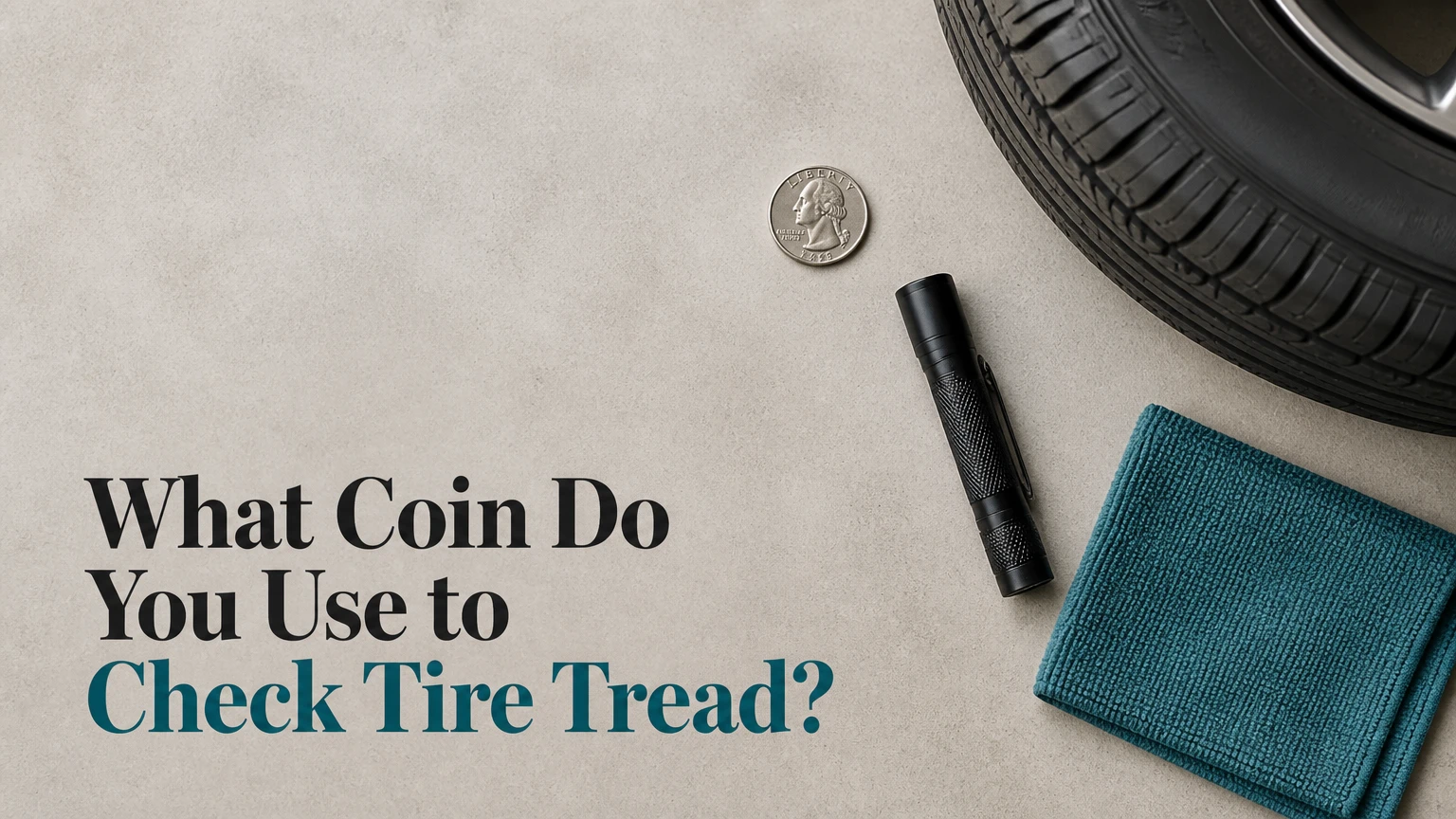
The most common answer to what coin do you use to check tire tread is a U.S. penny, inserted with Lincoln’s head pointing down. A U.S. quarter is often more useful because Washington’s head provides an earlier warning near 4/32 inch, while the penny mainly identifies tread approaching the 2/32-inch minimum.
Key Facts at a Glance
- A penny checks whether tire tread is near 2/32 inch.
- A quarter provides an earlier warning near 4/32 inch.
- Insert the coin with the person’s head pointing down.
- Test the inner, center, and outer tread grooves.
- Replace a tire when tread is flush with its wear bars.
- A tread-depth gauge is more accurate than any coin test.
What Coin Do You Use to Check Tire Tread?
Use a U.S. penny for a basic tire-tread check or a U.S. quarter for a more conservative safety check. The penny helps identify tread near the common 2/32-inch minimum, while the quarter warns you earlier, at approximately 4/32 inch, when wet-road performance may already be declining.
The penny test remains popular because almost every driver can perform it without buying a tool. Insert the penny into a main circumferential groove with Lincoln’s head upside down. If the tread covers part of Lincoln’s head, the groove has more than approximately 2/32 inch remaining. If the entire head remains visible, the tread is extremely worn.
The quarter test follows the same process. Insert the quarter with Washington’s head pointing down. If the tread touches or covers part of his head, the groove has more than approximately 4/32 inch remaining. If the top of his head is visible, start planning tire replacement, especially before heavy rain, snow, or long highway travel.
Is a Penny or Quarter Better for Tire Tread?
A quarter is better for early safety decisions, while a penny is better for identifying tread that has nearly reached the minimum allowable depth. Drivers should use the quarter test first and treat the penny test as a final warning rather than a target for normal replacement.
| Coin | Approximate threshold | What the result tells you | Best use |
| U.S. quarter | 4/32 inch | Wet-road safety margin is decreasing | Early replacement planning |
| U.S. penny | 2/32 inch | Tread is at or near the minimum | Immediate replacement warning |
| Both coins | 2/32 to 4/32 inch | Tire falls within a caution range | Confirm with a gauge |
| No suitable coin | Unknown | Result cannot be standardized | Use a tread-depth gauge |
A tire can still have more than 2/32 inch of tread and perform poorly in standing water. Tread grooves must channel water away from the contact patch. As the grooves become shallower, the tire has less space to move water, so hydroplaning resistance and wet braking can deteriorate before the tread reaches the legal minimum.
For that reason, passing the penny test does not automatically mean the tire is suitable for every condition. A tire that covers Lincoln’s head but fails the quarter test may be adequate for limited dry driving while still being a poor choice for frequent rain, high-speed travel, or an approaching winter season.
How Do You Perform the Penny Test?
The penny test takes about two minutes for all four tires. Park safely, position Lincoln’s head downward in a primary tread groove, and repeat the reading across several locations because a single measurement cannot reveal uneven wear.
Step 1: Park on a Flat Surface
Park the vehicle on level, solid ground and engage the parking brake. Switch off the engine before inspecting the tires.
For easier access to the front tires, turn the steering wheel fully toward one side. This exposes more of the tread surface and helps you reach the inner grooves, where hidden wear often develops.
Step 2: Find a Main Tread Groove
Choose one of the deeper grooves running around the tire’s circumference. Do not measure a shallow decorative channel, the outer shoulder edge, or the top of a tread-wear bar.
Primary grooves are designed to evacuate water and usually contain the molded wear indicators. Select a clear section without stones, packed mud, or debris that could stop the coin from reaching the bottom.
Step 3: Insert Lincoln’s Head Downward
Hold the penny so Lincoln’s face is visible and his head points toward the tire. Push the coin straight into the groove until its edge touches the bottom.
Do not tilt the penny forward or backward. A tilted coin changes the visible distance and can make the tread appear deeper than it is.
Step 4: Read the Result at Eye Level
If the tread covers the top of Lincoln’s head, that location has more than approximately 2/32 inch of tread. If Lincoln’s full head remains visible, the groove is near or below the minimum and the tire should be replaced.
The penny provides only a pass-or-fail estimate. It cannot tell you whether the groove measures 3/32, 5/32, or 7/32 inch. Use a gauge when an exact reading affects your decision.
Step 5: Repeat Across the Tire
Measure the inner groove, center groove, and outer groove. Then repeat the inspection at several points around the tire’s circumference.
A practical inspection includes at least six readings per tire:
- Inner, center, and outer positions near the front of the tire.
- Inner, center, and outer positions after moving the vehicle enough to expose another section.
Different readings matter. A safe reading on the outer groove cannot cancel an unsafe reading near the inner edge.
How Do You Perform the Quarter Test?
Insert a U.S. quarter into the tread groove with Washington’s head pointing down. If the tread covers part of Washington’s head, the groove has more than approximately 4/32 inch remaining. If the top of his head is fully visible, replacement planning should begin.
The testing procedure is otherwise identical to the penny test. Check the primary grooves, keep the coin vertical, and inspect the inner, middle, and outer portions of each tire.
The quarter test is particularly useful for drivers who regularly encounter:
- Heavy seasonal rain
- Standing water
- High-speed interstate travel
- Snow or slush
- Long commutes
- Family road trips
- Mountain or rural roads
A failed quarter test does not prove that a tire is legally bald. It indicates that the available tread has fallen below a more conservative benchmark. Confirm the result with a gauge, then consider the tire’s age, weather exposure, damage, and wear pattern before deciding how soon to replace it.
What Do Tire-Tread Measurements Mean?
Tire tread in the United States is commonly measured in thirty-seconds of an inch. A new passenger tire often starts near 9/32 to 11/32 inch, although performance tires, truck tires, winter tires, and specialty designs may begin at different depths.
| Tread depth | Approximate metric depth | Practical interpretation | Recommended action |
| 10/32 inch | 7.9 mm | Typical deep new-tire range | Continue routine checks |
| 8/32 inch | 6.4 mm | Substantial usable tread | Monitor normal wear |
| 6/32 inch | 4.8 mm | Generally useful all-season depth | Inspect before winter travel |
| 5/32 inch | 4.0 mm | Reduced snow and wet margin | Begin replacement planning |
| 4/32 inch | 3.2 mm | Wet traction concern | Shop for replacement tires |
| 3/32 inch | 2.4 mm | Very limited remaining margin | Replace soon |
| 2/32 inch | 1.6 mm | Wear-bar level | Replace immediately |
These numbers should guide decisions, not replace a complete inspection. A tire with 6/32 inch of tread can still be unsafe if it has sidewall cracking, exposed cords, a bulge, severe cupping, puncture damage, or excessive age.
Similarly, one groove may measure 6/32 inch while another measures 2/32 inch. The lowest valid reading determines the tire’s condition because the worn section remains part of the road-contact area.
Why Is 2/32 Inch Not an Ideal Replacement Target?
Two thirty-seconds of an inch is a final wear limit, not an ideal performance target. Waiting until every tire reaches that depth can leave little reserve for sudden rain, emergency braking, snow, or a long trip.
Tread depth affects how effectively a tire manages water. Deep grooves accept and redirect more water before pressure builds beneath the contact patch. Shallow grooves reach their capacity sooner, especially when vehicle speed increases or water depth rises.
The exact performance loss depends on tire design, compound, road texture, water depth, inflation pressure, load, and speed. A coin cannot evaluate these factors.
A practical rule is to start planning at 4/32 inch instead of waiting for 2/32 inch. Replacement may need to happen sooner when:
- Rain is frequent or intense.
- Winter weather is approaching.
- The vehicle travels at highway speeds daily.
- The tire has irregular wear.
- A long trip is scheduled.
- Another tire on the same axle is already worn.
- The tire has age-related cracking or damage.
How Accurate Is the Coin Test?
A coin test is suitable for a rapid screening check, but it is not a precision measurement. Coin wear, viewing angle, groove selection, insertion depth, lighting, and tread design can all affect the interpretation.
The test is most useful when the answer is obvious. If Lincoln’s full head is visible, the tire is severely worn. If a large portion of Washington’s head disappears, the tread is above the quarter threshold.
Borderline readings are harder to interpret. A driver may see the coin from an angle or choose a groove that is slightly deeper than the worn area beside it. In those situations, a manual or digital tread-depth gauge provides a clearer number.
Honest Limitation
A penny cannot determine whether a tire is structurally sound. The test does not detect internal belt separation, hidden impact damage, rubber hardening, sidewall weakness, repair quality, or load-related problems. It also cannot predict how a specific tire will brake in a storm.
Use the coin method as one part of a tire inspection, not as proof that the tire is completely safe.
What Is the Most Accurate Way to Check Tread?
A tread-depth gauge is the most accurate low-cost method available to most drivers. Manual gauges commonly cost a few dollars, while digital models provide an easy-to-read measurement in millimeters or thirty-seconds of an inch.
| Inspection method | Measurement detail | Typical cost | Main limitation |
| Penny test | Approximate 2/32-inch threshold | $0.01 | No exact measurement |
| Quarter test | Approximate 4/32-inch threshold | $0.25 | Screening result only |
| Wear bars | Indicates about 2/32 inch | Built into tire | Warns very late |
| Manual gauge | Individual 1/32-inch readings | $2-$8 | Requires careful positioning |
| Digital gauge | Numeric inch or millimeter display | $8-$25 | Battery and calibration matter |
| Professional inspection | Tread, damage, pressure, and wear pattern | Often free-$30 | Requires a shop visit |
To use a gauge, place its measuring probe into the groove and press the gauge base flat against the surrounding tread blocks. Record the inner, center, and outer measurements. Repeat at several points around each tire.
For consistent tracking, check the same groove locations monthly and write down the readings. A change from 7/32 to 5/32 inch across a known mileage interval provides more useful maintenance information than a one-time coin test.
What Do Different Readings Across One Tire Mean?
Different readings across one tire usually indicate an inflation, alignment, suspension, rotation, or mechanical problem. The tread pattern identifies the likely category, but a technician may need to inspect the vehicle before the tire is replaced.
| Wear pattern | Likely cause | What to check |
| Center worn faster | Chronic overinflation or load-related pressure mismatch | Cold tire pressure |
| Both shoulders worn | Underinflation | Pressure and possible leakage |
| Inner edge worn | Alignment or suspension geometry | Camber, toe, bushings |
| Outer edge worn | Alignment, cornering, or suspension issue | Toe, driving pattern, joints |
| Alternating high and low spots | Cupping or scalloping | Shocks, struts, balance |
| One isolated worn area | Skidding, braking, or tire defect | Brake operation and tire condition |
| Sawtooth tread edges | Toe misalignment or rotation issue | Alignment and rotation schedule |
The correct response is not simply to install another tire. Replacing a tire without correcting the cause can produce the same wear pattern on the new tread.
For example, a tire worn to 2/32 inch on its inner edge and 5/32 inch on its outer edge has failed the inspection. Averaging those readings would hide the dangerous section.
What Are Tire Wear Bars?
Tire wear bars are raised rubber strips molded across the main tread grooves. When the surrounding tread becomes level with a bar, approximately 2/32 inch remains and the tire has reached its final wear indicator.
Look for small triangles, arrows, or the letters “TWI” on the sidewall. These markings often point toward the wear-bar locations across the tread.
Do not place a coin directly on top of a wear bar. The bar sits above the true bottom of the groove, so it prevents the coin from descending fully and creates a misleading result.
Wear bars are useful because they cannot be misplaced like a separate tool. Their limitation is timing. They identify severe wear but do not provide an early wet-weather warning.
How Often Should You Check Tire Tread?
Check tire tread at least once a month and before long journeys. Inspect it more frequently when the vehicle covers high mileage, carries heavy loads, travels on rough roads, or shows signs of alignment or inflation problems.
Combine the tread inspection with a cold-pressure check. Pressure should be compared with the vehicle manufacturer’s placard, usually located inside the driver’s door area, rather than the maximum pressure printed on the tire sidewall.
Additional inspections are appropriate:
- After striking a pothole or curb
- Before hurricane or winter travel
- Before towing
- After an alignment problem
- When steering pulls to one side
- When vibration develops
- When road noise changes
- After a tire-pressure warning
- Before buying a used vehicle
Routine inspections reveal trends. A single reading shows current depth, while repeated readings show how quickly and how evenly the tire is wearing.
What Mistakes Make the Coin Test Unreliable?
The most common mistake is checking only one easily visible groove. Inner-edge wear can be severe even when the outside tread appears acceptable.
Other frequent errors include:
- Placing the coin on a wear bar: This produces a falsely shallow reading.
- Using a shoulder groove: Small shoulder channels may not represent the main tread depth.
- Tilting the coin: A diagonal coin changes the visible reference point.
- Reading from above: View the coin close to eye level.
- Leaving stones in the groove: Debris can prevent full insertion.
- Checking only one tire: Front and rear tires often wear at different rates.
- Ignoring the lowest reading: Tire safety is determined by the most worn valid location.
- Treating a pass as complete approval: The coin test does not evaluate cracks, bulges, age, or internal damage.
- Checking immediately after unusual loading: Heavy cargo can change tire shape and access, though it does not restore worn tread.
- Assuming all coins provide standard measurements: Coin dimensions and designs differ by country.
A clean, vertical, repeatable test is more valuable than several rushed readings.
What Can You Use Without a U.S. Coin?
Use a calibrated tread-depth gauge when a U.S. penny or quarter is unavailable. A gauge avoids uncertainty caused by different coin sizes, border widths, portraits, wear, and national designs.
Some countries promote local coin tests. A British 20p coin, for example, is commonly used as a visual check against the coin’s outer border. However, drivers should follow the method intended for that specific coin and jurisdiction rather than improvising with any coin that fits into a groove.
The safest universal approach is:
- Purchase a gauge marked in millimeters and thirty-seconds of an inch.
- Check the legal tread requirement where the vehicle is registered or driven.
- Measure the tire’s main grooves at multiple locations.
- Use the lowest reading for your decision.
- Replace the tire earlier when weather or driving conditions justify it.
A ruler is usually difficult to position accurately inside a narrow tread groove. A gauge is faster and more repeatable.
Should All Four Tires Be Replaced Together?
All four tires do not always require replacement, but tread differences, drivetrain type, tire size, and manufacturer requirements affect the decision. All-wheel-drive vehicles can be particularly sensitive to differences in tire circumference.
Replacing tires in axle pairs is a common practice when only two are worn. The new or deeper-tread tires are generally placed on the rear axle to improve rear stability on wet roads, even when the vehicle uses front-wheel drive.
Before mixing new and used tires, compare:
- Tire size
- Load index
- Speed rating
- Construction type
- Tread pattern
- Remaining tread depth
- Vehicle manufacturer instructions
- All-wheel-drive tolerance
A tire shop can measure circumference and tread depth before recommending one, two, or four replacements. Shaving a new tire to match existing tread is available in some situations, but it sacrifices usable rubber and should be evaluated against replacing a complete set.
When Should You Stop Driving on a Worn Tire?
Stop normal driving when tread has reached the wear bars, cords or belts are visible, a bulge appears, the tire repeatedly loses pressure, or severe vibration suggests structural damage. Arrange professional inspection or replacement instead of relying on another coin reading.
Immediate attention is also warranted when:
- One section is worn below the rest.
- A cut exposes internal material.
- The tire has a sidewall bubble.
- Tread is separating from the casing.
- A puncture lies in the sidewall or shoulder.
- The vehicle pulls suddenly.
- The tire makes rhythmic thumping sounds.
- Rubber is deeply cracked or missing.
A coin test should never overrule visible damage. Tread depth is only one part of tire condition.
Expert Rules for Interpreting Coin Tests
Rule 1: Use the Quarter Before the Penny
The quarter provides an earlier decision point. If the tire fails the quarter test, measure it with a gauge and begin replacement planning instead of waiting for Lincoln’s full head to appear.
Rule 2: Record the Lowest Reading
Do not average safe and unsafe measurements. A 2/32-inch inner groove makes the tire worn even when the outer groove measures 5/32 inch.
Rule 3: Correct the Cause of Uneven Wear
New tires cannot correct bad alignment, worn suspension components, incorrect pressure, or a missed rotation schedule. Diagnose the pattern before the replacement tire develops the same damage.
Rule 4: Consider the Next Driving Conditions
A tire may have enough tread for a few dry local trips but not enough reserve for a rainy interstate journey. Replacement timing should consider what the vehicle must do next, not only what it did yesterday.
Frequently Asked Questions
Can I use a dime to check tire tread?
A dime is not the standard U.S. coin for checking tire tread because its design does not provide the commonly recognized 2/32-inch or 4/32-inch reference points. Use a penny, quarter, built-in wear bars, or a calibrated tread-depth gauge for a clearer and more repeatable result.
Does Lincoln face up or down in the tire test?
Lincoln’s head should point downward into the tread groove. Insert the penny vertically until its edge reaches the bottom of the groove. If the tread covers part of Lincoln’s head, more than approximately 2/32 inch remains at that location.
Does Washington face up or down in the quarter test?
Washington’s head should point downward into the main tread groove. If the tread covers the top of his head, the groove has more than approximately 4/32 inch remaining. A fully visible head indicates that replacement planning should begin.
Can a tire pass the penny test and still be unsafe?
Yes. A tire can cover part of Lincoln’s head yet have reduced wet traction, hidden inner-edge wear, cracking, a bulge, a puncture, or internal damage. The penny test estimates one tread-depth threshold and cannot confirm the tire’s complete structural or performance condition.
How much tread does a new tire have?
Many new passenger tires have approximately 9/32 to 11/32 inch of tread. The exact starting depth varies by tire model and purpose. Winter, all-terrain, commercial, high-performance, and fuel-efficient tires may use different tread depths and block designs.
Is 4/32 inch enough tire tread?
Four thirty-seconds of an inch is above the common 2/32-inch wear limit, but it is an important replacement-planning point. Drivers who encounter frequent rain, snow, standing water, or high-speed travel should not assume that 4/32 inch provides the same traction as deeper tread.
The Bottom Line
A U.S. penny is the traditional answer to what coin do you use to check tire tread, but a quarter gives a more useful early warning. Use Lincoln’s head to identify tread near 2/32 inch and Washington’s head to check for approximately 4/32 inch.
Insert the coin headfirst into several main grooves across every tire. Treat the lowest reading as the deciding measurement, and use a tread-depth gauge when the result is close or uneven. Replace tires at the wear bars, sooner when weather, damage, or driving conditions demand a greater safety margin.