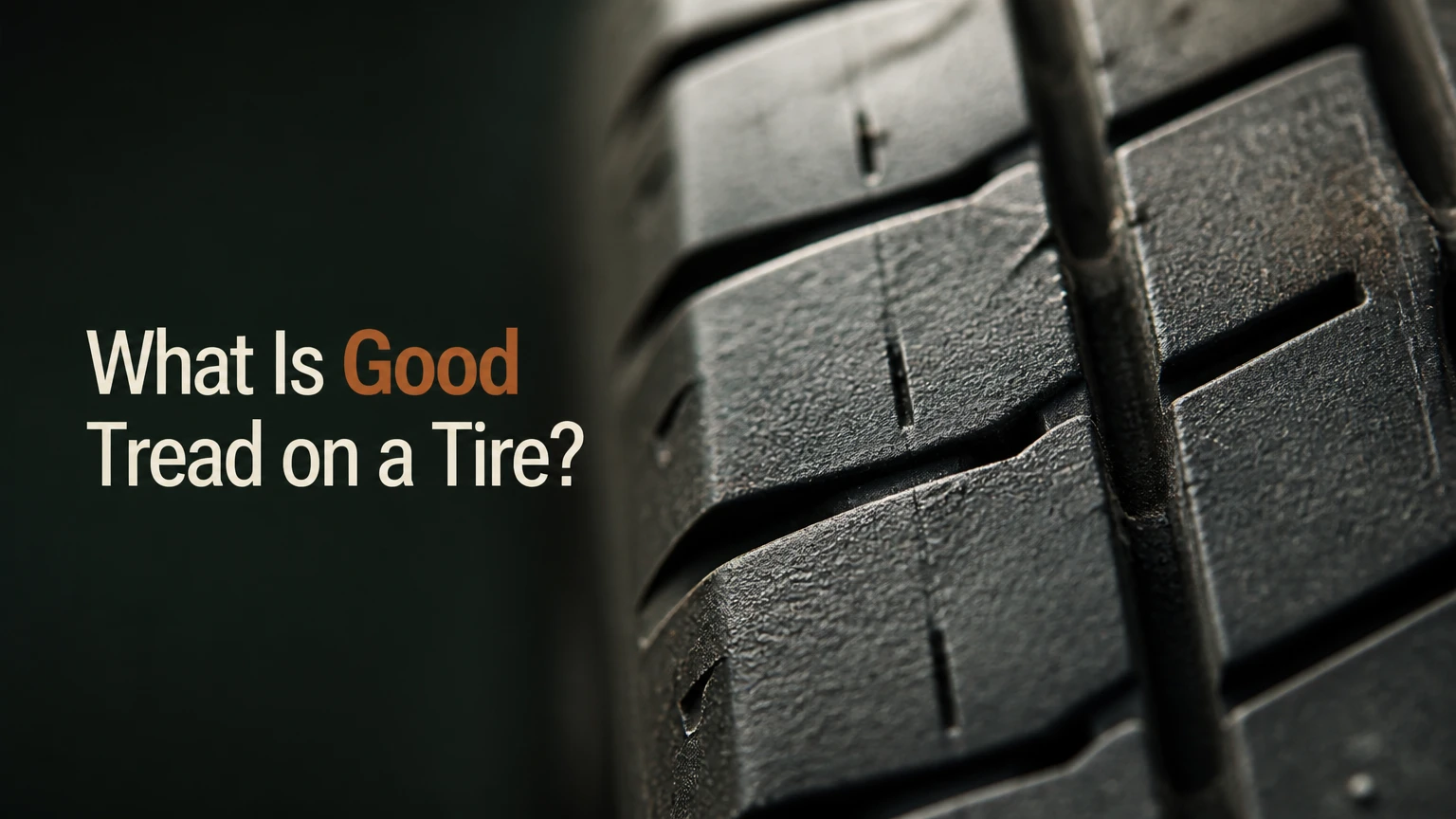
Good tread on a tire is generally 6/32 inch, or about 4.8 mm, of remaining depth or more. A tire at 4/32 inch may still be usable, but wet-road performance has already declined, while 2/32 inch is the worn-out replacement threshold recognized by U.S. tire-safety guidance.
Key Facts at a Glance
- 6/32 inch or deeper provides a strong tread-depth margin for normal all-season driving.
- 4/32 inch is the practical replacement-planning point for frequent rain or standing water.
- 2/32 inch is a worn-out threshold, not a desirable operating target.
- Most new passenger tires begin with approximately 9/32 to 11/32 inch of tread, although designs vary.
- Tread must be measured across multiple grooves and around the tire.
- Bulges, exposed cords, deep cracks, or irregular wear can require replacement regardless of tread depth.
What Tire Tread Depth Is Considered Good?
A tread depth of 6/32 inch or more is a useful general definition of good tire tread because the grooves still retain substantial space for moving water away from the contact patch. A reading between 5/32 and 6/32 inch is normally serviceable, but the driver should begin monitoring wear more closely.
Tread depth is only one part of tire condition. A tire with 7/32 inch remaining can still be unsafe if it has a sidewall bulge, exposed reinforcement, severe cracking, impact damage, or uneven wear that leaves one section nearly bald.
| Remaining depth | Metric equivalent | Practical condition | Recommended action |
| 9/32-11/32 in. | 7.1-8.7 mm | Typical new-tire range | Inspect monthly |
| 7/32-8/32 in. | 5.6-6.4 mm | Strong remaining tread | Continue normal monitoring |
| 6/32 in. | 4.8 mm | Good general tread | Suitable for normal use if evenly worn |
| 5/32 in. | 4.0 mm | Usable, partly worn | Monitor rain and winter performance |
| 4/32 in. | 3.2 mm | Wet-weather replacement point | Plan replacement in rainy conditions |
| 3/32 in. | 2.4 mm | Near the worn-out limit | Replace soon |
| 2/32 in. | 1.6 mm | Worn out | Replace immediately |
Michelin advises that wet-road braking performance begins to decline noticeably around 4/32 inch because a worn tire has less groove volume available to channel water. NHTSA states that tires should be replaced once tread reaches 2/32 inch.
What Does Tire Tread Actually Do?
Tire tread creates traction while managing water, loose material, temperature, noise, and tread-block movement. On a dry surface, the rubber compound and contact-patch design produce grip. On wet pavement, grooves and channels must also move water away before pressure builds beneath the tire.
A tread pattern contains several working parts:
- Tread blocks or lugs: Raised rubber sections that contact the road.
- Ribs: Continuous rows that support steering stability and straight-line tracking.
- Circumferential grooves: Channels running around the tire that collect and move water.
- Lateral grooves: Crossways passages that direct water toward the tread edges.
- Sipes: Narrow cuts that create additional biting edges, particularly on wet, snowy, or icy surfaces.
- Wear bars: Raised indicators molded into grooves at approximately 2/32 inch.
Tread depth measures the vertical distance from the top of a tread block to the bottom of a main groove. Measurements should be taken in the primary grooves, not on top of wear bars, stone ejectors, or shallow decorative channels.
Why Does Tread Depth Matter More in Rain?
Tread depth matters in rain because a rolling tire must provide space for water to escape from beneath the contact patch. As grooves become shallower, they hold and discharge less water, increasing the chance that the tire will lose direct contact with the pavement.
Hydroplaning is not controlled by tread depth alone. Vehicle speed, water depth, tire pressure, tire width, tread design, pavement condition, and vehicle load also influence the result. A tire with 6/32 inch can still hydroplane when driven too fast through deep standing water.
The practical rule is simple: the closer tread gets to 4/32 inch, the less safety margin the driver has in heavy rain. Reduce speed, increase following distance, avoid sudden steering inputs, and replace the tires earlier when frequent storms are part of normal driving. Michelin specifically identifies 4/32 inch as the level at which wet-road performance becomes noticeably reduced compared with a new tire.
Is 2/32 Inch a Safe Tread Depth?
No. A measurement of 2/32 inch is a worn-out replacement threshold, not a recommended definition of good tread. NHTSA’s guidance is direct: “Tires are not safe and should be replaced when the tread is worn down to 2/32 of an inch.”
Wear bars become level with the surrounding tread at approximately this depth. Once the tread surface is flush with a wear bar, the tire has exhausted its intended usable tread.
The 2/32-inch figure also should not be described as one universal legal rule for every driver worldwide. Legal requirements vary by country, state, vehicle class, tire location, and tire type. Drivers should check local regulations, but a local minimum should never override visible damage or poor wet-weather performance.
Waiting for 2/32 inch may save a small amount of tread life, but it leaves little reserve for emergency braking in rain. Drivers in storm-prone regions should normally begin replacement planning around 4/32 inch.
How Do You Measure Tire Tread Correctly?
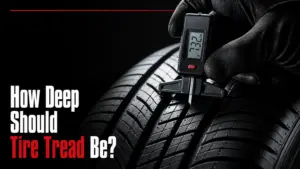
A tread-depth gauge is the most accurate home measurement method. Check each tire across its inner, center, and outer grooves, then repeat the measurements at several points around the circumference.
Step 1: Park on a Safe, Level Surface
Park away from traffic, engage the parking brake, switch off the engine, and allow the tires to cool. Turn the steering wheel to expose the tread face of each front tire.
Do not inspect a tire while the vehicle is supported only by a jack. A normal tread check does not require lifting the vehicle.
Step 2: Inspect for Damage Before Measuring
Look for cuts, puncturing objects, bubbles, sidewall bulges, exposed cords, separated rubber, deep cracking, or a localized flat spot. Any of these conditions may be more urgent than the tread-depth reading.
Run your hand lightly over the tread to identify cupping or feathering, but avoid protruding wire, glass, or metal.
Step 3: Use a Tread-Depth Gauge
Place the gauge base flat against adjacent tread blocks and extend its probe into a main groove. Keep the gauge perpendicular to the tread, then record the measurement.
Digital and mechanical gauges usually display either 32nds of an inch, millimeters, or both. Inexpensive gauges are more precise than judging tread by appearance alone.
Step 4: Measure Every Zone
Take readings at the following locations:
- Inner main groove
- Center main groove
- Outer main groove
- At least two additional positions around the tire
The tire’s condition should be judged by its lowest valid reading, not its average. A tire measuring 6/32 inch on the outside and 2/32 inch on the inside is worn out even though most of the tread appears usable.
Step 5: Compare All Four Tires
Compare side-to-side and front-to-rear measurements. A large difference can point to missed rotations, incorrect inflation, alignment problems, worn suspension parts, or drivetrain-specific wear.
Michelin recommends measuring several places across and around the tire rather than relying on one groove. NHTSA also advises checking tread at least monthly when checking tire pressure.
Can You Check Tread Without a Gauge?
Yes, but coin tests provide approximate thresholds rather than precise measurements. They are useful for identifying a tire near a replacement limit, although a tread gauge remains the better tool.
| Inspection method | Approximate threshold | Main advantage | Main limitation |
| Tread-depth gauge | Exact displayed reading | Measures wear precisely | Requires a small tool |
| Quarter test | About 4/32 in. | Useful wet-weather warning | Depends on coin and placement |
| Penny test | About 2/32 in. | Fast worn-out check | Detects wear very late |
| Wear-bar inspection | About 2/32 in. | Built into the tire | Does not show remaining depth above the bar |
For the penny test, place a U.S. penny into a main groove with Lincoln’s head pointing down. If the top of Lincoln’s head remains visible, the tread is approximately 2/32 inch or less and the tire should be replaced. NHTSA recognizes this method as a basic worn-tread check.
The quarter test offers an earlier warning. Insert a quarter with Washington’s head downward. If the tread does not reach the top of the head, the measurement is near or below 4/32 inch. Because coins can tilt or sit on debris, verify the result with a gauge.
How Does Good Tread Differ by Driving Condition?
Good tread depends partly on the conditions the tire must handle. Six thirty-seconds may be satisfactory for normal all-season driving, while a driver facing deep snow may need a larger reserve.
| Driving situation | Preferred remaining tread | Why the extra depth matters |
| Mostly dry urban roads | 4/32-6/32 in. or more | Allows normal drainage and braking margin |
| Frequent heavy rain | 6/32 in. or more | Preserves groove volume for water evacuation |
| Light winter conditions | At least 5/32-6/32 in. | Maintains usable snow channels and biting edges |
| Deep or frequent snow | About 6/32 in. or more | Helps the tread pack, release, and grip snow |
| Off-road mud or loose terrain | Pattern-specific, often above 6/32 in. | Deep voids must clear loose material |
| Performance driving | Condition-specific | Heat cycles and compound condition matter with depth |
Winter tires can become unsuitable for snow before reaching 2/32 inch. Michelin notes that many tire-safety organizations recommend winter-tire replacement at 4/32 inch to retain adequate cold-weather grip.
Depth also cannot convert the wrong tire into the right one. An all-season tire with deep tread may still lack the compound and pattern required for severe winter conditions. Likewise, an aggressive all-terrain pattern may have deep tread but produce more noise and less precise dry-road behavior than a touring tire.
Which Tread Pattern Is Best?
No tread pattern is best for every driver. Symmetrical patterns emphasize quiet operation and rotation flexibility, asymmetrical patterns divide wet and cornering functions across the tread, and directional patterns emphasize forward water evacuation.
| Tread pattern | Identifying feature | Typical strength | Rotation or mounting rule |
| Symmetrical | Same design across the tread | Quiet wear and flexible rotation | Usually supports multiple rotation patterns |
| Asymmetrical | Different inner and outer zones | Wet drainage plus cornering support | “Inside” and “outside” markings must be followed |
| Directional | V-shaped or arrow-like pattern | Strong forward water evacuation | Rotation direction must follow sidewall arrow |
| Hybrid all-terrain | Larger blocks and wider voids | Loose-surface traction | Follow manufacturer-specific instructions |
Directional tires mounted backward cannot channel water as designed. Asymmetrical tires mounted inside-out place the wrong tread zone at the outer shoulder. Neither problem can be diagnosed by tread depth alone, so sidewall markings should be checked after installation or rotation.
Avoid mixing substantially different tread designs, sizes, load ratings, or performance categories on the same axle unless the vehicle and tire manufacturers permit the combination.
What Do Uneven Tread Patterns Mean?
Uneven tread often indicates a vehicle or maintenance problem rather than ordinary tire aging. Measure the full tread width because the most dangerous wear may be hidden on the inner shoulder.
| Wear pattern | Likely contributors | Required response |
| Center worn faster | Excess inflation, incorrect pressure for load | Set cold pressure to vehicle specification |
| Both shoulders worn | Underinflation, overloading | Correct pressure and inspect for leakage |
| One shoulder worn | Camber or toe misalignment | Inspect alignment and suspension |
| Feathered tread edges | Incorrect toe setting | Perform alignment diagnosis |
| Cupped or scalloped areas | Worn shocks, imbalance, loose components | Inspect suspension and balance |
| Flat spot | Hard braking, storage, tire defect | Diagnose cause and assess replacement |
| Front tires worn faster | Steering and braking load, missed rotations | Follow the vehicle’s rotation schedule |
Inflation should be set from the vehicle placard, usually located on the driver’s door jamb, not from the maximum pressure molded on the tire sidewall. The sidewall figure is a maximum-rating reference, not the normal target pressure for the vehicle.
Rotating tires at the interval in the owner’s manual helps distribute wear. Bridgestone gives 5,000 miles as a general fallback when the vehicle manufacturer does not provide another interval.
When Should a Tire Be Replaced Despite Good Tread?
A tire should be replaced when it has structural damage, exposed reinforcement, a non-repairable puncture, severe cracking, or separation, even when the gauge shows more than 6/32 inch. Tread depth cannot prove that the casing and sidewall remain sound.
Replacement may also be necessary when:
- A sidewall has a bubble or bulge.
- Cords or belts are visible.
- A puncture lies in the sidewall or shoulder.
- The tread has separated from the casing.
- A previous repair is leaking or improperly installed.
- The tire repeatedly loses pressure.
- Vibration persists after balancing and mechanical inspection.
- Rubber condition has deteriorated with age or environmental exposure.
There is no single tread-only formula for tire age. Storage, heat, sunlight, pressure history, load, usage, and manufacturer guidance all affect serviceability. Check the tire identification code to determine its manufacturing date and have older tires inspected professionally.
Should Two or Four Tires Be Replaced?
Replace all four when tread wear, age, vehicle requirements, or drivetrain sensitivity make a matched set necessary. All-wheel-drive vehicles can be particularly sensitive to differences in rolling circumference, so the permitted tread-depth variation should be confirmed in the owner’s manual.
When replacing only two tires, major tire-industry guidance generally places the tires with deeper tread on the rear axle. Better rear traction reduces the risk of the rear tires losing grip first during wet cornering. USTMA advises pairing a single replacement with the deepest remaining tire and installing that pair on the rear when a single-tire replacement cannot be avoided.
Partial replacement still requires compatibility. Match the specified tire size, construction, load index, speed rating, and category unless the vehicle manufacturer authorizes an alternative.
How Much Usable Tread Does a Tire Have Left?
Usable tread is calculated by subtracting the replacement threshold from the current measurement. A tire at 6/32 inch has 4/32 inch remaining before the 2/32-inch worn-out point, but only 2/32 inch before reaching the 4/32-inch wet-weather planning threshold.
For example:
- Current measurement: 7/32 inch
- Wet-weather planning point: 4/32 inch
- Practical wet-weather reserve: 3/32 inch
- Worn-out threshold: 2/32 inch
- Total measurable reserve to worn-out: 5/32 inch
Remaining mileage cannot be calculated accurately from tread depth alone. A tire that lost 2/32 inch over 10,000 miles will not necessarily continue wearing at exactly the same rate because alignment, pressure, rotation, road temperature, driving style, and vehicle load can change.
Measure tread at consistent intervals and record the results. A sudden increase in wear rate is more diagnostically useful than a one-time mileage estimate.
How Do You Evaluate Tread on a Used Tire?
A used tire should have sufficient depth across its entire tread, compatible specifications, no structural damage, and a traceable age. One deep groove does not prove that the tire is a safe purchase.
Use this checklist before buying:
- Measure every main groove at several points.
- Reject any tire at or near 2/32 inch.
- Prefer more than 4/32 inch for regular wet-weather driving.
- Check both shoulders for hidden alignment wear.
- Inspect the inner sidewall, not only the visible outer sidewall.
- Look for patches, plugs, exposed cords, cracks, and bulges.
- Confirm size, load index, speed rating, and construction.
- Read the manufacturing-date code.
- Compare the tread pattern and depth with the tires already installed.
- Include mounting, balancing, valve, disposal, and alignment costs in the price.
A cheap used tire with 4/32 inch remaining may deliver little economic value once installation costs are added. A deeper tire can still be a poor purchase when it is old, damaged, mismatched, or irregularly worn.
Common Tire-Tread Inspection Mistakes
The most common mistake is checking only the visible outside shoulder. Alignment wear often develops on the inner edge, where the driver cannot see it during a casual walk-around.
Other frequent errors include:
- Measuring a shallow decorative groove instead of a main groove.
- Resting the gauge probe on a wear bar.
- Averaging readings instead of using the lowest measurement.
- Assuming 2/32 inch means safely usable.
- Ignoring pressure and structural damage.
- Checking only one tire.
- Treating a coin test as an exact measurement.
- Assuming deep tread guarantees a suitable winter tire.
- Failing to investigate rapid or uneven wear.
Practitioner rule of thumb: Record three measurements per tire during each pressure check. The pattern across time often reveals alignment or inflation problems before the tire looks visibly bald.
Counterintuitive truth: More tread depth does not always mean more dry-road responsiveness. Deep tread blocks can move more under cornering load, while worn tread has less water capacity. Tire engineering must balance wet grip, dry response, rolling resistance, noise, and service life.
The Bottom Line
Good tread on a tire is approximately 6/32 inch or deeper, provided the tire is evenly worn, properly inflated, correctly mounted, and free from structural damage. At 4/32 inch, begin planning replacement when wet roads are common. At 2/32 inch, the tire is worn out and should be removed from service.
Measure every tire monthly with a tread-depth gauge. Use the lowest reading across the tread, investigate uneven wear, and replace damaged tires regardless of how much tread appears to remain.
Frequently Asked Questions
Is 7/32-inch tire tread good?
Yes. A tread depth of 7/32 inch is generally considered good for a passenger tire because it remains above the 6/32-inch benchmark and retains substantial groove depth. Confirm that the reading is consistent across the inner, center, and outer tread and that the tire has no cracking, bulges, or irregular wear.
Is 5/32-inch tread still safe?
A tire at 5/32 inch is normally usable when it is evenly worn and undamaged, but it has less wet-weather reserve than a tire at 6/32 inch or deeper. Monitor it closely, increase following distance during rain, and begin budgeting for replacement before it reaches 4/32 inch.
How often should tire tread be checked?
Check tire tread at least once per month and before long trips. Measure tread while checking cold tire pressure, and inspect again after striking a pothole, noticing vibration, finding unusual pressure loss, or seeing a change in steering behavior. NHTSA recommends a monthly tread check alongside tire-pressure inspection.
Do front tires wear faster than rear tires?
Front tires often wear faster on front-wheel-drive vehicles because they handle steering, much of the braking load, and engine torque. The exact pattern depends on drivetrain, alignment, pressure, suspension, load, and driving style. Regular rotation helps distribute wear, but the vehicle manufacturer’s pattern and interval should be followed.
Can an alignment restore lost tire tread?
No. A wheel alignment can correct the geometry causing future uneven wear, but it cannot restore rubber already removed from the tire. A severely worn inner or outer shoulder may require replacement even when the alignment problem is corrected immediately.
Are wear bars enough to check tire safety?
Wear bars identify when tread has reached approximately 2/32 inch, but they do not warn early enough for drivers who need strong rain or snow performance. Use a tread-depth gauge to track wear before the bars become flush. NHTSA and USTMA identify flush wear indicators as a sign that replacement is due.