Tread depth is the vertical distance from the top of a tire’s tread blocks to the bottom of its main grooves. It is normally measured in 32nds of an inch in the United States or millimeters elsewhere, and it helps determine how effectively a tire can evacuate water, grip loose surfaces, and maintain control as it wears.
Key Facts at a Glance
- Most new passenger tires begin with approximately 10/32 to 11/32 inch of tread.
- A tread depth of 2/32 inch equals approximately 1.6 millimeters.
- NHTSA advises replacing tires when the tread reaches 2/32 inch.
- Wet-weather performance can deteriorate before a tire reaches the legal minimum.
- A tread-depth gauge provides a more useful measurement than a coin test.
- Unequal readings across one tire often indicate inflation, alignment, balance, or suspension problems.
What Is Tread Depth on a Tire?
Tire tread depth measures the remaining height of the rubber pattern that contacts and manages the road surface. The measurement starts at the lowest point of a major circumferential groove and ends at the top of the adjacent tread block.
Tread depth does not measure the complete thickness of the tire. Rubber, steel belts, body plies, inner liner material, and other structural components remain beneath the visible grooves. Cutting or driving beyond the usable tread therefore risks exposing structural material rather than revealing additional safe rubber.
Tire Rack defines tread depth as the vertical measurement from the top of the tread rubber to the bottom of the deepest grooves. It reports that average new car tires usually begin at 10/32 to 11/32 inch.
Three related terms are useful:
| Term | Meaning | Example for a 10/32-inch tire |
|---|---|---|
| Original tread depth | Depth when the tire is new | 10/32 inch |
| Remaining tread depth | Depth visible during inspection | 6/32 inch |
| Worn-away tread | Original depth minus remaining depth | 4/32 inch |
| Usable tread depth | Original depth minus the 2/32-inch endpoint | 8/32 inch |
| Usable tread consumed | Worn tread divided by usable tread | 50% |
A tire that began at 10/32 inch and now measures 6/32 inch has lost 4/32 inch. Because only 8/32 inch exists between its original depth and the 2/32-inch replacement point, it has consumed 50 percent of its nominal usable tread, not 40 percent.
Why Does Tire Tread Depth Matter?
Tire tread depth matters most when water, snow, mud, gravel, or debris separates the rubber from a stable road surface. Deeper grooves provide more open volume through which these materials can move before they interfere with the tire’s contact patch.
NHTSA states that tread supplies the gripping action that helps prevent a vehicle from slipping, particularly on wet or icy roads. The agency advises monthly tread checks and replacement when wear reaches 2/32 inch.
How Tread Moves Water
A rolling tire pushes water toward its circumferential and lateral channels. Those channels direct the water away from the portion of the tire carrying the vehicle’s load.
As the grooves become shallower, their capacity falls. At sufficient road speed or water depth, the tire may encounter water faster than the pattern can evacuate it. Hydraulic pressure then reduces direct rubber-to-road contact, producing partial or complete hydroplaning.
Vehicle speed, water depth, tire pressure, tread design, tread depth, load, and pavement texture all influence hydroplaning. Tread depth is therefore important, but no single tread measurement guarantees protection in every storm.
Does Deeper Tread Always Provide More Grip?
Deeper tread does not automatically provide better performance in every condition. Large tread blocks can move or squirm under cornering and braking forces, while shallow performance-tire patterns may use broad, stiff blocks that increase dry-road contact.
This creates a practical trade-off:
- Deep, open patterns favor water, mud, loose gravel, and snow evacuation.
- Broad, rigid blocks favor steering response and dry-road stability.
- Numerous small sipes help create biting edges on snow and ice.
- A worn pattern may still feel acceptable in dry weather while losing substantial wet-weather capability.
Tread depth should therefore be interpreted with the tire’s design and intended service, not as an isolated quality score.
How Is Tread Depth Measured?
Tread depth is commonly expressed in 32nds of an inch or millimeters. A reading of 8/32 inch means the groove is eight thirty-seconds of an inch deep, which simplifies to one-quarter inch but remains written as 8/32 for tire comparison.
Tread Depth Conversion Chart
| 32nds of an inch | Decimal inches | Millimeters | General interpretation |
|---|---|---|---|
| 12/32 | 0.375 | 9.5 mm | Deep new tread |
| 10/32 | 0.313 | 7.9 mm | Typical new passenger tire |
| 8/32 | 0.250 | 6.4 mm | Light to moderate wear |
| 6/32 | 0.188 | 4.8 mm | Serviceable, monitor winter use |
| 5/32 | 0.156 | 4.0 mm | Reduced snow capability |
| 4/32 | 0.125 | 3.2 mm | Reduced wet-weather margin |
| 3/32 | 0.094 | 2.4 mm | Near replacement |
| 2/32 | 0.063 | 1.6 mm | Replacement threshold |
| 1/32 | 0.031 | 0.8 mm | Severely worn |
Millimeter values are rounded. A digital gauge may display more decimal places, but that apparent precision does not eliminate variation between grooves or measurement locations.
What Is a Good Tire Tread Depth?
A good tread depth depends on the tire type, weather, vehicle use, and how soon the driver may encounter rain or snow. For an ordinary passenger vehicle, 6/32 inch or more generally leaves substantial usable tread, while 4/32 inch signals that replacement planning should begin for regular wet-weather driving.
The following chart separates practical planning thresholds from the final 2/32-inch endpoint.
| Remaining depth | Metric equivalent | Practical condition | Recommended action |
|---|---|---|---|
| 10/32 or more | 7.9 mm or more | New or near new | Record baseline and maintain pressure |
| 8/32 to 9/32 | 6.4-7.1 mm | Light wear | Continue monthly inspection |
| 6/32 to 7/32 | 4.8-5.6 mm | Moderate wear | Monitor snow and slush performance |
| 5/32 | 4.0 mm | Winter capability declining | Plan winter-tire replacement |
| 4/32 | 3.2 mm | Wet traction reduced | Shop for replacement before heavy-rain use |
| 3/32 | 2.4 mm | Little remaining margin | Replace promptly |
| 2/32 | 1.6 mm | Worn-out threshold | Replace immediately |
| Below 2/32 | Below 1.6 mm | Severely worn | Avoid driving except for necessary service |
Tire Rack classifies 4/32 inch as reduced wet traction, 3/32 inch as critically low, and 2/32 inch as the level regarded as legally worn in most states.
Practitioner insight: Do not treat 2/32 inch as a target service life. It is an endpoint. A driver who regularly travels at highway speeds in heavy rain needs more reserve than a driver operating slowly in a dry environment.
How Deep Is the Tread on a New Tire?
Most new passenger and all-season tires start near 10/32 or 11/32 inch, but original depth varies considerably by model. Performance tires may use shallower patterns, while winter and off-road products commonly use deeper grooves.
| Tire category | Typical new depth | Metric range | Design priority |
|---|---|---|---|
| Touring passenger tire | 10/32-11/32 | 7.9-8.7 mm | Comfort, mileage and all-season use |
| Performance summer tire | 8/32-10/32 | 6.4-7.9 mm | Dry response and cornering stability |
| Winter tire | 11/32-13/32 | 8.7-10.3 mm | Snow retention, slush evacuation and biting edges |
| Highway light-truck tire | 11/32-15/32 | 8.7-11.9 mm | Load support and road mileage |
| All-terrain tire | 13/32-17/32 | 10.3-13.5 mm | Mixed pavement, gravel and light mud |
| Mud-terrain tire | 16/32-22/32 | 12.7-17.5 mm | Large voids and self-cleaning in mud |
These are typical ranges rather than universal specifications. Always compare a used tire with the manufacturer’s original specification for that exact model and size.
A new performance tire with 9/32 inch is not automatically more worn or inferior to a touring tire with 11/32 inch. Their compounds, void ratios, block shapes, internal construction, and intended conditions differ.
How Do You Measure Tire Tread Depth?
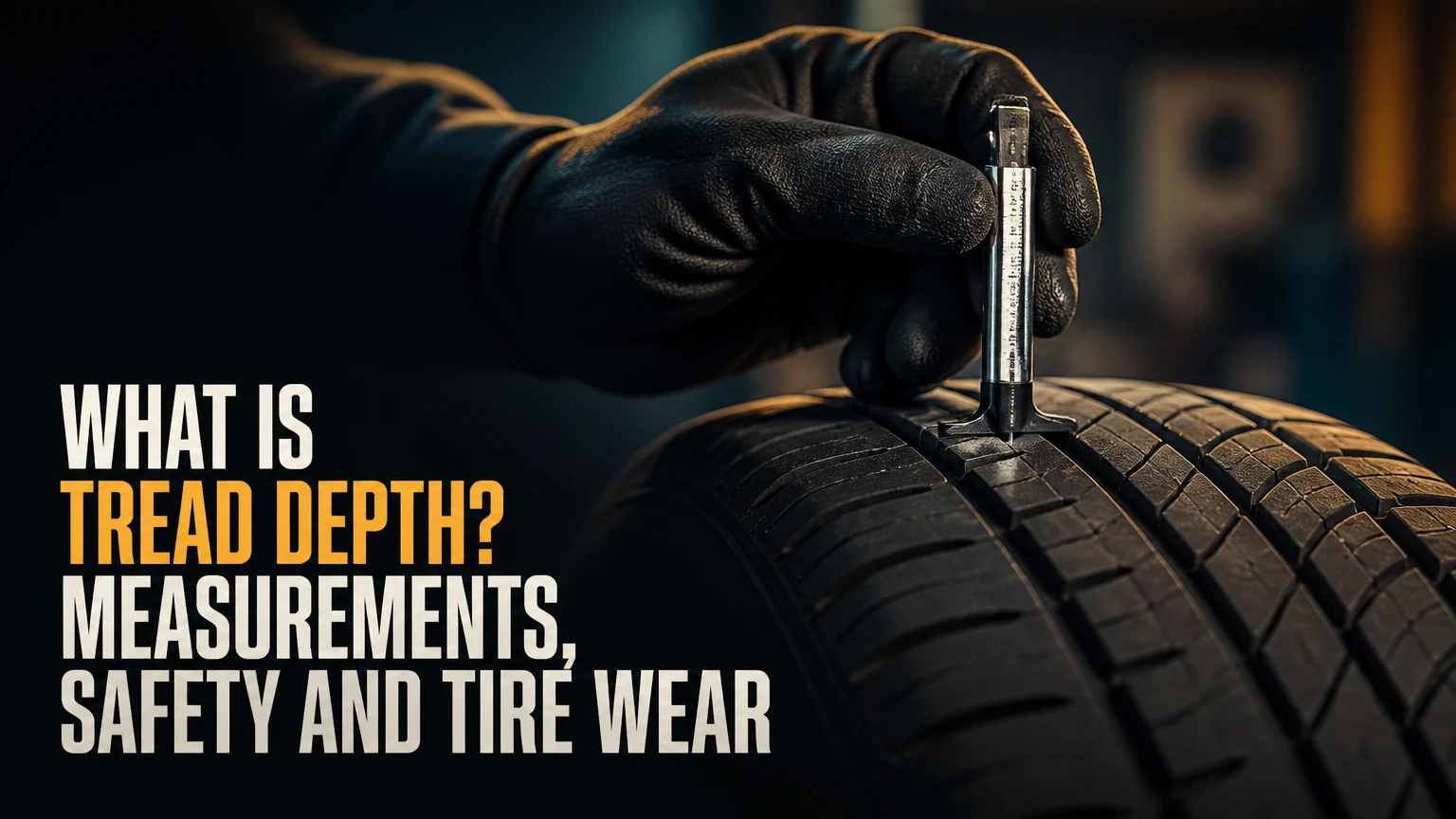
The most reliable home method uses a dedicated tread-depth gauge. Measure each tire in multiple grooves and across the inner, center, and outer portions of the tread because one reading cannot identify localized wear.
Using a Tread-Depth Gauge
- Park on a level surface. Set the parking brake and allow the tires to cool.
- Expose the tread. Turn the steering wheel to make the front tires easier to inspect.
- Extend or reset the probe. Follow the gauge’s zeroing instructions.
- Choose a major groove. Avoid raised wear bars, small decorative grooves, stones, and damaged areas.
- Insert the probe vertically. Place the base flat against the surrounding tread blocks.
- Read and record the measurement. Do not tilt the gauge.
- Repeat across the tire. Measure the inner, center, and outer tread at several points around the circumference.
- Use the lowest reliable reading. Recheck any result that differs sharply from adjacent measurements.
Tire Rack recommends a tread-depth gauge because a ruler is difficult to position accurately within the grooves.
A useful inspection record might read:
| Tire position | Inner | Center | Outer | Interpretation |
|---|---|---|---|---|
| Left front | 4/32 | 5/32 | 6/32 | Excess inner wear |
| Right front | 5/32 | 5/32 | 5/32 | Even wear |
| Left rear | 7/32 | 7/32 | 7/32 | Even wear |
| Right rear | 7/32 | 6/32 | 7/32 | Mild center wear |
In this example, the left-front tire’s lowest reading controls the immediate safety decision. The three-value pattern also suggests an alignment inspection rather than normal uniform wear.
How Often Should You Check It?
Check tread depth monthly, before long trips, before a wet or snowy season, and whenever the vehicle develops vibration, pulling, unusual tire noise, or steering changes. NHTSA specifically recommends checking tread at least once a month, ideally while checking tire pressure.
Monthly measurement also reveals the rate of change. A tire that loses 1/32 inch gradually over many months presents a different maintenance question from one that loses the same amount on one shoulder within several weeks.
Can You Check Tread Depth With a Penny?
A penny can identify whether a groove is near 2/32 inch, but it cannot provide a detailed tread measurement. Insert the penny into a major groove with Lincoln’s head pointing downward. If the entire head remains visible, the groove is approximately at or below the replacement threshold.
NHTSA describes the same basic check and says the tire should be replaced when the top of Lincoln’s head is visible.
Tread-Checking Methods Compared
| Method | Approximate cost | Information provided | Main limitation |
|---|---|---|---|
| Penny test | $0 | Near-2/32 warning | Does not quantify intermediate wear |
| Quarter test | $0 | Rough 4/32 warning | Informal and placement-sensitive |
| Built-in wear bars | Included | Shows 2/32 endpoint | May not reveal shoulder wear |
| Analog gauge | $3-$10 | Numerical 32nds or millimeters | Small scale can be misread |
| Digital gauge | $10-$25 | Numerical display and unit conversion | Battery and calibration dependence |
| Professional inspection | Varies | Tread, pressure, damage and chassis diagnosis | Requires a service visit |
Common mistake: A coin test performed in one center groove can miss a dangerously worn inner shoulder. Use a coin only as a quick screening tool, then inspect the complete width of all four tires.
What Are Tread-Wear Indicator Bars?
Tread-wear indicator bars are raised rubber bridges molded across major grooves. When the surrounding tread wears to the same height as a bar, approximately 2/32 inch remains at that location.
NHTSA explains that tires contain built-in raised treadwear indicators and advises replacement when the tread becomes level with them.
Wear bars make the endpoint visible without a tool, but they have limitations. A bar does not measure 4/32, 5/32, or 6/32 inch, and it may not expose a severe alignment-related problem on a shoulder before the center reaches the bar.
Inspectors should also distinguish wear indicators from small mold features, stone ejectors, and design elements. True wear bars cross the base of a main groove at repeated intervals around the tire.
What Do Uneven Tread Readings Mean?
Uneven tread readings usually indicate that the tire is not sharing load evenly across its contact patch or is not travelling squarely along the road. Pressure errors, misalignment, unbalanced assemblies, worn suspension parts, missed rotations, and aggressive driving can each create recognizable patterns.
| Wear pattern | Likely cause | What to check | Corrective action |
|---|---|---|---|
| Both outer shoulders worn | Chronic underinflation | Cold pressure and leaks | Inflate correctly and repair leakage |
| Center worn faster | Excess pressure for the load | Cold pressure and gauge accuracy | Set pressure from vehicle placard |
| One shoulder worn | Camber or toe misalignment | Alignment angles and bent parts | Align after repairing worn components |
| Feathered edges | Incorrect toe setting | Run hand across tread blocks | Perform alignment inspection |
| Cupped or scalloped dips | Worn shocks, imbalance or looseness | Suspension, wheel balance and bearings | Repair chassis issue and rebalance |
| Flat spot | Locked-wheel braking or long storage | ABS operation and tire roundness | Diagnose cause and assess replacement |
| Patchy drive-tire wear | Rotation interval or power delivery | Rotation history and alignment | Rotate if safe and correct underlying cause |
NHTSA notes that proper balance and wheel alignment help tires rotate correctly, prevent vibration, and maximize tire life.
Tread depth tells you how much rubber remains. The pattern tells you why it disappeared.
Practitioner rule: Correct the mechanical cause before installing new tires. New rubber installed on a vehicle with excessive toe, failed shocks, or incorrect pressure can reproduce the same wear quickly.
When Should Tires Be Replaced?
Replace a tire when the lowest valid tread reading reaches 2/32 inch, when a wear indicator becomes flush with the tread, or sooner when the vehicle’s operating conditions demand greater wet or winter capability. Damage, age, cracking, separation, exposed cords, bulges, or repeated pressure loss can require replacement regardless of tread depth.
NHTSA states plainly that tires are unsafe and should be replaced at 2/32 inch.
Use these planning points:
- At 6/32 inch: Continue normal monitoring, but assess winter requirements.
- At 5/32 inch: Expect reduced deep-snow and slush performance.
- At 4/32 inch: Begin replacement planning for frequent rain or highway use.
- At 3/32 inch: Replace promptly rather than consuming the final margin.
- At 2/32 inch: Remove the tire from ordinary service.
A tire may require immediate removal even at 8/32 inch if it has a sidewall bulge, exposed reinforcement, tread separation, deep cut, severe cracking, or unrepairable puncture.
Should All Four Tires Have the Same Tread Depth?
Matching tread depths are preferable because they help all four tires respond consistently during braking, cornering, acceleration, and electronic stability-control intervention. Significant differences can be especially problematic on some all-wheel-drive vehicles, where tire circumference differences may affect drivetrain operation.
Consult the vehicle manufacturer’s limits before replacing fewer than four tires on an all-wheel-drive system. Depending on the system and tire model, the practical remedy may involve replacing a full set, finding a matching used tire with verified condition, or professionally shaving a new tire to a specified depth.
When replacing only two tires on many passenger vehicles, installers commonly place the pair with greater tread depth on the rear axle to preserve rear stability in wet conditions. Follow the tire and vehicle manufacturer’s instructions for the specific application.
What Are the Commercial Tire Requirements?
For vehicles subject to U.S. federal commercial rules, front steering tires require at least 4/32 inch in each major tread groove, while other tire positions generally require at least 2/32 inch. FMCSA inspection records identify violations under 49 CFR 393.75 when front tread falls below 4/32 inch or other positions fall below 2/32 inch.
| Commercial position | Federal threshold | Metric equivalent | Operational consideration |
|---|---|---|---|
| Front steering axle | 4/32 inch | 3.2 mm | Steering and directional control |
| Other axle positions | 2/32 inch | 1.6 mm | Minimum federal threshold |
| Tire with exposed ply | Not acceptable | Not applicable | Remove from service |
| Tire with tread separation | Not acceptable | Not applicable | Remove from service |
| Tire with audible leak | Not acceptable | Not applicable | Repair or replace before operation |
Commercial fleets often use internal pull points above the legal floor. The objective is to reduce roadside failures, out-of-service findings, weather exposure, and unscheduled downtime rather than extracting every remaining fraction of tread.
Common Tread-Depth Mistakes
Measuring Only the Center
Center measurements can look acceptable while an inner shoulder has nearly reached the casing. Measure at least three positions across the width and several points around the circumference.
Treating 2/32 Inch as Universally Safe
The 2/32-inch figure identifies an end-of-service threshold, not equal performance to a new tire. Wet and snow capability can become unacceptable earlier.
Ignoring Tire Pressure
Underinflation, overinflation, and pressure differences change both the contact patch and the wear pattern. Measure pressure cold and use the vehicle placard, not the maximum pressure printed on the tire, as the normal starting specification.
Comparing Different Tire Designs by Depth Alone
A 9/32-inch summer tire and a 12/32-inch winter tire serve different purposes. Compound, siping, tread stiffness, void ratio, construction, and temperature range also influence performance.
Replacing Tires Without Diagnosing the Wear
One-sided, feathered, or cupped wear usually has an underlying cause. Replacing the tire without correcting alignment, balance, suspension, or pressure can waste the new tread.
The Bottom Line
What is tread depth? It is the measured distance between the top of a tire’s tread and the bottom of its main grooves, expressed in 32nds of an inch or millimeters. It helps drivers quantify wear, identify uneven patterns, and judge how much capacity remains for water, snow, and debris evacuation.
Use a tread-depth gauge across multiple points on every tire. Treat 4/32 inch as a replacement-planning level for regular wet-weather use, and regard 2/32 inch as the final replacement threshold rather than a mileage goal. Tread depth is only one part of tire safety, so inspect pressure, age, cracking, punctures, bulges, vibration, and wear patterns at the same time.
Frequently Asked Questions
Is 7/32 Inch a Good Tread Depth?
A tread depth of 7/32 inch is generally serviceable for a passenger tire and leaves considerably more rubber than the 2/32-inch replacement threshold. Its remaining life depends on the tire’s original depth, compound, alignment, pressure, rotation history, driving style, and climate. Continue monthly checks and compare readings across the full tread width.
How Long Will 4/32 Inch of Tread Last?
No reliable mileage can be calculated from 4/32 inch alone. A tire may lose 1/32 inch over several thousand miles or much faster if pressure, alignment, suspension, load, or driving conditions are unfavorable. At 4/32 inch, begin replacement planning instead of predicting an exact date from average mileage.
Is 5/32 Inch Safe in Snow?
A tread depth of 5/32 inch may remain usable in light winter conditions, but snow and slush performance is already declining compared with a new winter tire. Drivers who regularly encounter deep snow, mountain roads, untreated surfaces, or severe storms should use a more conservative replacement standard and inspect the winter compound’s condition.
Can a Tire Pass Inspection With Uneven Tread?
Inspection requirements vary by jurisdiction, but the lowest valid measurement usually matters more than the average. A tire with 5/32 inch in the center and 1/32 inch on an inner shoulder may fail or be unsafe despite its acceptable-looking center. Uneven wear also requires diagnosis of pressure, alignment, balance, or suspension.
Do Tire Rotations Increase Tread Depth?
A rotation does not restore tread. It changes each tire’s position so front-to-rear and drive-related wear can be distributed more evenly over time. Rotation can extend usable set life when performed before severe irregular wear develops, but it cannot reverse cupping, exposed cords, shoulder destruction, or alignment damage.
Does a Treadwear Warranty Guarantee a Tire’s Mileage?
A treadwear warranty is conditional rather than an unconditional prediction. Coverage commonly depends on documented rotations, correct inflation, alignment, eligible vehicle use, even wear, and measurement at the manufacturer’s specified endpoint. Compensation may also be prorated rather than providing a free replacement, so review the exact tire maker’s warranty terms.