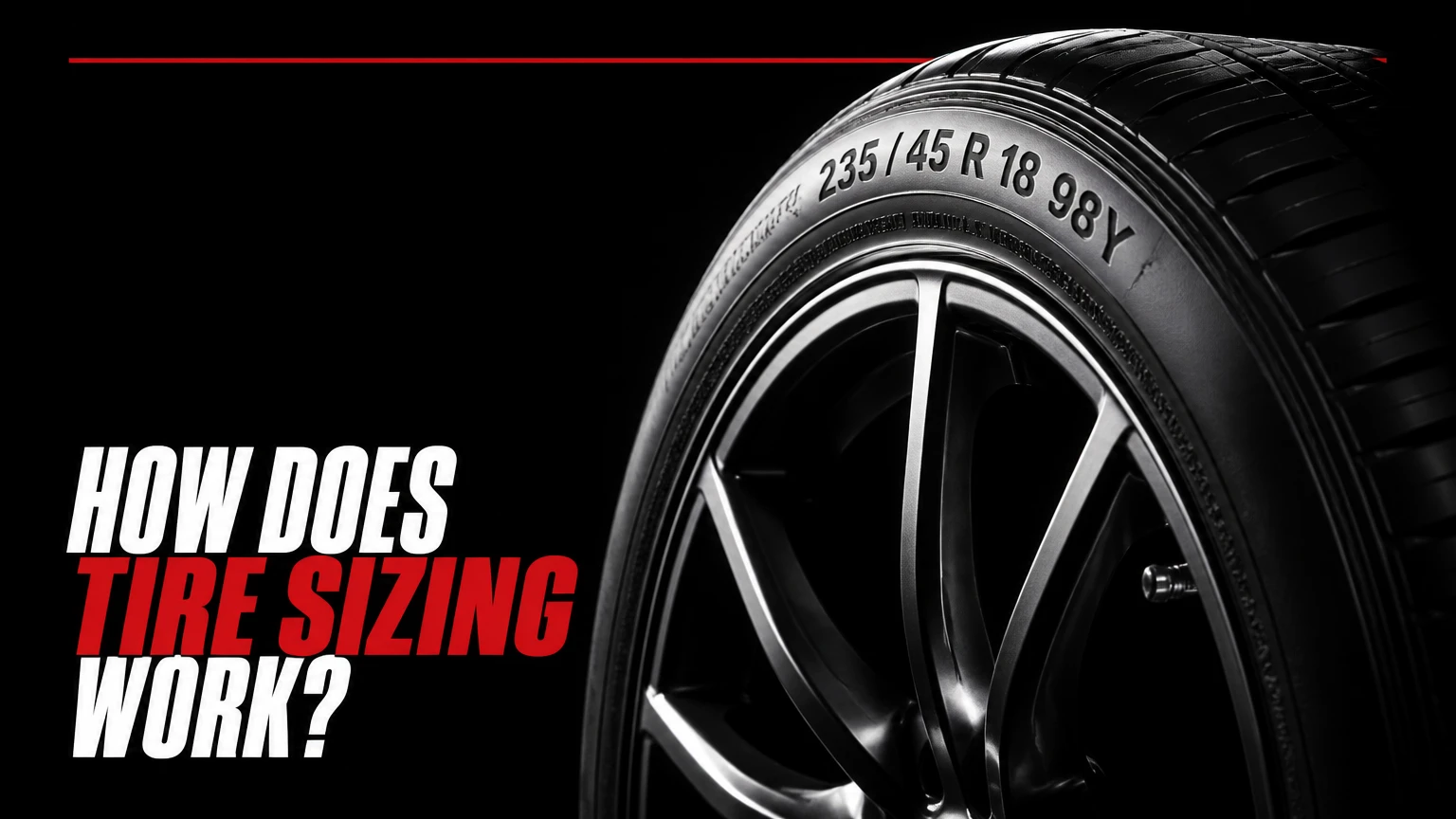
Tire sizing works through a standardized sidewall code that identifies a tire’s width, sidewall proportion, construction, wheel diameter, load capacity, and speed capability. In a size such as P225/45R17 91V, each number or letter describes a specific physical or performance requirement that must match the vehicle and wheel.
Key Facts at a Glance
- The first three-digit number usually states the tire’s nominal section width in millimeters.
- The two-digit aspect ratio expresses sidewall height as a percentage of section width.
- The wheel diameter is measured in inches, even when the tire width is measured in millimeters.
- The load index identifies the maximum load one properly inflated tire can support.
- The speed rating identifies a tested speed category, not a recommended driving speed.
- Replacement tires should meet or exceed the vehicle manufacturer’s load and speed requirements.
How Does Tire Sizing Work on the Sidewall?
A modern tire size combines measurements, construction information, and operating limits in one sequence. The common code P225/45R17 91V identifies a passenger-type tire with a nominal width of 225 millimeters, a sidewall height equal to 45 percent of that width, radial construction, a 17-inch wheel fitment, load index 91, and speed rating V.
The code is standardized enough to compare tires across manufacturers, but it is not a complete fitment guarantee. Two tires carrying the same nominal size can have slightly different measured widths or diameters because tread design, casing construction, approved wheel width, and manufacturing tolerances affect their mounted dimensions.
Tire Size Code Breakdown
| Code element | Example | Meaning | Practical effect |
| Service type | P | Passenger vehicle category | Influences load calculation |
| Section width | 225 | Nominal width in millimeters | Affects clearance and wheel fit |
| Aspect ratio | 45 | Sidewall is 45% of width | Affects diameter and ride quality |
| Construction | R | Radial tire construction | Standard on modern road vehicles |
| Wheel diameter | 17 | Fits a 17-inch wheel | Must match wheel diameter exactly |
| Load index | 91 | 615 kg or 1,356 lb per tire | Sets maximum supported load |
| Speed rating | V | Rated category up to 149 mph | Indicates heat and speed capability |
What Does the First Letter Mean?
The first letter identifies the tire’s service category rather than its exact dimensions. A “P” commonly identifies a P-metric passenger tire, while “LT” identifies an LT-metric tire designed for light trucks and heavier load service.
A tire without a prefix, such as 225/45R17, is commonly described as Euro-metric. P-metric and Euro-metric tires may look interchangeable, but their load calculations are not always identical. A replacement decision should therefore compare the full service description, inflation requirements, and vehicle placard rather than relying only on matching dimensions.
Other prefixes include “T” for certain temporary spare tires and “ST” for special trailer tires. ST tires are intended for trailer service and should not be installed on passenger vehicles.
What Does the Three-Digit Width Mean?
The number 225 represents a nominal section width of 225 millimeters. Section width is measured across the tire’s widest sidewall points when the tire is mounted on a specified wheel width and inflated according to the measuring standard.
The number does not describe tread width. A 225-millimeter tire can have a tread face noticeably narrower than 225 millimeters because section width includes the curved sidewalls. Actual width can also change when the same tire is mounted on wider or narrower approved wheels.
As a practical rule, increasing section width by 10 millimeters does not guarantee exactly 10 millimeters of additional tread contact. It may also reduce suspension, strut, fender, or inner-wheel-well clearance.
What Does the Aspect Ratio Mean?
The aspect ratio states sidewall height as a percentage of section width. A 225/45 tire has a calculated sidewall height of 101.25 millimeters because 225 multiplied by 0.45 equals 101.25.
A lower aspect-ratio number usually produces a shorter sidewall when width remains constant. Shorter sidewalls can improve steering response, but they generally provide less impact cushioning and less protection against pothole damage.
The aspect ratio is not a direct measurement in millimeters. A 45-series tire is not automatically the same height in every width. For example, 45 percent of 225 millimeters is 101.25 millimeters, while 45 percent of 245 millimeters is 110.25 millimeters.
What Does the R Mean?
The letter R identifies radial construction. In a radial tire, the body cords run approximately perpendicular to the direction of travel, while belts beneath the tread stabilize the contact area.
Radial construction is used on nearly all modern passenger and light-truck vehicles. Older or specialized tires may use “D” for diagonal construction or “B” for bias-belted construction, but these formats are uncommon in current passenger applications.
The construction letter should not be confused with a speed rating. In P225/45R17, the R belongs to the size description. The final letter, such as V, belongs to the service description.
What Does the Wheel Diameter Mean?
The number 17 means the tire fits a wheel with a 17-inch bead-seat diameter. This measurement must match exactly. A 17-inch tire cannot safely mount on a 16-inch or 18-inch wheel.
Wheel diameter does not describe the tire’s total outside diameter. A 225/45R17 tire has a calculated outside diameter of about 24.97 inches because the tire includes one sidewall above the wheel and another below it.
Wheel width is separate from wheel diameter. A 17-inch wheel may be available in widths such as 7, 7.5, 8, or 8.5 inches, and each tire model has an approved wheel-width range.
How Do You Calculate a Tire’s Actual Dimensions?
Tire dimensions can be estimated from the sidewall code by calculating sidewall height, converting millimeters to inches, and adding both sidewalls to the wheel diameter. The same figures can be used to estimate circumference, revolutions per mile, and the effect of changing sizes.
These calculations are nominal. Manufacturer specification sheets provide more accurate mounted dimensions because actual measurements vary with wheel width, inflation pressure, tread design, and production tolerances.
Tire Dimension Formulas
- Sidewall height in millimeters
Section width × aspect ratio as a decimal - Sidewall height in inches
Sidewall height in millimeters ÷ 25.4 - Overall diameter in inches
Wheel diameter + two sidewall heights - Circumference in inches
Overall diameter × 3.1416 - Approximate revolutions per mile
63,360 ÷ circumference
Worked Example: 225/45R17
For a 225/45R17 tire:
- Sidewall height: 225 × 0.45 = 101.25 mm
- Sidewall height in inches: 101.25 ÷ 25.4 = 3.99 inches
- Overall diameter: 17 + 3.99 + 3.99 = 24.97 inches
- Circumference: 24.97 × 3.1416 = 78.45 inches
- Approximate revolutions per mile: 63,360 ÷ 78.45 = 808
The calculation explains why changing width or aspect ratio can alter vehicle behavior even when the wheel diameter remains unchanged.
Common Size Comparison
| Tire size | Sidewall height | Overall diameter | Approx. circumference |
| 205/55R16 | 4.44 in | 24.88 in | 78.16 in |
| 225/45R17 | 3.99 in | 24.97 in | 78.45 in |
| 225/50R17 | 4.43 in | 25.86 in | 81.24 in |
| 245/40R18 | 3.86 in | 25.72 in | 80.80 in |
| 265/70R17 | 7.30 in | 31.61 in | 99.31 in |
The 205/55R16 and 225/45R17 sizes have similar overall diameters despite using different wheel sizes. This relationship is the basis of plus sizing.
What Are Load Index and Speed Rating?
The load index and speed rating form the tire’s service description. They confirm whether the tire can support the vehicle’s required load and operate within its specified performance category. A tire that fits the wheel can still be unsuitable if its service description is too low.
Manufacturers select these requirements according to axle loads, intended operating conditions, suspension tuning, and maximum vehicle performance. Replacement tires should normally meet or exceed the values shown on the vehicle placard or specified in the owner’s manual.
How Does the Load Index Work?
The load index is a code that corresponds to a defined maximum load at the tire’s specified inflation conditions. It is not the load in pounds or kilograms itself.
| Load index | Kilograms per tire | Pounds per tire | Four-tire theoretical total |
| 91 | 615 kg | 1,356 lb | 5,424 lb |
| 94 | 670 kg | 1,477 lb | 5,908 lb |
| 98 | 750 kg | 1,653 lb | 6,612 lb |
| 102 | 850 kg | 1,874 lb | 7,496 lb |
| 110 | 1,060 kg | 2,337 lb | 9,348 lb |
The four-tire total should not be used as the vehicle’s payload rating. Vehicle limits also depend on axle ratings, suspension, brakes, wheels, and the manufacturer’s gross vehicle weight rating.
Extra-load tires may include “XL” or “Reinforced” markings. These tires can support increased loads at specified higher pressures, but fitting an XL tire does not increase the vehicle’s certified payload.
What Does the Speed Rating Mean?
A speed rating is a tested performance category indicating the tire’s ability to withstand a specified speed under controlled load, pressure, and laboratory conditions. It is not permission to drive at that speed.
| Rating | Maximum category | Common application |
| S | 112 mph | Family cars and some light trucks |
| T | 118 mph | Sedans and crossovers |
| H | 130 mph | Touring and performance vehicles |
| V | 149 mph | Higher-performance cars |
| W | 168 mph | High-performance vehicles |
| Y | 186 mph | Ultra-high-performance vehicles |
Replacing a tire with a lower speed rating can affect handling, heat resistance, and manufacturer compliance even when the vehicle never approaches the rating’s maximum speed. All tires should have compatible ratings, particularly across the same axle.
What Are the Main Tire Sizing Systems?
Passenger and light-truck tires use several sizing systems because different vehicle categories and markets developed distinct load and measurement conventions. P-metric, Euro-metric, LT-metric, and flotation sizes are the formats most drivers encounter.
Sizing System Comparison
| System | Example | Measurement style | Typical use |
| P-metric | P225/65R17 | Millimeter width, percent ratio | Cars, crossovers, light-duty SUVs |
| Euro-metric | 225/65R17 | Similar metric format, no P | Cars, SUVs, European applications |
| LT-metric | LT265/70R17 | Metric size with LT prefix | Pickups, vans, towing |
| Flotation | 33×12.50R15 | Inches for diameter and width | Off-road vehicles and lifted trucks |
| Temporary spare | T125/80D16 | Compact emergency format | Limited-distance spare use |
| Special trailer | ST225/75R15 | Metric size with ST prefix | Towable trailers only |
Are LT Tires Better Than Passenger Tires?
LT tires are better for applications requiring their higher-load construction, but they are not automatically better for ordinary driving. Their heavier casings can increase durability under towing, hauling, gravel, or commercial use, while also adding weight, rolling resistance, noise, and ride stiffness.
Changing from a passenger tire to an LT tire may require different inflation pressure. Using the vehicle placard pressure without checking an approved load-and-inflation table can leave the LT tire underinflated for the required load.
Passenger tires generally provide a more compliant ride and lower rotational mass. LT tires are appropriate when the vehicle manufacturer specifies them or when a qualified fitment professional confirms the load, pressure, wheel, and handling requirements.
How Do You Choose the Correct Replacement Size?
The safest replacement is normally the size and service description listed on the driver’s door placard. The placard reflects the vehicle manufacturer’s tested combination of tire dimensions, load capacity, inflation pressure, wheel specifications, speedometer calibration, and electronic-control programming.
Use this seven-point check before purchasing:
- Match the complete tire size, not only the wheel diameter.
- Meet or exceed the required load index.
- Meet the specified speed rating unless an approved exception applies.
- Confirm that the tire fits the wheel’s width range.
- Check front, rear, and full-lock clearance.
- Preserve compatible circumference on ABS and AWD vehicles.
- Use the placard’s cold inflation pressure, not the sidewall maximum.
The maximum pressure printed on the tire is not the normal pressure recommendation for the vehicle. The placard pressure is selected for the vehicle’s load, handling, comfort, and braking requirements.
How Much Can You Change Tire Size?
Alternative tire sizes should usually remain close to the original overall diameter, with many fitment professionals using approximately 3 percent as an initial screening rule. That rule is not universal approval because clearance, wheel width, offset, load capacity, and electronic systems can reject a size that passes the diameter calculation.
Use this formula:
Diameter difference = (new diameter − original diameter) ÷ original diameter × 100
Changing from a 225/45R17 tire at 24.97 inches to a 225/50R17 tire at 25.86 inches increases diameter by approximately 3.56 percent. When the speedometer displays 60 mph, the vehicle would travel at roughly 62.1 mph before accounting for factory calibration and real tire dimensions.
A larger tire also raises the vehicle by only half the diameter increase. Adding 1 inch of tire diameter provides approximately 0.5 inch of additional ground clearance.
What Is Plus Sizing?
Plus sizing uses a larger-diameter wheel with a lower-profile tire while keeping the tire’s overall diameter close to the original. For example, a vehicle using 205/55R16 tires may accept 225/45R17 tires because their calculated diameters differ by less than half a percent.
The potential benefit is sharper steering response because the sidewall is shorter and the wheel may be wider. The trade-offs include a firmer ride, higher tire and wheel cost, greater pothole vulnerability, and sometimes increased unsprung weight.
A successful plus-size package must match more than diameter. Wheel offset, wheel width, brake clearance, hub bore, bolt pattern, load rating, and tire clearance all require confirmation.
Why Do AWD Vehicles Need Closely Matched Tires?
AWD vehicles may interpret tire-circumference differences as continuous wheel-speed differences. A substantial mismatch between axles can cause driveline binding, unwanted traction-control activity, or excessive wear in clutches and differentials.
Size labels alone do not ensure an adequate match. A new tire has a larger rolling circumference than a heavily worn tire of the same model and size. Different tire models may also have different measured diameters despite sharing the same sidewall code.
Follow the vehicle manufacturer’s tread-depth and circumference limits. Some AWD applications permit replacing one tire only when the new tire is professionally shaved to match the remaining tread depth. Others require two or four matching replacements.
Common Tire Sizing Mistakes
Using the Sidewall Maximum as the Normal Pressure
The tire sidewall states a maximum load and pressure condition, not necessarily the vehicle’s recommended daily pressure. Use the driver’s door placard and check pressure when the tires are cold.
Assuming Wider Always Means More Grip
A wider tire can change contact-patch shape, but compound, tread design, temperature, pressure, wheel width, and vehicle alignment also determine available traction. An excessively wide tire may perform worse in standing water or snow.
Ignoring Wheel Offset
A correctly sized tire can still rub if the replacement wheel positions it too far inward or outward. Offset changes suspension clearance, fender clearance, scrub radius, steering feel, and bearing loads.
Mixing Sizes on the Same Axle
Different sizes on the same axle can alter braking and cornering behavior. Unless the vehicle uses a manufacturer-designed staggered setup, tires on the same axle should match in size, type, and similar tread depth.
Replacing P-Metric Tires With LT Tires Without Recalculating
LT tires may need higher inflation pressure to carry an equivalent load. Direct substitution without checking load tables can create poor ride quality, overheating, reduced stability, or insufficient capacity.
Troubleshooting Tire Fitment Problems
| Symptom | Likely sizing cause | What to check |
| Rubbing at full steering lock | Tire too wide or wheel positioned inward | Section width, offset, inner clearance |
| Rubbing over bumps | Diameter too large or wheel positioned outward | Fender clearance and suspension travel |
| Speedometer reads low | New tire circumference is larger | Calculate diameter percentage |
| Speedometer reads high | New tire circumference is smaller | Compare mounted diameter |
| Ride became unusually harsh | Sidewall shorter or casing stiffer | Aspect ratio, LT marking, inflation |
| Steering feels heavy | Tire wider or wheel offset changed | Width, pressure, offset, alignment |
| ABS or AWD warning appears | Circumference mismatch | All four sizes and tread depths |
A fitment problem should be investigated before continued driving. Visible rubbing can damage the tire sidewall, while an incorrect load rating or inflation condition can produce heat buildup without obvious external warning.
Limitations of Tire Size Calculations
A tire-size calculator provides a useful estimate, but it cannot confirm complete fitment. Nominal dimensions do not account for tread protrusion, rim protection ribs, actual mounted width, suspension movement, steering angle, body modifications, alignment settings, or wheel offset.
Manufacturer specification sheets are more reliable than code-only calculations because they list measured overall diameter, section width, approved rim widths, tread depth, revolutions per mile, load capacity, and recommended use.
Final approval should come from the vehicle manufacturer’s documentation or a qualified tire professional who can inspect the vehicle and proposed wheel-and-tire combination.
Frequently Asked Questions
Where can I find my vehicle’s correct tire size?
The primary size is normally printed on the tire and loading information placard inside the driver’s door opening. The owner’s manual may list additional approved sizes. Check the placard instead of assuming that the tires currently installed are original, because a previous owner may have changed them.
Does a higher aspect ratio make a tire taller?
A higher aspect ratio makes the sidewall taller only when section width remains the same. A 225/60 tire has a taller sidewall than a 225/50 tire, but a wider tire with a lower ratio can still have a similar sidewall height. Calculate width multiplied by the ratio for an accurate comparison.
Can I put a different tire width on the same wheel?
A different width may fit when the tire manufacturer approves the wheel’s width and the vehicle has adequate clearance. The change must also preserve load capacity, diameter compatibility, steering clearance, and safe sidewall shape. Wheel diameter alone does not determine whether a tire is suitable.
Do all tires with the same size measure identically?
No. Tires with the same labeled size can differ slightly in mounted section width, tread width, overall diameter, and revolutions per mile. Construction, tread design, measuring wheel width, and manufacturing tolerances cause these differences. Compare each manufacturer’s specification sheet for sensitive fitments.
Why are tire width and wheel diameter in different units?
Modern metric tire codes combine a millimeter-based section width with an inch-based wheel diameter because the system developed from established wheel standards and later metric tire measurements. The mixed units appear unusual, but the format is widely used across passenger and light-truck tires.
Can larger tires affect fuel economy?
Larger or heavier tires can reduce fuel economy by increasing rotational mass, rolling resistance, aerodynamic drag, or effective gearing. The result depends on the size change, tire construction, tread compound, inflation, and driving conditions. A small diameter change may have little effect, while heavy off-road tires can cause a noticeable reduction.
The Bottom Line
Understanding how does tire sizing work begins with reading each sidewall element separately: service type, width, aspect ratio, construction, wheel diameter, load index, and speed rating. Those values describe the tire, but safe replacement also depends on inflation pressure, wheel width, offset, clearance, vehicle electronics, and manufacturer requirements.
Use the driver’s door placard as the starting point. Calculate diameter changes before considering alternatives, preserve the required load and speed ratings, and verify actual manufacturer specifications before installing a non-original size.