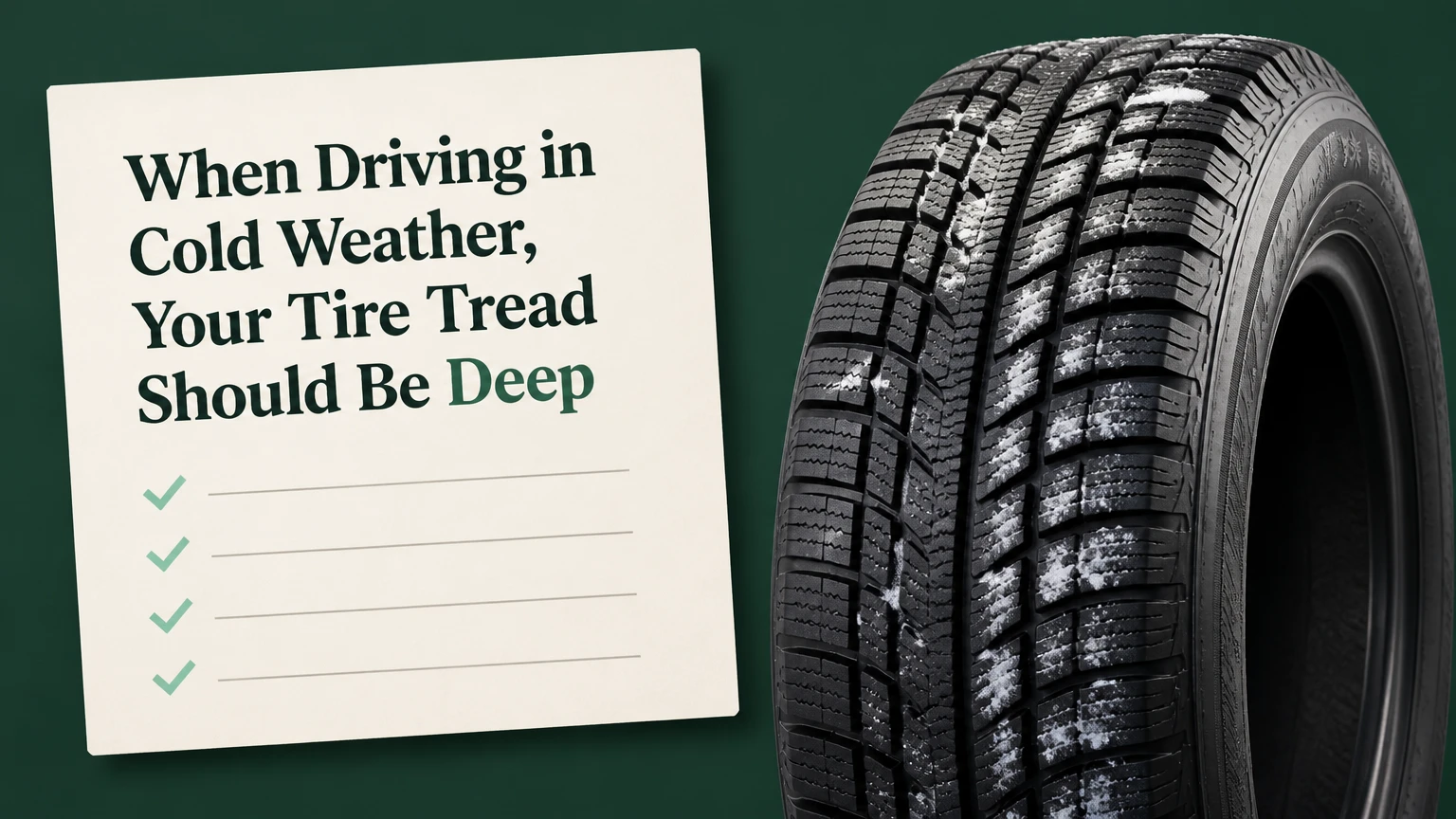
When driving in cold weather, your tire tread should ideally measure at least 6/32 inch for frequent snow and slush, with replacement considered near 5/32 inch. A tire at 4/32 inch has reduced wet and winter capability, while 2/32 inch is only the minimum wear limit and is unsuitable for dependable winter traction.
Key Facts at a Glance
- A remaining tread depth of 6/32 inch or more provides a useful margin for snow and slush evacuation.
- Snow traction begins declining noticeably around 5/32 inch of remaining tread.
- A tire at 4/32 inch may remain legal but has reduced wet-road and winter performance.
- A tread depth of 2/32 inch is the replacement limit used in most U.S. jurisdictions, not a winter-safety target.
- Cold weather commonly lowers tire pressure by about 1-2 PSI for each 10°F temperature decrease.
- Tread depth cannot compensate for a summer tire compound that has hardened in low temperatures.
How Much Tread Should You Have in Cold Weather?
For routine driving through snow, slush, and freezing rain, aim for 6/32 inch or more across every main tread groove. Start planning replacement around 5/32 inch, particularly when snow-covered roads are common.
Tire Rack recommends replacement at approximately 5/32 inch when snow mobility matters because shallow grooves cannot collect and release as much snow during each tire revolution. NHTSA identifies 2/32 inch as the minimum tread level, but that threshold indicates a worn-out tire rather than strong cold-weather performance.
| Remaining tread | Metric depth | Cold-weather interpretation | Recommended action |
| 10/32-12/32 inch | 7.9-9.5 mm | Typical new winter or deep-tread tire | Inspect pressure and wear monthly |
| 7/32-9/32 inch | 5.6-7.1 mm | Strong usable depth for rain, slush, and snow | Continue normal inspections |
| 6/32 inch | 4.8 mm | Practical winter-readiness target | Suitable if compound and wear are sound |
| 5/32 inch | 4.0 mm | Snow mobility begins declining | Plan replacement before severe conditions |
| 4/32 inch | 3.2 mm | Reduced wet and winter margin | Replace for regular rain, slush, or snow |
| 3/32 inch | 2.4 mm | Critically shallow for bad weather | Avoid winter travel and replace promptly |
| 2/32 inch | 1.6 mm | Worn-out threshold in most U.S. states | Replace immediately |
These thresholds are guidance, not a guarantee. Ice traction also depends on tire compound, tread design, vehicle speed, temperature, road treatment, and driver input.
Is 4/32 Inch of Tread Safe for Snow?
A tire with 4/32 inch of tread should not be treated as winter-ready for regular snow driving. It may still be above the minimum wear bars, but its grooves have lost much of the volume needed to process water, slush, and loose snow.
AAA recommends beginning to shop for replacement tires at 4/32 inch. Tire Rack places the snow-performance replacement point slightly higher, near 5/32 inch, because winter mobility deteriorates before the legal wear limit is reached.
A driver in a dry, cool climate may continue using a sound 4/32-inch all-season tire temporarily. A driver facing mountain snow, freezing rain, or frequent standing water needs a larger safety margin.
Is 6/32 Inch Enough for Winter Driving?
A 6/32-inch tread depth is generally serviceable for winter driving when the tire is the correct type, evenly worn, properly inflated, and free from age-related damage. It offers more groove volume than a 4/32-inch tire, but it is no longer close to new-tire depth.
Six thirty-seconds should therefore be viewed as a practical target, not a universal guarantee. A 6/32-inch summer tire can perform worse in freezing conditions than a properly designed winter tire at the same measured depth because tread compound affects flexibility and braking.
What Does Tire Tread Do on a Winter Road?
Tire tread creates traction by maintaining contact with the road while managing snow, slush, and water beneath the tire footprint. The tread system includes solid blocks, large grooves, smaller lateral channels, and fine slits called sipes.
Each feature performs a different job:
- Tread blocks provide the main contact surfaces.
- Circumferential grooves channel water and slush along the tire.
- Lateral grooves move material toward the tread shoulders.
- Sipes create numerous small edges that deform against packed snow and ice.
- Open voids collect snow temporarily before releasing it as the tire rotates.
Deep tread helps process greater volumes of loose material. However, depth alone does not prove that the pattern or rubber compound is appropriate for cold roads.
How Does Tire Tread Grip Snow?
Winter tread grips snow partly by trapping a controlled amount of snow inside its grooves. The retained snow can interact with snow on the road, while block edges and sipes provide additional mechanical grip.
The tread must then release that snow as the tire rotates. When the grooves become shallow, packed material can fill the available space more easily, reducing the tire’s ability to repeat the collection-and-release process.
This mechanism explains why a tire can remain legal yet feel noticeably less capable after wearing to approximately half of its original tread depth.
Why Does Cold Weather Reduce Tire Grip?
Cold weather reduces tire grip because rubber compounds become stiffer as temperature falls. A stiff tread block cannot conform to small irregularities in the road as effectively as a flexible winter compound.
Many tire manufacturers use approximately 45°F or 7°C as the seasonal point at which dedicated winter tires become beneficial. This is a practical switching guideline rather than a precise temperature at which every all-season tire suddenly fails.
A tire’s winter capability therefore depends on two separate variables:
- Mechanical capacity, created by sufficient grooves, edges, and sipes.
- Compound flexibility, determined by tire formulation, temperature, and age.
A deep but hardened tire may slide. A flexible tire with severely worn grooves may hydroplane or lose snow mobility. Both characteristics matter.
Why Does Tread Depth Matter in Slush and Rain?
Tread depth matters in slush and rain because liquid water cannot be compressed. The grooves must create enough space and flow paths to move water away before pressure lifts the tire from the pavement.
Tire Rack wet-braking testing illustrates the effect. In one sedan test from 60 mph, new tires stopped in 205 feet, tires worn to 4/32 inch required 270 feet, and tires at 2/32 inch required 400 feet. Test results vary by tire and vehicle, but the direction of the change is clear: shallower tread can greatly increase wet stopping distance.
Vehicle speed compounds the problem. Even adequate tread cannot eliminate hydroplaning risk when speed is excessive for the water depth.
What Tread Features Help in Cold Weather?
Cold-weather tread should combine usable depth with multiple biting edges, stable tread blocks, and channels that remain open under load. A winter tire usually has denser siping and a more open pattern than a summer performance tire.
| Tread feature | Primary function | Most useful condition | Limitation |
| Deep circumferential grooves | Move water and slush lengthwise | Rain and highway slush | Cannot prevent hydroplaning at every speed |
| Wide lateral channels | Expel snow and water sideways | Loose snow and slush | Can increase road noise |
| Dense siping | Creates small biting edges | Packed snow and light ice | Loses effectiveness as blocks wear |
| Flexible tread blocks | Conform to textured surfaces | Cold dry pavement and snow | May wear quickly in warm weather |
| Open shoulder design | Clears material near tread edges | Deeper snow | Can reduce dry-road precision |
| Studs, where legal | Scratch into hard-packed ice | Persistent polished ice | No universal benefit on dry or wet pavement |
Studded tires should not be described as universally superior. Their advantage depends on ice condition, temperature, pavement exposure, vehicle setup, and local restrictions.
Which Tire Type Is Best for Cold Weather?
Dedicated winter tires provide the strongest overall option when temperatures remain low and snow or ice occurs regularly. All-weather tires offer a useful compromise for drivers who need year-round convenience, while ordinary all-season tires are better suited to milder winters.
| Tire type | Common marking | Typical new tread | Best use | Main limitation |
| Studless winter | 3PMSF | 10/32-12/32 inch | Frequent cold, snow, and slush | Faster warm-weather wear |
| Studded winter | 3PMSF plus studs | 10/32-13/32 inch | Persistent hard-packed ice where legal | Noise, road wear, seasonal restrictions |
| All-weather | Usually 3PMSF | 10/32-12/32 inch | Moderate winter with year-round use | Less specialized than winter tires |
| All-season | Often M+S | 9/32-11/32 inch | Mild cold with limited snow | Compound and snow traction vary widely |
| Summer performance | No winter marking | 8/32-10/32 inch | Warm dry and wet pavement | Poor choice near or below freezing |
The Three-Peak Mountain Snowflake, or 3PMSF, indicates that a tire has met a defined acceleration-traction requirement in snow. It does not certify ice braking, hydroplaning resistance, or performance throughout the tire’s entire life.
The M+S marking primarily relates to tread geometry. It should not be interpreted as proof of severe-winter performance.
How Do You Measure Tire Tread Correctly?
Measure tread with a dedicated gauge at several locations on every tire. The lowest valid reading, not the average, determines whether the tire has enough usable tread.
Step 1: Park on Level Ground
Park the vehicle on a flat surface, set the parking brake, and switch off the engine. Turn the steering wheel to expose the front-tire tread, but never crawl beneath an unsupported vehicle.
Step 2: Clear the Main Grooves
Remove packed mud, stones, and snow with a blunt plastic tool. Do not use a sharp screwdriver that could puncture the groove base.
Step 3: Measure Multiple Locations
Place the gauge probe into a main circumferential groove. Keep the gauge base flat against the surrounding tread blocks.
Take readings at:
- The inner section
- The center section
- The outer section
- At least three positions around the circumference
Record the smallest measurement.
Step 4: Compare All Four Tires
Differences between tires can affect stability, braking, and all-wheel-drive systems. Compare readings on the same axle and between the front and rear axles.
Step 5: Inspect the Entire Tire
Check for cracks, exposed cords, bulges, punctures, missing tread chunks, and irregular wear. NHTSA recommends checking tread, sidewalls, pressure, damage, and tire age rather than relying on one measurement alone.
Should You Use the Quarter Test or Penny Test?
Use the quarter test for an early warning near 4/32 inch and the penny test only for identifying tread near the 2/32-inch wear limit. A tread-depth gauge remains more precise than either coin.
| Method | Approximate threshold | What the result means | Best use |
| Digital tread gauge | Measures exact depth | Shows readings in 1/32 inch or millimeters | Routine inspection |
| Mechanical gauge | Measures exact depth | Reliable when placed flat and correctly zeroed | Home or workshop use |
| U.S. quarter test | About 4/32 inch | Washington’s head fully visible indicates shallow tread | Wet-weather replacement warning |
| U.S. penny test | About 2/32 inch | Lincoln’s head fully visible indicates worn-out tread | Minimum-limit screening |
| Wear bars | 2/32 inch | Tread flush with bars indicates replacement | Visual confirmation |
The penny test can falsely reassure a winter driver because a tire may pass it at 3/32 inch while still being poorly suited to snow and slush.
Can Wear Bars Prove That a Tire Is Winter-Safe?
Standard wear bars cannot prove winter safety because they usually identify the 2/32-inch minimum. A tire may reach an unacceptable winter-performance level long before the tread becomes flush with those bars.
Some winter tires include additional snow-platform indicators at greater depth. Consult the tire manufacturer’s documentation because indicator shapes and thresholds vary by model.
How Does Cold Weather Affect Tire Pressure?
Cold weather commonly reduces tire pressure by approximately 1-2 PSI for every 10°F decrease in ambient temperature. The exact change depends on the starting temperature, initial pressure, tire volume, and whether the measurement is taken before or after driving.
The claim that a tire loses 10 PSI for every 10°F drop is incorrect. A loss that severe would suggest a leak, bead problem, valve fault, puncture, or major measurement error.
Check pressure when the tires are cold, usually after the vehicle has been parked for at least three hours. Inflate to the pressure printed on the vehicle placard, not the maximum pressure molded into the tire sidewall. NHTSA specifically distinguishes the manufacturer’s recommended pressure from the tire’s maximum-rated pressure.
What Do Winter Tire Wear Patterns Mean?
Uneven tread can leave part of the tire below the recommended depth even when the center appears acceptable. Measure across the full width before deciding that a tire is safe.
| Wear pattern | Likely cause | Winter consequence | Corrective action |
| Both shoulders worn | Chronic underinflation | Reduced stability and excess heat | Correct pressure and inspect for leaks |
| Center worn | Chronic overinflation | Smaller effective contact area | Set cold pressure to placard value |
| One shoulder worn | Alignment or suspension issue | Uneven grip during braking and turning | Perform alignment and component inspection |
| Feathered edges | Incorrect toe setting | Reduced directional stability | Check wheel alignment |
| Cupped or scalloped wear | Worn dampers, imbalance, or loose parts | Tire loses consistent road contact | Inspect suspension and balance |
| Isolated flat spot | Wheel lockup or long-term parking | Vibration and intermittent grip | Professional tire inspection |
Correcting alignment does not restore tread that has already worn away. Replace the tire when any main section falls below the chosen winter threshold.
Should You Install Two or Four Winter Tires?
Install winter tires as a complete set of four. Mixing winter tires with less-capable tires can create a large difference in grip between axles, especially during emergency braking or cornering.
Putting winter tires only on the front of a front-wheel-drive vehicle may improve acceleration while leaving the rear axle more likely to slide. Mounting them only on the rear may preserve rear stability but leave inadequate steering and braking grip at the front.
For all-wheel-drive vehicles, differences in tread depth and tire circumference may also conflict with manufacturer limits. Consult the owner’s manual before replacing fewer than four tires.
Can a Tire Have Deep Tread but Still Be Unsafe?
A tire can have deep tread and still be unsafe because tread depth does not reveal internal damage, age-related hardening, weather cracking, previous underinflation, or improper repairs.
NHTSA notes that some vehicle manufacturers recommend tire replacement after six years regardless of visible tread. The correct age limit varies, so drivers should check the vehicle manual, tire manufacturer guidance, and DOT date code.
Professional inspection is appropriate when a tire has:
- Sidewall cracks or bulges
- Repeated pressure loss
- Exposed cords
- Tread separation symptoms
- A puncture near the shoulder or sidewall
- Severe vibration
- Uncertain repair history
When Should You Replace Tires Before Winter?
Replace tires before winter when the shallowest groove approaches 5/32 inch and regular snow is expected. Replacement should occur sooner when there is structural damage, severe aging, or an unsuitable tire type.
A practical pre-winter decision sequence is:
- Measure every main groove.
- Identify the lowest reading.
- Inspect for uneven wear and damage.
- Confirm the tire type and markings.
- Check the DOT age code.
- Compare the tire with expected road conditions.
- Correct pressure using the vehicle placard.
- Schedule replacement before the first major storm.
Do not wait for snow to expose a traction problem. Tire availability and installation appointments often become limited after the first forecast of severe winter weather.
How Much Do Cold-Weather Tires Cost?
A set of four winter-capable passenger tires typically costs $400-$1,200 before optional wheels, taxes, disposal fees, and installation. Vehicle size, speed rating, load rating, brand, and regional supply create substantial variation.
| Expense | Typical passenger-car range | Typical SUV or light-truck range | Frequency |
| Four winter tires | $400-$1,000 | $600-$1,400 | Every 3-6 winter seasons |
| Mounting and balancing | $80-$180 | $100-$240 | Each seasonal installation |
| Dedicated winter wheels | $300-$900 | $450-$1,200 | Usually one-time |
| Seasonal storage | $60-$160 | $80-$200 | Per season |
| Alignment | $100-$200 | $120-$250 | When wear or handling indicates |
| Tread-depth gauge | $5-$30 | $5-$30 | One-time |
These are typical planning ranges, not quoted prices. Premium sizes, run-flat construction, EV specifications, and low-profile fitments may cost more.
Are Chains a Substitute for Adequate Tire Tread?
Chains are not a substitute for serviceable tires. They are temporary traction devices intended for specific snow or ice conditions and must be fitted to the correct tire size.
Chains may be required on designated mountain routes even when a vehicle has winter tires. They also have strict speed limits, clearance requirements, and axle-placement instructions.
Never install chains on a tire with exposed cords, severe cracking, a bulge, or critically shallow tread. Follow both the vehicle manual and chain manufacturer’s instructions.
What Tread Depth Fits Different Winter Conditions?
The required margin should increase with the amount of water, snow, slush, and untreated ice expected on the route.
| Driving condition | Practical tread target | Preferred tire type | Main risk |
| Cold but mainly dry pavement | 5/32 inch or more | Quality all-season or all-weather | Compound hardening |
| Frequent cold rain | 5/32 inch or more | All-weather or wet-rated all-season | Hydroplaning and longer braking |
| Occasional light snow | 6/32 inch or more | 3PMSF all-weather | Snow accumulation |
| Regular snow and slush | 6/32 inch or more | Dedicated winter tire | Reduced snow evacuation |
| Persistent packed snow | 6/32 inch or more | Dedicated winter tire | Limited braking and steering |
| Repeated polished ice | Deep winter tread | Studless or legal studded winter tire | Extremely low friction |
No tread depth makes glare ice predictable. Slow down, increase following distance, avoid abrupt inputs, and postpone travel when road agencies advise against driving.
Common Cold-Weather Tire Mistakes
Treating 2/32 Inch as a Safety Recommendation
Two thirty-seconds is a wear-out threshold. It does not represent adequate snow, slush, or rain performance.
Measuring Only the Center Groove
A tire may have 6/32 inch in the center and 3/32 inch on an inner shoulder. The lowest meaningful measurement controls the decision.
Inflating to the Sidewall Number
The sidewall usually lists the tire’s maximum rated pressure under specified conditions. Use the vehicle placard for normal inflation.
Waiting for the TPMS Warning
USTMA notes that many tire-pressure monitoring systems warn at approximately 25 percent underinflation. That threshold can be too late to prevent damage, so TPMS does not replace manual monthly checks.
Using Summer Tires Because the Tread Looks New
A nearly new summer tire may still have poor cold-weather capability. Tire category and compound matter as much as visible depth.
Buying Only Two Winter Tires
Unequal axle grip can make the vehicle unstable. Use a matched set of four whenever winter tires are required.
Expert Rules of Thumb
Measure for the worst road, not the average commute. A mostly clear route may still include one untreated bridge, shaded curve, or slush-filled exit ramp where additional tread matters.
Replace according to the shallowest safety-relevant groove. Averaging one deep section with one nearly worn-out shoulder hides the area most likely to lose traction first.
Separate legality from capability. A tire can be technically legal at 3/32 inch while being unsuitable for the weather, speed, and route a driver expects to encounter.
The Bottom Line
When driving in cold weather, your tire tread should measure at least 6/32 inch when regular snow or slush is expected. Begin planning replacement around 5/32 inch and treat 4/32 inch as a warning level for wet and winter roads.
The 2/32-inch wear bars indicate that a tire is worn out, not that it remained safe until that point. Measure each tire across its full width, check cold inflation pressure, use the correct seasonal tire type, and replace any tire with damage, severe aging, or inadequate tread before winter travel.
Frequently Asked Questions
Is 5/32 Inch of Tread Good for Winter?
Five thirty-seconds is a transition point rather than an ideal winter target. The tire may remain usable in light conditions, but snow mobility is beginning to decline. Drivers expecting repeated snow or slush should plan replacement and should not begin a severe winter season with only 5/32 inch remaining.
Do Winter Tires Need More Tread Than All-Season Tires?
Winter tires commonly start with deeper tread, but the replacement decision depends on the remaining depth and expected conditions. Both winter and all-season tires lose snow-processing capacity as grooves become shallow. A winter compound may remain flexible, yet it cannot fully overcome inadequate groove volume.
How Often Should Tire Tread Be Checked in Winter?
Check tread at least monthly, before long trips, and after noticing slipping, vibration, pulling, or unusual noise. Inspect again after a hard pothole impact or major pressure loss. Measuring at the beginning and middle of winter helps identify accelerated or uneven wear before it becomes severe.
Does Four-Wheel Drive Make Shallow Tread Safe?
Four-wheel drive can improve acceleration, but it does not create additional tire-road friction during braking. Steering and stopping still depend on the available grip at each tire. A four-wheel-drive vehicle with shallow tread can therefore accelerate confidently and then fail to stop or turn as expected.
Is the Penny Test Enough for Winter Tires?
The penny test is not enough for winter preparation because it mainly detects tread near 2/32 inch. Snow capability can decline several thirty-seconds earlier. Use a tread-depth gauge or quarter test and consider replacement near 5/32 inch when regular snow is expected.
Should Tire Pressure Be Lowered for Snow?
Do not intentionally lower pressure for ordinary road driving unless the vehicle manufacturer provides a specific instruction. Underinflation can increase heat, damage the tire, distort the footprint, and worsen steering response. Set cold pressure to the value on the driver-door placard and recheck it after major temperature changes.