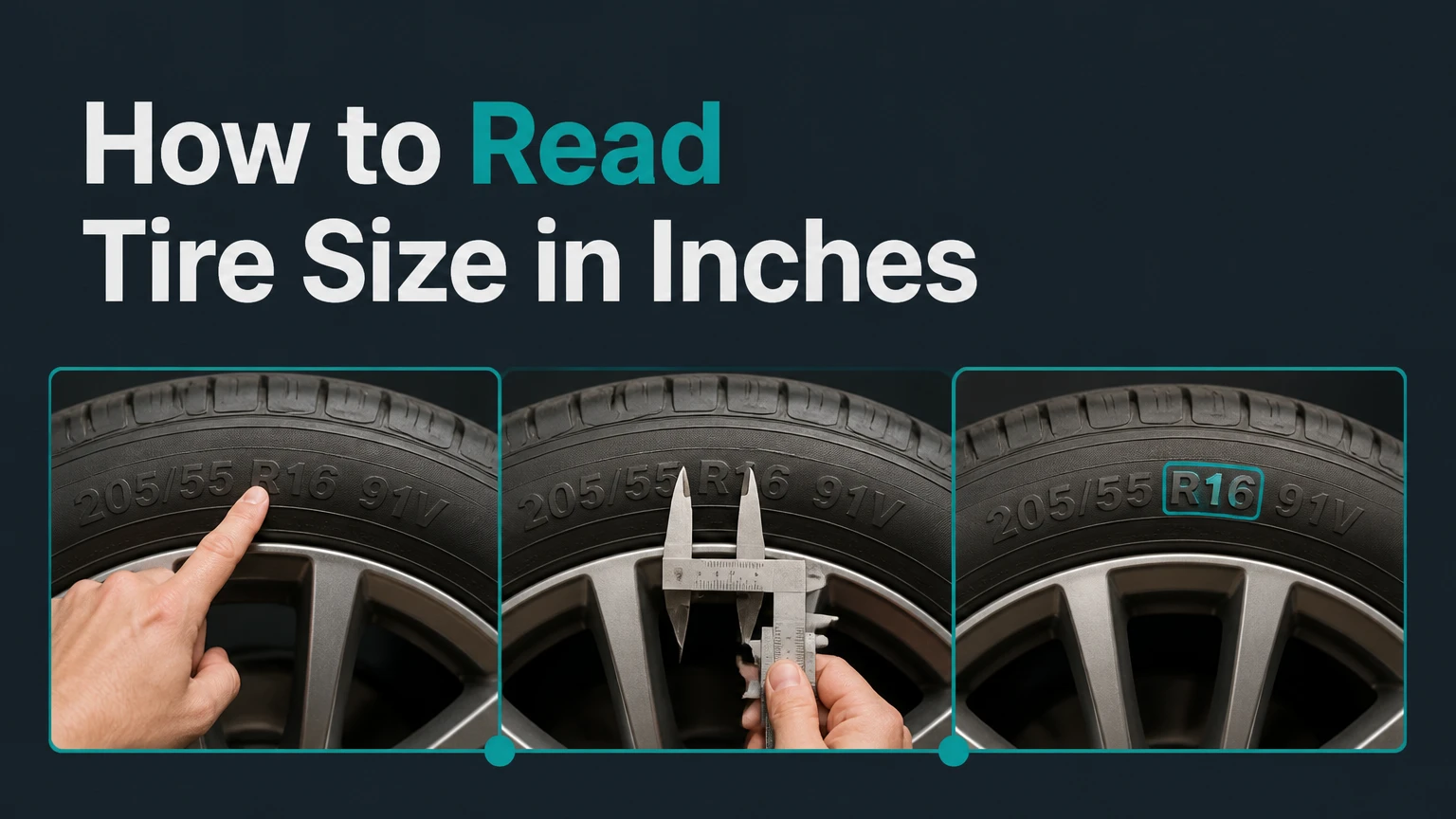
To learn how to read tire size in inches, identify the numbers in a format such as 33×12.50R17. The first number is the tire’s nominal overall diameter, the second is its nominal section width, the letter identifies construction, and the final number is the required wheel diameter.
Key Facts at a Glance
- A 33×12.50R17 tire is approximately 33 inches tall and 12.50 inches wide.
- The final number identifies wheel diameter, not total tire diameter.
- The letter R means radial tire construction.
- Flotation tire dimensions are nominal, so actual measurements can vary by model and wheel width.
- Section width measures the widest sidewall-to-sidewall distance, not the tread alone.
- A tire’s dimensions do not confirm vehicle fitment, load capacity, or safe wheel compatibility.
How Does Inch-Based Tire Sizing Work?
Inch-based tire sizing usually follows the flotation format overall diameter × section width, construction, wheel diameter. A size written as 35×12.50R18 describes a tire with a nominal 35-inch diameter, a nominal 12.50-inch section width, radial construction, and an 18-inch wheel opening.
This system is common on pickup trucks, Jeeps, SUVs, off-road vehicles, ATVs, lawn equipment, and some trailers. It differs from a metric size such as 285/70R17 because the flotation format displays the approximate overall tire height directly.
| Position | Example | Meaning | Unit |
| First number | 33 | Nominal overall tire diameter | Inches |
| Number after × | 12.50 | Nominal section width | Inches |
| Letter | R | Radial construction | Construction code |
| Final number | 17 | Required wheel diameter | Inches |
The measurements are nominal specifications rather than a guarantee that every tire marked 33×12.50R17 will measure exactly 33.00 inches by 12.50 inches. Tread design, casing construction, inflation pressure, measuring rim width, and manufacturer tolerances affect the published dimensions.
Before You Read the Tire Size
Reading the code takes less than one minute and requires no tools. Confirming whether the tire will fit safely requires more information than the four main characters in a flotation size.
| Requirement | Typical value | Why it matters |
| Reading time | 30-60 seconds | Enough to locate and decode the code |
| Difficulty | Beginner | No tire removal is required |
| Basic tool | Flashlight | Helps reveal raised sidewall lettering |
| Optional tool | Tape measure | Checks approximate installed dimensions |
| Essential reference | Door-jamb label | Shows the vehicle’s original tire specification |
| Fitment reference | Tire data sheet | Lists actual diameter and approved rim widths |
Clean dirt from the sidewall if necessary. Never crawl beneath a vehicle supported only by a jack, and do not treat a tape measurement as a substitute for the manufacturer’s specification sheet.
Step 1: Locate the Tire-Size Code
Find the raised lettering on the tire’s sidewall and look for a sequence containing an ×, an R, or several numbers separated by a slash and letter. A flotation size usually resembles 31×10.50R15, 33×12.50R17, or 35×13.50R20.
You may also see other codes nearby, including load range, maximum pressure, traction ratings, manufacturing date, and Department of Transportation identification. Those markings are important, but they are not part of the basic dimensional code.
You have found a flotation size when the first number resembles a complete tire diameter, usually between approximately 27 and 40 inches for common road-going trucks. A code beginning with 265, 285, or 315 is probably a metric width code rather than an inch-based overall diameter.
Success checkpoint: The code contains four readable components, such as 33, 12.50, R, and 17.
Common mistake: Reading “R17” as a 17-inch-tall tire. The number 17 identifies the wheel diameter only.
Step 2: Read the Overall Tire Diameter
The first number is the tire’s nominal overall diameter. In 33×12.50R17, the number 33 means the unladen, properly inflated tire is designed to measure approximately 33 inches from one outer tread surface to the opposite outer tread surface.
Overall diameter affects ground clearance, wheel-well clearance, effective gearing, speedometer accuracy, acceleration, and braking behavior. Increasing from a nominal 31-inch tire to a nominal 33-inch tire raises the axle center by approximately one inch because only half of the two-inch diameter increase appears beneath the axle.
Advertised diameter is not exact. One 33-inch tire may have a published diameter of 32.5 inches, while another may measure 32.8 or 33.1 inches under the manufacturer’s specified test conditions. Always compare the product data sheets when matching tires closely.
Success checkpoint: You can describe the first number as the approximate complete height of the unloaded tire.
Common mistake: Assuming a nominal 35-inch tire adds four inches of ground clearance over a 31-inch tire. The theoretical axle-height increase is approximately two inches.
Step 3: Read the Section Width
The second number is nominal section width. In 33×12.50R17, the value 12.50 means the widest sidewall-to-sidewall dimension is approximately 12.5 inches when the tire is mounted on its designated measuring rim.
Section width is not necessarily tread width. The tread may be narrower than the maximum casing width, and sidewall protectors or raised lettering may not be included in the manufacturer’s formal section-width measurement.
Wheel width also influences the installed measurement. Mounting the same tire on a wider approved wheel generally spreads the casing and slightly increases section width. Mounting it on a narrower approved wheel pulls the sidewalls inward and changes the tread profile.
| Tire marking | Nominal section width | Approximate width in millimeters |
| 10.50 | 10.50 in | 267 mm |
| 11.50 | 11.50 in | 292 mm |
| 12.50 | 12.50 in | 318 mm |
| 13.50 | 13.50 in | 343 mm |
| 14.50 | 14.50 in | 368 mm |
The conversion uses 25.4 millimeters per inch. A 12.50-inch section width therefore corresponds to approximately 317.5 millimeters, although that does not make it identical to every metric tire marked 315.
Success checkpoint: You identify the second value as casing width rather than tread width.
Common mistake: Buying the widest tire that appears to fit the fender without checking the wheel’s approved width range.
Step 4: Identify the Tire Construction
The letter between the section width and wheel diameter identifies tire construction. R means radial construction, which is the standard design for most modern passenger, light-truck, and highway tires.
Radial tires use body cords arranged approximately perpendicular to the direction of travel, with stabilizing belts beneath the tread. This construction normally provides better heat control, tread life, and road behavior than traditional bias-ply construction.
| Marking | Construction | Typical application |
| R | Radial | Modern trucks, SUVs, road and off-road use |
| D | Diagonal or bias-ply | Specialty, agricultural, trailer, or equipment tires |
| B | Belted bias | Less common specialty applications |
| Hyphen | Often bias construction | Lawn, ATV, agricultural, or older size formats |
A size such as 20×8.00-8 uses a hyphen instead of R. That marking generally indicates a different construction convention, commonly seen on lawn and utility equipment. Confirm the exact construction through the tire manufacturer because specialty naming systems are not perfectly uniform.
Success checkpoint: You understand that R describes the internal casing, not the tire’s radius.
Common mistake: Interpreting R17 as “radius 17.” It means radial construction for a 17-inch wheel.
Step 5: Read the Wheel Diameter
The final number is the required wheel diameter measured at the bead-seat area. A 33×12.50R17 tire must be installed on a 17-inch-diameter wheel designed for the same tire and bead standard.
Wheel diameter is not measured across the wheel’s outermost decorative edges. A wheel marketed as 17 inches will physically measure more than 17 inches from outer lip to outer lip because the official dimension refers to the bead-seat diameter.
A 17-inch tire cannot safely fit a 16-inch or 18-inch wheel. Similar-looking sizes are not interchangeable, and attempting to mount a mismatched tire can damage the bead, wheel, mounting equipment, or installer.
Success checkpoint: The tire’s final number matches the wheel’s stated bead-seat diameter exactly.
Common mistake: Checking only wheel diameter. The wheel must also have an approved width, suitable load rating, correct bolt pattern, and appropriate offset.
Step 6: Calculate the Approximate Sidewall Height
A flotation tire does not normally print sidewall height as a separate number. Calculate it by subtracting wheel diameter from overall tire diameter, then dividing the result by two.
Formula:
[
\text{Sidewall height} =
\frac{\text{overall tire diameter} – \text{wheel diameter}}{2}
]
For a 33×12.50R17 tire:
[
\frac{33 – 17}{2} = 8\text{ inches}
]
The approximate sidewall height is therefore eight inches. This calculation assumes the tire reaches its nominal 33-inch diameter, so the product data sheet may produce a slightly different result.
| Tire size | Calculation | Approximate sidewall height |
| 31×10.50R15 | (31 – 15) ÷ 2 | 8.0 in |
| 33×12.50R17 | (33 – 17) ÷ 2 | 8.0 in |
| 35×12.50R17 | (35 – 17) ÷ 2 | 9.0 in |
| 35×12.50R20 | (35 – 20) ÷ 2 | 7.5 in |
| 37×13.50R20 | (37 – 20) ÷ 2 | 8.5 in |
Notice that two tires with the same overall diameter can have different sidewall heights. A 35-inch tire on a 17-inch wheel has more sidewall than a 35-inch tire on a 20-inch wheel.
Success checkpoint: Adding two sidewalls to the wheel diameter returns the nominal overall diameter.
Common mistake: Assuming every 35-inch tire has the same ride characteristics. Wheel diameter and sidewall height materially change impact absorption and steering response.
Worked Example: What Does 35×12.50R18 Mean?
A 35×12.50R18 tire is approximately 35 inches tall, 12.5 inches wide at its broadest casing point, built with radial construction, and designed for an 18-inch wheel. Its nominal sidewall height is approximately 8.5 inches.
The calculation is:
[
\frac{35 – 18}{2} = 8.5\text{ inches}
]
This code does not reveal the tire’s load index, load range, speed rating, tread type, approved wheel-width range, actual measured diameter, or vehicle compatibility. Those specifications must be checked separately.
For example, two 35×12.50R18 tires can have different load capacities, weights, tread depths, approved rim widths, and published diameters even though their basic size markings match.
How Do You Convert a Metric Tire Size to Inches?
Convert a metric size by changing section width from millimeters to inches, calculating sidewall height from the aspect ratio, and adding two sidewalls to the wheel diameter. A metric size does not state overall diameter directly.
For 285/70R17:
- Convert the width:
[
285 \div 25.4 = 11.22\text{ inches}
] - Calculate one sidewall:
[
11.22 \times 0.70 = 7.85\text{ inches}
] - Calculate overall diameter:
[
17 + (7.85 \times 2) = 32.70\text{ inches}
]
The theoretical size is therefore approximately 32.7 inches tall by 11.2 inches wide, often described informally as a 33-inch tire.
| Metric size | Width in inches | Calculated diameter | Approximate flotation class |
| 265/70R17 | 10.43 in | 31.61 in | 32×10.50R17 |
| 285/70R17 | 11.22 in | 32.70 in | 33×11.50R17 |
| 285/75R16 | 11.22 in | 32.83 in | 33×11.50R16 |
| 315/70R17 | 12.40 in | 34.36 in | 35×12.50R17 |
| 37×12.50R17 | 12.50 in | 37.00 in nominal | Similar to some 315-335 mm options |
These are dimensional comparisons, not automatic substitutes. Load rating, actual diameter, approved wheel width, clearance, and manufacturer specifications still need verification.
Inch Sizing Versus Metric Tire Sizing
Flotation sizing makes nominal height easy to recognize, while metric sizing provides width and sidewall proportion with finer numerical control. Neither system is inherently better for every vehicle.
| Feature | Flotation size | Metric size |
| Example | 35×12.50R17 | 315/70R17 |
| First value | Overall diameter | Section width |
| Width unit | Inches | Millimeters |
| Sidewall value | Calculated from diameter | Percentage of width |
| Height visibility | Stated directly | Must be calculated |
| Common use | Trucks and off-road vehicles | Passenger cars, SUVs, and trucks |
| Size precision | Broad nominal categories | More incremental combinations |
| Replacement matching | Simple height comparison | Strong OEM specification matching |
Flotation sizing is useful when an off-road owner thinks in terms of 33-inch, 35-inch, or 37-inch tires. Metric sizing is useful when matching a manufacturer-selected combination of width, sidewall ratio, wheel diameter, load index, and speed rating.
Are Advertised Tire Dimensions Exact?
Advertised flotation dimensions are nominal, not exact. The tire manufacturer’s specification table is more reliable than the size name when clearance, gearing, or drivetrain matching depends on small dimensional differences.
A tire labeled 35 inches may publish a diameter below or above that nominal figure. Its mounted and loaded height can also differ because vehicle weight compresses the lower sidewall. Tread wear gradually reduces diameter further.
Several variables affect the measured result:
- Manufacturer casing design
- Tread depth and tread pattern
- Measuring rim width
- Inflation pressure
- Vehicle load
- Tire temperature
- Manufacturing tolerance
- Remaining tread depth
A practical rule is to compare published overall diameter and revolutions per mile, rather than assuming two tires with the same nominal size are dimensionally identical.
Will an Inch-Size Tire Fit Your Vehicle?
The size code alone cannot confirm fitment. Safe fitment requires correct wheel diameter and width, sufficient vehicle clearance, suitable load capacity, acceptable wheel offset, and compatible drivetrain dimensions.
Check these specifications before purchasing:
| Fitment check | What to verify | Risk if ignored |
| Wheel diameter | Exact final tire-size number | Tire cannot mount safely |
| Approved rim width | Manufacturer’s listed range | Poor bead support or irregular wear |
| Overall diameter | Clearance at full steering and suspension travel | Fender or suspension rubbing |
| Section width | Inner and outer sidewall clearance | Contact with control arms or bodywork |
| Load rating | Meets or exceeds vehicle requirement | Heat buildup or structural failure |
| Wheel offset | Places tire correctly in wheel well | Bearing stress or rubbing |
| Speedometer effect | Difference from original diameter | Incorrect displayed speed |
| Drivetrain matching | Similar rolling circumference on all driven wheels | Differential or transfer-case stress |
A larger tire may fit while the vehicle is parked but rub during braking, cornering, suspension compression, or full steering lock. Clearance should be checked dynamically, not only by looking at the stationary wheel well.
How Do Larger Tires Affect Speedometer Readings?
A larger overall diameter travels farther per revolution, so the vehicle may move faster than the speedometer indicates. A smaller tire generally causes the speedometer to display a speed higher than the vehicle’s actual road speed.
Use this approximate formula:
[
\text{Actual speed} =
\text{indicated speed} \times
\frac{\text{new diameter}}{\text{original diameter}}
]
Changing from a 31-inch tire to a 33-inch tire at an indicated 60 mph gives:
[
60 \times \frac{33}{31} = 63.9\text{ mph}
]
The vehicle would theoretically travel about 63.9 mph when the speedometer displays 60 mph. Actual results should use each tire’s published diameter or revolutions-per-mile specification.
Larger tires also reduce effective gearing. The vehicle may accelerate more slowly, hold transmission gears differently, and place more load on brakes, steering parts, wheel bearings, and driveline components.
Common Mistakes and How to Fix Them
| Mistake | Why it causes a problem | Correct action |
| Treating wheel size as tire height | R17 means a 17-inch wheel, not a 17-inch tire | Read the first number for flotation diameter |
| Treating section width as tread width | The casing may be wider than the tread | Check the manufacturer’s section and tread data |
| Assuming nominal sizes are exact | Two 35-inch tires may have different diameters | Compare published specifications |
| Ignoring approved wheel width | An unsuitable wheel distorts the casing | Use a wheel within the listed width range |
| Matching size but not load capacity | Dimension does not establish strength | Match load index or load range to the vehicle |
| Mixing different diameters on 4WD | Rolling differences stress driveline components | Match model, size, wear, and circumference |
| Measuring only at ride height | Rubbing can occur during steering or compression | Check full lock and suspension travel |
| Buying by appearance | Aggressive tread may add weight, noise, and resistance | Match tread design to actual driving conditions |
Expert Insight 1: Rim Width Changes the Tire’s Shape
Approved rim width is not a minor detail. A narrow wheel can pull the sidewalls inward and crown the tread, while a wider wheel can spread the casing and expose the sidewall more. Use the manufacturer’s measuring-rim specification when comparing published widths.
Expert Insight 2: Diameter Matters More Than the Size Name
For four-wheel-drive and all-wheel-drive vehicles, rolling circumference can matter more than the sidewall label. Tire model, air pressure, tread wear, and actual dimensions can create differences even when nominal codes appear similar.
Expert Insight 3: Static Clearance Is Incomplete
A tire that clears the body while parked may contact the liner, sway bar, control arm, or fender during reverse steering, articulation, braking dive, or compression. A proper fitment inspection reproduces those conditions before normal road use.
How Are ATV and Lawn Tire Sizes Read?
Many ATV, lawn, garden, and utility tires use a three-number inch format such as 20×8-8. The first number is overall diameter, the second is section width, and the final number is wheel diameter.
For a 20×8-8 tire:
- 20 means approximately 20 inches in overall diameter.
- 8 means approximately 8 inches in section width.
- The final 8 means the tire fits an 8-inch wheel.
The hyphen often appears where a radial road tire would show an R. Specialty tires may use additional construction, ply, load, or service markings, so confirm the manufacturer’s technical sheet before replacing an equipment tire.
How Much Do Inch-Size Tires Cost and Last?
Tire price rises with diameter, width, casing strength, brand, tread design, and load capacity. Size alone cannot predict exact cost or lifespan.
| Tire category | Typical per-tire price | Typical service range |
| Lawn or small utility | $40-$140 | 200-600 operating hours |
| ATV or UTV | $80-$250 | 2,000-6,000 miles |
| 31-33 inch light-truck | $180-$380 | 40,000-65,000 miles |
| 35-37 inch off-road | $300-$650 | 30,000-55,000 miles |
| 40 inch and larger specialty | $550-$1,200+ | Highly use-dependent |
These are broad market ranges rather than guarantees. Mud-terrain tires often wear faster and produce more road noise than highway-terrain tires. Alignment, rotation intervals, inflation pressure, vehicle weight, towing, and off-road use can matter more than nominal diameter.
Final Tire-Size Verification Checklist
Before ordering an inch-sized tire, verify all of the following:
- Read the complete code from the existing tire.
- Compare it with the vehicle’s door-jamb label and owner’s manual.
- Confirm the new tire’s published overall diameter.
- Check actual section width and approved wheel-width range.
- Match or exceed the required load capacity.
- Confirm wheel diameter, offset, and load rating.
- Calculate the change in speedometer reading and effective gearing.
- Inspect clearance at full steering lock and suspension compression.
- Avoid mixing different models, diameters, or tread depths on driven axles.
- Ask a qualified tire professional to verify modified-vehicle fitment.
Conclusion
The simplest way to understand how to read tire size in inches is to decode the sequence from left to right. In 33×12.50R17, 33 is nominal tire diameter, 12.50 is nominal section width, R means radial construction, and 17 is wheel diameter.
Those four components explain the basic dimensions, but they do not guarantee safe fitment. Confirm actual diameter, approved rim width, load capacity, vehicle clearance, wheel offset, and drivetrain compatibility before purchasing or installing a different tire size.
Frequently Asked Questions
Is a 33-inch tire actually 33 inches tall?
A tire marketed as 33 inches is approximately 33 inches tall under specified measuring conditions, but its published diameter may be slightly smaller or larger. Check the manufacturer’s technical data because tread design, casing construction, rim width, inflation pressure, vehicle load, and tread wear affect the measured diameter.
What does 12.50 mean on a tire?
The value 12.50 in a size such as 33×12.50R17 represents nominal section width in inches. It measures the broadest casing width from sidewall to sidewall on a specified wheel. It does not necessarily represent tread width, and the installed measurement can change slightly with wheel width.
Is 285/70R17 the same as 33×12.50R17?
No. A 285/70R17 calculates to approximately 32.7 inches tall and 11.2 inches wide, while a 33×12.50R17 is nominally 33 inches tall and 12.5 inches wide. They may belong to the same height category, but their width, load ratings, actual diameter, and wheel requirements can differ.
Can I put a 12.50-inch-wide tire on any wheel?
No. A 12.50-inch-wide tire must be mounted on a wheel within the tire manufacturer’s approved rim-width range. A wheel that is too narrow or too wide can alter tread contact, sidewall support, steering behavior, bead security, wear patterns, and the tire’s measured section width.
Can I mix metric and inch-sized tires?
The naming systems can be mixed only when the tires’ actual specifications are properly matched, but installing different dimensions or models on the same vehicle is risky. Four-wheel-drive and all-wheel-drive systems can be especially sensitive to rolling-circumference differences. Match size, model, wear level, load capacity, and revolutions per mile.
Does a wider tire always provide more traction?
No. A wider tire changes the contact-patch shape, but traction also depends on rubber compound, tread design, inflation pressure, surface conditions, vehicle weight, and temperature. Extra width can improve flotation on some soft surfaces, yet it can increase hydroplaning risk, steering effort, rolling resistance, and fitment problems.