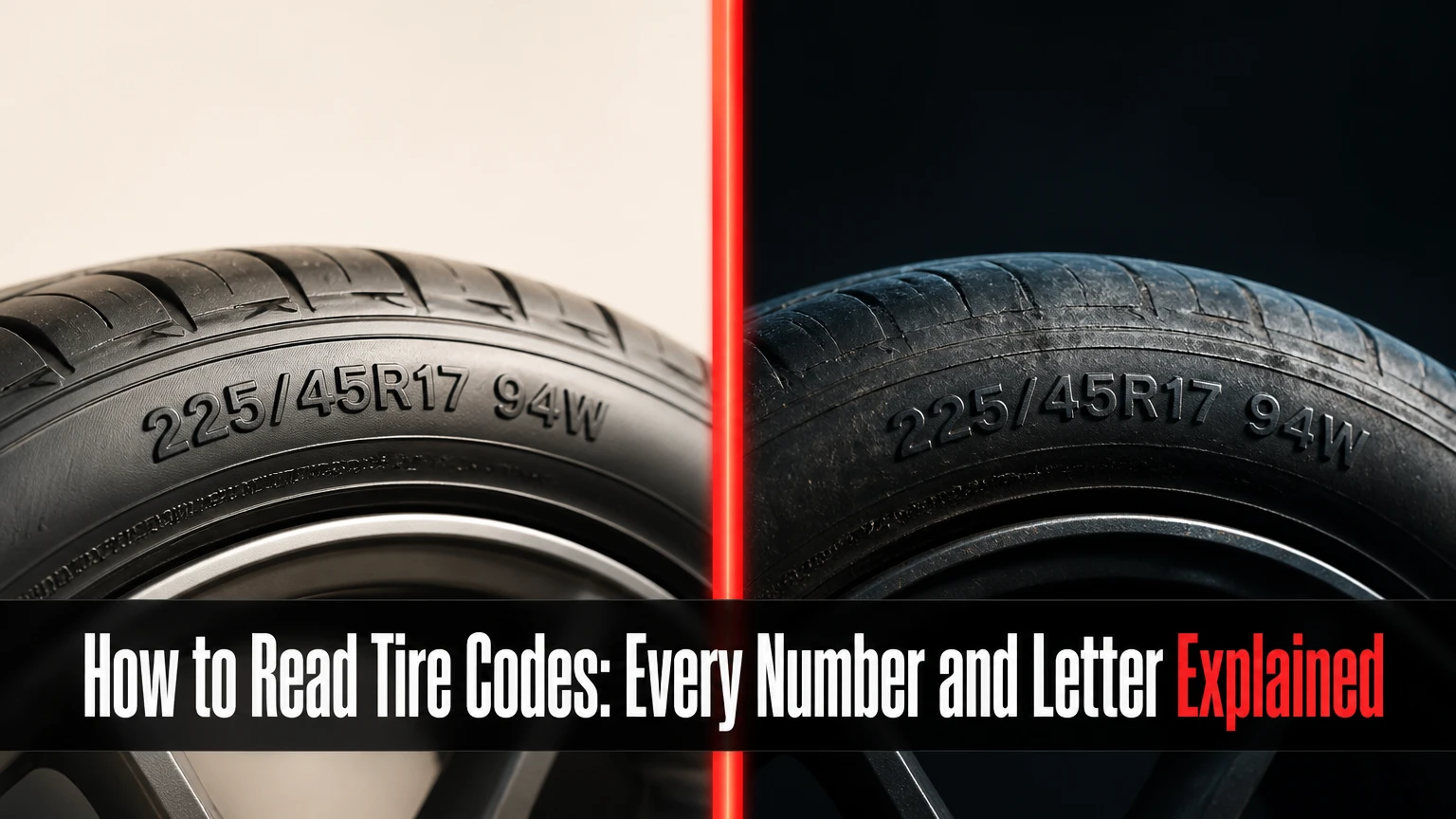
To learn how to read tire codes, start with the main size sequence, such as P215/65R15 95H. Read it from left to right: vehicle class, tire width, sidewall ratio, construction, wheel diameter, load index, and speed rating. Then check the DOT date, load markings, weather symbols, and installation instructions elsewhere on the sidewall.
Key Facts at a Glance
- The first three-digit number is the nominal tire width in millimeters.
- The number after the slash is sidewall height expressed as a percentage of tire width.
- The wheel-diameter number refers to the rim, not the tire’s total diameter.
- The load index and speed letter must meet the vehicle manufacturer’s requirements.
- The final four digits of the full DOT code identify the production week and year.
- A 3PMSF symbol confirms tested snow traction, while M+S is primarily a tread-design designation.
How to Read Tire Codes Step by Step
A standard passenger-tire code can be decoded in seven steps. Using P215/65R15 95H as the example, each character describes a separate fitment or performance attribute. Michelin uses the similar example 205/55R17 91V to identify width, profile, construction, rim size, load rating, and speed rating.
| Code section | Example | Meaning | Practical effect |
|---|---|---|---|
| Service type | P | Passenger-vehicle tire | Identifies the sizing system |
| Section width | 215 | 215 millimeters | Influences clearance and footprint |
| Aspect ratio | 65 | 65% of 215 mm | Determines nominal sidewall height |
| Construction | R | Radial | Identifies internal ply arrangement |
| Rim diameter | 15 | 15-inch wheel | Must match the wheel exactly |
| Load index | 95 | 1,521 lb per tire | Maximum rated load when correctly inflated |
| Speed rating | H | 130 mph | Tested maximum under specified conditions |
Step 1: Identify the Service-Type Prefix
The first letter identifies the tire’s intended application or sizing category. A P prefix means P-metric passenger tire, while LT identifies a light-truck tire designed for higher loads and demanding truck applications.
Common prefixes include:
- P: Passenger cars, crossovers, minivans, and some SUVs
- LT: Light trucks, heavy SUVs, pickups, and commercial vans
- T: Temporary-use spare tire
- ST: Special Trailer tire intended for trailer axles
- C after the rim size: Commercial or van tire in some metric systems
A code without a prefix, such as 225/65R17, is commonly called Euro-metric. A missing P does not mean the tire is defective or unclassified. It means the tire follows a different standardized sizing convention.
Do not install an ST tire on a passenger vehicle. ST tires are engineered for trailer service, not for steering, acceleration, or normal driven-axle behavior.
Step 2: Read the Tire Width
The first three-digit number gives the nominal section width in millimeters. In P215/65R15, the tire is approximately 215 millimeters wide from sidewall to sidewall when measured under the standard conditions used for that tire size.
Convert millimeters to inches by dividing by 25.4:
215 ÷ 25.4 = 8.46 inches
The number is nominal, not a guarantee of the exact installed width. Rim width, tire model, load, and inflation can cause two tires labeled 215 to measure slightly differently. Michelin defines section width as the distance between the outer sidewalls, excluding raised lettering and decorative features.
A wider tire may require more wheel-well clearance. It can also alter steering feel, rolling resistance, hydroplaning behavior, and wheel protection, so width should not be changed independently of the full fitment calculation.
Step 3: Calculate the Aspect Ratio
The number after the slash is the aspect ratio. It expresses nominal sidewall height as a percentage of section width, not as a measurement in millimeters.
For 215/65R15:
215 mm × 0.65 = 139.75 mm
The nominal sidewall is therefore about 139.75 millimeters, or 5.50 inches, high.
| Tire size | Width | Aspect ratio | Nominal sidewall height |
|---|---|---|---|
| 215/65R15 | 215 mm | 65% | 139.8 mm |
| 215/55R17 | 215 mm | 55% | 118.3 mm |
| 225/45R18 | 225 mm | 45% | 101.3 mm |
| 245/40R19 | 245 mm | 40% | 98.0 mm |
A lower ratio usually creates a shorter sidewall when width remains similar. Shorter sidewalls can sharpen steering response, but they normally provide less cushioning against potholes and curb impacts.
The ratio alone does not reveal total tire height. You must combine both sidewalls with the wheel diameter to estimate overall diameter.
Step 4: Identify the Construction Letter
The letter following the aspect ratio describes the tire’s internal construction. R means radial, the dominant construction for modern passenger vehicles.
Radial tire cords generally run across the tire from bead to bead at roughly 90 degrees to the direction of travel. The belt package beneath the tread stabilizes the contact area.
Other markings include:
- D: Diagonal or bias-ply construction
- B: Bias-belted construction
- No construction letter: May indicate a conventional bias tire in certain older or specialized formats
Michelin’s motorcycle guidance confirms that R means radial, B means bias-belted, and a missing construction letter may identify a standard bias tire.
Do not casually mix radial and bias tires. Their different deflection and handling characteristics can produce unpredictable vehicle behavior.
Step 5: Match the Wheel Diameter
The number after the construction letter is the required wheel diameter in inches. In P215/65R15, the tire fits a 15-inch wheel measured at the bead-seat diameter.
This number is not the tire’s outside diameter. The complete tire is larger because its sidewalls extend above and below the wheel.
The approximate outside diameter is:
Wheel diameter + two sidewall heights
For a 215/65R15 tire:
- Wheel diameter: 15 inches
- Sidewall height: 5.50 inches
- Approximate outside diameter: 15 + 5.50 + 5.50 = 26.0 inches
The rim diameter must match exactly. A 16-inch tire cannot be safely mounted on a 15-inch wheel, even when other numbers look similar.
Step 6: Decode the Load Index
The load index is the number immediately after the size. It corresponds to a standardized table showing how much weight one tire can support under specified inflation and operating conditions.
In P215/65R15 95H, load index 95 corresponds to 1,521 pounds, or 690 kilograms, per tire.
| Load index | Maximum load per tire | Kilograms | Four-tire mathematical total |
|---|---|---|---|
| 91 | 1,356 lb | 615 kg | 5,424 lb |
| 95 | 1,521 lb | 690 kg | 6,084 lb |
| 100 | 1,764 lb | 800 kg | 7,056 lb |
| 102 | 1,874 lb | 850 kg | 7,496 lb |
| 110 | 2,337 lb | 1,060 kg | 9,348 lb |
The mathematical total is not permission to load the vehicle to that weight. Gross vehicle weight rating, axle ratings, wheel strength, suspension capacity, and inflation requirements may impose lower limits.
Michelin states, “A tire’s load rating must always meet or exceed the value specified by the vehicle manufacturer.” A higher load index is generally acceptable when the complete fitment is approved, but it does not increase the vehicle’s legal or mechanical carrying capacity.
What Does XL Mean on a Tire?
XL means Extra Load. An XL tire has reinforced construction and can carry more load than a standard-load tire of the same nominal size when inflated to its specified pressure.
XL does not mean extra-large. It also does not mean the driver may exceed the vehicle’s axle or gross-weight ratings. Michelin notes that XL tires are commonly specified for heavier passenger vehicles and SUVs.
Step 7: Read the Speed Rating
The final letter is the speed rating. It represents the maximum speed at which the tire can carry its rated load under defined laboratory conditions.
In 95H, H identifies a maximum rated speed of 130 mph, or 210 km/h.
| Rating | Maximum mph | Maximum km/h | Common application |
|---|---|---|---|
| S | 112 | 180 | Family sedans and vans |
| T | 118 | 190 | Sedans, minivans, crossovers |
| H | 130 | 210 | Touring and sport sedans |
| V | 149 | 240 | Performance vehicles |
| W | 168 | 270 | High-performance vehicles |
| Y | 186 | 300 | Very high-performance vehicles |
| (Y) | Above 186 | Above 300 | Specialized high-speed tires |
The speed rating is not a recommended driving speed. Tire condition, pressure, road temperature, vehicle load, repairs, weather, and road hazards can reduce safe operating speed.
Michelin recommends replacement tires that meet or exceed the vehicle manufacturer’s specified speed rating. Its current chart lists T at 118 mph, H at 130 mph, V at 149 mph, W at 168 mph, and Y at 186 mph.
How Do You Read the DOT Tire Date Code?
The tire’s manufacturing date appears in the final four digits of the complete DOT Tire Identification Number. The first two digits represent the production week, and the final two identify the year.
For example:
DOT XXXX XXXX 3425
- 34: Manufactured during the 34th week
- 25: Manufactured in 2025
A code ending in 0724 means the tire was produced in the seventh week of 2024.
The complete DOT sequence may appear on only one side of the tire. Goodyear warns that a mounted tire’s full DOT number can face inward, making only a partial sequence visible from outside the vehicle.
Tires made before 2000 may have a three-digit date code. Those tires are now several decades old and should not be treated as serviceable merely because visible tread remains.
The DOT date is the manufacturing date, not an automatic expiration date. Michelin recommends annual professional inspections after five years of service and replacement by ten years from manufacture as a precaution, regardless of remaining tread.
What Do UTQG Tire Ratings Mean?
Uniform Tire Quality Grading uses treadwear, traction, and temperature grades to compare certain passenger tires sold in the United States. UTQG information is molded into the sidewall of covered tires, although some tire categories are exempt.
A marking may read:
TREADWEAR 500 TRACTION A TEMPERATURE A
| UTQG category | Example | What it measures | Important limitation |
|---|---|---|---|
| Treadwear | 500 | Comparative wear rate | Most useful within one manufacturer |
| Traction | AA | Wet straight-line braking | Does not grade cornering or hydroplaning |
| Temperature | A | Heat resistance | Assumes correct load and inflation |
| Lowest common grade | C | Minimum qualifying category | Not a complete safety score |
Treadwear
Treadwear is a comparative grade derived from controlled testing against a reference tire. A grade of 400 theoretically indicates twice the wear life of a grade of 200 under the test system.
That relationship should not be converted directly into mileage. Driving style, alignment, rotation, inflation, climate, road surface, vehicle weight, and compound design can produce very different real-world results.
Cross-brand comparisons also deserve caution because manufacturers assign grades based on their test interpretation within the federal framework. UTQG is better for comparing related models than predicting an exact lifespan.
Traction
UTQG traction grades are AA, A, B, and C, from highest to lowest. The test evaluates straight-line wet braking performance on specified surfaces.
It does not directly measure:
- Dry braking
- Wet cornering
- Snow or ice performance
- Hydroplaning resistance at every speed
- Overall handling quality
A tire with an AA grade is not automatically the best tire for every driver.
Temperature
Temperature grades are A, B, and C, with A representing the highest heat-resistance category. Heat buildup increases when a tire is underinflated, overloaded, damaged, or driven at excessive speed.
NHTSA regulations require applicable passenger tires to display their UTQG information, although limited-production and certain specialized tires can be excluded.
What Do M+S and the Snowflake Symbol Mean?
M+S and the Three-Peak Mountain Snowflake symbol are not equivalent. M+S primarily indicates qualifying mud-and-snow tread geometry, while 3PMSF confirms that the tire passed a standardized acceleration-traction test on medium-packed snow.
| Marking | Meaning | Performance testing | Best interpretation |
|---|---|---|---|
| M+S | Mud and Snow | No equivalent severe-snow performance test | Basic all-season or all-terrain designation |
| M/S | Mud and Snow | Same general category as M+S | Manufacturer marking variation |
| 3PMSF | Three-Peak Mountain Snowflake | Standardized snow-traction threshold | Verified severe-snow capability |
| Studdable | Accepts approved studs | Depends on tire and jurisdiction | Ice-focused seasonal application |
Michelin explains that M+S is based on tread-geometry criteria, while the 3PMSF symbol requires a specific snow-traction test.
The 3PMSF test does not grade braking, cornering, or ice traction in every condition. Drivers facing frequent ice, deep snow, or prolonged freezing temperatures should evaluate the complete winter-tire design, not one symbol alone.
How Are Truck and Off-Road Tire Codes Different?
Truck and off-road tires may use LT-metric, numeric, flotation, or commercial sizing. The reading method changes slightly, but the code still communicates dimensions, construction, wheel fitment, and load capacity.
| Format | Example | How to read it | Typical use |
|---|---|---|---|
| P-metric | P265/70R17 | Width in mm, ratio, construction, rim | Passenger SUVs and pickups |
| LT-metric | LT265/70R17 | Same sequence with light-truck class | Towing and heavier truck service |
| Euro-metric | 265/70R17 | Metric size without P prefix | Cars, SUVs, and vans |
| Flotation | 33×12.50R15LT | Diameter × width × rim, in inches | Off-road trucks |
| C-metric | 225/65R16C | Metric commercial tire | Vans and light commercial vehicles |
A flotation code such as 33×12.50R15LT means an approximately 33-inch outside diameter, 12.50-inch nominal width, radial construction, 15-inch wheel, and light-truck application.
Do not assume that an LT tire and a same-size P-metric tire are interchangeable. Their load tables, required pressures, ride characteristics, weight, and casing construction can differ.
What Do Load Range and Ply Rating Mean?
Load range identifies a tire’s load and pressure category. Letters such as C, D, and E are commonly seen on light-truck tires.
The historical phrase “10-ply rating” does not necessarily mean the tire contains ten physical plies. Modern materials can achieve equivalent strength with fewer casing layers.
| Load range | Traditional ply rating | Common LT maximum pressure* | Typical context |
|---|---|---|---|
| C | 6-ply rated | About 50 psi | Lighter truck service |
| D | 8-ply rated | About 65 psi | Moderate hauling |
| E | 10-ply rated | About 80 psi | Heavy pickup and towing |
| F | 12-ply rated | About 95 psi | Higher-capacity commercial use |
*Typical values only. Read the tire specification and use the vehicle placard or approved load-inflation data.
A higher load range can produce a firmer ride and greater tire weight. It does not automatically improve braking, traction, fuel economy, or payload capacity.
How Do Directional and Asymmetric Markings Work?
Directional and asymmetric tires must be installed according to their sidewall instructions. A directional tire has a rotation arrow, while an asymmetric tire is marked Inside and Outside.
For a directional tire, the arrow must point in the direction of forward wheel rotation. Mounting it backward can reduce the tread’s intended water-displacement performance.
For an asymmetric tire, the side marked Outside must face away from the vehicle. These tires can normally rotate in either direction once the correct side faces outward.
Some tires are both directional and asymmetric. Those designs may require side-specific fitment and careful wheel-position planning.
Where Should You Find the Correct Replacement Size?
The driver’s door-jamb placard is generally the first reference for replacement tire size and cold inflation pressure. The owner’s manual and vehicle manufacturer’s approved fitment information provide additional guidance.
Use this order:
- Read the vehicle placard.
- Confirm the owner’s-manual specification.
- Check the current tire for comparison.
- Verify load index and speed rating.
- Confirm wheel size and approved rim-width range.
- Investigate any difference before buying.
The tire currently installed may not be the factory size. Previous owners sometimes install alternate wheels, incorrect load ratings, or cosmetic plus-size combinations.
Original-equipment markings may also appear on the tire. These identify versions developed for particular vehicle manufacturers or models, with possible tuning for noise, handling, rolling resistance, comfort, or electronic-system compatibility. Michelin recommends considering the same OE designation when the vehicle specifies it.
Common Tire-Code Mistakes and How to Fix Them
Mistaking Wheel Size for Overall Tire Size
The 17 in 225/65R17 is the wheel’s bead-seat diameter. It does not mean the complete tire is 17 inches tall.
Calculate approximate outside diameter by converting the sidewall height to inches, multiplying by two, and adding the wheel diameter.
Treating the Aspect Ratio as Millimeters
The 65 in 225/65R17 does not mean a 65-millimeter sidewall. It means the sidewall is nominally 65 percent of 225 millimeters.
The calculated sidewall height is 146.25 millimeters.
Using the Sidewall Maximum as Normal Pressure
The maximum-pressure marking on the tire is not automatically the vehicle’s recommended daily pressure. Use the cold inflation pressure on the vehicle placard unless an approved application requires different data.
Choosing a Lower Load Index
A physically fitting tire can still be unsafe when its load index is below the vehicle specification. Match or exceed the required index while maintaining the correct size, pressure system, and application.
Assuming a Higher Speed Rating Is Always Better
A higher speed rating may accompany a different casing, compound, ride quality, tread life, and cold-weather behavior. The correct tire must suit the whole application, not one letter.
Reading Only the Visible DOT Sequence
The complete DOT date may be molded on the inward-facing sidewall. Inspect the other side before concluding that the date code is missing.
Limitations of Tire Sidewall Codes
Tire codes describe specifications, but they cannot reveal the tire’s complete condition. A correct size and recent production date do not rule out impact damage, underinflation history, internal separation, puncture damage, improper repairs, chemical exposure, or prolonged outdoor storage.
Sidewall codes also cannot predict exact tread life. A tire’s service life depends on alignment, pressure maintenance, rotation, road conditions, climate, vehicle load, compound, and driving behavior.
Use the code to confirm identity and compatibility. Use physical inspection, pressure checks, tread measurements, and service history to judge condition.
Frequently Asked Questions
What Does ZR Mean in a Tire Code?
ZR identifies a radial tire designed for a high-speed category historically associated with speeds above 149 mph. Modern tires often show ZR within the size plus a more precise service-description rating, such as W, Y, or (Y). Use the final speed symbol to determine the applicable standardized maximum.
Can I Use a Tire With a Higher Load Index?
A higher load index is generally acceptable when the tire size, construction, wheel fitment, inflation requirements, and vehicle application remain approved. It does not increase the vehicle’s payload rating because axles, wheels, suspension, and chassis ratings still control the allowable load.
Can I Mix H-Rated and V-Rated Tires?
The safest practice is to use matching tires with the manufacturer-specified rating, especially on the same axle. Mixing ratings can create different steering, cornering, heat, and wet-weather behavior. When temporary mixing is unavoidable, consult the vehicle and tire manufacturers about positioning and operating limits.
What Does Tubeless Mean on a Tire?
Tubeless means the tire is designed to retain air through an airtight inner liner when mounted on a compatible tubeless wheel. It normally does not require a separate inner tube. The marking may appear as Tubeless or TL, depending on the manufacturer and market.
Does the DOT Code Show When a Tire Expires?
No. The DOT code shows when the tire was manufactured. It does not print a universal expiration date. Age recommendations vary by manufacturer, vehicle maker, service conditions, inspection results, storage history, and jurisdiction, so age must be considered alongside condition and manufacturer guidance.
Can Two Tires With the Same Code Be Different Sizes?
Two tires with the same nominal size can have small dimensional differences. Tread design, approved measuring-rim width, casing shape, and manufacturer tolerances affect actual width and diameter. Check the product specification sheet when clearance, wheel width, or a four-wheel-drive diameter match is sensitive.
The Bottom Line
Knowing how to read tire codes lets you verify size, wheel compatibility, load capacity, speed capability, production date, weather classification, and installation direction before buying or mounting a tire. Decode the main sequence from left to right, then compare every safety-related value with the vehicle placard rather than relying only on the tire already installed.