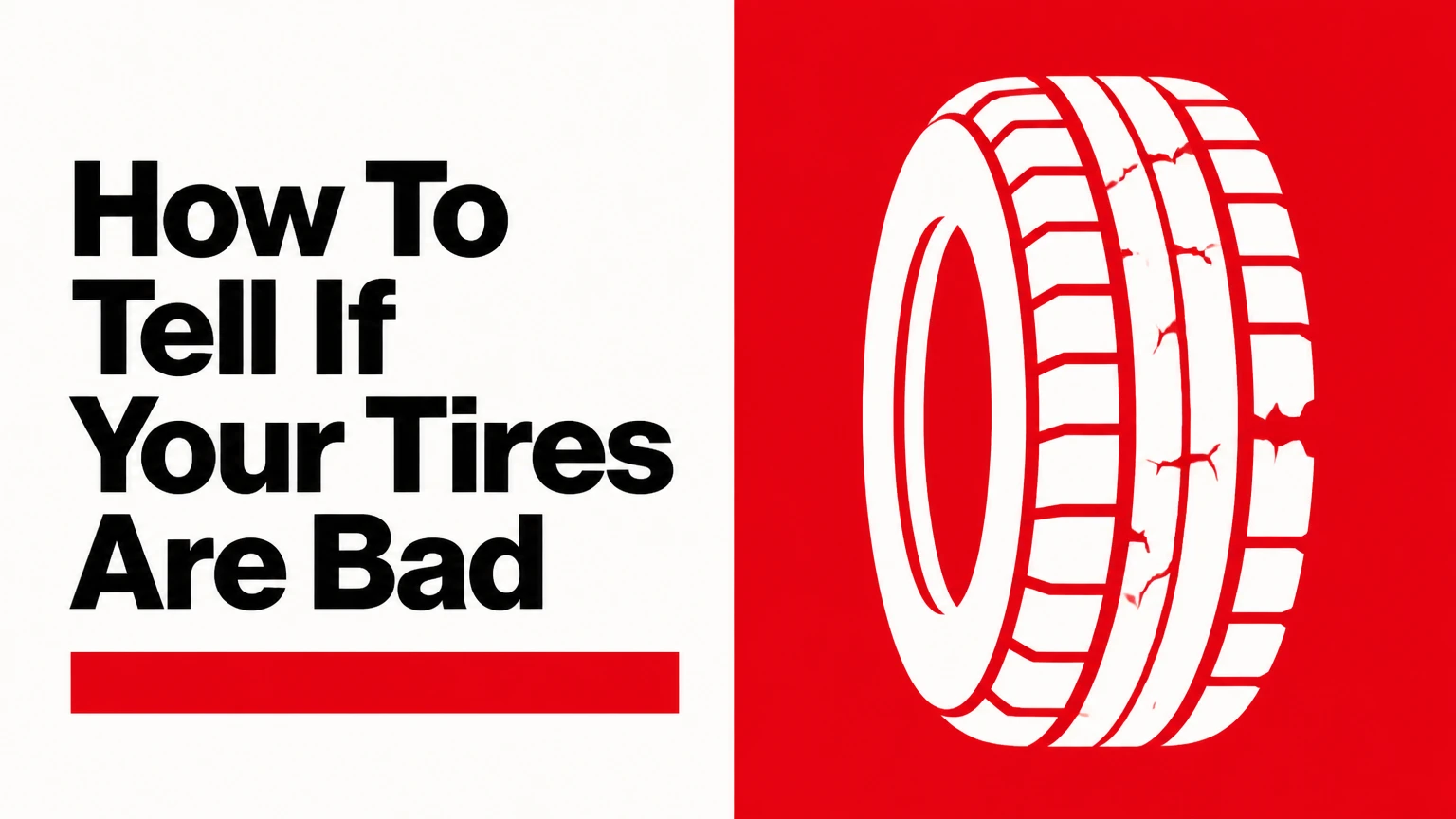
You know how to tell if your tires are bad when the tread depth drops below 3 millimeters, the sidewalls develop visible structural cracks, or uneven wear patterns expose the underlying steel belts. Rubber degradation from age, mechanical suspension failures, and daily friction actively destroy the tire casing long before a catastrophic blowout forces a replacement.
Key Facts / At a Glance
- Legal tread minimum in most jurisdictions is 1.6 millimeters (2/32 of an inch), but wet traction severely degrades at 3 millimeters.
- Rubber structural integrity expires after 6 to 10 years, regardless of how many miles the vehicle has been driven.
- Cupping or wavy tread patterns indicate failed shock absorbers, not just an out-of-balance wheel.
- Replacing only one tire on an All-Wheel Drive (AWD) vehicle can destroy the central differential due to rotational differences.
- Tire Pressure Monitoring Systems (TPMS) only alert you when pressure drops 25% below normal, meaning unseen damage occurs before the light activates.
What Causes A Tire To Fail?
A tire fails when its structural integrity, rubber compounds, or tread depth degrades to a point where it can no longer safely disperse water, handle vehicle load, or maintain inflation pressure. This degradation happens through four distinct physical and chemical mechanisms.
Every acceleration, braking action, and turn scrapes microscopic layers of rubber off the contact patch. Friction is the intended wear mechanism, but it is heavily accelerated by poor driving habits. Chemical aging, also known as oxidation, occurs constantly. Oxygen reacts with the polymer chains in the rubber, causing the material to harden and lose its elasticity. According to a 2022 report by the Tire Industry Association (TIA), this hardening process happens even in climate-controlled storage environments.
Mechanical stress breaks down the internal architecture. A modern tire is a complex assembly of inner butyl liners, polyester body plies, and rigid steel belts. Impacting potholes or curbs at high speeds permanently deforms these steel belts. Finally, thermal cycling destroys the chemical bonds. The continuous transition between a cold resting state and the high heat generated by highway speeds literally cooks the rubber compounds over several years, rendering them brittle and highly susceptible to sudden pressure loss.
How Long Do Tires Really Last?
Most standard all-season passenger tires last between 40,000 and 60,000 miles, while their maximum safe structural lifespan caps strictly at six to ten years from the date of manufacture. You must monitor both mileage and calendar age simultaneously.
Age degradation is an invisible threat. A tire that sits in a garage for eight years might look brand new, but its internal structural adhesives have likely dried out. When driven at highway speeds, the heat buildup causes the brittle tread block to cleanly detach from the steel carcass. This is known as tread separation. The National Highway Traffic Safety Administration (NHTSA, 2021) explicitly warns that tires older than six years pose an exponentially higher risk of tread separation compared to newer tires.
Environmental factors accelerate this aging timeline. Vehicles parked outside face intense ultraviolet (UV) radiation and atmospheric ozone. Ozone specifically attacks the double bonds in natural and synthetic rubber, causing a phenomenon known as ozonolysis, commonly referred to as dry rot. You will see this manifest as a network of fine, spiderweb-like cracks inside the tread grooves and along the outer sidewall. Once these cracks expose the white fabric plies underneath, the tire is fundamentally ruined and requires immediate replacement.
How To Tell If Your Tires Are Bad At Home
You can execute a comprehensive safety inspection in your own driveway using only a flashlight and a cheap mechanical gauge. Performing this check monthly prevents highway emergencies and extends the life of your vehicle’s suspension.
Step 1: Measure Tread Depth Accurately
Do not rely on the outdated penny or quarter tests. A copper coin provides no granular data about uneven wear. Purchase a mechanical tire tread depth gauge (usually under $5 at any auto parts store). Push the pin to the base of the tread groove and read the measurement. Take three separate readings across the face of the tire: the outer edge, the direct center, and the inner edge. A reading of 4 millimeters provides safe rain traction. A reading of 3 millimeters means you must order replacements. A reading of 1.6 millimeters means the vehicle is legally unsafe to drive.
Step 2: Locate the Tread Wear Indicators
Manufacturers mold small, raised rubber bridges inside the deep longitudinal grooves of the tire. These are called wear bars. Run your finger inside the main groove. If the main tread blocks are physically flush and level with these horizontal wear bars, your tire has reached the legal 1.6-millimeter limit. At this depth, the tire cannot channel water away from the contact patch, guaranteeing hydroplaning at highway speeds.
Step 3: Read the DOT Date Code
Locate the letters “DOT” printed on the lower sidewall near the wheel rim. Look for an oval capsule containing a four-digit number at the end of the text string. This sequence reveals the exact manufacturing date. The first two digits signify the week, and the final two digits signify the year. A code of “3420” means the tire was built during the 34th week of 2020. If that four-digit number ends in a year older than six years ago, the structural casing is severely compromised.
Step 4: Perform a Tactile Sidewall Inspection
Visual checks miss internal casing ruptures. Turn your steering wheel all the way to the left to expose the inside facing shoulder of the front tires. Run your bare hand firmly along the interior and exterior rubber walls. You are feeling for bubbles, bulges, or sudden lumps. A bubble indicates that the rigid inner liner has snapped (usually from a pothole impact) and highly pressurized air is now pressing directly against the thin outer cosmetic rubber. This is a ticking time bomb that will result in a blowout upon the next hard impact.
What Do Abnormal Wear Patterns Mean?
Abnormal wear patterns indicate severe mechanical failures within your vehicle’s alignment geometry or suspension architecture. Tires should wear perfectly evenly across the entire flat surface of the contact patch.
When a tire wears rapidly on specific edges or in strange patterns, the tire itself is rarely the root cause. The rubber is simply the messenger recording the mechanical abuse it receives from the chassis. Diagnosing these patterns early saves you from destroying a brand new set of replacement tires.
| Wear Pattern Description | Root Mechanical Cause | Required Immediate Action |
|---|---|---|
| Center Wear (Bald middle, thick edges) | Chronic over-inflation | Deflate to the pressure listed on the driver’s door jamb. |
| Edge Wear (Bald edges, thick middle) | Chronic under-inflation | Inflate tires immediately (check for slow puncture leaks). |
| One-Sided Shoulder Wear | Severe Camber misalignment | Schedule a four-wheel computerized alignment. |
| Feathering (Sharp edges on one side of blocks) | Severe Toe misalignment | Fix bent tie rods and perform a front-end alignment. |
| Cupping / Scalloping (Dipped, wavy craters) | Blown shocks or struts | Replace suspension dampers, then balance the wheels. |
What Noises And Vibrations Indicate Failure?
A failing tire produces rhythmic vibrations and low-frequency roaring noises that escalate directly with the speed of the vehicle. You can isolate tire defects from engine or transmission issues by shifting the car into neutral while coasting at highway speeds.
If the vibration or noise persists while the engine is idling in neutral, the issue is directly tied to your rotational assembly (the wheels, tires, or wheel bearings). Tires that have shifted their internal steel belts become out-of-round, meaning they are no longer perfect circles. This creates a severe vertical hop.
| Sensation or Symptom | Auditory Cue | Probable Defect |
|---|---|---|
| Steering wheel shakes at 50-70 mph | Rhythmic thumping | Front wheels are out of balance. |
| Driver’s seat vibrates intensely | Low drone | Rear wheels are out of balance. |
| Vehicle aggressively pulls left or right | Slapping sound | Radial tire pull (broken internal steel belt). |
| Constant loud humming at all speeds | Helicopter-like chopping | Severe tire cupping or a failed wheel bearing. |
Run-Flat vs. Standard Tires: Which Is Better?
Standard tires offer superior ride comfort and longevity, while run-flat tires provide the distinct security of driving up to 50 miles after a complete puncture. Your choice depends heavily on whether your vehicle includes a spare tire in the trunk.
Many modern luxury vehicles delete the spare tire entirely to save weight, forcing owners to use run-flat technology. Run-flats utilize heavily reinforced, ultra-thick sidewalls that can support the entire weight of the car even with zero air pressure. However, this engineering comes with significant compromises in daily drivability.
| Evaluation Criteria | Standard All-Season Tires | Run-Flat Tires | High-Performance Summer Tires |
|---|---|---|---|
| Puncture Recovery | Immobilized immediately. | Drive 50 miles at 50 mph. | Immobilized immediately. |
| Ride Comfort | Soft and compliant. | Stiff, harsh over bumps. | Firm, precise feedback. |
| Repairability | Easily patched if in the tread. | Cannot be legally patched. | Easily patched if in the tread. |
| Tread Lifespan | 50,000 to 70,000 miles. | 30,000 to 40,000 miles. | 15,000 to 30,000 miles. |
| Replacement Cost | Baseline cost. | 30% to 50% more expensive. | 40% to 60% more expensive. |
What Are The Typical Replacement Costs?
Replacing a standard set of four passenger tires typically costs between $400 and $800, while specialized performance or truck tires can easily exceed $1,200. The cost heavily depends on the manufacturer tier and the speed rating of the rubber compound.
Tier 1 manufacturers (like Michelin, Bridgestone, and Continental) invest billions in research and development, resulting in compounds that stop shorter in the rain and last longer. Tier 2 brands (like Falken, General, and Kumho) offer excellent value, providing roughly 85% of the performance for a lower price.
| Tire Category | Lifespan Expectancy | Typical Cost (Per Tire) | Best Application |
|---|---|---|---|
| Budget / Unbranded Import | 30,000 miles | $50 to $90 | Emergency replacement only. |
| Tier 2 All-Season | 50,000 miles | $90 to $140 | Daily commuters on a budget. |
| Tier 1 Premium Touring | 70,000 miles | $150 to $250 | High-mileage drivers wanting comfort. |
| All-Terrain / Light Truck | 60,000 miles | $180 to $320 | SUVs, towing, and off-road use. |
| Dedicated Winter / Snow | 4 to 5 winter seasons | $120 to $220 | Regions with heavy snow and ice. |
Why Do Electric Vehicle Tires Wear Out Faster?
Electric vehicles (EVs) consume tires 20% to 30% faster than traditional gas-powered cars due to extreme vehicle weight and instant torque delivery. An EV requires specially engineered High-Load (HL) tires to handle these unique physical demands.
The battery packs in electric vehicles add roughly 1,000 to 1,500 pounds of curb weight compared to an equivalent combustion engine car. This massive weight pushes the rubber into the pavement with significantly more force. Furthermore, electric motors deliver 100% of their rotational torque the millisecond you touch the accelerator. This instant twisting force acts like sandpaper against the tread blocks. Finally, the aggressive regenerative braking systems found in EVs drag on the tires continuously every time you lift off the throttle, accelerating wear on both acceleration and deceleration. If you own an EV, you must rotate your tires every 5,000 miles strictly to combat this accelerated degradation.
Common Tire Maintenance Mistakes
Drivers frequently ruin perfectly good tires by relying on automated dashboard systems or attempting to save money with partial replacements. A lack of basic mechanical understanding leads to thousands of dollars in easily avoidable repairs.
Replacing only one tire is the most expensive mistake you can make. If you drive an All-Wheel Drive (AWD) vehicle, all four tires must have identical tread depths. If you place a brand new tire (with 10 millimeters of tread) on the same axle as a worn tire (with 4 millimeters of tread), the new tire has a larger overall circumference. It will rotate slightly slower than the worn tire. Over hundreds of miles, this rotational difference binds the gears inside the central transfer case, completely destroying the AWD system. Always replace tires in pairs (front or rear), or in sets of four for AWD vehicles.
Another severe error is trusting the Tire Pressure Monitoring System (TPMS) as your primary maintenance tool. The TPMS light on your dashboard is a federally mandated emergency warning, not a daily maintenance gauge. By the time that light illuminates on your dash, your tire is already 25% under-inflated. Driving at highway speeds on a tire that is 25% low generates massive internal heat, breaking down the sidewall and permanently compromising the casing. You must check tire pressures manually once a month using a physical gauge.
Finally, relying on used tires is a massive gamble. Used tire shops often coat old rubber in shiny silicone sprays to make them look viable. However, you have no idea if that tire was previously driven for fifty miles while completely flat, which destroys the inner liner. You also do not know if the tire has a hidden, unsafe puncture patch near the shoulder.
Frequently Asked Questions
How old can tires be before they become unsafe?
Tires become structurally unsafe ten years after their manufacturing date, regardless of tread depth or visual appearance. Most major manufacturers recommend pulling them off the road at the six-year mark to prevent sudden tread separation caused by chemical adhesives drying out.
Can you legally drive on tires with exposed wire?
No. Driving on tires with exposed steel belts or fabric cords is illegal and exceptionally dangerous. The tire has zero puncture resistance at this stage, and the exposed steel will rust instantly upon contact with water, destroying the internal carcass.
Why does my steering wheel shake at 65 miles per hour?
A steering wheel that shakes heavily between 55 and 70 miles per hour indicates a wheel imbalance. The heavy spot on the tire and wheel assembly creates a harmonic vibration at those specific speeds. A mechanic must attach small lead or zinc weights to the rim to counterbalance it.
Are used tires a safe alternative to budget new tires?
Used tires carry hidden risks, such as internal broken belts from previous pothole impacts or improper patches. A new, budget-friendly Tier 2 tire offers a far safer alternative because it comes with a manufacturer warranty and uncompromised internal architecture.
Does patching a tire reduce its speed rating?
Yes. According to the Tire Industry Association guidelines, once a performance tire is punctured and patched, it immediately loses its factory speed rating. The tire is safe for normal highway commuting, but it can no longer safely sustain the extreme speeds it was originally rated for.