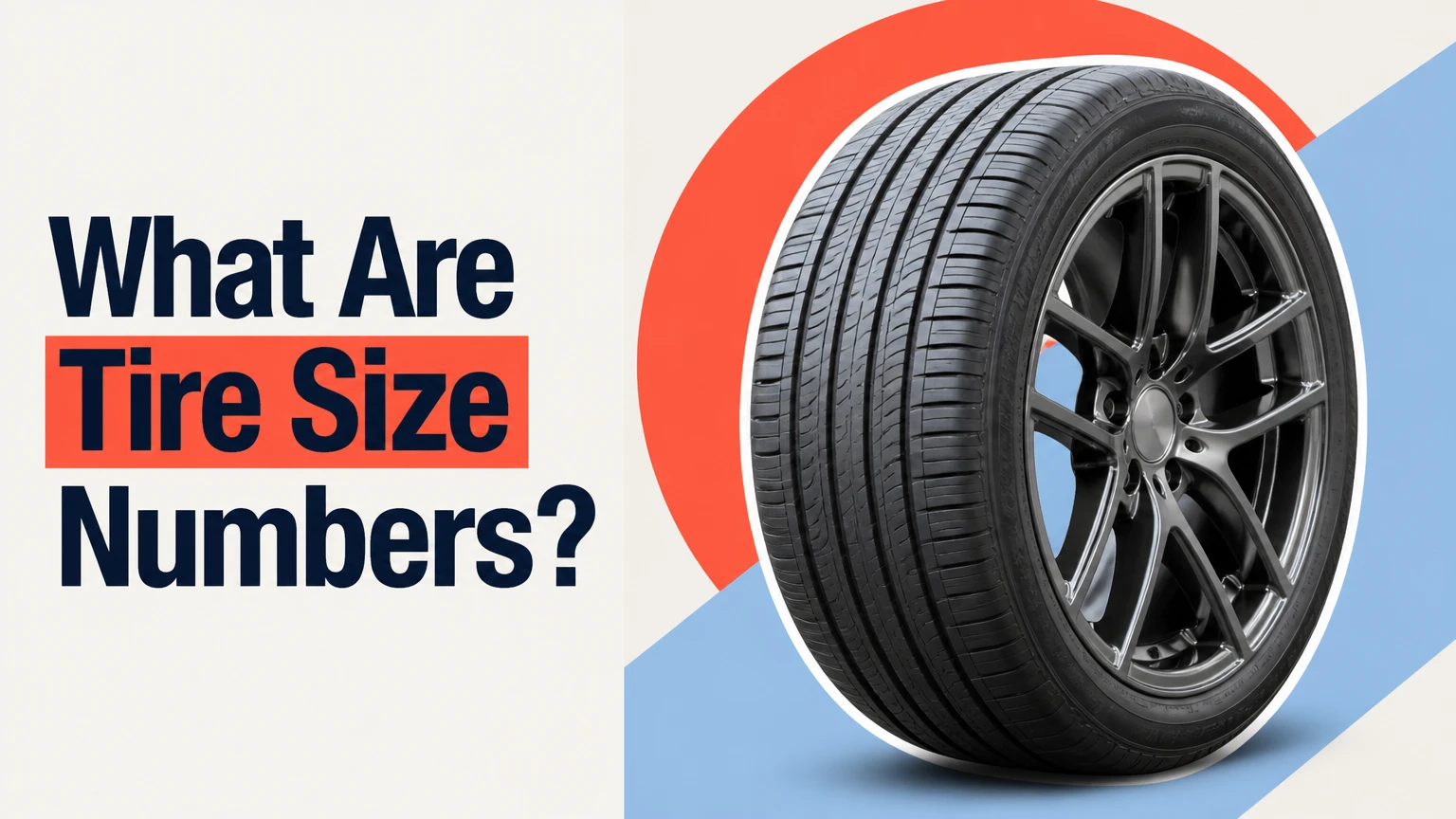
Tire size numbers represent a standardized alphanumeric code molded into the sidewall that dictates the physical dimensions, load capacity, and maximum safe speed of a tire. These digits ensure you purchase the exact replacement rubber required to maintain your vehicle’s structural safety, speedometer accuracy, and mechanical clearance.
Key Facts / At a Glance
- The standard passenger metric sequence (e.g., P215/65R15 95H) details seven specific engineering parameters.
- Section width is measured in millimeters, while the wheel rim diameter is measured in inches.
- Load index and speed ratings dictate the maximum weight and velocity the tire can sustain before structural failure.
- Changing your overall tire diameter by more than 3 percent disrupts modern traction control systems.
- All-wheel-drive vehicles require four identical tire sizes with tread depths matching within 2/32 of an inch to prevent differential damage.
How Do You Read Passenger Tire Size Codes?
A standard passenger car tire size appears as a continuous string of letters and numbers, such as P215/65R15 95H. Each segment of this sequence provides absolute mechanical data required for proper fitment. You read the code from left to right, transitioning from the intended vehicle class down to the specific performance limits of the rubber compound.
What Does the Service Type Letter Mean?
The first letter of the tire code identifies the specific vehicle class the tire was engineered to support. Manufacturers tune the internal casing strength based on this letter.
A tire starting with “P” stands for P-Metric, indicating the tire belongs on standard passenger cars, minivans, or light crossover SUVs. An “LT” prefix denotes a Light Truck tire built with heavy internal plies to support full-size vans and heavy-duty pickups carrying cargo. An “ST” signifies a Special Trailer tire meant strictly for boat or utility trailers. If the tire code has no starting letter, it is a Euro-Metric tire. Euro-Metric tires share the same dimensions as P-Metric tires but utilize slightly different internal load inflation tables.
How Is Section Width Measured?
The first three-digit number indicates the section width of the tire measured in millimeters. This measurement represents the linear distance from the widest point of the outer sidewall to the widest point of the inner sidewall when the tire is properly mounted and inflated.
A tire marked 215 measures 215 millimeters across its widest point. Wider tires increase the physical contact patch with the pavement. A larger contact patch improves dry cornering grip and braking performance. However, increasing the section width also increases aerodynamic drag, rolling resistance, and the likelihood of hydroplaning in standing water.
What Does the Aspect Ratio Indicate?
The two-digit number following the slash mark represents the aspect ratio, which dictates the vertical height of the tire sidewall. This number is not an absolute measurement. It is a percentage of the section width.
In a 215/65R15 tire, the aspect ratio is 65. The sidewall height equals 65 percent of 215 millimeters, resulting in a height of 139.75 millimeters. Low-profile tires feature aspect ratios under 50. These short sidewalls offer stiff cornering support and rapid steering response. High-profile tires feature ratios above 60. These tall sidewalls contain a larger volume of compressed air, providing superior shock absorption over potholes and rough pavement.
What Do Internal Construction Letters Reveal?
The letter following the aspect ratio explains how the fabric and steel cords are layered inside the tire carcass. Almost all modern passenger tires feature an “R” for radial construction.
In a radial tire, the internal structural plies run at 90-degree angles directly across the tire from bead to bead. This layout allows the sidewall to flex independently of the tread, minimizing heat buildup and reducing rolling resistance. Occasionally, you will encounter a “D” for diagonal or bias-ply construction. Bias-ply cords run in a crisscross pattern. You only find bias-ply construction on vintage restoration vehicles, heavy agricultural tractors, or low-speed utility trailers.
How Is Rim Diameter Classified?
The two-digit number following the construction letter specifies the diameter of the wheel rim that the tire fits, measured in inches. This is the most inflexible number on the entire sidewall.
A tire with a 15 rating requires a wheel measuring exactly 15 inches in diameter. Attempting to force a 16-inch tire onto a 16.5-inch rim will result in the tire bead failing to seat. Inflating an incorrectly matched tire and rim combination often leads to a fatal structural explosion during the mounting process.
How Does the Load Index Work?
The two-digit or three-digit number near the end of the sequence is the load index. This code corresponds to an industry-standard chart defining the maximum weight a single tire can support when inflated to maximum pressure.
A load index of 95 indicates the tire can support 1,521 pounds (690 kilograms). You multiply this number by four to calculate the total theoretical load capacity of the vehicle. You must never replace a factory tire with a new tire carrying a lower load index. The Tire and Rim Association (2023) dictates that downgrading your load index introduces immediate risks of sudden sidewall blowouts during evasive maneuvers.
| Load Index Code | Maximum Weight (lbs) | Maximum Weight (kg) | Typical Vehicle Category |
|---|---|---|---|
| 85 | 1,135 | 515 | Subcompact hatchbacks |
| 91 | 1,356 | 615 | Standard family sedans |
| 95 | 1,521 | 690 | Crossover SUVs |
| 104 | 1,984 | 900 | Mid-size pickup trucks |
| 121 | 3,197 | 1,450 | Heavy-duty commercial trucks |
Which Speed Rating Do You Need?
The final letter in the tire size sequence is the speed rating. This letter indicates the maximum sustained speed the tire can handle before centrifugal force and heat generation cause the tread to separate from the casing.
Most commuter vehicles require an S, T, or H speed rating. High-performance sports cars demand V, W, or Y ratings to handle extreme track temperatures. Replacing a factory V-rated tire with a cheaper T-rated tire severely compromises the vehicle’s handling stability, even at normal highway speeds. The stiffer casing required for a higher speed rating also improves emergency braking performance.
| Speed Rating Code | Max Sustained Speed (mph) | Max Sustained Speed (km/h) | Target Vehicle Class |
|---|---|---|---|
| Q | 99 | 160 | Winter tires, off-road trucks |
| T | 118 | 190 | Family minivans, basic sedans |
| H | 130 | 210 | Touring sedans, compact SUVs |
| V | 149 | 240 | Sport sedans, performance SUVs |
| Y | 186 | 300 | Exotic sports cars, supercars |
What Are the Alternative Sizing Systems?
While the P-Metric system dominates the passenger market, commercial trucks and off-road vehicles rely on entirely different numerical languages. These alternative systems prioritize total payload capacity and raw physical dimensions over detailed aspect ratios.
You cannot blindly mix sizing systems. An LT-metric tire utilizes thicker rubber and high-tensile steel belts to contain inflation pressures reaching 80 PSI. A standard P-metric tire typically maxes out at 35 to 44 PSI. Applying a P-metric tire to a 2500-series work truck guarantees premature tire failure under load.
| Sizing System | Example Format | Primary Application | Structural Distinction |
|---|---|---|---|
| P-Metric / Euro-Metric | P215/65R15 | Passenger cars, crossovers | Measures width in millimeters and profile in percentages. |
| Flotation (Off-Road) | 33×12.50R15LT | Lifted trucks, rock crawlers | Measures exact total height and total width in inches. |
| Commercial Light Truck | LT235/85R16 | Towing vehicles, heavy vans | Requires high tire pressure (up to 80 PSI) for heavy loads. |
| ISO Metric (Commercial) | 195R14C | European delivery vans | Omits the aspect ratio. Defaults to an 80 or 82 percent profile. |
How Do You Calculate Total Tire Diameter?
You can calculate the exact total outer diameter of any metric tire using a basic mathematical formula. This calculation is required when you want to change wheel sizes while keeping the overall vehicle height identical to the factory specifications.
The formula requires converting the millimeter section width into inches, calculating the sidewall height, multiplying it by two (for the top and bottom of the tire), and adding the wheel rim diameter. Follow these exact steps for a 215/65R15 tire:
- Multiply the width (215) by the aspect ratio as a decimal (0.65). This equals 139.75 millimeters of sidewall height.
- Multiply that height by 2. This equals 279.5 millimeters of total rubber top to bottom.
- Divide by 25.4 to convert millimeters into inches. This equals 11.00 inches.
- Add the rim diameter (15 inches). The total calculated outer diameter is 26.00 inches.
Which Other Sidewall Numbers Matter?
Beyond the primary size dimensions, tire sidewalls display several other numerical codes that determine safety, lifespan, and compatibility. You must review these secondary metrics before finalizing a purchase.
The DOT Date Code verifies the age of the rubber. Look for a string starting with “DOT” ending in four digits near the wheel rim. A code reading 2425 means the tire was manufactured during the 24th week of the year 2025. You should scrap any passenger tire over six years old, regardless of remaining tread depth, because the chemical compounds degrade and become brittle.
The UTQG (Uniform Tire Quality Grading) system provides three distinct ratings for Treadwear, Traction, and Temperature. A treadwear grade of 400 means the tire should theoretically last four times longer on a testing track than a control tire graded at 100. Traction receives a letter grade (AA, A, B, C) evaluating straight-line wet braking. Temperature receives a letter grade (A, B, C) evaluating the tire’s ability to dissipate high-speed heat.
Original Equipment (OE) markings appear as small symbols or letter codes (like N0 for Porsche, a star for BMW, or MO for Mercedes-Benz). These codes indicate the tire compound was engineered specifically for a single vehicle manufacturer’s suspension geometry.
How Does Changing Tire Size Impact Performance?
Drivers frequently alter their tire size numbers to modify the visual stance or handling characteristics of their vehicles. Any deviation from the factory door placard introduces strict mechanical trade-offs.
Plus-sizing involves increasing the wheel rim diameter and the tire section width while simultaneously decreasing the aspect ratio. A “Plus One” setup upgrades a 16-inch wheel to a 17-inch wheel. This shorter sidewall drastically improves steering response and lateral grip on dry pavement. However, it increases unsprung weight, extends braking distances slightly, and creates a noticeably harsher ride over broken pavement.
Down-sizing involves moving to a smaller wheel rim with a taller, narrower tire. Drivers utilize this strategy heavily for winter weather. A narrower section width slices through standing snow and slush rather than floating on top of it. The taller sidewall provides superior protection against hidden potholes. The drawback includes increased body roll and sluggish steering transitions during aggressive driving.
According to the National Institute for Automotive Service Excellence (2022), a change in total tire diameter greater than 3 percent will cause transmission shift timing errors and anti-lock braking (ABS) malfunctions in modern vehicles.
What Are the Common Tire Buying Mistakes?
Purchasing the incorrect tire size numbers wastes money and compromises vehicular safety. The most frequent errors involve ignoring drivetrain tolerances and misinterpreting load requirements.
Mixing different tire sizes on All-Wheel-Drive (AWD) vehicles causes immediate mechanical damage. Systems utilized by Subaru and Audi require all four tires to possess identical sizing numbers and matching physical tread depths within 2/32 of an inch. Unequal diameters force the central drivetrain differential to spin continuously to compensate for the varying wheel speeds. This friction overheats the differential fluid and destroys the transmission components.
Substituting a passenger tire onto a heavy-duty chassis represents another severe error. P-metric tires cost significantly less than LT-metric tires, tempting budget-conscious truck owners. Passenger tires experience excessive sidewall flex and rapid heat buildup when subjected to the weight of a loaded truck bed or a heavy towing trailer.
How Much Do Different Tire Sizes Cost?
Tire pricing scales directly with the physical dimensions and performance ratings molded into the sidewall. A larger rim diameter, wider section width, and higher speed rating all require specialized internal construction that increases manufacturing costs.
Low-profile performance tires and heavy-duty flotation tires require advanced silica compounds to balance grip and longevity. A standard commuter tire utilizes basic carbon black compounds, keeping the cost per unit low.
| Category & Size Example | Typical Application | Tread Lifespan Expectancy | Average Cost Per Unit |
|---|---|---|---|
| Standard Commuter (195/65R15) | Economy hatchbacks, older sedans | 50,000 to 70,000 miles | $70 to $120 |
| Crossover Touring (225/60R17) | Mid-size SUVs, family vans | 45,000 to 65,000 miles | $130 to $190 |
| High Performance (245/40R19) | Sport sedans, performance coupes | 20,000 to 40,000 miles | $220 to $350 |
| Heavy Off-Road (35×12.50R17LT) | Lifted trucks, rock crawlers | 35,000 to 50,000 miles | $280 to $450 |
How to Troubleshoot Abnormal Wear Metrics?
Your tire size numbers can be perfectly matched to your vehicle, but improper inflation or suspension damage will rapidly destroy the tread. Reading the wear pattern identifies the underlying mechanical failure.
Center tread wear indicates severe over-inflation. When you push too much air pressure into the tire, the center of the casing balloons outward. This forces the middle two inches of the tread to absorb all acceleration and braking friction, leaving the outer edges completely untouched.
Outer edge wear on both sides of the tread indicates severe under-inflation. The lack of air pressure causes the center of the tire to collapse inward. The vehicle’s total weight transfers directly onto the stiff outer sidewall shoulders.
Single edge wear or cupping indicates a suspension geometry failure. The wheel alignment is out of specification. Either the camber angle is leaning the tire heavily onto one edge, or failing shock absorbers are allowing the tire to physically bounce down the highway, scrubbing chunks of rubber off in a scalloped pattern.
Frequently Asked Questions (FAQ)
Are tire size numbers universal worldwide?
Yes, the metric sizing system is a recognized global standard utilized by every major international tire manufacturer. While alternative commercial systems exist for specialized equipment, a 225/50R17 tire purchased in Europe features the exact same dimensional geometry as one purchased in North America or Asia.
Where can I find my factory tire size?
You find the original factory tire size printed on the vehicle information placard located inside the driver-side door jamb. You should always reference this door sticker rather than the numbers on your current tires, as a previous owner may have installed incorrect sizes.
Can I put wider tires on my stock rims?
You can safely increase the section width of your tire by 10 to 20 millimeters on a factory rim. Going beyond this limit forces the tire bead to bulge outward unnaturally. A tire too wide for its rim destabilizes the contact patch and ruins steering feel.
What happens if I use a tire with a lower load index?
Installing a tire with a load index below the manufacturer specification causes the sidewall to flex excessively under the vehicle’s normal weight. This constant flexing generates immense internal heat, which quickly degrades the rubber casing and triggers high-speed blowouts.
Does tire size affect my speedometer?
Yes, altering the total outer diameter of your tire directly alters the rotational speed of the wheel. Installing a taller tire causes the wheel to spin slower for any given physical distance, making your speedometer read a slower velocity than you are actually traveling.