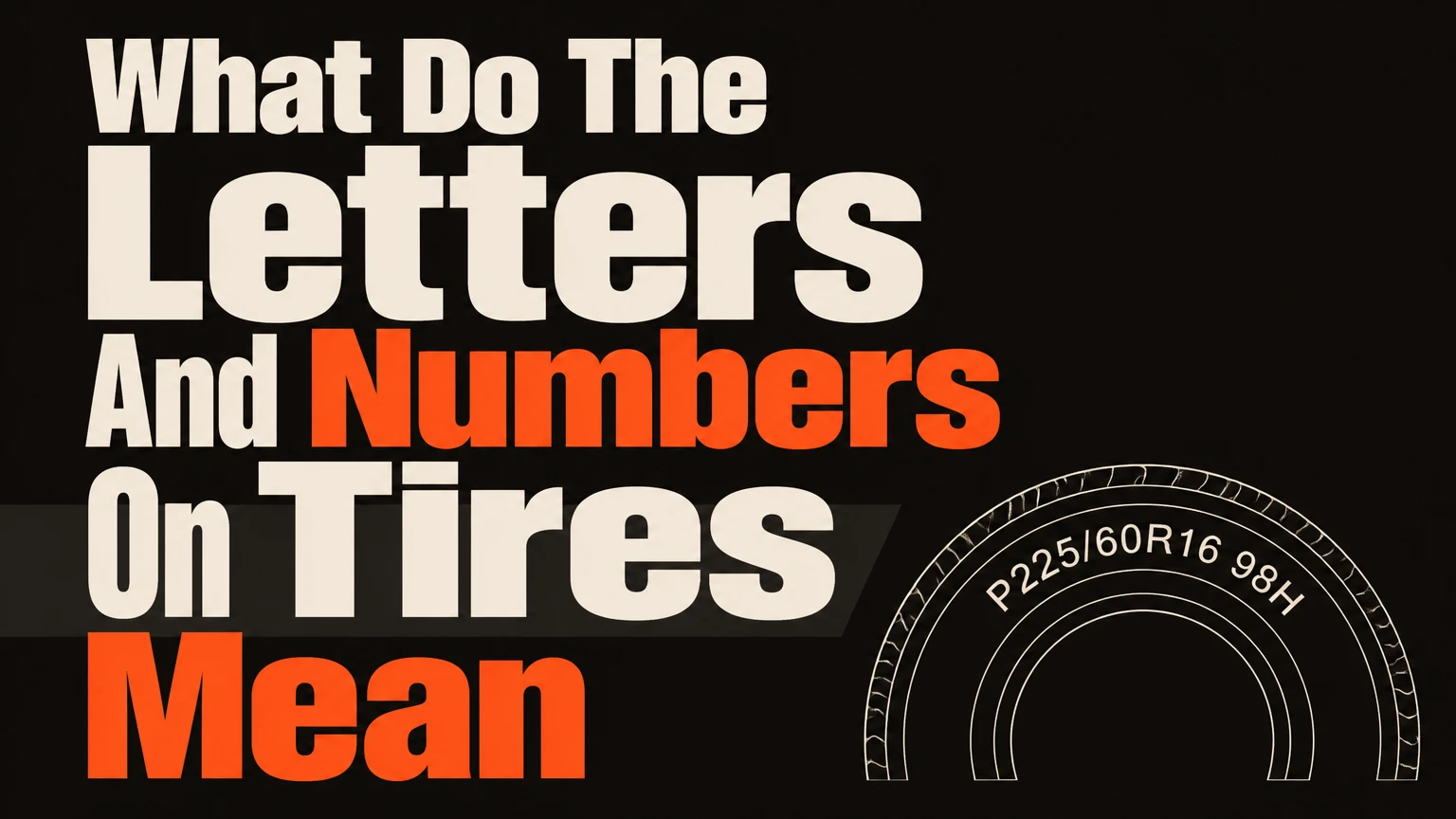
The letters and numbers on a tire sidewall form the Tire Service Description and Size Code. This standardized sequence dictates the exact physical dimensions, maximum weight capacity, and safe operating limits of your tire. Understanding this code guarantees you purchase the correct replacements and maintain vehicle handling.
Key Facts / At a Glance
- The primary alphanumeric sequence defines the vehicle application, section width, aspect ratio profile, internal construction, and wheel rim diameter.
- Load index numbers specify the absolute maximum weight a single tire can support safely at maximum inflation.
- Speed rating letters indicate the top speed the tire can withstand over time without experiencing thermal failure.
- The final four digits of the Department of Transportation (DOT) code reveal the exact week and year the tire was manufactured.
- Uniform Tire Quality Grading (UTQG) scores measure expected treadwear longevity, wet traction g-force limits, and heat resistance.
- The maximum pressure number on the sidewall is an engineering limit, not the recommended daily driving pressure for your specific vehicle.
The Anatomy of the Tire Size Code
Every modern street tire features a primary size code stamped into the rubber. A standard sequence looks like this: P215/65R15 95H. This sequence contains two distinct sections. The first section (P215/65R15) details the physical dimensions and structural geometry. The second section (95H) dictates the operational safety limits for weight and speed.
What does the first letter indicate?
The first letter identifies the intended vehicle class and engineering standard for the tire. This letter determines the baseline load capacity and the internal reinforcement strategy used during manufacturing.
- P (Passenger): These tires are engineered for standard cars, minivans, crossovers, and light SUVs. They belong to the P-Metric system, standardizing load capacities for everyday commuting.
- LT (Light Truck): These feature heavy-duty internal plies and stiffer sidewalls. They are built for full-size pickups, commercial vans, and vehicles that tow heavy loads. LT tires require significantly higher inflation pressures than P-Metric tires to carry their rated loads.
- ST (Special Trailer): These are constructed exclusively for trailer axles. They have extremely stiff sidewalls to reduce trailer sway at highway speeds. You must never mount an ST tire on a passenger vehicle steering axle.
- T (Temporary): This designates a space-saver spare tire. These tires have severe speed and distance limitations and are designed solely to get a vehicle to a repair shop.
- No Letter: A size starting directly with a number indicates a Euro-Metric tire. These tires adhere to European standards and carry slightly different load capacities at specific inflation pressures compared to P-Metric equivalents.
How are section width and aspect ratio measured?
The section width is the three-digit number following the initial letter. This number measures the width of the tire from the widest point of the outer sidewall to the widest point of the inner sidewall in millimeters. A tire labeled 215 measures exactly 215 millimeters across its widest point when mounted on the correct rim.
The aspect ratio is the two-digit number following the forward slash. This represents the height of the sidewall profile expressed as a percentage of the section width. In a 215/65 size, the sidewall height is 65 percent of 215 millimeters, which equals 139.75 millimeters.
Altering the aspect ratio dramatically changes how a vehicle handles. Lower aspect ratios reduce the amount of flexible rubber between the wheel and the road. This improves lateral stability but compromises shock absorption.
| Aspect Ratio Range | Sidewall Height | Handling Precision | Ride Comfort Level | Vulnerability to Potholes |
|---|---|---|---|---|
| 30 to 40 | Very Short | Razor-sharp | Extremely Stiff | Very High |
| 45 to 55 | Medium | Balanced | Moderate | Moderate |
| 60 to 70 | Tall | Sluggish | Excellent | Low |
| 75 to 85 | Very Tall | Vague | Floating | Very Low |
What does the R stand for in tire size?
The letter R indicates Radial construction. Radial tires are the undisputed industry standard for modern passenger vehicles. Inside a radial tire, the internal fabric and steel cords run perpendicular to the direction of travel (at exactly 90 degrees). This radial geometry prevents the tread block from squirming and distorting under lateral loads. The result is superior fuel efficiency, cooler running temperatures, and vastly improved tread life.
Older vehicles or specialized equipment may use different letters. The letter D indicates Diagonal or Bias-Ply construction, where cords cross diagonally at 30 to 45-degree angles. Bias-ply tires offer extreme sidewall puncture resistance but generate excessive heat at highway speeds. The letter B indicates Belted Bias construction, a rare hybrid format mostly found on vintage classic cars.
The final two-digit number in this primary sequence specifies the wheel diameter. A number 15 means the tire is manufactured to fit precisely onto a 15-inch diameter metal wheel rim.
What do the letters and numbers on tires mean for safety and performance?
Immediately following the dimensional sequence is the service description. This two-part code (such as 95H) dictates the absolute physical limits of the tire. Ignoring these numbers can lead to catastrophic tire failure, suspension damage, or a severe loss of vehicle control.
How much weight can your tire support?
The load index is a standardized numerical code that maps directly to the maximum weight capacity a single tire can safely support when fully inflated. The index typically ranges from 70 (335 kg) for small commuter cars to 126 (1700 kg) for heavy commercial trucks.
To determine the gross capacity of your vehicle, you must cross-reference the load index number with a standardized chart and multiply that figure by four.
| Load Index Code | Capacity (kg) | Capacity (lbs) | Total Vehicle Capacity (lbs) | Typical Vehicle Match |
|---|---|---|---|---|
| 91 | 615 | 1356 | 5424 | Compact sedans |
| 95 | 690 | 1521 | 6084 | Midsize family cars |
| 100 | 800 | 1764 | 7056 | Crossover SUVs |
| 115 | 1215 | 2679 | 10716 | Half-ton pickup trucks |
Automotive engineers select suspension components based on the factory load index. Replacing a factory tire with one that has a lower load index guarantees the new tire will run hotter, degrade faster, and potentially suffer a blowout under heavy braking.
What is the maximum safe speed for your tire?
The speed rating is an alphabetical code indicating the highest speed a tire can safely sustain over an extended period. As a tire spins faster, internal friction generates massive amounts of heat. Higher speed ratings require specialized rubber compounds and extra structural cap plies to prevent the tire from disintegrating at extreme temperatures.
| Letter Rating | Maximum Speed (km/h) | Maximum Speed (mph) | Vehicle Application | Heat Resistance Level |
|---|---|---|---|---|
| Q | 160 | 99 | Winter tires, off-road trucks | Low |
| S | 180 | 112 | Entry-level commuter cars | Standard |
| T | 190 | 118 | Standard passenger sedans | Standard |
| H | 210 | 130 | Sport coupes, minivans | Elevated |
| V | 240 | 149 | Performance cars | High |
| W | 270 | 168 | Exotic sports cars | Ultra-High |
| Y | 300 | 186 | Track-oriented hypercars | Maximum |
Even if you never drive at 130 miles per hour, speed ratings remain deeply relevant. A tire with a V rating possesses stiffer shoulders and better heat dissipation than a tire with a T rating. Downgrading your vehicle’s factory speed rating will noticeably degrade steering response, increase braking distances, and interfere with the calibration of modern electronic stability control systems.
Manufacturing Dates and Quality Grades
Beyond the primary size code, manufacturers mold critical diagnostic information into the lower sidewall near the wheel rim. These secondary codes dictate the legal lifespan of the tire and provide comparative metrics for shopping.
How do you check tire age using the DOT code?
Every tire sold in North America features a Department of Transportation (DOT) serial number. This sequence proves the tire passed minimum safety standards. The most vital component is the final four digits, which indicate the exact week and year of manufacture.
The format is WWYY. If the final four digits read 3424, the tire was constructed during the 34th week of the year 2024.
Rubber compounds degrade continuously due to ozone exposure, ultraviolet light, and natural chemical breakdown. This degradation happens whether the tire is driven daily or sits untouched in a climate-controlled garage. The National Highway Traffic Safety Administration (NHTSA) reports that tires lose significant structural integrity after six years. Most automotive manufacturers mandate replacing all tires after six years, and 10 years is the absolute drop-dead safety limit regardless of how much tread depth remains.
What are UTQG ratings and how are they tested?
The Uniform Tire Quality Grading (UTQG) system is a government-mandated testing standard that scores passenger tires on three distinct performance metrics. These metrics are Treadwear, Traction, and Temperature.
The Treadwear grade is a comparative number based on a control standard of 100. Tires are driven over a specific 7,200-mile highway loop in Texas. A tire graded 400 will theoretically last four times longer than the control tire. Because manufacturers interpret the final wear data themselves, treadwear grades are only highly accurate when comparing tires within the same brand.
The Traction grade evaluates a tire’s ability to stop in a straight line on wet concrete and wet asphalt. It is not a measure of cornering grip.
| Traction Grade | Asphalt Stopping (g-force) | Concrete Stopping (g-force) | Performance Category | Price Premium |
|---|---|---|---|---|
| AA | Above 0.54 | Above 0.41 | Ultra-High Performance | 30 to 50 percent |
| A | Above 0.47 | Above 0.35 | Grand Touring All-Season | 15 to 25 percent |
| B | Above 0.38 | Above 0.26 | Standard Economy | Base cost |
| C | Below 0.38 | Below 0.26 | Specialty or Vintage | Variable |
The Temperature grade (A, B, or C) measures the tire’s resistance to heat generation at sustained high speeds. An A rating means the tire easily dissipates heat at speeds exceeding 115 mph.
Weather Capabilities and Terrain Symbols
Tire sidewalls utilize specific icons to indicate the environmental conditions the rubber compound was designed to handle. Misinterpreting these symbols is a primary cause of winter accidents.
Which weather and terrain symbols matter most?
The two most common weather indicators are the M+S designation and the 3PMSF symbol. They represent vastly different levels of winter capability.
The M+S (Mud and Snow) symbol simply indicates that the tire’s tread geometry features wider gaps than a standard summer tire. It is a visual geometry standard. It does not guarantee that the rubber compound will remain flexible in freezing temperatures. Standard all-season tires carry this mark, but they routinely harden into rigid plastic below 45 degrees Fahrenheit (7 degrees Celsius).
The 3PMSF (Three-Peak Mountain Snowflake) symbol requires the tire to pass rigorous objective testing. The tire must achieve a traction index of at least 110 percent compared to a standard reference tire during the ASTM F1805 winter acceleration test on medium-packed snow. A tire with this symbol utilizes a specialized silica-infused compound that remains pliable in sub-zero conditions.
| Weather Symbol | Visual Description | Legal Testing Standard | Optimal Temperature Range |
|---|---|---|---|
| M+S | Letters on sidewall | Void ratio geometry only | Above 45 degrees Fahrenheit |
| 3PMSF | Snowflake inside a mountain | ASTM F1805 acceleration test | Below 45 degrees Fahrenheit |
| XL | Letters on sidewall | Internal burst pressure test | All temperatures |
| Ice Grip | Jagged mountain peak | ISO 19447 braking on ice | Sub-zero icy roads |
The XL (Extra Load) symbol indicates the internal structure is reinforced. An XL tire can handle higher inflation pressures, allowing it to carry heavier loads than a Standard Load (SL) tire of the identical physical size.
Expert Insights on Choosing the Right Specifications
Selecting the correct tire requires aligning the sidewall codes with your specific driving environment and vehicle geometry.
Tire engineer John Stone notes: “Consumers routinely make a critical error by looking at the sidewall to find their recommended tire pressure. The MAX PRESS number molded into the rubber indicates the absolute bursting limit under maximum load. Inflating a tire to this number shrinks the contact patch, ruins the ride quality, and accelerates center tread wear. Always use the pressure listed on the placard inside your driver’s side door jamb.”
Your driving persona dictates which specifications to prioritize:
The Budget Commuter: Prioritize tread longevity and fuel economy. Look for a UTQG Treadwear rating over 500. A standard T or H speed rating is sufficient. Stick to the factory aspect ratio (typically 60 to 70) to ensure a comfortable ride over deteriorating city streets.
The Performance Enthusiast: Prioritize maximum cornering grip and immediate steering response. Look for V, W, or Y speed ratings. Ensure the UTQG Traction grade is AA and the Temperature grade is A. Accept a lower Treadwear rating (200 to 300), as softer, stickier rubber compounds inherently wear out much faster.
The Truck and Towing Professional: Prioritize cargo capacity and sidewall puncture resistance. Look exclusively for an LT prefix rather than a P. Check for a high numerical Load Index (115 or higher) or a distinct XL symbol. Standard passenger tires will experience extreme sidewall flex and heat buildup if subjected to heavy trailer tongue weight.
Common Sidewall Code Mistakes to Avoid
Purchasing tires without verifying the technical codes creates severe handling imbalances. Avoid these common failure modes.
Mixing Load Ratings: Installing a Standard Load (SL) tire next to an Extra Load (XL) tire on the same axle is highly dangerous. The XL tire has a stiffer sidewall and requires higher pressure. Under heavy braking or emergency swerving, the SL tire will compress faster than the XL tire, inducing sudden and unpredictable oversteer.
Buying Expired Inventory: Retailers often heavily discount older tire inventory. Buying a brand new tire that has been sitting in a warehouse for five years means you only have one safe year of driving left before the rubber degrades structurally. Always verify the four-digit DOT code before completing the purchase.
Ignoring Directional Markers: Many high-performance and winter tires feature asymmetrical or directional tread patterns. The sidewall will explicitly say “Outside” or feature a large arrow indicating the direction of rotation. Mounting a directional tire backward forces the tread grooves to push water into the center of the tire rather than evacuating it, resulting in violent hydroplaning at low speeds.
Downgrading Speed Ratings for Winter: While it is common to drop one speed rating level when buying dedicated winter tires (from V to H), dropping multiple levels severely compromises the vehicle’s dry-road handling. The softer winter compound combined with a lower speed rating creates a spongy, delayed steering response.
Frequently Asked Questions
Where can I find the correct tire size for my car? The safest place to find your factory tire size is the tire and loading information placard permanently affixed to the driver’s side door jamb. You can also find this code in the vehicle owner’s manual. The door placard provides the exact size, load index, speed rating, and recommended cold inflation pressure.
Can I put a higher load index tire on my car? Yes, installing a tire with a higher load index than the factory specification is completely safe. The new tire will support more weight and often features a more robust internal structure. However, you must never install a tire with a lower load index than what the manufacturer specified.
What happens if I use tires with different aspect ratios? Mixing aspect ratios across axles alters the vehicle’s rake, interferes with anti-lock braking sensors, and disrupts the traction control system. The wheel speed sensors will read different rotational speeds due to the varying tire diameters, triggering dashboard warning lights and potentially disabling the all-wheel-drive system.
Do I have to replace all four tires at once? For all-wheel-drive (AWD) vehicles, you must replace all four tires simultaneously if the tread depth difference exceeds 2/32 of an inch. Differing diameters force the center differential to work continuously to compensate for the varying rotational speeds, which leads to catastrophic drivetrain failure. For two-wheel-drive vehicles, you can replace tires in pairs, always installing the new rubber on the rear axle to prevent hydroplaning oversteer.
What does it mean if my tire has no letters before the numbers? A tire size that begins directly with a number (such as 225/45R17) is a Euro-Metric tire. These tires operate under the European Tyre and Rim Technical Organisation standards. They are dimensionally identical to P-Metric tires but carry slightly different load capacities at specific inflation pressures.
How do I know if my tire has dry rot? Dry rot manifests as fine cracks in the rubber along the sidewall or deep within the tread grooves. These cracks indicate that the chemical bonds within the rubber compound have broken down due to age and UV exposure. If you can see distinct webbing or if cracks penetrate into the deeper layers of the sidewall, you must replace the tire instantly to prevent a high-speed blowout.