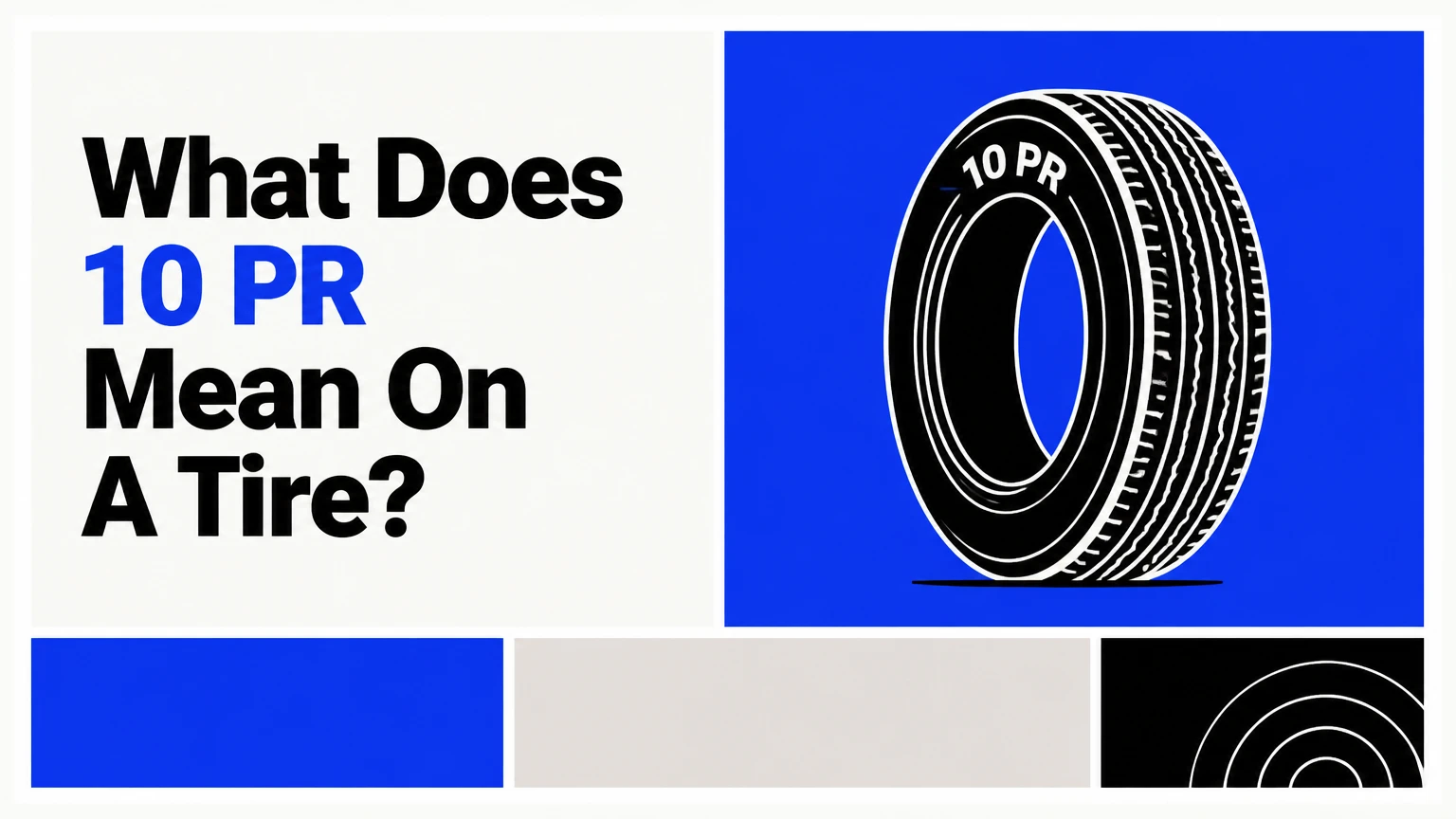
When asking what does 10 pr mean on a tire, you are looking at the ply rating system that defines a tire’s maximum load-carrying capacity. A 10 PR designation signifies a heavy-duty truck tire equivalent in strength to 10 layers of traditional bias-ply cotton fabric. In modern automotive standards, this rating corresponds directly to a Load Range E classification, requiring up to 80 PSI to support heavy towing and hauling.
Key Facts / At a Glance
- Modern Equivalent: A 10 PR rating translates precisely to Load Range E on modern metric tire sizing charts.
- Maximum Pressure: These heavy-duty tires typically require 80 Pounds per Square Inch (PSI) to achieve their maximum payload capacity.
- Weight Capacity: A standard 10 PR tire carries a Load Index between 115 and 123, supporting roughly 2,600 to 3,400 pounds per individual wheel.
- Physical Construction: Modern 10 PR tires do not contain 10 physical layers of material. They rely on two or three ultra-high-strength synthetic layers made of nylon, polyester, or steel.
- Target Vehicles: These tires are engineered specifically for 3/4-ton trucks, 1-ton trucks, commercial vans, and heavy equipment trailers.
Understanding What Does 10 PR Mean On A Tire In Real-World Towing
The ply rating system originated in the early days of automotive engineering. Early tire manufacturers built internal casings using overlapping layers of cotton fabric. More layers equaled a stronger tire capable of carrying heavier loads. A 10-ply tire literally contained 10 distinct sheets of cotton woven into the carcass.
Material science advanced significantly over the decades. Manufacturers replaced weak cotton with high-tensile steel belts, advanced polyester cords, and nylon wraps. These synthetic materials offered exponential strength improvements. Two layers of heavy-duty modern steel and polyester can easily exceed the structural integrity of 10 vintage cotton layers.
Because consumers were already accustomed to measuring tire strength by counting plies, the tire industry kept the old terminology as a relative strength index. A 10 PR designation no longer counts the physical sheets of fabric. It guarantees that the modern two-ply or three-ply casing matches the extreme load-bearing strength of a legacy 10-ply cotton tire.
How The Load Range Letter System Replaced PR
To standardize tire ratings globally, regulatory bodies eventually introduced the Load Range letter system. This alphabetical system provides a cleaner way to categorize tire strength.
Each letter steps up in strength, and each letter correlates directly to an older ply rating. Load Range C replaces the 6-ply rating. Load Range D replaces the 8-ply rating. Load Range E serves as the direct, exact equivalent to the 10 PR standard. When you shop for tires today, you will rarely see “10 PR” stamped on the sidewall in large font. You will instead see a sizing code ending in the letter E, such as LT275/65R18 E.
How 10 PR Load Ranges Compare To Other Truck Tires
Choosing the right heavy-duty tire requires understanding how the 10 PR rating fits into the broader spectrum of truck and trailer tires. Upgrading from a factory passenger tire to a Load Range E tire changes your vehicle’s fundamental suspension geometry.
The following table breaks down the specific technical differences across the common ply rating categories.
| Ply Rating (PR) | Load Range Letter | Max Inflation Pressure | Typical Max Load Per Tire | Primary Application |
|---|---|---|---|---|
| 4 PR | Standard Load (SL) | 35 to 44 PSI | 1,500 to 2,000 lbs | Passenger cars, small SUVs, daily commuting. |
| 6 PR | Load Range C | 50 PSI | 2,100 to 2,400 lbs | Mid-size trucks (Tacoma, Ranger), light off-roading. |
| 8 PR | Load Range D | 65 PSI | 2,500 to 3,000 lbs | 1/2-ton trucks (F-150, Silverado 1500), moderate towing. |
| 10 PR | Load Range E | 80 PSI | 2,600 to 3,400 lbs | 3/4-ton trucks (F-250, Ram 2500), heavy fifth-wheel towing. |
| 12 PR | Load Range F | 95 PSI | 3,500 to 4,000+ lbs | 1-ton dual-rear-wheel trucks, commercial box trucks. |
Why Does A 10 PR Tire Require 80 PSI?
Air pressure carries the weight of your vehicle, not the rubber itself. The tire casing acts as a heavy-duty pressure vessel designed to trap and contain compressed air. A 10 PR tire utilizes an exceptionally thick, rigid casing engineered to withstand an internal pressure of 80 PSI without bursting.
Running a tire at 80 PSI prevents a dangerous physical process called deflection. When you drop a 15,000-pound fifth-wheel trailer onto your truck’s rear axle, the added weight physically squashes the tire down toward the pavement. This sidewall compression forces the rubber to flex rapidly as the tire rolls at highway speeds.
Rapid flexing generates extreme internal heat through a physical property known as hysteresis. If a tire gets too hot, the vulcanized chemical bonds holding the rubber layers together begin to melt and separate. This heat generation causes catastrophic tread separation and highway blowouts. Inflating a 10 PR tire to 80 PSI physically stiffens the sidewall, prevents deflection, eliminates excess friction, and keeps the tire running cool under massive structural stress.
The Single Versus Dual Load Index Phenomenon
When you read the sidewall of a 10 PR tire, you will often spot a pair of numbers separated by a slash next to the load range letter. A common example looks like 123/120E.
The first number (123) represents the tire’s maximum load index when installed as a single tire on an axle. A 123 index equals roughly 3,417 pounds. The second number (120) represents the tire’s maximum load index when installed in a dual-rear-wheel (DRW) configuration. A 120 index equals roughly 3,086 pounds.
Tire engineers purposefully de-rate the load capacity of tires in a dual setup. Roads feature crowns and dips that cause vehicle weight to shift unevenly. A pothole might temporarily force the inner tire to carry the entire axle load. By lowering the official capacity rating for dual configurations, manufacturers build in a safety margin that prevents single-tire failure on uneven terrain.
Tread Designs Available For 10 PR Tires
The 10 PR casing provides the structural foundation of the tire. Manufacturers then wrap that structural foundation in various rubber compounds and tread patterns to suit specific driving environments. Heavy-duty truck owners can select from four primary tread categories.
The table below highlights the performance trade-offs among the different Load Range E tread options.
| Tire Tread Type | Tread Void Ratio | Sidewall Puncture Shielding | Highway Noise (Estimated) | Typical Mileage Warranty |
|---|---|---|---|---|
| Highway Terrain (H/T) | Low (Tight blocks) | Standard 10 PR thickness | Quiet (68-72 dB) | 50,000 to 70,000 miles |
| All-Terrain (A/T) | Moderate (Open lugs) | Reinforced shoulder blocks | Moderate (72-76 dB) | 40,000 to 60,000 miles |
| Mud-Terrain (M/T) | High (Massive voids) | Extreme multi-ply armor | Loud (78-85 dB) | No mileage warranty |
| Special Trailer (ST) | Solid continuous ribs | Standard 10 PR thickness | Very Quiet (Trailer only) | 2 to 4 years of use |
Highway Terrain For Commercial Hauling
Highway Terrain tires prioritize low rolling resistance and long-lasting tread wear. The tight tread blocks keep more rubber in constant contact with the pavement. This design maximizes steering response and minimizes road noise. Commercial van drivers and cross-country haulers rely heavily on H/T tires to improve fuel economy while supporting heavy cargo.
All-Terrain For Mixed Daily Use
All-Terrain tires serve as the undisputed favorite for modern heavy-duty truck owners. The tread pattern features wider gaps designed to expel water, mud, and light snow. Manufacturers often add aggressive biting edges to the upper sidewalls. These tires provide an ideal balance, handling weekend off-road trips while maintaining acceptable on-road manners.
Mud-Terrain For Extreme Environments
Mud-Terrain tires utilize massive rubber blocks separated by deep, wide trenches. These tires excel at digging through deep mud, loose sand, and jagged rocks. The 10 PR construction is highly visible here, as manufacturers utilize the thick casing to prevent sharp rocks from puncturing the sidewall. They suffer from terrible fuel economy, rapid tread wear on pavement, and deafening highway noise.
Special Trailer Applications
Special Trailer (ST) tires use a 10 PR casing optimized exclusively for the trailing axles of heavy RVs, boat trailers, and equipment haulers. They feature extremely stiff sidewalls specifically engineered to prevent lateral trailer sway in high winds. ST tires contain chemical compounds formulated to resist UV rotting while parked. They have very low speed ratings and are never legal or safe for installation on passenger vehicles.
The Hidden Drawbacks Of A 10-Ply Rating
Upgrading a standard commuter truck to a 10 PR tire introduces severe mechanical consequences that many drivers fail to anticipate. These tires are built for commercial-grade stress, and they penalize light-duty usage.
First, they deliver a harsh, unforgiving ride when your truck bed is empty. A standard passenger tire absorbs road imperfections and potholes. A 10 PR tire inflated to 80 PSI acts like a solid wheel of concrete, transferring every bump directly into the vehicle’s suspension and cabin.
Second, they dramatically increase your vehicle’s unsprung mass. A standard 4-ply truck tire weighs approximately 38 pounds. A 10 PR tire in the exact same physical dimensions easily weighs 60 to 70 pounds due to the dense steel and synthetic casing layers. This massive weight penalty forces the engine to work harder to rotate the wheels.
A 2022 mechanical engineering analysis published by the Society of Automotive Engineers demonstrated that increasing unsprung tire weight by just 10 pounds per corner extends braking distances by 3 to 5 percent at highway speeds. The extra rotational mass also routinely drops city fuel efficiency by 1 to 3 miles per gallon.
The OEM Wheel Rim Danger
One of the most dangerous mistakes truck owners make involves pairing heavy-duty tires with light-duty rims. Upgrading the tire does not magically upgrade the truck’s wheels.
“Many drivers upgrade to a Load Range E tire for towing stability, completely forgetting that their factory aluminum wheels are often stamped with a 65 PSI maximum limit,” notes automotive chassis engineer David Childers. “Mounting an 80-PSI tire on a 65-PSI rim is a structural failure waiting to happen under a heavy payload.”
Before installing a 10 PR tire, you must physically remove your current wheels and inspect the inner spokes. The manufacturer usually stamps the maximum wheel load capacity and maximum PSI limit on the backside of the metal hub.
How To Find The Correct Unladen Tire Pressure
Running a 10 PR tire at 80 PSI provides incredible stability when towing a heavy trailer. Running that same tire at 80 PSI when driving an empty truck to the grocery store creates a dangerous situation. Over-inflation bows the center of the tire outward. Only the narrow center strip of tread touches the road, leading to rapid center-wear and a severe loss of wet-weather traction.
To determine the exact correct pressure for daily, unladen driving, industry professionals rely on the Chalk Test.
- Step 1: Prep the tire. Inflate the cold tire to a high baseline pressure, such as 65 PSI.
- Step 2: Mark the tread. Use a piece of thick sidewalk chalk to draw a thick, straight line horizontally across the entire width of the tire tread.
- Step 3: Roll the vehicle. Drive the truck in a perfectly straight line on flat, dry pavement for roughly 100 feet. Do not turn the steering wheel.
- Step 4: Inspect the chalk line. Look at the chalk mark on the tire. If the chalk is completely erased in the center but untouched on the outer edges, the tire is over-inflated. Drop the pressure by 3 PSI and repeat the test.
- Step 5: Find the flat contact patch. Continue adjusting the pressure and repeating the test until the chalk line wears off perfectly evenly from shoulder to shoulder. This is your mathematically perfect unladen daily driving pressure.
Depending on the weight of your vehicle, you might discover your unladen rear tires perform best at 45 PSI, while the heavier front engine requires 55 PSI. You must remember to air the tires back up to 80 PSI before hooking up a heavy trailer.
Who Should Actually Buy A 10 PR Tire?
Choosing the correct ply rating requires an honest assessment of your typical driving habits. Over-buying tire capability wastes money and degrades vehicle handling.
The Daily Commuter
If you drive a half-ton truck (like a Ford F-150 or Chevy Silverado 1500) primarily for commuting, hardware store runs, and family hauling, avoid 10 PR tires. The stiff ride will make daily driving miserable. Standard load passenger tires or a Load Range C (6 PR) light truck tire will perfectly support the factory payload rating while preserving ride comfort and fuel economy.
The Weekend Hauler
If you tow a travel trailer, a heavy boat, or a multi-horse trailer on weekends, upgrading to a 10 PR tire serves as a mandatory safety upgrade. The stiff sidewalls completely eliminate the terrifying “mushy” feeling in the rear suspension during lane changes. They dramatically reduce trailer sway in high winds. The U.S. Tire Manufacturers Association (2023) load and inflation safety guidelines recommend Load Range E tires for any bumper-pull trailer exceeding 7,000 pounds.
The Commercial Workhorse
Landscapers, contractors, and hotshot haulers operating 3/4-ton or 1-ton trucks require 10 PR tires exclusively. A Load Range E tire effortlessly handles the extreme point-load weight of a bed full of wet gravel or heavy steel tools. The ultra-thick sidewalls provide vital armor against screws, nails, and sharp debris commonly found on active construction sites.
Frequently Asked Questions
Can I put 10 PR tires on a half-ton truck?
Yes, you can physically install them on a half-ton truck as long as the tire sizing matches your wheels and suspension clearance. However, the tire will heavily degrade the ride quality and decrease fuel economy. The truck’s suspension and braking systems will still limit your maximum towing capacity, regardless of how strong the tires are.
How many miles should a 10 PR tire last?
A standard Load Range E highway or all-terrain tire typically lasts between 40,000 to 60,000 miles. Their lifespan depends entirely on disciplined inflation practices, alignment health, and the weight of the loads frequently hauled. Mud-terrain tires constructed with 10 PR casings often wear out much faster on pavement.
Is it safe to mix 8 PR and 10 PR tires on the same truck?
No. You should never mix different ply ratings on the same vehicle, especially on the same axle. A 10 PR tire reacts to steering input, braking torque, and load shifts completely differently than an 8 PR tire. Mixing them creates severe handling instability, unpredictable swerving during emergency braking, and dangerous trailer sway.
How do I know if my current tires are 10 PR?
Check the sidewall of your tire. Look for a string of letters and numbers indicating the size, such as LT275/65R18. The “LT” stands for Light Truck. Following the size numbers, you will usually find a letter indicating the load range. The letter “E” confirms the tire has a 10-Ply Rating. You may also find the text “10 PR” printed in small letters near the tire bead.
Does a 10 PR tire prevent all flats?
No tire is completely puncture-proof. A 10 PR tire significantly reduces the chance of sidewall cuts from sharp rocks on trails, and it resists tread punctures from small debris better than standard passenger tires. A large industrial nail or a thick piece of glass can still penetrate the thick casing and cause a flat.