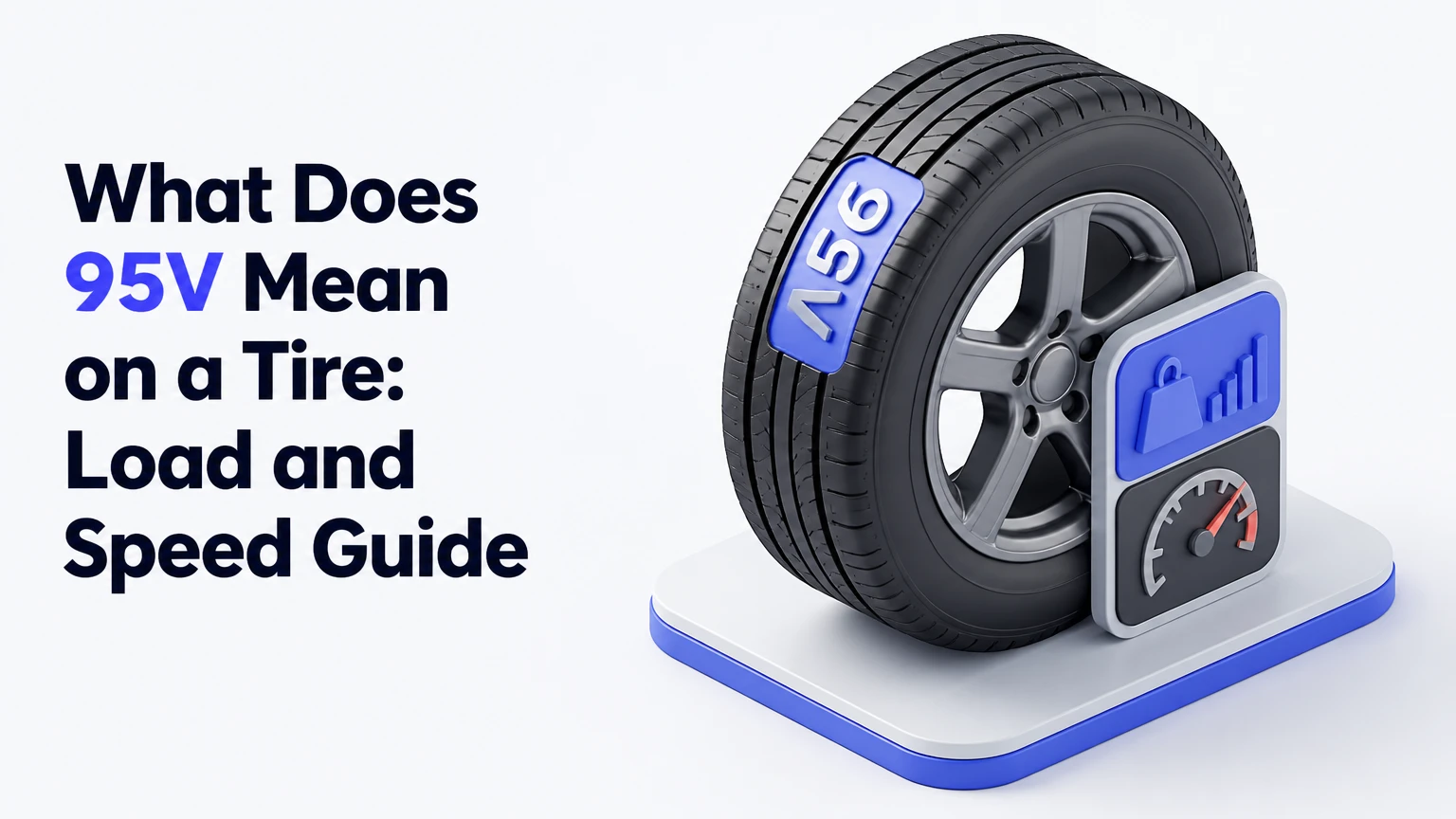
On a tire sidewall, the code 95V is the service description indicating the exact physical limits the tire can safely handle. The number 95 is the load index dictating a maximum capacity of 1,521 pounds per tire, while the letter V is the speed rating indicating a maximum sustained safe speed of 149 mph.
Key Facts / At a Glance
- Single Tire Load Limit: 1,521 lbs (690 kg) when inflated to maximum recommended pressure.
- Total Vehicle Load Limit: 6,084 lbs (2,760 kg) across four identical tires.
- Maximum Safe Speed: 149 mph (240 km/h) under standard laboratory testing conditions.
- Typical Vehicle Match: Sporty sedans, compact crossovers, and luxury daily driver vehicles.
- Tire Construction: V-rated tires feature reinforced internal belts to prevent heat failure at highway speeds.
What Does 95V Mean on a Tire?
When you ask what does 95v mean on a tire, you are looking at two independent metrics engineered into a single code. The European Tyre and Rim Technical Organisation (ETRTO) and the Tire and Rim Association (TRA) standardize these codes globally. Every tire manufactured must pass strict laboratory endurance testing to earn this specific alphanumeric designation. The rating guarantees the tire will not suffer structural failure when subjected to the stated limits of weight and rotational friction.
The number 95 represents a fixed point on the standardized global load index chart. It does not correlate to 95 pounds or 95 kilograms. Instead, the index maps directly to a verified carrying capacity of exactly 1,521 pounds (690 kg) per individual tire. To utilize this full capacity, the tire must be inflated to the precise air pressure listed on the driver side door placard of the vehicle.
The letter V designates the maximum sustained speed the tire can handle before thermal breakdown occurs. The V rating certifies the tire for speeds up to 149 mph (240 km/h). This letter is an evolution of early European speed rating systems, where letters were assigned alphabetically as vehicle top speeds increased throughout the twentieth century. Today, the speed rating functions primarily as a heat dissipation metric rather than an outright speed limit for daily commuting.
The Engineering Physics Behind the Ratings
The service description tells you exactly what operating limits the tire was engineered to survive during standardized testing. Tires do not simply burst because a vehicle drives fast. They fail because the internal rubber plies melt and separate under immense heat and centrifugal force.
When a vehicle moves, the portion of the tire touching the asphalt (the contact patch) flattens out, then springs back into a round shape as the wheel turns. This continuous flexing generates massive internal heat. If you exceed the 1,521-pound limit of a 95 load index, the sidewalls compress too deeply. The excessive flexing generates thermal loads the rubber compound cannot shed, leading to tread separation.
To achieve a V speed rating, tire manufacturers alter the internal construction of the tire carcass. Standard commuter tires rely on basic steel belts. A V-rated tire adds nylon cap plies, often spirally wound at zero degrees across the steel belts. These specialized plies physically constrain the tire, preventing centrifugal force from stretching the rubber outward at 149 mph.
Tire engineer John Stone from the Tire Industry Association explains the mechanics clearly: “The speed rating is essentially a heat rating. A V-rated tire runs significantly cooler at 75 mph on the highway than an S-rated tire runs at the exact same speed. That thermal efficiency directly prevents high-speed blowouts during long summer road trips.”
Load Index and Speed Rating Tables
To understand where your equipment fits within the automotive industry, you must compare it against the surrounding ETRTO classifications. The following tables map the exact specifications across common passenger vehicle sizes.
Table 1: Load Index Context and Weight Limits
| Load Index | Capacity (Pounds) | Capacity (Kilograms) | Typical Vehicle Match |
|---|---|---|---|
| 93 | 1,433 lbs | 650 kg | Compact family sedans |
| 94 | 1,477 lbs | 670 kg | Midsize commuter cars |
| 95 (Your Spec) | 1,521 lbs | 690 kg | Sporty sedans, compact CUVs |
| 96 | 1,565 lbs | 710 kg | Large passenger cars |
| 97 (XL) | 1,609 lbs | 730 kg | Heavy electric vehicles, wagons |
Table 2: Speed Rating Context and Top Speeds
| Speed Rating | Max Speed (mph) | Max Speed (km/h) | Construction Characteristic |
|---|---|---|---|
| T | 118 mph | 190 km/h | Standard plies, flexible sidewall |
| H | 130 mph | 210 km/h | Mild reinforcement, touring compound |
| V (Your Spec) | 149 mph | 240 km/h | Nylon cap plies, rigid shoulder |
| W | 168 mph | 270 km/h | High-tensile belts, stiffest rubber |
| Y | 186 mph | 300 km/h | Exotic car spec, maximum heat shedding |
Is It Safe to Downgrade from 95V to 95H?
Downgrading from a 95V to a 95H tire is generally not recommended if your vehicle manufacturer explicitly requires a V rating on the door placard. While both tires carry the exact same 1,521-pound weight capacity, the H-rated tire features a softer internal construction that fundamentally alters vehicle handling dynamics.
Many drivers attempt this downgrade to save money upfront. An H-rated touring tire usually costs less and offers a slightly longer treadwear warranty. The tradeoff comes in the form of emergency handling stability. Because the H-rated tire lacks the rigid nylon cap plies found in the V-rated model, the sidewalls flex more during aggressive maneuvers. This creates a “mushy” feeling in the steering wheel and delays the vehicle response to sudden steering inputs.
A 2022 tire testing study by Consumer Reports found that replacing V-rated Original Equipment Manufacturer (OEM) tires with lower-tier H-rated variants increased wet stopping distances by an average of 4 to 7 feet. In a highway emergency braking scenario, 7 feet is the difference between a safe stop and a rear-end collision. Furthermore, modern traction control and anti-lock braking systems are calibrated in the factory to expect a specific level of tire stiffness. Changing that stiffness can cause these safety systems to engage prematurely or inefficiently.
Upgrading to 97V or 95W Specifications
Upgrading your tires to a higher load index or a higher speed rating is entirely safe and often yields distinct performance benefits. When you move up the scale, you increase the safety margin of your vehicle under extreme conditions.
If you upgrade from a 95V to a 97V, you are moving from a Standard Load (SL) tire to an Extra Load (XL) tire. The 97V tire supports 1,609 pounds, an 88-pound increase per corner. This upgrade is highly beneficial for drivers who frequently pack their vehicles with heavy cargo, tow small trailers, or drive modern battery-electric vehicles. The thicker internal cords required to achieve the 97 rating will make the ride quality slightly firmer over potholes, but the tire will resist wearing out on the inner edges under heavy weight.
Upgrading from a 95V to a 95W increases your thermal ceiling from 149 mph to 168 mph. You do not need to drive 168 mph to see the benefits. The W-rated tire utilizes a stickier rubber compound and much stiffer shoulder blocks. This translates to incredibly crisp steering response and higher grip thresholds on freeway on-ramps. The only honest drawback to a W-rated tire is longevity. The sticky rubber compound grips the road better but wears away faster, typically lasting 10,000 fewer miles than a V-rated equivalent.
Table 3: 95V Replacement Options Compared
| Service Description | Ride Quality | Steering Response | Ideal Driver Persona |
|---|---|---|---|
| 95H (Downgrade) | Soft and quiet | Slightly delayed | Budget daily commuter |
| 95V (OEM Spec) | Balanced firm | Crisp and accurate | Standard luxury driver |
| 95W (Upgrade) | Very firm | Extremely sharp | Performance enthusiast |
| 97V XL (Upgrade) | Stiffest under load | Heavy but stable | EV or cargo hauler |
Common Mistakes When Replacing 95V Tires
Tire replacement involves strict mathematical matching, yet drivers routinely make errors that compromise vehicle safety. The most dangerous assumption is the belief that speed ratings only apply to track driving.
The “I never drive 149 mph” fallacy is the leading cause of incorrect tire installations. Drivers assume they can safely install cheap T-rated (118 mph) or S-rated (112 mph) tires because the local speed limit is only 70 mph. This ignores the physics of heat dissipation. A speed rating dictates overall handling, cornering stability, and continuous heat shedding. Driving a heavy sedan on an under-rated tire at 75 mph on a 100-degree summer day pushes the tire dangerously close to its thermal failure point.
Mixing different speed ratings or load indexes on the same axle is another frequent error. Installing a 95V on the left front wheel and a 95H on the right front wheel causes an immediate handling imbalance. Because the V-rated tire has a stiffer sidewall, the vehicle will pull hard toward the softer H-rated tire under heavy braking. Traction levels will also differ wildly in the rain, causing the car to spin unpredictably if traction is lost.
Finally, drivers often rely entirely on the numbers printed on the old tires they are removing. This assumes the previous owner or mechanic installed the correct tires. You must always check the white and yellow tire information placard located inside the driver side door jamb. This sticker displays the true factory requirements mandated by the vehicle engineers.
How Does Tire Pressure Change the 95 Load Capacity?
A tire with a 95 load index only supports 1,521 pounds when it is inflated to the optimal pressure specified on the vehicle placard. If the tire pressure drops, the carrying capacity drops simultaneously in a direct mathematical curve.
According to technical documentation by the European Tyre and Rim Technical Organisation, an underinflated tire physically cannot support its stated load index. ETRTO load-inflation tables show that a 95-index tire inflated to 36 PSI supports its full 1,521-pound capacity. If that same tire drops to 30 PSI, the structural capacity drops to approximately 1,350 pounds.
If a vehicle requires a total capacity of 5,500 pounds, but the tires are underinflated by just 6 PSI, the vehicle is suddenly driving in an overloaded state. This is why tire pressure monitoring systems (TPMS) are federally mandated. Overloading an underinflated tire forces the sidewall to flex past its design limits, building internal friction heat until the steel belts snap and the tire blows out. Never try to soften a firm ride by dropping the air pressure below the factory specification.
Pricing and Lifespan Expectations
The cost of a 95V tire varies heavily based on the manufacturer tier, the rubber compound quality, and the specific tread pattern. Because V-rated tires require more complex internal engineering than standard commuter tires, they sit at a higher baseline price point.
A typical V-rated all-season tire will last between 40,000 to 60,000 miles, translating to roughly three to five years of average driving. This lifespan is notably shorter than standard H-rated touring tires, which routinely reach 65,000 to 80,000 miles. V-rated tires use a softer silica-infused rubber compound designed to maintain grip at higher speeds, which naturally accelerates treadwear. When budgeting for replacements, expect to pay between $110 and $220 per tire.
Table 4: 95V Cost and Lifespan by Brand Tier
| Brand Tier Level | Price Range (Per Tire) | Expected Lifespan | Example Manufacturers |
|---|---|---|---|
| Tier 1 (Premium) | $180 – $250 | 45,000 – 55,000 miles | Michelin, Pirelli, Continental |
| Tier 2 (Mid-Range) | $130 – $170 | 50,000 – 60,000 miles | Falken, Hankook, Kumho |
| Tier 3 (Budget) | $85 – $120 | 35,000 – 45,000 miles | Westlake, Lionhart, Lexani |
Do You Need 95V Tires for an Electric Vehicle?
Electric vehicles introduce unique stress factors to tires due to their heavy battery packs and instant torque delivery. If you drive an EV, adhering to the 95 load index and V speed rating is a strict safety requirement rather than a suggestion.
The average electric sedan weighs 1,000 pounds more than a comparable gas-powered vehicle. This constant downward force requires the rigid sidewalls found in V-rated tires to prevent the car from swaying heavily through corners. Furthermore, electric motors deliver maximum torque the moment you press the accelerator. Standard plies in lower-rated tires will physically warp under this sudden rotational force, tearing the tread blocks apart within just 10,000 miles. Many EV manufacturers actually require a 97V Extra Load (XL) tire to handle the combination of battery weight and torque.
Expert Recommendations by Driving Style
Choosing the correct replacement tire requires matching the physical engineering of the rubber to your actual driving environment. Evaluate your daily use case before purchasing a complete set of four.
The Daily Highway Commuter: If your owner manual lists 95V as the primary spec but allows 95H as an alternative, you can safely switch to a Tier 1 or Tier 2 H-rated touring tire. This will save you money on the initial purchase, provide a noticeably quieter cabin on rough concrete, and give you an extra 15,000 miles of tread life.
The Enthusiast Driver: Stick strictly to the OEM 95V specification or upgrade to a 95W. If you enjoy taking back roads and demand immediate feedback from the steering wheel, downgrading your speed rating will ruin the driving dynamics of your car. The firm sidewalls of a V-rated premium tire like a Michelin Pilot Sport guarantee the car goes exactly where you point it.
The Family Hauler: If you frequently drive with four passengers, a trunk full of luggage, or a hitch-mounted cargo rack, upgrade to a 97V XL. The reinforced internal belts of the Extra Load specification prevent the rear of the vehicle from sagging and wandering at highway speeds when fully loaded.
Frequently Asked Questions
Does 95V mean the tire is good in the snow? No, the 95V designation only specifies weight capacity and heat dissipation limits. Winter traction is determined entirely by the tread pattern and the flexibility of the rubber compound in freezing temperatures. You can buy a 95V summer tire that is useless in the snow, or a 95V winter tire that excels in it.
What happens if I put 1,600 lbs on a 95V tire? Overloading a tire past its 1,521-pound limit causes the sidewalls to compress excessively. This generates massive internal friction heat. If driven at highway speeds in an overloaded state, the internal rubber will melt away from the steel belts, resulting in a sudden and catastrophic blowout.
Can I mix 95V and 95H tires on my car? You should never mix speed ratings across the same axle. Placing a stiff 95V tire next to a softer 95H tire causes unpredictable handling. The vehicle will pull sharply to one side during panic braking, and the tires will lose traction at entirely different speeds on wet pavement.
Where do I find the correct tire rating for my car? Open the driver side door and look at the metal door jamb (the B-pillar). You will find a permanent white and yellow sticker labeled “Tire and Loading Information.” This placard lists the exact size, load index, speed rating, and cold inflation pressure required by the engineers who designed the car.
Does changing the speed rating affect auto insurance? In some jurisdictions, particularly in Europe under TÜV regulations, installing a tire with a lower speed rating than the factory specification makes the vehicle unroadworthy. If you are involved in a high-speed accident in the United States, an insurance adjuster could technically cite incorrectly rated tires as a contributing factor, though it is a rare occurrence.
The Bottom Line
Understanding what does 95v mean on a tire protects your vehicle from high-speed failure and premature treadwear. By respecting the 1,521-pound maximum load limit and the 149-mph thermal threshold, you guarantee your suspension performs exactly as the manufacturer intended. Always check your door placard before making a purchase, invest in matched sets across all four wheels, and maintain exact tire pressures to get the full safety benefits of your V-rated equipment.