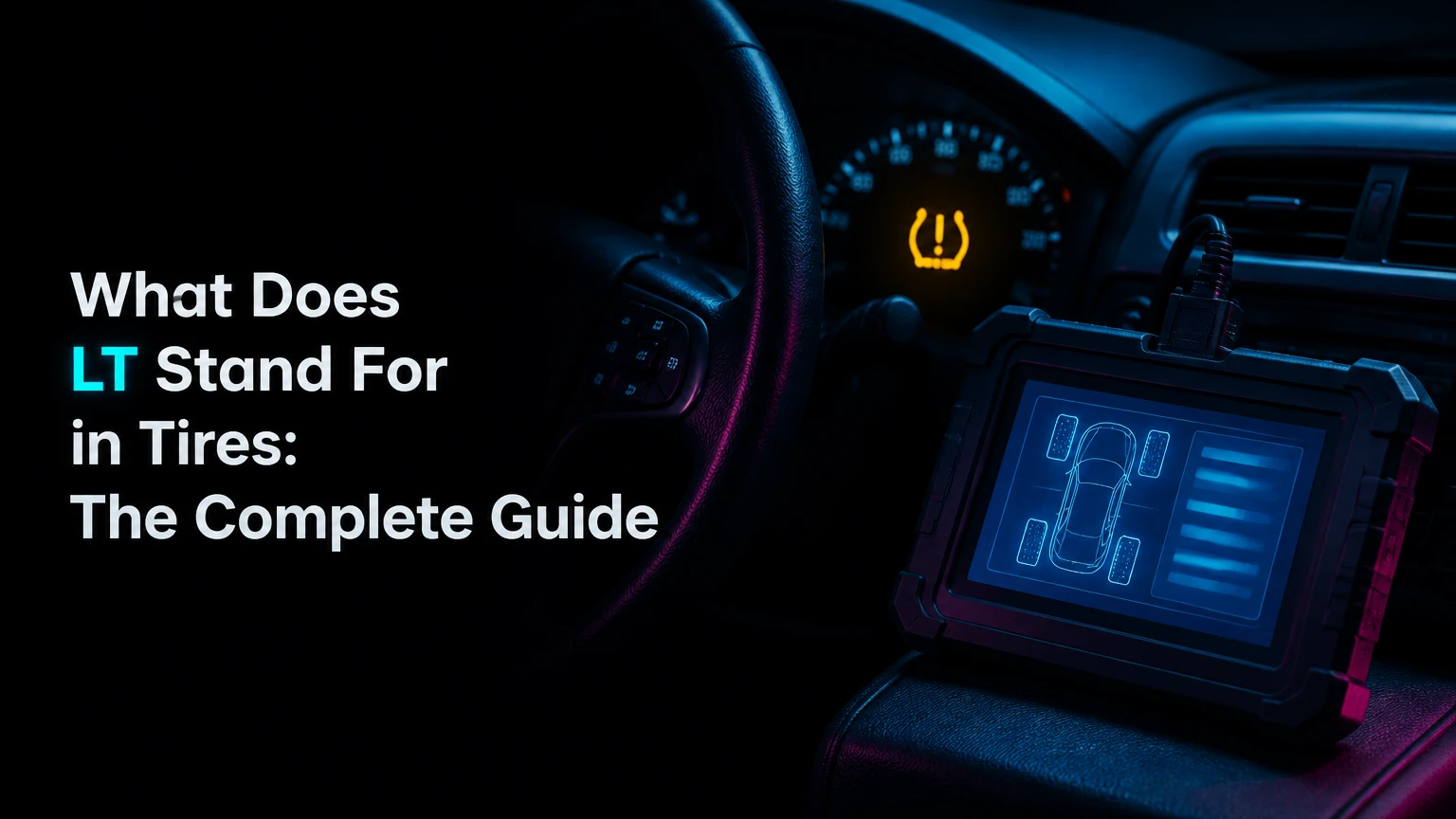
On a tire sidewall, the exact keyword what does lt stand for in tires refers directly to the Light Truck classification. The Tire and Rim Association designates this specialized construction for tires engineered to carry heavy payloads, withstand severe towing stresses, and navigate rugged off-road terrains. Unlike standard passenger vehicle tires, light truck tires require significantly higher inflation pressures to support heavy commercial and recreational vehicle weights safely.
Key Facts / At a Glance
- LT stands for Light Truck, indicating a tire casing reinforced with extra steel and rubber plies.
- These heavy-duty tires require operating pressures between 50 and 95 PSI to maintain their structural integrity under heavy loads.
- Modern light truck tires utilize an alphabetical Load Range system (C, D, E, F) rather than the outdated cotton ply-rating numbers.
- Expect to pay a 20 to 40 percent price premium for a light truck tire compared to an identically sized passenger tire.
- Installing a standard passenger tire on a heavy-duty vehicle designed for light truck tires voids the Gross Vehicle Weight Rating and creates mechanical safety liabilities.
What Are The Core Engineering Differences in LT Tires?
An LT tire is built from the bead up to survive extreme mechanical stress and resist structural deformation. While passenger tires prioritize a quiet ride and low rolling resistance, light truck variants prioritize puncture resistance and maximum load stability.
Heavy-Duty Sidewall and Bead Construction
The sidewall of a light truck tire contains substantially more rubber thickness and additional polyester or steel plies compared to a standard tire. This rigidity prevents the tire from bowing outward when subjected to massive vertical weights, such as a heavy trailer tongue pressing down on the rear axle. Furthermore, the bead bundle (the reinforced steel cable loop that locks the tire to the metal wheel rim) is significantly thicker. This thick bead prevents the tire from unseating during high-torque applications or when drivers intentionally lower the air pressure for off-road rock crawling.
Deeper Tread Depths and Specialized Rubber Compounds
Light truck tires generally leave the factory with tread depths ranging from 15/32 to 18/32 of an inch. A standard passenger tire typically features a tread depth of 10/32 to 12/32 of an inch. The rubber compound used in a light truck tire is formulated specifically to resist “chunking” or “chipping.” When a standard tire spins on sharp gravel, the abrasive rocks tear small pieces of rubber away from the tread blocks. A heavy-duty casing resists this abrasion, allowing the tire to maintain its grip and structural integrity on unpaved logging roads or construction sites.
How Does Load Capacity Work in Light Truck Tires?
The rubber structure of a tire does not actually carry the weight of the vehicle. The compressed air contained inside the tire chamber carries the load, and light truck tires are engineered specifically to contain massive amounts of high-pressure air safely.
The Critical Role of Inflation Pressure
Standard passenger (P-metric) tires reach their maximum load capacity at an inflation pressure of 35 to 44 PSI. If you add more weight to a standard tire, the air volume cannot push back with enough force, causing the tire sidewall to compress and flatten. When a flattened tire rolls down the highway, the excessive flexing generates massive internal friction. According to the US Tire Manufacturers Association (USTMA), heat buildup from underinflation is the leading cause of catastrophic tread separation. Light truck tires solve this by utilizing a casing strong enough to hold 50 to 95 PSI. This high-density air column easily supports heavy diesel engines and loaded cargo beds without allowing the sidewall to flex dangerously.
Understanding Load Range and Ply Ratings
Historically, tire manufacturers measured strength by counting the physical layers of cotton fabric embedded in the rubber. A 10-ply tire had 10 actual layers of cotton. Today, modern steel belts and synthetic Kevlar cords are vastly stronger than cotton. A modern tire might only possess two or three physical plies, but it offers the equivalent strength of an older 10-ply tire. The industry now uses an alphabetical Load Range to indicate this ply-equivalent strength.
Table 1: Light Truck Load Range Classifications
| Load Range Letter | Historical Ply Equivalent | Max Inflation Pressure | Maximum Load Per Tire (Typical) |
| Load Range C | 6-Ply Equivalent | 50 PSI | 2,000 to 2,500 lbs |
| Load Range D | 8-Ply Equivalent | 65 PSI | 2,500 to 3,000 lbs |
| Load Range E | 10-Ply Equivalent | 80 PSI | 3,000 to 3,800 lbs |
| Load Range F | 12-Ply Equivalent | 95 PSI | 3,800 to 4,300 lbs |
What Are The Three Main Types of LT Tire Designations?
Tire manufacturers categorize light truck sizes into three major layouts based on their dimensional formats. You will find these specific alphanumeric codes molded directly into the outer sidewall of the tire.
The LT-Metric Layout
The LT-Metric format is the most widely utilized standard on modern heavy-duty vehicles. A typical size reads as LT265/70R17. The “LT” prefix immediately identifies the heavy-duty construction. The “265” indicates the cross-section width of the tire in millimeters. The “70” is the aspect ratio, meaning the sidewall height is exactly 70 percent of the width. The “R” stands for radial construction, and the “17” signifies the wheel rim diameter in inches.
The LT-Flotation Layout
Flotation sizing is engineered specifically for extreme off-road driving and relies entirely on imperial inch measurements. A common size is 35×12.50R15 LT. In this format, the “LT” suffix is placed at the end of the sequence. The “35” represents the total outer diameter of the tire in inches. The “12.50” indicates the total width in inches. These tires are designed with excessively wide footprints to help a heavy truck “float” over deep mud, loose sand, and unstable silt without sinking.
The LT-Numeric Layout
The numeric layout is an older standard format found predominantly on commercial delivery vans, vintage trucks, and specialty agricultural equipment. An example size is 7.50R15 LT. This format drops the aspect ratio entirely. The “7.50” indicates the cross-section width in inches, and it implies a very tall, narrow tire profile. This narrow profile allows the tire to slice through top layers of mud to find hard traction on commercial job sites.
LT-Metric vs P-Metric: Which Should You Choose?
Choosing between a passenger (P-metric) tire and a light truck tire requires matching the tire casing to the actual curb weight and primary usage environment of the vehicle. There is no universally superior choice, as each design offers distinct trade-offs in comfort, capability, and efficiency.
Table 2: Direct Comparison of Tire Classifications
| Feature Category | P-Metric (Standard Passenger) | LT-Metric (Light Truck) |
| Ride Quality | Smooth and compliant over bumps. | Stiff, harsh, and transmits road vibrations. |
| Puncture Resistance | Vulnerable to sharp rocks and debris. | Highly resistant to sidewall tearing and tread chipping. |
| Towing Stability | Sidewalls flex, leading to dangerous trailer sway. | Rigid casing eliminates trailer sway entirely. |
| Vehicle Fuel Economy | Excellent, due to low rolling resistance and light weight. | Poor, due to heavy unsprung mass and high rolling friction. |
| Recommended Use | Daily commuting and paved highway road trips. | Heavy hauling, fifth-wheel towing, and off-road trails. |
The Daily Commuter Persona
If you drive a mid-size truck or an SUV primarily on paved highways and city streets, you should select a standard P-metric tire. These tires absorb potholes cleanly, keep cabin noise to a minimum, and maximize your fuel efficiency. Installing heavy-duty tires on a vehicle used solely for commuting will ruin the ride quality for no practical benefit.
The Weekend Overlander Persona
Drivers who commute during the week but venture onto rocky forest service roads on the weekend should choose a Load Range C light truck tire. This 6-ply equivalent classification offers the mandatory puncture defense required for jagged gravel trails. Because it operates at a moderate 50 PSI, it will not destroy your daily driving comfort as severely as a commercial-grade tire would.
The Heavy Hauler Persona
Commercial tradesmen carrying heavy tools in the cargo bed and drivers towing large fifth-wheel travel trailers must choose Load Range E tires. When you apply 1,500 pounds of tongue weight to the rear axle of a truck, a standard tire will compress and cause the rear end of the vehicle to sway violently at highway speeds. A Load Range E tire, inflated to 80 PSI, remains completely rigid under that tongue weight, ensuring safe and stable vehicle dynamics.
How Much Do LT Tires Cost and How Long Do They Last?
Upgrading to a heavy-duty casing requires a larger upfront financial investment and introduces ongoing operational costs associated with vehicle fuel efficiency and component wear.
Initial Purchase Price Premium
You should expect light truck tires to cost roughly 20 to 40 percent more than an identically sized standard passenger tire. This price premium accounts for the massive volume of extra steel, heavy polyester cords, and specialized silica rubber compounds utilized in the manufacturing process. While a standard set of truck tires might cost 600 to 900 dollars, a premium set of Load Range E all-terrain tires typically spans 1,000 to 1,600 dollars.
Tread Life Expectations on Pavement vs Gravel
On pristine paved highways, both tire classifications offer similar lifespans, generally surviving between 50,000 and 70,000 miles. However, the lifespan diverges drastically depending on the driving surface. If a standard passenger tire is frequently operated over jagged gravel or heavily rutted dirt roads, the tread blocks will chip away rapidly. A standard tire can fail prematurely within 20,000 miles in these conditions. A light truck tire features cut-and-chip resistant rubber that will confidently push through its full rated tread life regardless of the road surface.
Table 3: Cost and Lifespan Impact by Tire Classification
| Tire Classification | Typical Purchase Price (Set of 4) | Expected Paved Highway Lifespan | Expected Gravel Road Lifespan | Fuel Economy Impact |
| P-Metric (Standard) | $600 to $900 | 50,000 to 70,000 miles | 15,000 to 25,000 miles | Baseline (Optimal MPG) |
| LT Load Range C | $800 to $1,200 | 50,000 to 65,000 miles | 45,000 to 55,000 miles | 1 MPG Decrease |
| LT Load Range E | $1,100 to $1,600+ | 50,000 to 70,000 miles | 50,000 to 60,000 miles | 2 to 3 MPG Decrease |
What Are The Most Common Mistakes When Switching to LT Tires?
Understanding what does lt stand for in tires is only the first step. Consumers frequently mismanage tire pressures and vehicle weight ratings when transitioning between standard and heavy-duty rubber, leading to expensive component failures.
The Lowering Pressure Trap
The most dangerous mistake drivers make is switching from a passenger tire to a heavy-duty tire and continuing to use the 35 PSI inflation recommendation listed on the driver-side door placard. Because heavy casings are extremely stiff, the tire itself absorbs some of the internal air pressure’s lifting ability. To carry the exact same physical payload, a light truck tire requires higher inflation pressure than a passenger tire. Inflating a 10-ply tire to only 35 PSI causes severe underinflation. The sidewall will overheat rapidly on the highway, resulting in catastrophic tread separation. Always consult a tire load inflation table to find the correct revised pressure for your specific vehicle weight.
Expert Insight:
To find the exact correct street pressure for an aftermarket heavy-duty tire, practitioners use the “chalk test.” Draw a thick line of white chalk across the tire tread from shoulder to shoulder. Drive the vehicle forward in a straight line for 100 feet. If the chalk wears off only in the dead center, the tire is overinflated. If the chalk wears off only on the outer edges, it is underinflated. Adjust the air pressure until the chalk line wears away perfectly evenly across the entire tread block.
Downgrading Original Equipment Requirements
If a heavy-duty truck rolls off the factory assembly line with an LT tire requirement printed on the door sticker, you must never swap them out for cheaper P-metric tires. Downgrading the tire classification intentionally compromises the vehicle’s safe Gross Axle Weight Rating. Furthermore, installing passenger tires on a commercial vehicle creates severe legal and mechanical safety liabilities. If a downgraded tire blows out while towing, insurance companies can deny the claim due to improper equipment installation.
The Over-Speccing Flaw
Many consumers assume that tougher always equals better. Putting a stiff 10-ply Load Range E tire onto a lightweight commuter SUV or a compact truck ruins the vehicle’s suspension compliance. The lightweight vehicle does not possess enough mass to compress the rigid tire casing. This results in a brutally jarring ride, accelerated wear on ball joints and shock absorbers, and a significant increase in stopping distances. Adding 20 pounds of unsprung rotating mass to each wheel hub forces your brake system to work much harder to stop the vehicle.
Frequently Asked Questions
Can you put LT tires on an SUV?
You can install heavy-duty tires on an SUV, provided the vehicle has enough wheel well clearance and suspension capacity. However, unless the SUV is used for heavy towing or frequent off-roading, the upgrade will result in a harsher ride, reduced fuel economy, and longer stopping distances.
Are LT tires better in the snow?
Heavy-duty tires are not inherently better in winter conditions than standard tires. In fact, extremely stiff sidewalls and hard rubber compounds often struggle to conform to icy surfaces. A standard passenger winter tire with a pliable rubber compound and heavy siping will outperform a heavy-duty mud-terrain tire on packed snow and ice.
Do LT tires require special wheels?
You can mount heavy-duty tires on standard factory wheels, provided the wheel width matches the tire manufacturer’s recommended specifications. However, ensure the wheel itself is rated to handle the high inflation pressures (up to 80 PSI) required by Load Range E tires, as older passenger car wheels can fail under extreme pressure.
What is the difference between LT and ST tires?
While Light Truck tires are designed for the steering and drive axles of passenger vehicles, ST stands for Special Trailer. Trailer tires are custom-contoured for maximum vertical load limits and feature extremely stiff sidewalls to prevent swaying. You should never use a trailer tire on a passenger vehicle, and trailer tires generally have strict maximum speed limits of 65 miles per hour.
How do I know if my truck requires LT tires?
Open your driver-side door and locate the factory tire information placard. If the original tire size listed on the sticker begins with the prefix “LT” or specifies a high inflation pressure above 45 PSI, your vehicle requires heavy-duty tires to safely meet its engineered payload and towing capacities.
The Bottom Line
When determining exactly what does lt stand for in tires, the answer goes far beyond a simple acronym. The Light Truck designation represents a fundamental shift in tire engineering, moving away from ride comfort and fuel efficiency toward structural rigidity, extreme puncture resistance, and massive load-carrying capabilities. By matching the correct load range to your actual towing and driving habits, you ensure maximum vehicle safety and prevent premature tire failure on the highway.