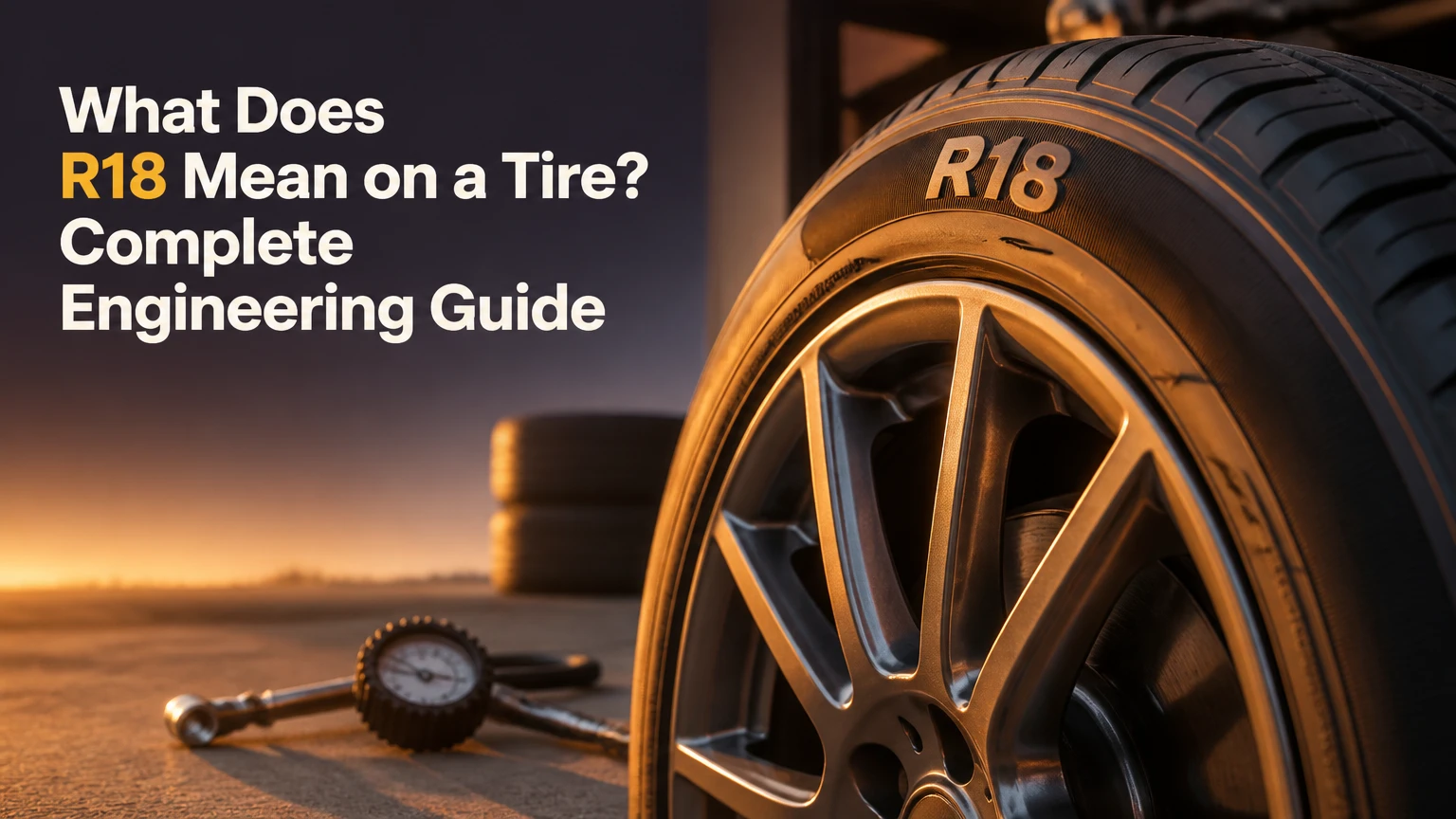
On a passenger vehicle tire, the “R18” designation means the tire utilizes a radial internal ply construction and is manufactured to fit a wheel rim measuring exactly 18 inches in diameter. The “R” dictates the perpendicular alignment of internal steel belts, while the “18” strictly defines the required metal wheel size for proper mounting.
Key Facts / At a Glance
- The letter “R” stands for Radial, indicating that the tire’s internal reinforcing cords run straight across the tread from bead to bead.
- The number “18” represents the physical diameter of the wheel rim in inches, not the total height of the tire.
- You cannot mount an R18 tire onto a 17-inch or 19-inch wheel under any circumstances.
- R18 tires are considered the modern baseline size for mid-sized sedans, crossovers, and performance hatchbacks.
- Upgrading a vehicle to an 18-inch wheel requires recalculating the tire aspect ratio to keep the speedometer accurate.
How Does the R18 Tire Code Work?
To understand exactly what does R18 mean on a tire, you must look at the two separate engineering metrics combined into one code. The alphanumeric stamp dictates the internal structural design of the rubber casing and the rigid mechanical constraint of the mounting process.
The Engineering Behind Radial Construction (The R)
The “R” stands for Radial. This indicates how the internal reinforcing ply cords are mapped out inside the tire carcass. In a radial tire, these cords run perpendicularly straight across the tread from one bead to the other. They form a 90-degree angle relative to the direction of travel.
By keeping the sidewall flex entirely independent from the tread contact patch, radial tires allow the tread to remain flat and firmly planted on the pavement during cornering. This internal architecture dramatically reduces friction and heat buildup compared to older bias-ply configurations. The US Department of Transportation (2022) notes that radial tires improve vehicle fuel efficiency by up to 10 percent over bias-ply alternatives due to lower rolling resistance.
The Strict Measurement of Wheel Diameter (The 18)
The “18” represents the linear diameter of the metal wheel rim in inches. This is a rigid mechanical constraint. A tire marked R18 has an inner bead opening containing high-tensile steel wire designed to lock onto an 18-inch barrel.
The inner opening of the tire cannot stretch. You cannot compress an 18-inch tire to safely sit on a 17-inch wheel, nor can you stretch it to fit a 19-inch wheel. Automotive engineers specify wheel diameters down to the millimeter to ensure the tire bead seats airtight against the metal rim flange. Attempting to mix diameters causes catastrophic bead failure during inflation.
Reading the Full Tire Sidewall Sequence
The R18 designation never sits alone on a sidewall. It functions as the central anchor of a standardized alphanumeric sequence established by the Tire and Rim Association (TRA). A standard high-performance size reads as 245/40R18 97Y.
The first number represents the section width. In the example above, the total width of the tire from sidewall to sidewall is 245 millimeters. This measurement determines how wide the contact patch is on the pavement. Wider tires generate higher mechanical grip but slightly increase rolling resistance.
The second number is the aspect ratio. This percentage dictates the profile height of the sidewall relative to the width. An aspect ratio of 40 means the sidewall height is exactly 40 percent of the 245-millimeter width. You can calculate the exact physical sidewall height using simple multiplication.
Sidewall Height = 245 mm * 0.40 = 98 mm.
The final block dictates load and speed capabilities. The number 97 is the load index, which correlates to a maximum safe carrying capacity of 1,609 pounds per tire at maximum inflation. The letter Y denotes a safe operating speed up to 186 mph. You must never replace a factory tire with a unit that has a lower load index than the original manufacturer specification.
What Are the Main Types of R18 Tires?
Eighteen-inch tires represent the dominant baseline size across the modern automotive industry. They are categorized into distinct functional subcategories based on rubber compound hardness and tread block geometry. The application determines the internal casing strength and the exterior tread design.
Structural Variations by Application
All-Season R18 tires utilize a medium-firm rubber compound fortified with silica. They feature asymmetric tread blocks designed for quiet highway cruising and dependable water evacuation. Ultra-High Performance (UHP) Summer variants use much softer compounds and large outer shoulder blocks. They emphasize immediate steering response but lose all flexibility in freezing temperatures.
All-Terrain R18 variants feature multi-ply sidewalls and deep tread voids to clear mud and rocks. These are predominantly fitted to light trucks and rugged crossovers. Run-Flat R18 models are engineered with heavily reinforced, self-supporting sidewalls. They maintain structural integrity for up to 50 miles after a complete loss of air pressure.
| Category | Average Lifespan | Optimal Temperature | Typical Price Range |
|---|---|---|---|
| Standard All-Season | 50,000 to 70,000 miles | 20 F to 100 F | $120 to $180 |
| UHP Summer | 20,000 to 30,000 miles | Above 45 F | $180 to $350 |
| All-Terrain (A/T) | 40,000 to 60,000 miles | 0 F to 95 F | $200 to $320 |
| Run-Flat (RFT) | 30,000 to 45,000 miles | 20 F to 100 F | $220 to $400 |
How Do R18 Tires Compare to R17 and R20 Sizes?
Choosing a wheel diameter alters the ratio of metal rim to rubber sidewall on your vehicle. An R18 tire sits precisely in the middle ground between the thick rubber cushioning of a 17-inch setup and the rigid, aggressive layout of a 20-inch configuration.
The Physics of Wheel Sizing
A smaller R17 tire offers high ride comfort. The thicker rubber sidewall acts as a secondary suspension system, absorbing harsh impacts from potholes and broken pavement. However, that taller sidewall flexes significantly during hard cornering, resulting in sluggish steering response.
An R18 tire provides a balanced compromise. It reduces sidewall flex enough to sharpen steering input while retaining sufficient rubber depth to protect the metal rim from curb strikes. Moving up to an R20 tire removes almost all sidewall flex. This yields near-instant lateral stability for sports cars. The tradeoff is a severe reduction in ride comfort and a high vulnerability to wheel damage.
| Metric | R17 Setup (Smaller Rim) | R18 Setup (Baseline) | R20 Setup (Plus-Sized) |
|---|---|---|---|
| Ride Comfort | High impact absorption | Balanced dampening | Low impact absorption |
| Steering Response | Moderate lateral flex | Crisp and predictable | Immediate and aggressive |
| Unsprung Weight | Lowest (improves mpg) | Moderate baseline | Highest (reduces mpg) |
| Rim Protection | Excellent curb distance | Adequate safety margin | Poor pothole resistance |
Expert Insights on R18 Tire Installation and Maintenance
Proper installation of an R18 tire requires matching the millimeter width of the rubber to the correct inch width of the metal barrel. A common automotive engineering rule dictates that a tire operates safely only when mounted on a rim that supports its structural width.
A 245-millimeter wide R18 tire requires a metal rim width between 8.0 inches and 9.5 inches. Forcing a wide tire onto a narrow 7.0-inch rim causes the tread to bulge in the center, accelerating wear. Stretching a narrow tire onto a wide rim exposes the metal lip to damage and increases the risk of sudden bead unseating during cornering.
| Tire Section Width | Minimum Rim Width | Ideal Rim Width | Maximum Rim Width |
|---|---|---|---|
| 215 mm | 7.0 inches | 7.5 inches | 8.5 inches |
| 225 mm | 7.0 inches | 8.0 inches | 8.5 inches |
| 235 mm | 7.5 inches | 8.5 inches | 9.0 inches |
| 245 mm | 8.0 inches | 8.5 inches | 9.5 inches |
| 255 mm | 8.5 inches | 9.0 inches | 10.0 inches |
Maintaining correct tire pressure is the single most important factor for longevity. You must never inflate an R18 tire to the maximum PSI listed on the rubber sidewall. The European Tyre and Rim Technical Organisation (ETRTO) specifies that drivers should strictly follow the vehicle manufacturer inflation settings printed on the driver-side door jamb placard. According to the National Highway Traffic Safety Administration (2022), underinflated tires are a leading cause of tread separation and sidewall blowouts at highway speeds.
What Are Common Mistakes When Buying R18 Tires?
Consumers frequently misunderstand alphanumeric tire codes and purchase components that compromise vehicle safety. The most dangerous mistakes stem from misinterpreting the letter R and ignoring the load index requirements of heavy vehicles.
Believing the R Stands for Radius
Assuming the R stands for radius is a frequent arithmetic error. If a wheel possessed an 18-inch radius, the total metal wheel diameter would be 36 inches, or 3 feet tall. The R strictly identifies the radial construction method. The number 18 identifies the full diameter of the wheel barrel.
Ignoring the Load Index on SUVs
Downsizing your sidewall aspect ratio to achieve a sportier look on an 18-inch wheel often drops the tire’s load index. If a heavy crossover requires a load index of 103 (1,929 pounds per tire), installing a low-profile R18 tire with a load index of 95 (1,521 pounds per tire) creates a severe safety hazard. The casing will overheat and fail under normal cargo weights.
Pushing the Width Limit
Attempting to mount the widest possible R18 tire inside a factory wheel well alters the scrub radius of the suspension. A tire that is too wide will rub against the inner fender liner during full steering lock. Stick to your vehicle manufacturer’s recommended section width to preserve the factory suspension geometry.
How to Troubleshoot Ride Issues After Upgrading
If you notice performance issues after installing new R18 tires on your vehicle, you must check the overall rolling diameter of the new setup. Changing tire sizes often disrupts the vehicle’s onboard computer calculations.
When upgrading from a 16-inch or 17-inch factory wheel to an 18-inch wheel, you must decrease the tire aspect ratio to keep the total wheel height identical. Automotive mechanics follow the three percent rule. The total combined height of the new R18 tire and wheel must stay within plus or minus 3 percent of the original factory dimensions. Failing this rule causes the speedometer to display inaccurate readings and disrupts the anti-lock braking system sensors.
| Symptom | Mechanical Cause | Corrective Action |
|---|---|---|
| Speedometer reads too slow | Overall tire diameter is too tall | Reduce the aspect ratio profile |
| Harsh cabin vibrations | Overinflated low-profile sidewalls | Lower PSI to door placard rating |
| Rubbing sounds on turns | Tire section width exceeds fender gap | Install narrower tires or wheel spacers |
| Center tread wears quickly | Rim barrel is too narrow for the tire | Remount tires on a wider wheel |
Frequently Asked Questions
Can you put an R18 tire on a 17-inch rim?
No. An R18 tire features an inner bead manufactured exactly to 18 inches. It is physically impossible to safely mount it on a 17-inch rim. Doing so will completely destroy the airtight seal and damage the structural steel wire inside the tire bead.
What is the standard pressure for an R18 tire?
There is no universal standard pressure for any tire size. The correct pressure depends entirely on the weight of the vehicle it supports. You must check the tire information placard located on the inside of the driver-side door jamb for the exact recommended PSI.
Are R18 tires considered low profile?
An R18 tire is only low profile if the aspect ratio is below 50. A 245/40R18 is a low-profile performance tire with a short sidewall. Conversely, a 265/70R18 used on a pickup truck features a very tall, thick sidewall and is not considered low profile.
How much does an average R18 tire weigh?
A typical passenger car R18 tire weighs between 22 and 27 pounds. All-terrain light truck tires in an R18 size weigh significantly more, generally between 45 and 55 pounds per tire, due to the thicker sidewall plies and deeper tread blocks.
Does upgrading to R18 wheels affect gas mileage?
Yes. Upgrading to larger 18-inch wheels typically increases rotational mass and unsprung weight compared to smaller factory wheels. This heavier metal and wider rubber footprint creates higher rolling resistance, which generally results in a 1 to 2 percent reduction in overall fuel economy.
Understanding what does r18 mean on a tire empowers you to make safe, accurate purchasing decisions. Always verify both your wheel diameter and your vehicle load requirements before finalizing any tire replacement.