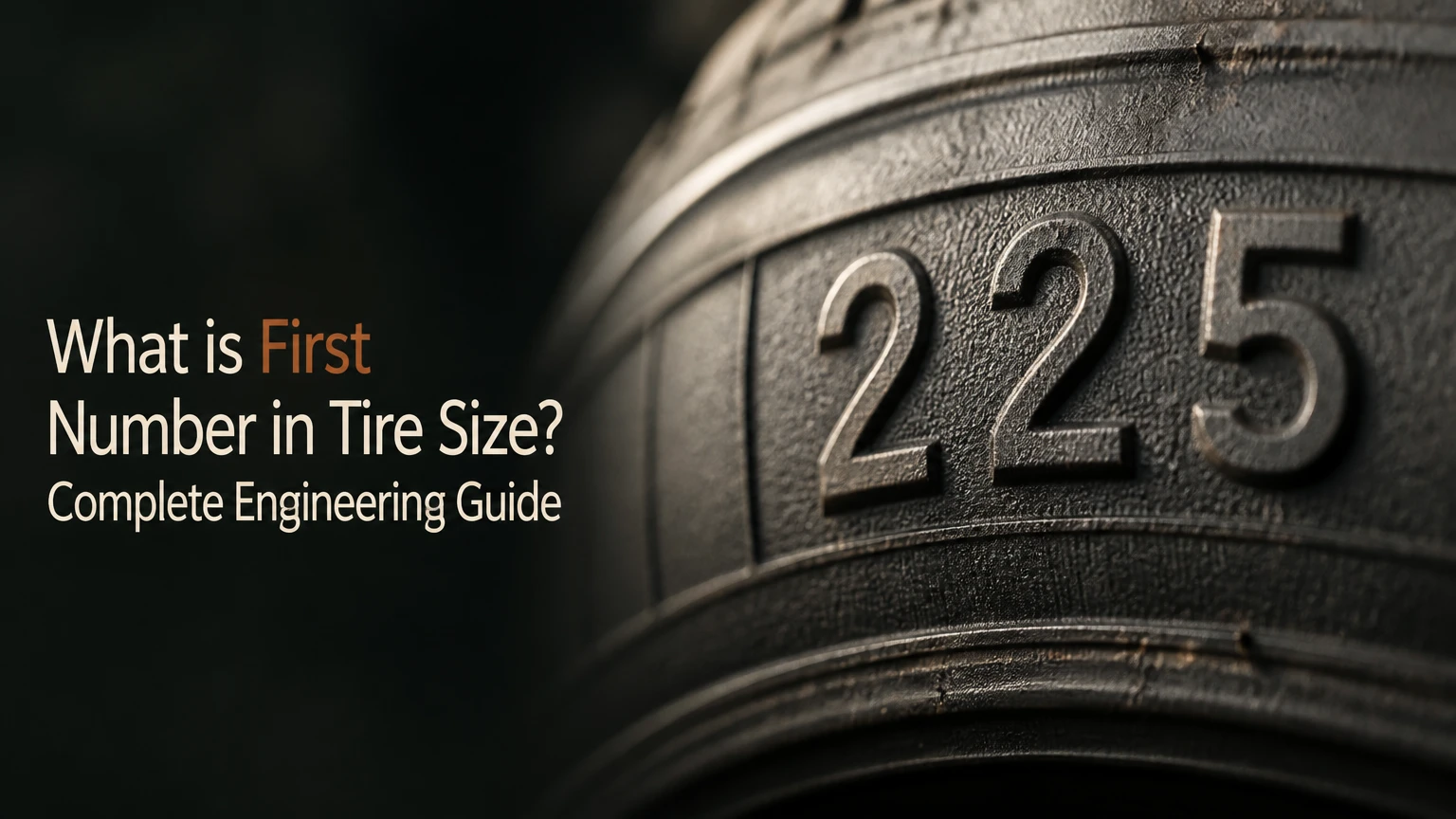
The first number in a tire size indicates the nominal section width of the tire measured in millimeters. When you look at a tire branded with the sequence 225/45R17, the number 225 means the tire measures exactly 225 millimeters from its inner sidewall to its outer sidewall at the widest point.
Key Facts / At a Glance
- The first number represents section width, not the width of the tread touching the road.
- Manufacturers measure this distance in millimeters after mounting the tire on a standardized measuring rim.
- Every 10-millimeter increase in width drastically alters the physical shape of the contact patch.
- Changes to this number directly affect dry grip, hydroplaning resistance, and fuel economy.
- Mounting the exact same tire on a wider or narrower wheel will change its actual installed width.
Understanding What is First Number in Tire Size on the Sidewall
Drivers frequently ask what is first number in tire size when they need to replace their factory rubber or upgrade their vehicle setup. This leading digit represents the nominal section width. Automotive engineers define the section width as the linear distance between the exterior surfaces of the sidewalls when the tire is inflated to its optimum operating pressure.
This measurement does not include the physical tread blocks that touch the pavement. The section width focuses entirely on the structural casing of the tire. Because the sidewalls bulge outward slightly under air pressure, the section width is always the absolute widest physical dimension of the tire assembly. A tire with a first number of 245 measures 245 millimeters across its casing, ensuring mechanics and drivers know exactly how much physical space the inflated rubber will occupy inside the wheel well.
The Math Behind the Number
The first number dictates the rest of the tire geometry. The second number on a sidewall (the aspect ratio) is a mathematical percentage of the first number. If a tire is marked 225/50R17, the sidewall height is exactly 50 percent of the 225-millimeter width. This makes the physical sidewall 112.5 millimeters tall. If you change the first number to 245 but keep the 50 percent aspect ratio, your sidewall becomes 122.5 millimeters tall. Changing the section width automatically changes the overall diameter of the wheel unless you adjust the aspect ratio down to compensate.
How Do Engineers Measure Section Width?
Tire manufacturers determine section width using a strict, standardized engineering process governed by organizations like the European Tyre and Rim Technical Organisation (ETRTO) and the U.S. Tire and Rim Association (TRA). A 2023 technical bulletin from the TRA outlines that a tire must achieve a state of physical equilibrium before any dimensions are recorded.
The measurement protocol removes temporary structural stresses caused by the manufacturing and shipping processes. Technicians do not simply take a tape measure to an unmounted tire in a warehouse. They follow a specific mechanical sequence to find the true width.
- Measuring Rim Selection: Technicians mount the tire on a highly specific “measuring rim” designated for that exact tire dimension.
- Maximum Inflation: The assembly is inflated to its maximum standard test pressure, which usually sits between 35 and 45 PSI. No vehicle weight is applied to the tire during this stage.
- Thermal Conditioning: The inflated tire rests in a climate-controlled room for exactly 24 hours. This resting period allows the internal nylon cords, steel belts, and rubber compounds to stretch, settle, and relieve internal tension.
- Caliper Application: Engineers use large mechanical calipers to measure the distance from the outermost point of the exterior sidewall to the outermost point of the interior sidewall.
- Decoration Subtraction: Any raised white lettering, decorative ribs, or protective rim guard flanges are mathematically subtracted from the caliper reading to yield the true structural width.
Does Section Width Equal Tread Width?
Section width is never the exact same measurement as tread width. The section width measures the widest point of the bulging sidewall, while the tread width measures only the physical rubber blocks designed to contact the road surface.
Tread width is generally 8 to 9 percent narrower than the stated section width on a standard passenger car tire. A tire with a section width of 225 millimeters will typically have a tread width closer to 205 millimeters. This difference exists because the structural shoulders of the tire must curve inward from the widest part of the casing to meet the flat tread face.
High-performance track tires often feature squared-off shoulders, bringing the tread width much closer to the section width. Standard commuter tires feature rounded, sloping shoulders to improve ride comfort and reduce road noise, resulting in a significantly narrower physical contact patch compared to the stated first number.
Sizing Frameworks and Structural Variations
While the first number always represents millimeters, the structural framework of the casing changes how that width behaves under load. Manufacturers place specific letters before the first number to designate the internal construction and load limits of the tire.
| Prefix System | Measurement Meaning | Structural Focus | Typical Application |
| P-Metric (P) | Millimeters of width for standard passenger loads | Optimized for ride comfort, low noise, and standard inflation pressures | Honda Civic, Toyota Camry, Ford Escape |
| Euro-Metric (None) | Millimeters of width without a prefix letter | Features slightly higher load index limits than P-Metric equivalents | BMW 3-Series, Audi A4, Volkswagen Golf |
| LT-Metric (LT) | Millimeters of width designed for light truck use | Features stiffer, reinforced sidewalls requiring higher air pressures | Ford F-250, Chevrolet Silverado 2500, Ram 3500 |
| Flotation Sizes | The first number is overall height in inches | Focuses on total tire volume to prevent sinking in mud or sand | Jeep Wrangler Rubicon, Ford Bronco, Custom off-road builds |
What Happens When You Change the First Number?
Changing the section width drastically alters the physical shape of the contact patch. The contact patch is the small footprint of rubber that actually touches the pavement at any given moment.
If you keep the same vehicle weight and tire pressure but install a wider tire, the total area of the contact patch does not magically increase. Instead, the shape of the footprint changes. A narrow tire creates a contact patch that is long and narrow. A wide tire creates a contact patch that is short and wide. This physical reshaping of the rubber footprint dictates everything about how your car accelerates, corners, and handles severe weather.
Woody Rogers, former director of tire information at Tire Rack, notes: “The section width determines the physical real estate you have to work with, but the rim width dictates how much of that real estate actually touches the road during a corner.”
A short, wide contact patch resists sideways deformation during aggressive cornering, generating massive lateral grip on dry asphalt. However, that same wide footprint acts like a snowplow in winter weather, forcing the tire to push snow and standing water out of the way rather than slicing cleanly through it.
Narrow versus Wide Tires: Which Perform Better?
Choosing the correct section width requires an honest assessment of your driving environment. A wider tire is not automatically a better tire. Upgrading to a wider section width introduces distinct mechanical compromises in fuel efficiency, wet weather safety, and wallet impact.
| Width Category | Primary Advantage | Major Compromise | Expected Lifespan |
| 165mm – 195mm (Narrow) | Slices through deep snow and resists hydroplaning perfectly | Lower cornering limits on dry pavement | 60,000 – 80,000 miles |
| 205mm – 235mm (Standard) | Balances fuel economy with adequate daily traction | Lacks the aesthetic aggression of high-performance rubber | 45,000 – 65,000 miles |
| 245mm – 275mm (Wide) | Delivers excellent dry braking and high-speed stability | Increases rolling resistance and lowers fuel economy | 30,000 – 45,000 miles |
| 285mm – 325mm+ (Ultra-Wide) | Provides maximum mechanical grip for high-horsepower cars | Extreme hydroplaning risk in heavy rain | 15,000 – 25,000 miles |
The Advantages of Narrow Tires
Narrow tires excel in poor weather conditions. Because the vehicle weight is concentrated onto a smaller lateral area, narrow tires exert higher pressure per square inch onto the road surface. This increased surface pressure allows the tire to bite through snow, slush, and standing water to find the solid pavement underneath. Furthermore, narrow tires feature less frontal aerodynamic drag and significantly lower rolling resistance. This directly translates to improved fuel economy and longer tread life.
The Advantages of Wide Tires
Wide tires dominate dry performance metrics. A wider section width puts more rubber laterally across the road, which drastically reduces braking distances in emergency stops on dry pavement. The wider structural casing also manages heat much better under heavy friction loads. Aesthetically, wide tires fill out the wheel wells of modern vehicles, giving the car an aggressive, muscular stance that automotive enthusiasts prefer.
Honest Limitations of Upgrading
Wide tires are explicitly poor choices for daily commuting in regions with heavy rainfall or deep winter snow. A 285-millimeter tire requires significantly more energy to roll down the highway than a 215-millimeter tire, meaning your gas mileage will drop immediately. Furthermore, wide tires act like water skis in heavy rain. The wider the tire, the more water it must evacuate per second to maintain road contact. When the tire cannot evacuate water fast enough, hydroplaning occurs, resulting in a total loss of steering and braking control.
Can I Fit Wider Tires on My Stock Wheels?
You can usually increase your section width by 10 to 20 millimeters on your factory wheels, but you are strictly bound by the physical width of the metal rim. The actual, real-world width of a tire changes depending on the rim it is mounted on.
Industry engineering standards dictate that every 0.5-inch change in rim width alters the tire’s actual section width by approximately 5 millimeters. If you take a 225-millimeter tire and move it from a 7.5-inch rim to an 8.0-inch rim, the new physical section width expands to 230 millimeters.
Squeezing a massive 255-millimeter tire onto a narrow factory rim forces the sidewalls to pinch inward aggressively. This ballooning effect rounds off the tread blocks, drastically reducing your contact patch and causing rapid, premature wear down the dead center of the tire. Conversely, stretching a narrow tire onto an excessively wide rim exposes the metal lip of the wheel to curb damage and risks a catastrophic bead failure under heavy cornering loads.
| Modification Type | Handling Result | Speedometer Error Risk | Suspension Clearance Risk |
| +10mm width on stock rim | Slightly sharper steering | Negligible (Usually under 1 mph) | Very low risk of rubbing |
| +20mm width on stock rim | Mushy steering response | High (Requires aspect ratio drop) | Moderate risk over bumps |
| -10mm width for winter tires | Better steering feel in slush | Negligible | Zero risk |
| Different front/rear widths (AWD) | Unpredictable oversteer | Critical failure point | High risk to differentials |
Expert Rules for Choosing the Right Section Width
Automotive engineers categorize the ideal section width based on the primary usage environment of the vehicle. If you are modifying your vehicle, adhere to these professional practitioner guidelines.
For the Daily Commuter:
Stick exactly to the manufacturer placard located on your driver-side door jamb. Standard commuter widths between 185 and 215 millimeters offer the mathematical optimum for long-term ownership costs. You will maximize your fuel economy, benefit from the lowest replacement tire prices, and maintain the exact suspension geometry the factory engineers designed.
For the Track Enthusiast:
You can safely increase your first number by 10 to 20 millimeters over the stock baseline. This upgrade expands your lateral footprint, giving your chassis more mechanical grip to lean on during high-speed cornering. You must verify that your current wheel rim is wide enough to safely support the larger section width without pinching the sidewalls.
For the Winter Driver:
Implement the “minus-sizing” strategy. Purchase dedicated winter tires that are exactly 10 millimeters narrower than your factory summer tires. A narrower winter tire slices through slush and heavy snowpack with vastly superior efficiency compared to a wide tire, which tends to float dangerously on top of the snow layer.
Troubleshooting Common Width Upgrading Mistakes
When drivers change the first number on their sidewall without doing the proper math, mechanical failures occur rapidly. Look for these specific symptoms if you recently upgraded your tire width.
Symptom: Polished metal patches on your inner suspension struts or frayed plastic inside your wheel wells.
The Fix: Your chosen section width is physically too wide for the vehicle chassis. The inside sidewall of the tire is rubbing against suspension components during sharp turns. You must either revert to your factory section width, install mechanical wheel spacers, or purchase new aftermarket wheels with a lower offset to push the tire away from the suspension.
Symptom: Your vehicle feels unstable on the highway, and the steering response feels delayed or “mushy.”
The Fix: You have pinched a wide tire onto a narrow rim. The sidewalls lack vertical support, causing the casing to roll over onto itself during lane changes. You must upgrade to a wider wheel rim that correctly matches the structural requirements of your chosen tire size.
Symptom: Your all-wheel-drive (AWD) vehicle is making grinding noises, or the transmission feels jerky.
The Fix: You installed different section widths on the front and rear axles without maintaining an identical rolling circumference. AWD differentials require the front and rear tires to rotate at the exact same speed. Mixing widths alters the overall height of the tires, causing the axles to fight each other. Never mix tire sizes on an AWD vehicle unless explicitly approved by the factory manual.
Frequently Asked Questions
What does the 225 mean on a tire size?
The number 225 means the tire has a nominal section width of 225 millimeters. This measurement spans from the outer edge of the exterior sidewall to the outer edge of the interior sidewall when the tire is properly mounted and inflated on a standardized measuring rim.
Is a higher first number better for tires?
A higher first number provides more mechanical grip on dry pavement and shorter braking distances. However, a higher number is worse for fuel economy, increases road noise, and significantly raises the risk of hydroplaning in heavy rain or floating on top of deep winter snow.
Can I replace a 215 tire with a 225 tire?
You can safely replace a 215-millimeter tire with a 225-millimeter tire provided you adjust the aspect ratio. This is called plus-sizing. You must ensure your wheel rim is wide enough to support the extra 10 millimeters of width, and verify there is adequate physical clearance inside your wheel wells.
How does tire width affect fuel economy?
Wider tires feature increased aerodynamic drag and a larger frontal surface area. More importantly, they contain more physical mass and generate higher rolling resistance against the pavement. The engine must burn more fuel to maintain momentum, directly reducing your overall miles per gallon.
Does tire width change the height of the tire?
Yes, increasing the tire width directly increases the height of the tire if the aspect ratio remains the same. The sidewall height is a strict percentage of the section width. A 245/50 tire is physically taller and has a larger overall diameter than a 225/50 tire.
The Bottom Line
Understanding exactly what is first number in tire size ensures you make safe, cost-effective decisions for your vehicle. That initial digit dictates your physical section width in millimeters, controlling the shape of your contact patch, your dry cornering limits, and your resistance to severe weather. Whether you stick to the narrow efficiency of your factory placard or upgrade to a wider performance stance, maintaining the correct relationship between your section width, aspect ratio, and rim width is the foundation of automotive safety.