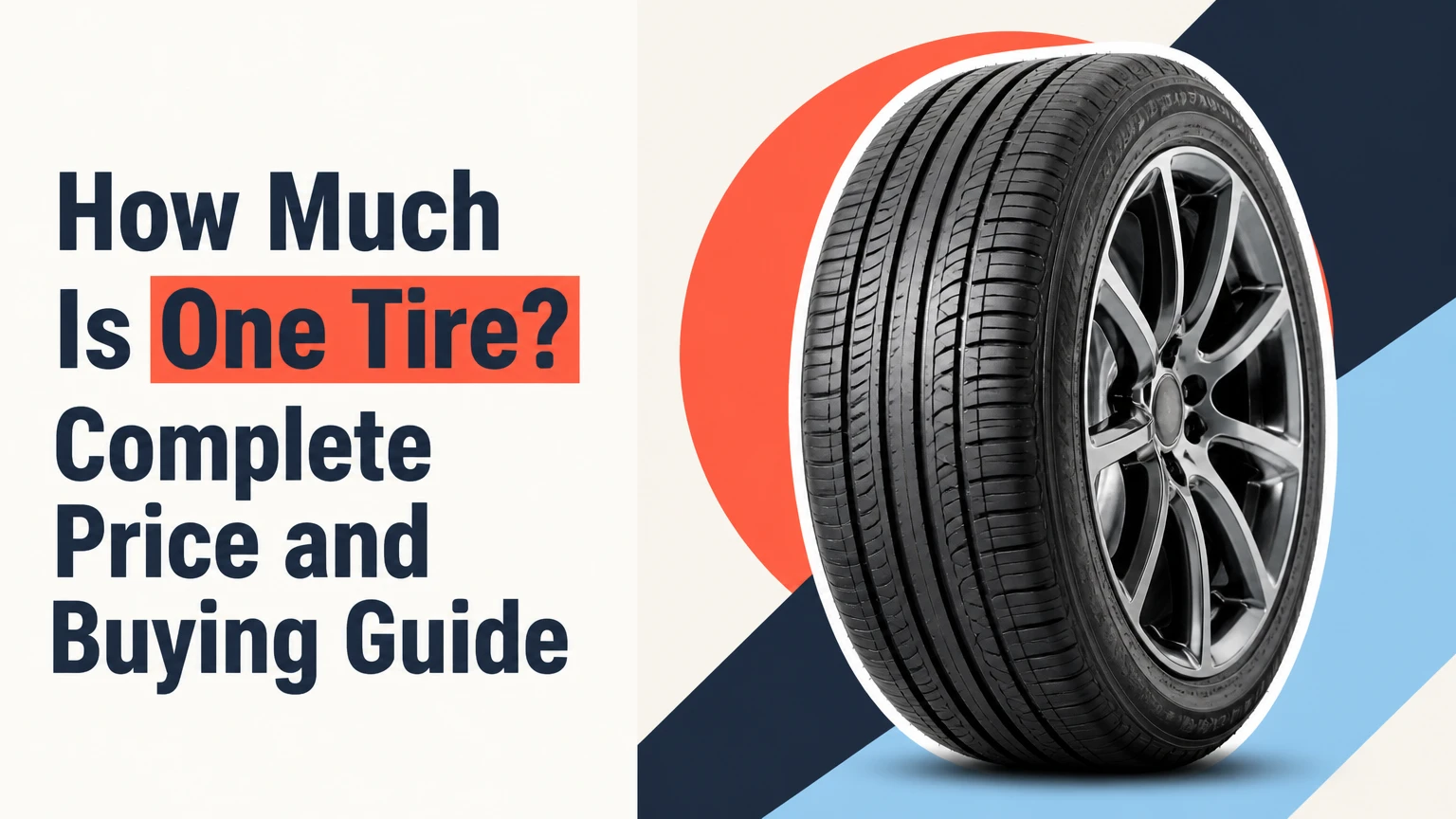
One new passenger-car tire typically costs $60-$250 before installation, while the installed price usually reaches $90-$320 after mounting, balancing, a valve or TPMS service, disposal and tax. Performance, run-flat, EV, truck and oversized tires commonly cost $200-$600 each, with specialized models sometimes exceeding $1,000.
Key Facts at a Glance
- A basic economy tire generally costs $60-$110 before installation.
- A mainstream all-season tire commonly costs $110-$220.
- Installation and shop fees typically add $25-$70 per tire.
- Large wheels, run-flat construction and high speed ratings raise the price.
- Replacing one tire is not always appropriate for AWD vehicles.
- The lowest advertised tire price is rarely the final out-the-door price.
How Much Is One Tire by Tire Category?
The price of one tire depends primarily on its size, construction, performance level and intended vehicle. A common compact-car all-season tire may cost less than $120, while a 20-inch run-flat, performance SUV or heavy-duty truck tire can cost several hundred dollars.
The following ranges are typical U.S. retail estimates rather than fixed national prices. Local inventory, manufacturer rebates, taxes and installation policies can change the final amount.
| Tire category | Typical tire-only price | Typical installed price | Common application |
| Economy passenger tire | $60-$110 | $90-$170 | Older compact cars, low annual mileage |
| Standard all-season | $110-$220 | $145-$290 | Sedans, crossovers, daily commuting |
| Touring or grand touring | $140-$260 | $175-$330 | Quiet highway driving, longer tread warranties |
| Winter tire | $120-$300 | $155-$370 | Snow, ice and sustained cold weather |
| Summer performance | $150-$400 | $190-$480 | Sports sedans, coupes and performance cars |
| Run-flat tire | $180-$500 | $225-$590 | BMW, Mercedes-Benz, MINI and some luxury vehicles |
| EV-focused tire | $170-$450 | $210-$540 | Electric vehicles with high weight and torque |
| All-terrain truck tire | $190-$450 | $235-$540 | Pickups, SUVs and mixed road use |
| Mud-terrain tire | $250-$600 | $300-$700 | Off-road trucks and reinforced applications |
| Commercial or specialty tire | $300-$1,000+ | $360-$1,150+ | Heavy-duty, exotic or uncommon fitments |
A tire advertised at $129 may therefore cost $175 after installation and fees. Comparing only the tire’s displayed price can understate the purchase by 20% to 45%.
How Much Is One Tire Installed?
One installed tire commonly costs $90-$320 for an ordinary passenger vehicle. The total includes the tire, mounting it to the wheel, computer balancing, reinstalling the wheel and torquing the lug nuts correctly.
Discount Tire states that its installation package includes mounting, balancing and a valve stem or TPMS rebuild kit, while charges can vary by market and installation complexity. It also notes that disposal may be charged when the old tire is left with the retailer.
| Charge | Typical amount per tire | When it applies |
| Tire purchase | $60-$600+ | Every new-tire purchase |
| Mounting and balancing | $20-$45 | Usually required |
| Rubber valve stem | $3-$10 | Wheels without direct TPMS sensors |
| TPMS service kit | $7-$20 | Vehicles with direct TPMS |
| Old-tire disposal | $3-$12 | When the shop keeps the old tire |
| Shop supplies | $2-$10 | Retailer-dependent |
| Road-hazard plan | $10-$50 | Optional protection |
| Sales tax | Varies by location | Based on local tax rules |
| Alignment | $90-$200 per vehicle | Separate service, not normally per tire |
| Mobile installation | $25-$100+ extra | Selected retailers and service areas |
Ask for an out-the-door quote that includes the tire, installation, disposal, TPMS work, tax and optional protection. This prevents a low advertised price from becoming an unexpectedly high invoice.
Why Can Two Tires of the Same Size Cost Differently?
Two tires with the same dimensions can have substantially different prices because dimensions establish fitment, not quality or intended performance. Compound chemistry, internal reinforcement, tread design, noise control, warranty coverage and production volume all affect the price.
A premium touring tire may use a tread pattern designed to reduce highway noise and maintain wet grip as the tread wears. A cheaper tire in the same size may provide acceptable basic transportation but carry a shorter warranty, generate more road noise or offer less refined wet-weather behavior.
Major price factors include:
- Brand and product line: Flagship products generally cost more than entry-level lines.
- Tread warranty: A 70,000-mile warranty usually costs more than a tire with no mileage warranty.
- Speed rating: W, Y and other high-speed fitments often use costlier construction.
- Load capacity: XL and LT tires require reinforced structures.
- Run-flat technology: Reinforced sidewalls increase material and manufacturing costs.
- Seasonal compound: Winter compounds must remain flexible at low temperatures.
- Low-volume size: Uncommon sizes cost more because fewer units are produced and stocked.
- Original-equipment specification: Manufacturer-approved versions can command a premium.
- Wheel diameter: A 20-inch tire generally costs more than a comparable 16-inch tire.
- Specialized design: EV, acoustic-foam, competition and off-road tires add engineering features.
The practical rule is simple: match the tire to the vehicle and driving conditions before comparing prices. A cheaper tire that does not meet the required load index, speed rating or vehicle specification is not an equivalent option.
Does Tire Size Affect the Cost?
Tire size is one of the strongest price variables. Larger rim diameters, wider tread sections, lower-profile sidewalls and higher load ratings commonly increase the cost because they require more material, more complex construction or lower-volume production.
A code such as P205/55R16 91V contains the principal fitment information:
- P: Passenger-vehicle tire.
- 205: Nominal section width in millimeters.
- 55: Sidewall height as a percentage of width.
- R: Radial construction.
- 16: Required wheel diameter in inches.
- 91: Load index.
- V: Speed rating.
The wheel diameter must match exactly. A 17-inch tire cannot be mounted safely on a 16-inch wheel, even when the other numbers appear similar.
| Example size | Vehicle type | Typical all-season price | Cost tendency |
| 185/65R15 | Subcompact car | $75-$145 | Lower |
| 205/55R16 | Compact or midsize car | $90-$190 | Moderate |
| 225/65R17 | Crossover or small SUV | $120-$240 | Moderate |
| 235/60R18 | Midsize SUV | $150-$300 | Higher |
| 245/40R19 | Sport sedan | $180-$400 | High |
| 275/55R20 | Full-size truck or SUV | $210-$500 | High |
Never select a tire solely because another size costs less. Alternative sizing requires verification of wheel width, overall diameter, load capacity, suspension clearance, speedometer effect and manufacturer guidance.
Can You Replace Only One Tire?
You can replace one tire when the remaining tires are close in tread depth, construction, size and wear, but a single replacement is not always mechanically appropriate. The safest decision depends on the drivetrain, the tread difference and the vehicle manufacturer’s requirements.
NHTSA-hosted manufacturer guidance warns against replacing only one tire in circumstances where unequal wear can affect handling, braking and electronic stability systems. Other manufacturer materials recommend replacing at least both tires on the same axle, with the deeper-tread tires installed on the rear.
When One Tire May Be Acceptable
A single tire may be reasonable when:
- The damaged tire is nearly new.
- The replacement is the same model and specification.
- The tread-depth difference remains within the vehicle maker’s limit.
- The vehicle is two-wheel drive and the paired tire has minimal wear.
- A qualified technician confirms that the match is appropriate.
When You May Need Two or Four Tires
Replace two tires when the other tire on the axle has meaningful wear or when an exact model match is unavailable. Replace all four when an AWD system requires closely matched rolling circumferences and the existing tires are too worn to match a new tire.
Some tire retailers can shave a new tire’s tread to match the remaining set. That option may cost less than four tires, but it removes usable tread from a new product and is not offered everywhere.
Should New Tires Go on the Front or Rear?
When replacing only two tires, the pair with deeper tread should generally be installed on the rear axle. Greater rear traction helps reduce the risk of rear-wheel loss of grip and oversteer on wet roads.
Manufacturer materials available through NHTSA repeat this placement guidance for two-tire installations.
This rule can feel counterintuitive on a front-wheel-drive car because the front wheels steer and drive the vehicle. However, worn rear tires can lose lateral grip suddenly in standing water, making the vehicle harder to recover.
Follow the vehicle owner’s manual when it provides a specific requirement. Directional tires, staggered wheel sizes and manufacturer-approved fitments can limit rotation and placement choices.
Are Cheap Tires Safe?
A properly certified budget tire in the correct size, load index and speed rating can provide legal basic transportation. The trade-off is that low purchase price does not guarantee equal wet braking, snow traction, tread consistency, noise control or warranty coverage compared with a stronger mid-tier or premium product.
Budget tires make the most sense for a low-value vehicle driven short distances at moderate speeds in mild conditions. They are less attractive for high annual mileage, heavy rain, winter travel, performance driving or vehicles that regularly carry heavy loads.
| Buyer priority | Economy tire | Mid-tier tire | Premium tire |
| Typical price | $60-$120 | $100-$220 | $160-$400+ |
| Tread warranty | 30,000-50,000 miles or none | 45,000-70,000 miles | 55,000-80,000 miles |
| Wet-weather focus | Basic | Balanced | Often advanced |
| Ride and noise | Variable | Generally controlled | Usually more refined |
| Product selection | Limited in unusual sizes | Broad | Broad but expensive |
| Best use | Low-mileage local driving | Most daily drivers | High mileage or demanding conditions |
Do not assume that the most expensive tire is automatically best. A summer performance tire may cost more than a touring tire while wearing faster and performing poorly in freezing conditions. The correct category matters more than prestige.
Is a Used Tire Worth Buying?
A used tire can reduce the immediate cost to approximately $25-$100, but its actual value depends on remaining tread, age, repair history and internal condition. A low price is poor value when the tire has uneven wear, old rubber, sidewall damage or an unknown history.
Check the full Tire Identification Number before buying. USTMA explains that the final four digits show the week and year of manufacture. For example, 2424 indicates production during the 24th week of 2024.
Reject a used tire with:
- Sidewall bulges, exposed cords or deep cracking.
- A plug or patch near the shoulder or sidewall.
- Uneven, cupped or one-sided tread wear.
- Less tread than the price justifies.
- A different size, load index or construction from the required fitment.
- Evidence that it was driven while severely underinflated.
- An unreadable or suspiciously removed date code.
Used tires rarely include meaningful treadwear or road-hazard protection. They are most defensible as a temporary, carefully inspected replacement, not as the default choice for a high-mileage family vehicle.
How Long Does One Tire Last?
A passenger tire commonly lasts 30,000-80,000 miles, but tire type, alignment, pressure, rotation, driving style and road conditions can shorten or extend that range. Performance and mud-terrain tires often wear faster than touring tires because traction and specialized tread design take priority over maximum mileage.
USTMA recommends following the vehicle manufacturer’s rotation interval or rotating every 5,000-8,000 miles when no interval is specified.
NHTSA states, “Tires are not safe and should be replaced” at 2/32 inch of remaining tread. NHTSA also recommends monthly tread and pressure checks.
Compare Cost per 1,000 Miles
Purchase price alone does not reveal long-term value.
| Tire example | Installed cost | Actual service life | Cost per 1,000 miles |
| Economy tire | $115 | 32,000 miles | $3.59 |
| Mid-tier all-season | $190 | 55,000 miles | $3.45 |
| Premium touring | $270 | 72,000 miles | $3.75 |
| Performance tire | $330 | 30,000 miles | $11.00 |
| All-terrain tire | $360 | 48,000 miles | $7.50 |
Mileage warranties are conditional rather than guaranteed service lives. Claims may require documented rotations, proper inflation, qualifying wear and replacement before the tire becomes too old or damaged.
Will a New Tire Fix Vibration or Uneven Wear?
A new tire will not permanently solve vibration or abnormal wear when the actual cause is alignment, wheel damage, suspension wear, incorrect inflation or poor balancing. Replacing the rubber without correcting the cause can damage the new tire within a relatively short distance.
| Wear or driving symptom | Likely cause | Correct action |
| Wear on both tread shoulders | Chronic underinflation | Check for leaks and use door-jamb pressure |
| Excessive center wear | Overinflation or application mismatch | Correct pressure and verify fitment |
| Wear on one edge | Camber or toe misalignment | Inspect suspension and align vehicle |
| Cupped or scalloped tread | Worn suspension or imbalance | Inspect shocks, struts and wheel balance |
| Vibration at highway speed | Imbalance, bent wheel or tire defect | Balance and inspect wheel runout |
| Pulling to one side | Alignment, pressure or tire-conicity issue | Diagnose before replacing more parts |
The pressure printed on the tire sidewall is not normally the routine inflation target. Use the pressure specified on the driver-door placard or in the owner’s manual unless the vehicle manufacturer instructs otherwise.
Where Is the Best Place to Buy One Tire?
The best seller is the one that can supply the correct fitment, provide a clear installed quote and support the tire after purchase. Online sellers may offer broader inventory, while local shops can simplify installation, inspections and future service.
| Buying channel | Main advantage | Main limitation | Best for |
| Independent tire shop | Local advice and flexible service | Inventory varies | Personalized fitment help |
| National tire chain | Broad support and service network | Package fees vary | Multi-location convenience |
| Warehouse club | Competitive package pricing | Membership or scheduling limits | Standard family vehicles |
| Online tire retailer | Wide size and brand selection | Requires installer coordination | Uncommon fitments |
| Dealership | Exact OE specification access | Often higher pricing | Lease returns and specialized vehicles |
| Used-tire seller | Lowest immediate cost | Limited history and warranty | Temporary replacement |
Discount Tire confirms that installation fees vary by region and that tires purchased elsewhere can still be mounted for a per-tire charge. Its advertised wheel-and-tire package prices may exclude mounting, balancing, valve or TPMS service, disposal and shop supplies.
Compare identical products using the full brand, model, size, load index and speed rating. Two quotes for “a 225/65R17 tire” may refer to entirely different products.
How Can You Pay Less for One Tire?
The safest savings come from comparing equivalent products and controlling additional fees, not from buying the wrong size or an unsuitable construction.
Use these strategies:
- Request an itemized out-the-door quote.
- Compare the exact model rather than only the size.
- Check manufacturer rebates and retailer promotions.
- Ask whether installation includes future rotations and balancing.
- Decline optional protection only after understanding the risk.
- Repair a qualifying puncture instead of replacing the tire.
- Correct alignment and pressure problems before installing new rubber.
- Avoid changing to an oversized wheel package without calculating future tire costs.
- Consider a reputable mid-tier tire rather than the cheapest available product.
- Compare cost per mile when warranties and expected life differ substantially.
Do not postpone replacement when cords are visible, a sidewall is bulging or the tire has serious structural damage. Saving money is not a valid reason to continue using an unsafe tire.
How Do You Estimate the Correct Total Before Buying?
Estimate the correct total in five steps: identify the exact fitment, choose the correct tire category, price the tire, add mandatory services and decide whether one, two or four tires are mechanically appropriate.
Step 1: Read the Required Tire Size
Check the driver-door placard and owner’s manual. Use the current sidewall only when you know the installed size is correct.
Step 2: Confirm the Service Description
Decide whether you need all-season, winter, summer, all-terrain, run-flat, EV-specific or another specialized construction.
Step 3: Match the Full Specification
Verify size, load index, speed rating, XL or LT designation, run-flat requirement and any manufacturer-specific marking.
Step 4: Add the Complete Installation Cost
Include mounting, balancing, valve or TPMS service, disposal, tax and any selected road-hazard coverage.
Step 5: Confirm the Replacement Quantity
Measure the tread on all four tires. Ask whether the drivetrain allows one new tire or requires a matched axle pair or complete set.
A driver pricing a $160 tire might calculate:
- Tire: $160
- Installation and balancing: $30
- TPMS kit: $12
- Disposal: $6
- Shop supplies: $4
- Subtotal before tax: $212
That $212 figure is more useful than the $160 shelf price.
Expert Rules of Thumb
Compare Installed Prices, Not Advertised Prices
A $15 difference in tire price can disappear after installation packages, disposal charges and included maintenance are considered. Compare the complete invoice and the services provided after the sale.
Treat Irregular Wear as a Vehicle Problem
A tire worn heavily on one edge is evidence, not merely an old part. Diagnose alignment, pressure, wheel or suspension issues before allowing the replacement to develop the same pattern.
Match the Tire Before Chasing the Warranty
A long mileage warranty does not compensate for the wrong seasonal or performance category. Select the tire that fits the climate, vehicle load and driving pattern first, then compare warranties within that category.
Frequently Asked Questions
How much is a set of four tires?
A set of four passenger-car tires usually costs $360-$1,280 installed, depending on size and category. Economy sets may remain below $500, while premium SUV, EV, run-flat or performance sets commonly exceed $1,000. Alignment, road-hazard coverage and uncommon TPMS requirements can raise the total further.
Is tire installation included in the listed price?
Installation is often excluded from the displayed tire price. Retailers may charge separately for mounting, balancing, valve or TPMS service, disposal and shop supplies. Some packages bundle several services into one installation fee. Always request a written out-the-door total before authorizing the purchase.
Can a punctured tire be repaired instead of replaced?
A simple puncture may be repairable when the damage is within the central tread area, the opening is small and the tire was not driven while flat. Shoulder damage, sidewall punctures, exposed cords, large injuries and structural damage usually require replacement. The tire must be removed for a proper internal inspection.
Do run-flat tires cost more?
Run-flat tires commonly cost more because reinforced sidewalls must support the vehicle temporarily after pressure loss. A single run-flat often costs $180-$500 before installation. They may also ride more firmly, offer fewer model choices and require careful matching with the vehicle’s suspension and monitoring system.
Does wheel alignment come with a new tire?
Wheel alignment is normally a separate service rather than part of standard tire installation. An alignment may cost approximately $90-$200, depending on the vehicle and local labor rate. Alignment should be checked when wear is uneven, the vehicle pulls, the steering wheel is off-center or suspension parts were replaced.
How old should a new tire be when purchased?
A newly purchased tire does not need to have been manufactured within the last few weeks, but the buyer should inspect the DOT date code and ask about older inventory. Storage conditions and manufacturer guidance matter. Avoid treating tread depth alone as proof that an older tire remains suitable.
The Bottom Line
For most passenger vehicles, the answer to how much is one tire is approximately $60-$250 for the tire alone and $90-$320 installed. Economy tires fall near the lower end, while large, performance, run-flat, EV, truck and specialty tires can cost $200-$1,000 or more.
The most accurate estimate requires the complete tire size, load and speed ratings, vehicle drivetrain, remaining tread depth and an itemized installation quote. Buy the correct fitment first, compare the complete installed cost second and correct any alignment or suspension problem before the new tire begins wearing.