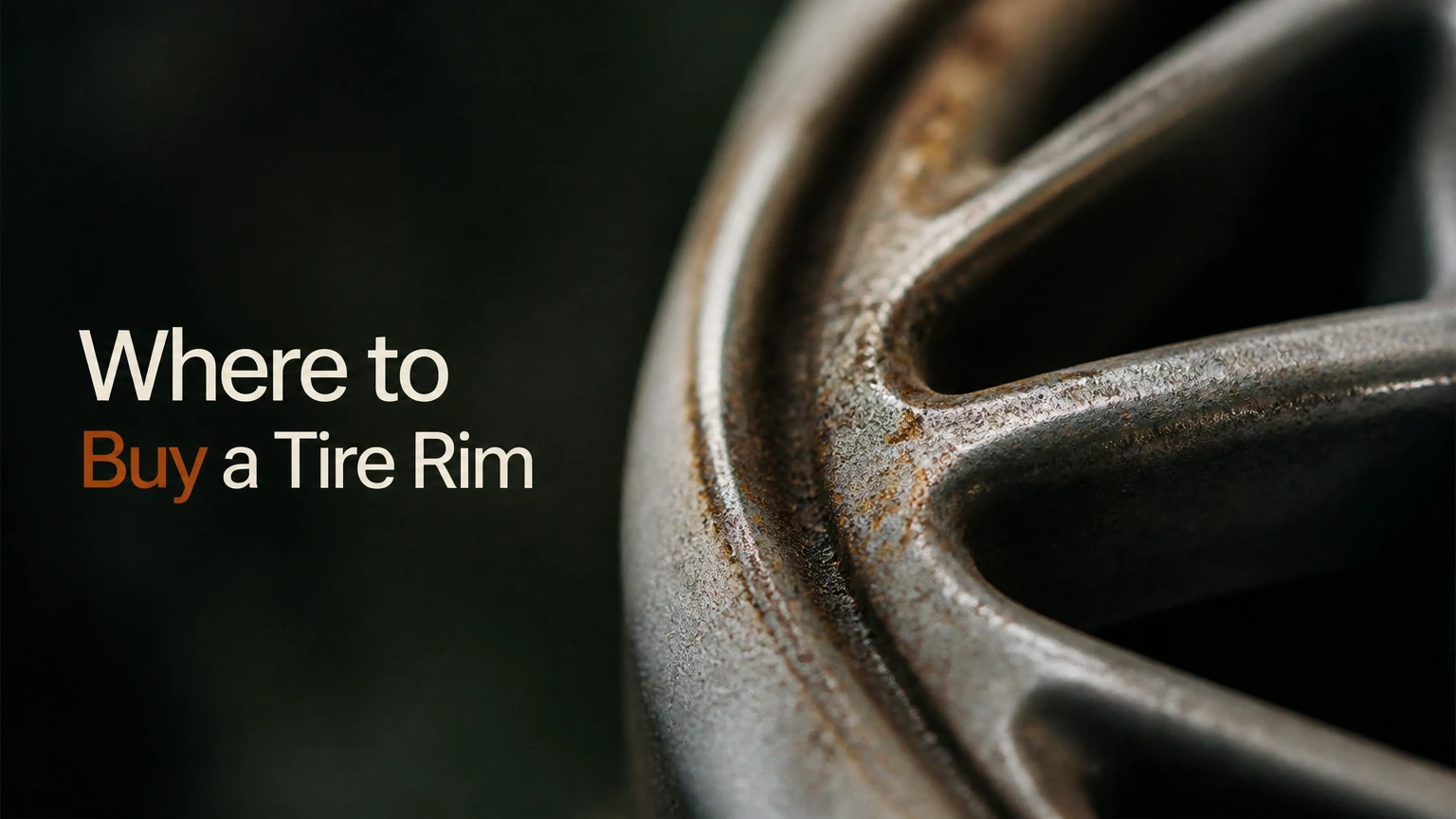
You can buy a tire rim, more precisely a replacement wheel, from a tire retailer, auto-parts dealer, wheel specialist, local tire shop, or marketplace such as Tire Rack, Discount Tire, or eBay Motors. The safest purchase matches your vehicle’s year, make, model, trim, bolt pattern, diameter, width, offset, center bore, load rating, and brake clearance before checkout.
Key facts at a glance
- A replacement wheel must match the tire’s bead-seat diameter unless you replace the tire at the same time.
- Bolt pattern, offset, center bore, load rating, and brake clearance determine whether an aftermarket wheel safely fits.
- Typical wheel prices range from $40-$150 for basic steel wheels and $100-$400 for ordinary cast-alloy wheels.
- Online wheel retailers usually provide broader inventory, while local tire shops combine fitment advice with mounting and balancing.
- A used wheel requires inspection for bends, cracks, weld repairs, corrosion, and incorrect lug-seat geometry.
- A new wheel may still require TPMS service, hub rings, lug nuts, mounting, balancing, shipping, and alignment checks.
What is a tire rim?
A tire rim is the outer part of a wheel that holds the tire bead and helps create an airtight seal. In everyday automotive language, “rim” and “wheel” mean the same product, but technically a complete wheel also includes the center disc, spokes, hub-mounting surface, barrel, and center bore.
A tire cannot attach to a vehicle by the rim edge alone. The complete wheel bolts to the vehicle hub, supports the tire, transfers braking and cornering forces, and preserves the designed relationship between the tire and suspension. Most modern passenger vehicles use tubeless tires, so the bead seats against machined areas of the wheel to contain air.
The National Highway Traffic Safety Administration treats tires and wheels as safety-critical components, although NHTSA does not approve individual aftermarket wheel brands. That distinction matters: a seller’s “fits your vehicle” filter is useful, but it does not replace checking the wheel’s load rating and physical clearance.
Do you need a rim or a complete wheel?
You normally need a complete wheel, not a separate rim edge. Wheel manufacturers and retailers list products by diameter and width, such as 17×8, because the consumer receives the entire metal assembly that mounts to the hub.
A tire shop can sometimes repair a mildly bent wheel, but a cracked wheel, a wheel with a failed weld, or a wheel that repeatedly loses air should be replaced rather than cosmetically refinished. A replacement wheel also makes sense when a single factory wheel is damaged and the remaining three wheels are structurally sound.
Where to buy a tire rim
The best place to buy a tire rim depends on whether you value fitment certainty, price, selection, immediate installation, or access to used original-equipment wheels. A vehicle-specific online retailer is usually the simplest choice for a new wheel, while a local tire shop is usually the most convenient choice when installation and inspection are part of the purchase.
| Seller type | Typical wheel selection | Fitment help | Typical fulfillment | Main risk |
|---|---|---|---|---|
| Tire Rack | New OEM and aftermarket, 15-22 inches | Year, make, model, trim database | 2-7 business days, typical | Shipping and return freight |
| Discount Tire | New alloy and steel, common sizes | Vehicle filter and store confirmation | Same day to 7 days | Limited uncommon applications |
| Local tire shop | OEM replacement and aftermarket | Technician inspection | Same day for stocked wheels | Smaller catalog |
| eBay Motors | New, used, take-offs, custom wheels | Seller listings vary | 2-10 business days | Misdescribed condition or fitment |
| Auto-parts retailer | Steel, OEM-style, common alloy wheels | Catalog and VIN support vary | 1-7 business days | Incomplete offset or bore details |
| Salvage yard | Used OEM wheels, often single units | Part-number and visual matching | Same day to several days | Hidden bends, corrosion, or damage |
Which retailer is best for most buyers?
Tire Rack or Discount Tire is the safest starting point for a new wheel when the vehicle is a common North American model and the buyer wants fitment filtering. Both retailers can connect wheel selection with tire mounting, balancing, and delivery, but the final product page still deserves a manual check.
A local independent tire shop is often better when the car has modified suspension, large brakes, unusual trim equipment, a damaged wheel that must be matched, or a same-day transportation need. The technician can compare the existing wheel, check hub contact, and reject a visibly unsuitable option before installation.
eBay Motors and salvage yards can produce the lowest price for a single OEM wheel, especially for a discontinued vehicle. They require more diligence because a wheel may look straight in photographs yet have a radial bend, corrosion at the bead seat, a different offset, or a lug-seat design that does not match your hardware.
Which specifications must match?
The wheel diameter, wheel width, bolt pattern, offset, center bore, load rating, and brake clearance must suit the vehicle and tire. The door-jamb placard provides factory tire information, but the owner’s manual, VIN lookup, wheel casting marks, and a reputable fitment database are needed to confirm every wheel dimension.
A wheel marking such as 18×8, 5×114.3, ET35, CB67.1 generally describes an 18-inch diameter, 8-inch width, five-lug pattern with a 114.3-millimeter pitch-circle diameter, 35-millimeter positive offset, and 67.1-millimeter center bore.
| Specification | Example value | What it controls | What happens when wrong |
|---|---|---|---|
| Diameter | 18 inches | Tire bead-seat size | Tire cannot mount safely if diameter differs |
| Width | 8.0 inches | Approved tire-width range | Poor handling, bead stress, or sidewall distortion |
| Bolt pattern | 5×114.3 | Hub and lug-hole alignment | Wheel will not seat correctly |
| Offset | ET35 | Inner and outer wheel position | Suspension contact or fender rubbing |
| Center bore | 67.1 mm | Hub pilot fit | Vibration if centering is inadequate |
| Load rating | 690 kg per wheel | Supported vehicle load | Overload risk and premature failure |
| Backspacing | 5.88 inches, typical | Inner lip position | Brake or suspension interference |
How do diameter and width affect tire choice?
Wheel diameter must equal the tire’s designated rim diameter. An 18-inch tire fits an 18-inch wheel, not a 17-inch or 19-inch wheel. Wheel width must fall within the tire manufacturer’s approved range, which is printed in the tire catalog or technical data rather than guessed from appearance.
Changing from a factory 17×7.5 wheel to an 18×8 wheel can improve steering response with the correct tire, but the larger wheel usually requires a lower-profile tire. Lower sidewalls reduce impact cushioning, raise pothole damage risk, and can make replacement tires more expensive.
What does offset mean?
Offset is the distance between a wheel’s centerline and its hub-mounting face, measured in millimeters. Positive offset places the mounting face toward the wheel’s outer side and moves the wheel inward; lower or negative offset moves the wheel outward.
A small offset change affects both sides of the wheel. For example, changing from ET45 to ET35 on the same-width wheel moves the wheel outward by approximately 10 millimeters. That may improve inner strut clearance, but it can also increase fender rubbing and alter steering geometry.
Why do center bore and hub rings matter?
The center bore is the hole in the wheel’s center that fits over the vehicle’s hub pilot. An aftermarket wheel can have a larger center bore than the hub, but a correctly sized hub-centric ring may fill the gap and help center the wheel during installation.
Hub rings do not correct an incorrect bolt pattern, offset, wheel load rating, or brake-clearance problem. They also do not compensate for a bent wheel or an unbalanced tire. A vibration after installation requires a dynamic balance check, lug-torque verification, and inspection of the hub and wheel mating surfaces.
Which wheel material should you buy?
Steel wheels are usually the best value for winter, fleet, and utility use; cast aluminum wheels suit most daily drivers; flow-formed wheels reduce weight at a higher price; and forged wheels target demanding performance applications. Material choice should follow impact exposure, vehicle weight, tire size, and budget rather than appearance alone.
| Wheel construction | Typical price per wheel | Typical weight position | Suitable use | Main limitation |
|---|---|---|---|---|
| Painted steel | $40-$150 | Heaviest | Winter, fleet, work trucks | Corrosion and limited styling |
| Cast aluminum | $100-$400 | Moderate | Daily driving and upgrades | Can crack under severe impact |
| Flow-formed aluminum | $200-$600 | Lower than cast | Performance street use | Higher cost, not automatically race-grade |
| Forged aluminum | $600-$2,000+ | Lowest typical | Track and high-end performance | Expensive and often custom ordered |
Steel wheels tend to bend under a severe impact, while aluminum wheels may crack depending on design, alloy, speed, tire pressure, and impact angle. A bend is not harmless, but it can sometimes be identified and repaired; a cracked structural wheel generally warrants replacement.
Cast-alloy wheels offer the widest range of factory-style designs and finishes. They are appropriate for ordinary commuting, but an inexpensive cast wheel is not automatically equivalent to an original-equipment wheel in load rating, corrosion protection, or quality control.
Flow forming stretches and compresses the outer barrel of a cast wheel during manufacturing. The process can improve strength-to-weight performance, but the wheel’s face and spoke design still determine much of its stiffness and brake clearance.
Forged wheels begin with a billet or forged blank and receive extensive machining. Their low weight can reduce unsprung and rotational mass, yet their cost is difficult to justify for a commuter vehicle that faces potholes and curb impacts.
How much do rims cost?
A replacement wheel typically costs $40-$150 for basic steel, $100-$400 for cast alloy, and $200-$600 for flow-formed construction, before tire service and shipping. The complete installed cost is commonly $150-$800 per wheel when a tire, TPMS sensor, mounting, balancing, or special lug hardware is also involved.
| Purchase component | Typical cost | When it applies | Cost-control decision |
|---|---|---|---|
| Basic steel wheel | $40-$150 | Common commuter and winter sizes | Match the factory diameter and offset |
| Cast-alloy wheel | $100-$400 | Daily-driver replacement or styling | Compare load rating and warranty |
| Used OEM wheel | $75-$300 | Single replacement or discontinued model | Pay for inspection or return protection |
| Tire transfer | $20-$45 | Existing tire remains usable | Confirm tire has no bead or sidewall damage |
| Mount and balance | $25-$60 | Tire installed on replacement wheel | Request road-force balance if vibration persists |
| TPMS service | $0-$100 | Sensor transfer or new sensor | Verify sensor frequency and relearn method |
| Hub rings or lug hardware | $15-$120 | Aftermarket fitment requires them | Use the wheel maker’s specified parts |
| Shipping | $0-$150 | Online purchase | Compare delivered price, not list price |
A tire transfer is worthwhile only when the tire is the correct size, has adequate tread, has no sidewall damage, and has not developed bead damage from the original wheel. Mounting a tire with a damaged bead onto a new wheel can create a slow leak that appears to be a wheel problem.
The price of a wheel-and-tire package can be lower than buying both components separately because mounting and balancing are bundled. Ask whether the package includes TPMS sensors, lug nuts, center caps, hub rings, shipping, and disposal fees before comparing offers.
How to buy the correct wheel
Use a vehicle-specific catalog, then verify the physical specifications and installation requirements with the seller before paying. A careful buyer can complete the research in 20-40 minutes, while a local shop can usually confirm a standard replacement during a 30-90 minute appointment.
Step 1: Record the factory application
Read the driver-door placard and owner’s manual for tire sizes, then record the exact year, make, model, trim, drivetrain, and brake package. A 2020 Honda Accord Sport, for example, may use different wheel dimensions from another Accord trim with a smaller brake package.
If the original wheel remains available, photograph its inner markings. Manufacturers often cast or stamp diameter, width, offset, part number, and load information on the back of the spokes or barrel.
Step 2: Confirm the seven fitment checks
Ask the retailer to confirm diameter, width, bolt pattern, offset, center bore, load rating, and brake clearance. Do not accept “universal fit” as a specification because universal wheels often depend on separate lug hardware, hub rings, or vehicle-specific clearance.
The vehicle’s gross axle weight rating is a useful reference for load capacity. The wheel’s per-wheel load rating should meet or exceed the axle requirement after dividing the axle load between two wheels, with appropriate safety margin.
Step 3: Decide whether to retain the tire
Keep the current tire only if its diameter matches the replacement wheel and the tire remains serviceable. Replace the tire too when changing wheel diameter, when tread depth is low, or when the tire’s age and condition make remounting poor value.
Tire manufacturers commonly recommend replacing tires at 10 years from manufacture regardless of tread, while many vehicle and tire professionals recommend inspection from six years onward. Check the DOT date code and the tire manufacturer’s guidance rather than relying on tread depth alone.
Step 4: Check hardware and sensors
Confirm whether the replacement wheel uses conical, spherical, or flat lug seats and whether the original lug nuts are compatible. Incorrect lug-seat geometry can prevent proper clamping even when the bolt pattern appears correct.
Check TPMS sensor compatibility before installation. Direct sensors may use vehicle-specific frequencies and valve stems, while some vehicles require a relearn procedure after sensor transfer.
Step 5: Calculate the delivered and installed price
Add wheel price, shipping, mounting, balancing, TPMS work, lug hardware, hub rings, alignment checks, and taxes. A $140 online wheel can exceed a $190 local wheel after $35 shipping and $60 of service.
Ask about the return policy before ordering. Confirm whether a mounted wheel can be returned, whether return freight is deducted, and whether curb rash, finish damage, or a fitment claim changes the policy.
Step 6: Install and verify
Have a qualified tire shop mount and balance the assembly using equipment rated for the wheel and tire size. The shop should clean the hub face, torque the lugs to the vehicle manufacturer’s specification, verify clearance, and check air pressure.
After driving 25-50 miles, recheck lug torque if the installer or wheel manufacturer recommends it. Return immediately for steering shake, air loss, scraping, clicking, or visible movement at the hub.
Can you safely buy a used wheel?
You can safely buy a used wheel when the part number, dimensions, load rating, and condition are verified and the seller accepts returns. Used OEM wheels are often a practical match for a single damaged wheel, but photographs alone cannot prove that a wheel is straight or structurally sound.
Inspect the inner and outer lips for flat spots, cracks, weld repairs, deep gouges, and corrosion around the bead seat. Ask the seller for close photographs of every spoke, the inner barrel, casting marks, and the hub area.
A professional wheel shop can check radial and lateral runout with a balancer or measuring equipment. The acceptable limit varies by manufacturer and wheel, so a generic “under 2 millimeters is fine” rule should not replace the vehicle or wheel maker’s specification.
Avoid a wheel with a repaired crack, a visible weld on a structural section, severe bead-seat corrosion, missing chunks, or an unknown history after a high-speed collision. Cosmetic curb rash is different from a bent inner lip, but both should be disclosed.
What certifications and markings matter?
Wheel markings should identify the manufacturer, size, offset, load rating, and applicable compliance marks. JWL and VIA markings are associated with Japanese wheel testing and registration systems, while TÜV approval is associated with German technical certification; the presence of a mark should still be checked against the manufacturer’s documentation.
Certification marks do not guarantee that a wheel fits your specific car. A certified 18×8 wheel can still have the wrong bolt pattern, insufficient brake clearance, an unsuitable offset, or inadequate load rating for a heavy electric vehicle.
The SAE International wheel standards and vehicle manufacturer specifications provide technical context, but retail product pages vary in detail. Request a technical drawing or fitment sheet when the listing omits center bore, load capacity, or lug-seat information.
Common problems after buying a wheel
Most post-installation wheel problems come from incorrect fitment, poor balancing, damaged mating surfaces, incompatible hardware, or a defective wheel. Symptoms should be investigated promptly because continuing to drive can damage tires, wheel bearings, studs, or suspension components.
| Symptom | Likely cause | First inspection | Usual correction |
|---|---|---|---|
| Steering shake at 55-75 mph | Imbalance or bent wheel | Dynamic balance and runout | Rebalance or replace wheel |
| Slow air loss | Bead corrosion or tire damage | Soapy-water leak test | Repair bead area or replace tire |
| Scraping while turning | Excessive width or low offset | Full-lock clearance check | Change wheel or tire specification |
| Vibration immediately after fitment | Missing hub ring or dirty hub | Hub and center-bore inspection | Install correct ring and clean surfaces |
| Loose-feeling wheel | Wrong lug-seat hardware | Lug-nut and stud inspection | Install specified hardware and torque |
| ABS or TPMS warning | Sensor or relearn issue | Scan and sensor test | Program, replace, or relearn sensor |
A steering shake that begins after wheel installation is not normal break-in. Ask the shop to check balance, radial and lateral runout, lug torque, hub cleanliness, and tire bead seating in that order.
Rubbing at full steering lock can result from tire width, wheel width, offset, ride height, liner position, or brake and suspension modifications. Do not solve rubbing by removing a liner or adding random spacers without checking load paths and fastener engagement.
Which seller and wheel type fit your situation?
A daily commuter usually benefits from an OEM replacement or properly rated cast-alloy wheel from a vehicle-filtered retailer. A winter driver may prefer inexpensive painted steel wheels, while a performance driver should prioritize weight, brake clearance, load rating, and documented construction over decorative spoke design.
| Buyer situation | Recommended seller | Recommended wheel | Avoid |
|---|---|---|---|
| Single damaged OEM wheel | Salvage yard or OEM specialist | Matching factory part number | Mixing different offsets |
| Daily commuter | Tire Rack, Discount Tire, local shop | OEM-style alloy or steel | Unverified universal wheels |
| Snow and salted roads | Local shop or established online retailer | Painted steel with winter tires | Unprotected polished finishes |
| Track-day vehicle | Performance wheel dealer | Flow-formed or forged wheel | Unknown load rating |
| Heavy SUV or EV | OEM dealer or specialist | High-load-rated wheel | Passenger-car wheel with low capacity |
| Lowest upfront cost | Used-parts marketplace | Inspected used OEM wheel | No-return listings |
A heavy EV deserves special attention because battery weight can raise axle loads, and large brakes can reduce available barrel clearance. Vehicle-specific load data matters more than a wheel’s advertised appearance.
A track wheel is also a poor choice for a winter commuter if its finish is difficult to clean, its low-profile tire is vulnerable to potholes, or replacement availability is limited. The best wheel is application-specific, not universally superior.
Expert buying rules that prevent expensive mistakes
Match the wheel by part number when replacing one OEM wheel. Two wheels may share diameter and bolt pattern yet differ in offset, spoke shape, center bore, or brake clearance. The original-equipment part number is often more reliable than a photograph or generic model description.
Treat a wheel-and-tire quote as a complete system price. Installation, sensors, valve stems, lug nuts, hub rings, taxes, and shipping can add $75-$250 to one-wheel work. Comparing only advertised wheel prices systematically favors online listings with incomplete packages.
Do not use spacers to rescue unknown fitment. A spacer changes offset, stud engagement, hub contact, and bearing loading. A properly engineered spacer system may be appropriate for a documented build, but a random spacer is not a substitute for selecting the correct wheel.
FAQ
Can I buy only one rim for my car?
Yes, you can buy one replacement wheel if the other three wheels remain structurally sound and the replacement matches their diameter, width, offset, bolt pattern, center bore, finish, and load rating. A matching OEM part number is the most reliable route for a single-wheel replacement.
Do new rims come with tires?
New rims are usually sold without tires unless the listing specifically says “wheel and tire package.” Confirm whether the package includes mounted tires, balancing, TPMS sensors, valve stems, center caps, lug nuts, hub rings, shipping, and installation before ordering.
Can any rim fit any tire?
No. A tire must match the wheel diameter and remain within the tire manufacturer’s approved wheel-width range. The wheel must also fit the vehicle hub, brake system, suspension, fenders, and load requirements, so tire compatibility alone does not make a rim vehicle-compatible.
Is it cheaper to buy rims online or locally?
Online wheels often have lower list prices and broader selection, but local shops can be cheaper after shipping, mounting, balancing, returns, and installation are included. Compare the complete installed quote, especially when buying one wheel or a tire-and-wheel package.
Do aftermarket rims need different lug nuts?
Aftermarket rims may require different lug nuts because lug-seat shape, thread size, shank length, or tuner-style design can differ from the factory hardware. Never assume the original lug nuts fit; verify the wheel manufacturer’s hardware specification before installation.
How do I know whether a damaged rim is repairable?
A mildly bent steel or alloy wheel may be repairable if the wheel maker and local specialist consider the damage safe to correct. A cracked structural section, failed weld, severe corrosion at the bead seat, or repeated air loss usually calls for replacement rather than repair.
The Bottom Line
The safest place to buy a tire rim is a vehicle-specific wheel retailer or reputable local tire shop that confirms fitment and offers installation support. Tire Rack and Discount Tire are strong starting points for new wheels, while eBay Motors, salvage yards, and OEM specialists can make sense for inspected used replacements.
Before paying, verify diameter, width, bolt pattern, offset, center bore, load rating, brake clearance, lug-seat design, TPMS compatibility, return terms, and the complete installed price. The correct wheel is the one that fits the vehicle’s hub and brakes, supports its load, works with the tire, and remains safe after professional mounting.