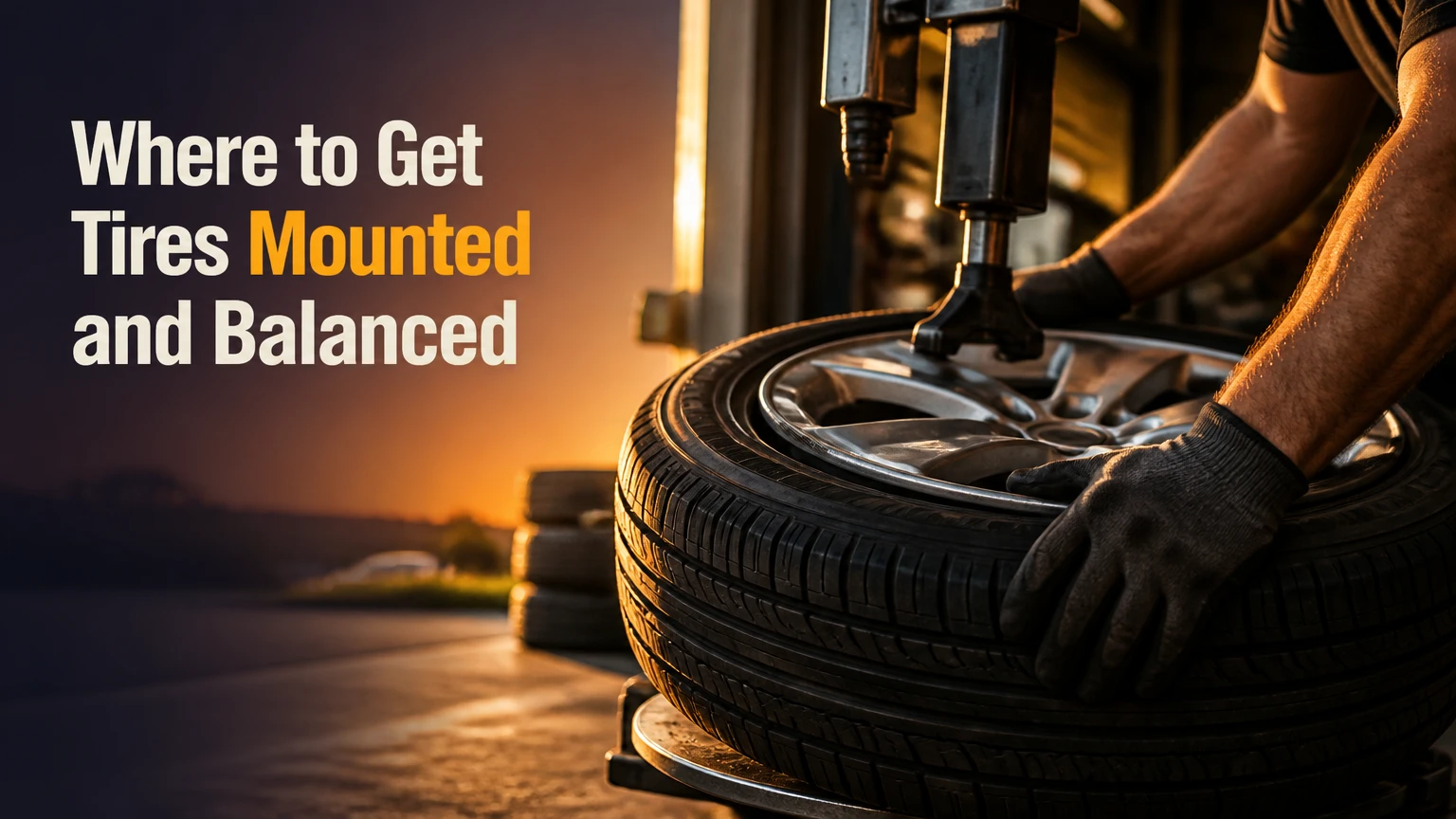
You can get tires mounted and balanced at a national tire chain, warehouse club, independent repair shop, mobile tire service, or dealership service center. The best choice depends on whether you are buying tires there, bringing online tires, driving a specialty vehicle, and prioritizing price, speed, equipment, or warranty support.
Key facts at a glance
- Tire mounting puts a tire onto a wheel; balancing corrects weight variation in the complete wheel and tire assembly.
- Typical mounting and balancing costs range from $15-$75 per tire, with carry-in tires usually costing more.
- A normal appointment takes about 45-120 minutes for four tires, excluding seasonal rushes and parts delays.
- The vehicle door-jamb placard, not the tire sidewall maximum, specifies normal cold inflation pressure.
- Wheel alignment and tire balancing solve different problems, so new tires do not automatically require an alignment.
- A persistent highway-speed vibration after balancing can indicate tire uniformity, wheel runout, bent rims, or suspension damage.
What are mounting and balancing?
Tire mounting is the mechanical installation of a rubber tire onto a compatible metal wheel. Tire balancing is the correction of weight variation in the assembled tire and wheel, usually with clip-on or adhesive weights after a computerized spin test.
Mounting requires a tire changer, bead lubricant, compressed air, and a compatible valve or TPMS service kit. The technician removes the old tire, inspects the rim, installs the replacement, seats both beads, inflates the assembly, and checks for leaks.
Balancing addresses an assembly that does not distribute mass evenly around its axis. A small imbalance creates centrifugal force as speed rises, which can produce steering-wheel shake, seat vibration, irregular tread wear, or accelerated wear in wheel bearings and suspension components.
Mounting and balancing are commonly sold together because a tire change disturbs the wheel assembly. Balancing a tire without mounting it is impossible, while mounting without balancing can leave a new installation uncomfortable or mechanically stressed.
Where can you get tires mounted and balanced?
National tire chains usually offer the best combination of tire inventory, standardized pricing, warranty support, and balancing equipment. Warehouse clubs can be inexpensive when you purchase tires there, while independent shops often provide more flexible carry-in policies and deeper mechanical diagnosis.
Call before driving over. Shops differ sharply on whether they install customer-supplied tires, service run-flat tires, handle TPMS sensors, accept oversized wheels, or guarantee work performed on tires purchased elsewhere.
| Provider | Typical installed service | Typical time for four tires | Best fit |
|---|---|---|---|
| National tire chain | $20-$40 per tire | 45-90 minutes | Common passenger vehicles and tire purchases |
| Warehouse club | $15-$25 per tire when purchased there | 60-120 minutes | Members prioritizing package price |
| Independent repair shop | $25-$50 per tire | 60-90 minutes | Carry-in tires and broader diagnosis |
| Mobile tire service | $40-$75 per tire | 45-60 minutes onsite | Home or workplace installation |
| Dealership service center | $30-$60 per tire | 90 minutes or longer | OEM fitment and brand-specific vehicles |
Prices are typical U.S. practitioner ranges, not universal rate cards. Disposal, new valve stems, TPMS kits, oversized wheels, run-flat tires, sales tax, and alignment may add separate charges.
How much does mounting and balancing cost?
Mounting and balancing typically costs $60-$300 for four tires, depending on provider, wheel size, tire construction, and whether the tires were purchased from the same business. A tire installation package may include rotation, disposal, valve hardware, road-hazard coverage, or lifetime balancing, so the lowest per-tire quote is not always the lowest total cost.
Carry-in tires frequently cost more because the shop loses the tire-sale margin and assumes installation liability. Some facilities refuse outside tires; others require proof that the tire size, load index, speed rating, and construction match the vehicle.
| Cost item | Typical amount | When it applies |
|---|---|---|
| Mount and balance, tire bought onsite | $15-$40 per tire | Standard passenger-car installation |
| Mount and balance, carry-in tire | $25-$75 per tire | Online or customer-supplied tires |
| Rubber valve stem | $3-$8 per wheel | Conventional valve replacement |
| TPMS rebuild kit | $8-$25 per wheel | Sensor seal, core, cap, and grommet service |
| Tire disposal | $3-$10 per tire | Old casing retained by the shop |
| Four-wheel alignment | $90-$180 | Uneven wear, pulling, or altered suspension |
| Road-force balance | $20-$50 per tire | Persistent vibration or difficult assembly |
Costco, Sam’s Club, Discount Tire, Firestone Complete Auto Care, and local shops publish different package rules by location. Verify the out-the-door total, because “installation” can mean mounting only, or it can include balancing, valve service, disposal, torque checks, and a warranty.
What happens during mounting and balancing?
A professional tire installation follows a controlled sequence: deflation, bead breaking, demounting, wheel inspection, valve or TPMS service, mounting, bead seating, inflation, balancing, and final installation. The quality of the inspection and final torque check matters as much as the machine used.
Step 1: Remove and inspect the old assembly
The technician records the wheel position, removes the valve core to release pressure, and breaks the beads away from the rim flanges. The wheel is checked for cracks, bends, corrosion, damaged bead seats, and objects lodged in the tire.
A bent wheel can create symptoms that weights cannot correct. Corrosion around the bead seat can also cause a slow leak after the new tire is installed.
Step 2: Demount the tire carefully
A tire changer separates the old casing from the wheel without damaging the rim or TPMS sensor. Low-profile tires, run-flat tires, and large alloy wheels require more careful clamping and tool positioning than ordinary steel wheels.
The technician should avoid blindly applying a pry bar near an internal sensor. A damaged sensor may trigger a TPMS warning after installation.
Step 3: Replace valve hardware and mount the tire
The shop installs a new rubber valve stem or a TPMS rebuild kit when the hardware is serviceable. Sensor replacement is different from a rebuild kit: a rebuild renews seals and the valve core, while a failed sensor requires a new programmed unit.
Bead lubricant is applied before the replacement tire goes onto the rim. Dry mounting increases the chance of bead damage, rim scratches, and incomplete seating.
Step 4: Seat the beads and set pressure
Compressed air pushes each bead against the rim seat. After both beads seat evenly, the technician sets pressure according to the vehicle placard, which may specify different front and rear values.
The U.S. National Highway Traffic Safety Administration identifies the vehicle certification label or owner’s manual as the source for recommended tire pressure. The maximum pressure molded into a tire sidewall is a structural limit, not the vehicle’s normal operating setting.
Step 5: Spin-balance the assembly
The balancing machine spins the complete wheel and tire, measures imbalance, and identifies where correction weight belongs. The technician then installs adhesive weights inside the wheel barrel or clip-on weights on an approved flange.
Modern alloy wheels may require adhesive weights to preserve appearance and avoid damage to a decorative flange. The final result should be checked with the wheel mounted in the correct position and the machine’s centering hardware fitted properly.
Step 6: Reinstall and torque the wheels
The technician starts each lug nut by hand, lowers the vehicle enough to prevent rotation, and uses a calibrated torque wrench for final tightening. A typical passenger vehicle may require roughly 80-100 foot-pounds, but the manufacturer’s specification controls.
A torque specification is not a universal number. Ford, Toyota, Honda, BMW, and Subaru models can use different values, thread sizes, seating surfaces, and retorque instructions.
What should the installation include?
A complete tire installation should include wheel inspection, bead lubrication, valve or TPMS service, bead seating, inflation, computerized balancing, lug torque verification, and a leak check. Sensor relearn or reset should also be included when the vehicle’s TPMS requires it.
Ask the service advisor to identify each included item on the estimate. “Mounting” alone may exclude balancing, and “tire installation” may exclude alignment, disposal, premium valve hardware, or tire-pressure monitoring work.
Use this checklist before authorizing work:
- Confirm tire size, load index, speed rating, and directional rotation requirements.
- Ask whether the shop accepts customer-supplied tires.
- Confirm the price for four tires, including disposal and valve or TPMS hardware.
- Ask whether the shop uses standard balancing or road-force measurement.
- Request the manufacturer’s lug torque specification on the work order.
- Confirm TPMS relearn, pressure setting, and post-service leak inspection.
- Ask whether balancing or rotation is covered during the tire warranty period.
Can a shop mount tires bought online?
Many independent shops and national chains mount online tires, but acceptance, pricing, and liability policies vary by location. Online tire retailers may also ship directly to an affiliated installer, which simplifies delivery and lets the shop verify the order before the appointment.
Confirm these details before ordering:
- The exact tire size, including XL, LT, run-flat, or original-equipment marking.
- The shop’s maximum wheel diameter and tire-width capability.
- The carry-in installation price per tire.
- Whether the shop charges for tire disposal and TPMS service.
- The return process if a tire arrives damaged or has the wrong specification.
- Whether the installer will mount tires supplied by a private seller.
A tire bought online does not automatically have the correct fitment. Check the vehicle placard, owner’s manual, and manufacturer fitment data rather than relying only on a retailer’s vehicle lookup.
Do new tires need an alignment?
New tires do not automatically need a wheel alignment, but an alignment is appropriate when the vehicle pulls, the steering wheel is off-center, or the old tires show one-sided or feathered wear. Balancing corrects rotational weight variation; alignment corrects wheel angles such as toe, camber, and caster.
An alignment cannot repair a tire imbalance. Balancing cannot correct a bent suspension component or incorrect toe. A shop that recommends alignment for every tire purchase may be following a package policy rather than diagnosing a measured condition.
Request an alignment inspection after hitting a pothole, replacing steering or suspension parts, lowering a vehicle, or observing rapid inside-edge wear. A normal tire installation needs pressure setup and balance, not an automatic alignment upsell.
Which provider is right for you?
The best provider depends on the service combination, not the business label. A warehouse club often wins for tires purchased there, an independent shop often wins for carry-in tires and diagnosis, and a dealership is more suitable when OEM procedures or unusual sensor systems matter.
| Driver situation | Preferred provider | Reason | Main drawback |
|---|---|---|---|
| Buying four standard tires | National chain | Inventory, package warranty, quick scheduling | Seasonal queues |
| Warehouse-club member | Costco or Sam’s Club | Competitive package pricing | Membership and appointment delays |
| Bringing online tires | Independent shop | Flexible carry-in policy | Higher installation fee |
| Homebound or office-based driver | Mobile installer | No waiting-room visit | Weather and equipment limits |
| Luxury vehicle with low-profile tires | Performance tire shop | Road-force and rim expertise | Higher labor cost |
| Newer vehicle with complex TPMS | Dealership or specialist | OEM scan and relearn capability | Usually highest price |
When is mobile tire service a good choice?
Mobile tire service is a good choice for standard passenger vehicles when convenience outweighs the premium, especially for home or workplace installation. Mobile vans may carry compact changers and balancers, but they may not support every run-flat, oversized, commercial, or high-performance wheel.
Mobile service is a poor fit for a cracked rim, suspected suspension fault, severe tire damage, or a vehicle requiring alignment. A fixed shop has lifts, alignment racks, broader tire inventory, and more options for diagnosing a vibration.
When is road-force balancing worth paying for?
Road-force balancing is worth considering when a standard balance is within tolerance but the vehicle still vibrates, particularly with low-profile tires, stiff sidewalls, large wheels, or suspected tire and wheel runout. A road-force machine applies a load roller while measuring force variation and radial runout.
Standard balancing detects mass imbalance. Road-force testing can reveal a tire’s stiff spot, a wheel’s high spot, or a mismatch that produces a repeating vibration even after several ounces of weights are removed and reapplied.
Road-force balancing is not a substitute for a bent-wheel repair or defective-tire warranty claim. The technician should measure the wheel and tire, identify the source, and explain whether rotating the tire on the rim, replacing the tire, or repairing the wheel is appropriate.
When should tires be balanced again?
Tires should be balanced again after a tire is removed and remounted, a wheel weight falls off, a tire develops a speed-related vibration, or a wheel and tire receive impact damage. Routine rebalancing at every 5,000-7,500 miles is not mandatory unless the vehicle manufacturer or tire provider recommends it.
Rotation intervals often fall near 5,000-8,000 miles, but rotation does not automatically require balancing. A technician should balance an assembly when symptoms, measured imbalance, uneven wear, or service history justifies it.
Mud, packed snow, and debris inside a wheel can imitate imbalance. Clean the wheel first, then test the assembly before buying additional balancing work.
Why does the car still vibrate after service?
A vehicle can continue vibrating after mounting and balancing because of tire uniformity variation, wheel runout, incorrect centering, a loose weight, bent rims, suspension wear, or debris inside the wheel. The vibration’s speed, location, and timing help separate these causes.
- Steering-wheel shake at 55-75 mph often points toward a front assembly, but it is not proof.
- Seat or floor vibration more often implicates a rear assembly or driveline.
- Vibration at one narrow speed range commonly indicates balance or uniformity.
- Vibration that changes under acceleration can involve axles, mounts, or driveline components.
- A vehicle that pulls immediately after service usually has pressure, alignment, tire conicity, or brake issues rather than simple imbalance.
- Repetitive thumping can indicate a damaged casing, shifted belt, flat spot, or separated tread.
Return to the installer promptly if the symptom began immediately after service. Request a recheck of lug torque, pressures, balance, wheel seating, and tire damage before authorizing unrelated repairs.
What should you check before leaving the shop?
Before leaving, verify cold tire pressures, lug-nut torque, TPMS status, wheel position, and the absence of leaks or warning lights. A short road test at local and highway speeds can expose a balance problem while the installation record is still available.
Check that:
- The steering wheel remains centered on a straight road.
- No TPMS warning remains after sensor relearn.
- Tire pressures match the door placard.
- Directional tires point in the correct rotation direction.
- Asymmetric tires show the correct inside and outside markings.
- Lug nuts use the correct seat type for the wheel.
- No adhesive weight contacts brake components.
- The vehicle does not pull or produce new clicking, rubbing, or thumping sounds.
Recheck pressures when the tires are cold, ideally before driving or after the vehicle has been parked for several hours. Pressure rises during driving, so a hot reading should not be used to reduce pressure to the placard value.
Common mistakes and better fixes
Reusing old valve hardware
Old rubber stems can leak after a tire change, and worn TPMS seals can produce intermittent pressure loss. Replace standard stems and rebuild serviceable TPMS sensors during installation.
Confusing balancing with alignment
A balance problem concerns rotating mass; an alignment problem concerns wheel geometry. Ask the shop to show the symptom or measurement supporting each service.
Allowing impact-only lug tightening
An impact gun can quickly seat lug nuts, but final torque should be checked with a calibrated torque wrench. Uneven or excessive torque can complicate wheel removal and damage studs or wheel mounting surfaces.
Ignoring wheel corrosion
Corrosion at the bead seat can cause a slow leak that resembles a defective tire. Cleaning the sealing surface and testing the assembly in water or with leak-detection solution can identify the cause.
Selecting the cheapest carry-in quote
A $20 mounting price may exclude balancing, TPMS service, disposal, or road-force testing. Compare the complete four-wheel invoice instead of a single labor line.
Treating every vibration as a balance issue
A balance service cannot fix a separated tire belt, bent rim, worn tie rod, bad wheel bearing, or failing CV axle. A persistent symptom requires diagnosis rather than repeated weight installation.
FAQ
Can I get tires mounted and balanced without buying tires from the shop?
Yes, some independent shops, tire chains, and mobile installers accept customer-supplied tires. Carry-in pricing commonly runs $25-$75 per tire, and some businesses refuse outside tires or exclude installation warranties, so confirm policy before ordering.
Is balancing included when I buy new tires?
Balancing may be included in an installation package, but the phrase is not standardized. Ask whether the price includes four balances, valve or TPMS service, disposal, pressure setup, torque verification, and free follow-up balancing.
How long can I drive after mounting new tires?
A properly installed tire can be driven immediately, but the first trip should include a short inspection for vibration, pulling, leaks, and warning lights. Follow the tire manufacturer’s break-in guidance, especially for performance, winter, or studded tires.
Can tire shops balance a wheel without mounting a new tire?
Yes, a shop can remove and rebalance an existing tire and wheel assembly. The technician should first inspect tread, pressure, wheel damage, and missing weights because balancing cannot correct structural tire or suspension defects.
Why did my TPMS light come on after tire installation?
The TPMS light may appear because a sensor was damaged, a seal leaked, the system needs a relearn procedure, or pressure is incorrect. Check cold pressures first, then return to the installer for a sensor scan and relearn.
Should all four tires be replaced at once?
Replacing all four tires is usually preferable for vehicles with all-wheel drive and for vehicles with substantial tread differences, but the vehicle manufacturer may permit smaller differences. A shop should compare tread depth, tire construction, and drivetrain requirements before recommending two or four.
The bottom line
The best place to get tires mounted and balanced is usually the business that can verify fitment, accept your tire source, service the valve or TPMS hardware, balance the assembly correctly, and provide a clear total price. Choose a warehouse club for an economical tire package, an independent shop for carry-in tires and diagnosis, a mobile installer for convenience, or a specialist and dealership for complex wheels and vehicle systems. Ask for mounting, balancing, pressure setup, torque verification, and TPMS service before you book where to get tires mounted and balanced.