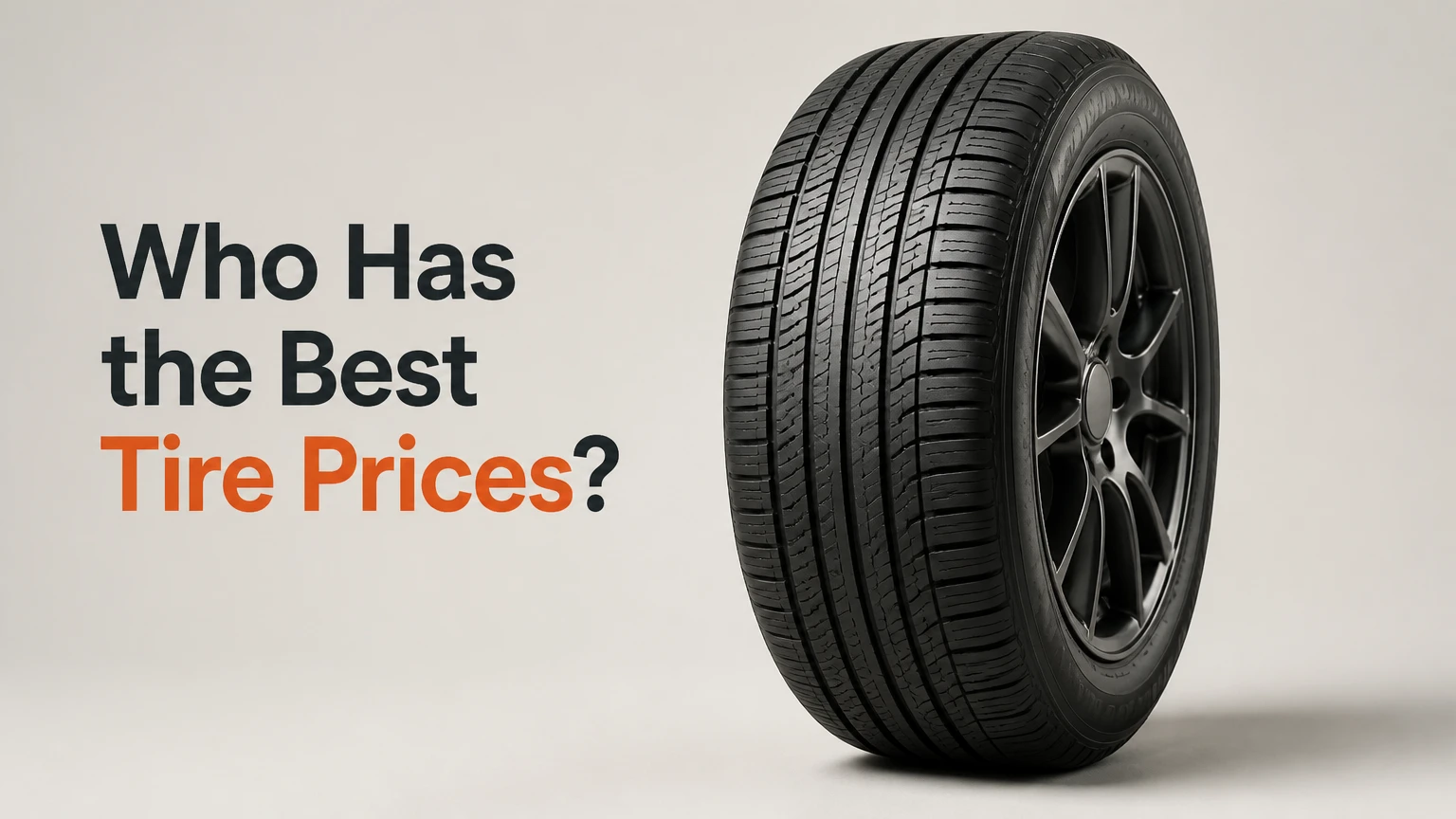
Walmart usually has the lowest upfront tire prices, while Discount Tire often delivers the best all-around value and Costco can win for members buying premium tires during promotions. The cheapest purchase depends on the installed four-tire total, including mounting, balancing, disposal, warranty coverage, rotations, repairs, membership fees, and applicable rebates.
Key Facts at a Glance
- Walmart commonly has the lowest sticker price for budget and entry-level tires.
- Discount Tire is often the strongest value when free rotations, balancing, and flat repairs matter.
- Costco can produce the lowest premium-tire total for members using manufacturer promotions.
- Online retailers often have the widest selection, but local installation can erase the price advantage.
- A realistic comparison requires the same tire size, load index, speed rating, service package, and warranty terms.
- Typical installed pricing for four conventional passenger tires ranges from about $320 to more than $1,200 before taxes.
What Does Tire Pricing Actually Include?
Tire pricing is the total cost of buying, installing, maintaining, repairing, and eventually replacing a tire. A $95 tire can cost more than a $125 tire after mounting, balancing, disposal, shipping, road-hazard coverage, and required service are added.
The core calculation is:
Out-the-door total = tire price × quantity + installation + fees + shipping + membership cost – instant rebates
Installation commonly includes mounting and balancing, but the package differs by retailer. Valve stems, tire-pressure-monitoring service, disposal, alignment, nitrogen, road-hazard certificates, and taxes may appear separately. Ask for an itemized quote for all four tires before comparing sellers.
The National Highway Traffic Safety Administration states that “tires are the only parts of your vehicle that make contact with the road.” That contact makes fitment, braking performance, wet traction, and load capacity more important than a small difference in purchase price.
Typical cost components
| Cost component | Typical amount | When it applies | Common mistake |
|---|---|---|---|
| Passenger tire | $75-$250 each | Most sedans, crossovers, and minivans | Comparing different sizes or ratings |
| Mounting and balancing | $15-$35 each | Nearly every shop installation | Assuming online installation is included |
| Tire disposal | $2-$8 each | Old tires left at the installer | Omitting four disposal charges |
| TPMS service | $0-$15 each | Sensor inspection or valve replacement | Treating a warning light as a tire defect |
| Alignment | $90-$180 per vehicle | Uneven wear or steering pull | Buying tires before diagnosing wear |
| Road-hazard protection | $0-$25 each or included | Puncture and impact damage terms vary | Assuming every puncture is covered |
| Shipping | $0-$25 each | Online orders without free delivery | Ignoring shipping to a third-party shop |
Prices are typical U.S. retail ranges, not guaranteed quotes. Tire size, state taxes, local labor rates, vehicle complexity, and inventory can change the final figure substantially.
Who Has the Best Tire Prices by Retailer?
Walmart generally wins the lowest initial price, Discount Tire often wins maintenance-adjusted value, Costco is strongest for promoted premium sets, and online sellers win selection. No retailer wins every vehicle size because regional stock, installation capacity, rebates, and the exact tire model change the result.
Retailer comparison
| Retailer | Typical tire price | Typical installation | Best advantage | Main limitation |
|---|---|---|---|---|
| Walmart Auto Care | $55-$150 each | $15-$25 each | Lowest budget entry price | Service availability varies by store |
| Discount Tire | $90-$280 each | $20-$35 each | Rotations, repairs, broad chain support | Road-hazard certificates may cost extra |
| Costco | $120-$300 each | About $18-$25 each | Premium promotions and member service | Membership and appointment wait times |
| Sam’s Club | $90-$250 each | About $18-$25 each | Club promotions and package pricing | Fewer locations than Walmart |
| Tire Rack | $80-$300 each | $25-$45 each locally | Reviews, tests, and specialty inventory | Installer fees are separate |
| SimpleTire | $65-$250 each | $25-$45 each locally | Large online catalog | Warranty claim coordination can be slower |
| Local independent shop | $85-$300 each | $20-$45 each | Personal service and flexible brands | Pricing consistency varies |
These figures describe typical market ranges rather than fixed national rates. A local Walmart may have a cheaper installation fee than a nearby store, while a Discount Tire promotion or Costco manufacturer rebate can reverse the initial ranking.
Walmart: best for the lowest upfront price
Walmart is usually the first place to check when the purchase budget is the main constraint. Its catalog includes private-label and value brands, common passenger sizes, and occasional national-brand promotions that can lower the four-tire total.
Walmart is less attractive when the vehicle needs a specialty size, run-flat tire, high-load SUV tire, or immediate expert diagnosis. Store staffing, appointment availability, and service consistency differ by location, so verify that the chosen Auto Care Center can install the tire and service the vehicle’s TPMS.
A $70 tire installed at $20 per tire produces a typical pre-tax total of $360 for four tires after $40 in disposal and related fees. A $95 tire at a shop charging $30 per tire can reach $540. The cheaper tire is still the cheaper purchase, but the difference is smaller than the sticker prices suggest.
Verdict: Walmart is the likely winner for budget tires and older vehicles when local service availability is acceptable.
Discount Tire: best for maintenance-adjusted value
Discount Tire often provides the best total value for drivers who keep a vehicle several years and use included maintenance. Many locations provide free tire inspections, rotations, balancing, and puncture repairs for eligible tires, although policies and protection plans vary.
Discount Tire can also compare a valid competitor quote on the same tire and service conditions. Do not assume that every advertised online price qualifies automatically. Confirm the retailer’s current price-match terms, inventory status, shipping conditions, rebates, and installation requirements.
The chain is less attractive when its available tire model costs substantially more than a comparable option or when a customer purchases optional road-hazard certificates without expecting to use them. The certificate can make sense for drivers on construction routes, gravel roads, or high annual mileage, but it is not automatically economical for every commuter.
Verdict: Discount Tire is often the best value when free maintenance and convenient puncture support are worth more than the lowest initial quote.
Costco: best for premium tires during promotions
Costco becomes competitive when a member buys Michelin, Bridgestone, or another premium line during a manufacturer or warehouse promotion. A $60-$100 instant rebate on four tires can offset part of the membership cost and reduce the premium over mid-range brands.
Costco’s installation package typically includes mounting, balancing, new rubber valve stems, tire rotation, and tire repair services under stated conditions. Costco does not mean zero installation cost in every market, and road-hazard coverage has eligibility limits. The warehouse club also requires membership, which adds an annual expense unless the household already uses Costco.
Costco’s main practical weakness is service scheduling. A popular promotion can create appointment delays, and a driver needing same-day replacement may pay more elsewhere to avoid unsafe driving on damaged or worn tires.
Verdict: Costco is a strong premium-tire choice for existing members who can wait for an appointment and use the active promotion.
Online retailers: best for selection and uncommon sizes
Tire Rack, SimpleTire, Amazon, and similar distributors can beat local prices when the required tire is discontinued, performance-oriented, seasonal, or unavailable nearby. Tire Rack also publishes fitment information, customer reviews, test results, and installer directories that make comparison easier.
Online pricing must include delivery and installation. A $110 tire with free shipping plus $35 installation costs about $580 for four tires after $40 in shop fees. A $100 tire with $20 shipping per tire and $25 installation costs about $600. The lower tire price does not guarantee the lower installed total.
Online purchases also divide responsibility among three parties: the seller handles the order and product warranty, the installer handles mounting and balancing, and the tire manufacturer handles some defect or mileage claims. Preserve the invoice, installation receipt, mileage records, and rotation history.
Verdict: Online buying wins for selection, specialty fitments, and transparent model comparison, not automatically for installed cost.
Which Retailer Has the Lowest Installed Cost?
Walmart most often has the lowest installed cost for budget tires, but Discount Tire and Costco can win after maintenance or promotions are included. The correct comparison uses one tire model, one specification, four tires, identical services, and the same treatment of rebates and membership costs.
Sample four-tire comparison
| Scenario | Walmart | Discount Tire | Costco | Online seller |
|---|---|---|---|---|
| Budget tire price | $280 | $360 | $520 | $320 |
| Installation and disposal | $100 | $140 | $100 | $160 |
| Membership or shipping | $0 | $0 | $65 membership | $0-$80 shipping |
| Promotion or rebate | $0 | $0 | -$80 | -$40 |
| Estimated pre-tax total | $380 | $500 | $605 | $440-$520 |
| Typical completion time | Same day to 3 days | Same day to 3 days | 2-7 days | 2-7 days plus installer |
The table illustrates decision logic, not a quote for a particular vehicle. Costco’s membership charge belongs in the comparison only when the buyer would join solely for the tire purchase. An existing member should compare the tire transaction without assigning the entire membership price to the tires.
How should you compare quotes?
- Copy the exact tire identification, such as P215/60R16 95H.
- Confirm the same brand, model, size, load index, speed rating, and construction.
- Request four tires, mounting, balancing, valve stems, disposal, TPMS service, taxes, and alignment separately.
- Subtract instant rebates only when the buyer qualifies and can complete the required redemption.
- Add membership or shipping charges that would not otherwise occur.
- Record the warranty, free-service, and road-hazard terms in writing.
- Compare the final total and the expected service burden, not the tire line alone.
A quote that says “installed from $X” is not enough. Ask whether the amount includes disposal, valve stems, TPMS labor, shop supplies, and road-hazard protection.
What Tire Specifications Change the Price?
Tire size, load index, speed rating, construction, tread design, and vehicle category drive price more than the retailer name. A 20-inch reinforced crossover tire can cost twice as much as a 16-inch standard passenger tire because it uses more material and requires tighter structural performance.
The driver-side door-jamb placard is the safest starting point. It lists the manufacturer’s approved size and inflation pressure, while the tire sidewall shows the tire’s actual size, load index, speed rating, and construction.
Specification effects
| Specification | Example | Typical price effect | Safety implication |
|---|---|---|---|
| Rim diameter | 16-inch versus 20-inch | 20-inch often costs $40-$130 more each | Must clear brakes and match fitment |
| Load index | 95 versus 104 | Higher-load tire often costs $15-$60 more | Supports heavier vehicle loads |
| Speed rating | H versus V or W | Higher rating often adds $10-$50 each | Maintains designed handling capability |
| Construction | Standard versus XL | XL often adds $10-$40 each | Changes load capacity and pressure needs |
| Seasonal design | All-season versus winter | Winter set often costs $20-$80 more each | Improves cold-weather traction |
| Run-flat construction | Standard versus run-flat | Often adds $40-$120 each | Allows limited travel after air loss |
| Vehicle type | Sedan versus light truck | LT and heavy SUV tires cost more | Changes load, casing, and durability |
Do not downgrade the load index or speed rating to obtain a lower quote without confirming compatibility with the vehicle manufacturer’s specification. A cheaper incorrect tire can create handling, clearance, insurance, or warranty problems.
Why does UTQG matter?
UTQG, or Uniform Tire Quality Grading, provides treadwear, traction, and temperature information for many passenger tires sold in the United States. The treadwear number is comparative within a manufacturer’s testing system, not a guaranteed mileage figure across brands.
A 600-rated tire will not necessarily last twice as long as a 300-rated tire. Driving style, alignment, inflation, climate, road surface, vehicle weight, and tire rotation frequency can dominate actual wear. Treat UTQG as one screening signal, then check independent testing, warranty terms, wet braking, noise, and owner feedback.
Which Tire Type Offers the Best Long-Term Value?
Mid-range touring tires usually offer the best balance for ordinary commuters, while premium tires can justify their price on heavy SUVs, luxury vehicles, and severe-weather routes. Ultra-budget tires make sense only when immediate affordability outweighs shorter tread life, higher noise, and weaker wet-weather performance.
Value by driving situation
| Driver situation | Suitable category | Typical set price | Value reason | Avoid when |
|---|---|---|---|---|
| 8,000 miles annually | Budget all-season | $300-$500 | Low purchase cost | Frequent rain or highway travel |
| 15,000 miles annually | Mid-range touring | $500-$800 | Better wear and wet handling | Vehicle needs specialty fitment |
| Luxury SUV | Premium crossover | $800-$1,400 | Noise, braking, load support | Vehicle is near end of service life |
| Snow-belt commuter | All-season plus winter set | $900-$1,600 total | Cold-weather traction | Mild climate and low mileage |
| Gravel-road driver | Highway-terrain or all-terrain | $700-$1,300 | Stronger casing and puncture resistance | Quiet highway driving is the priority |
| Electric vehicle owner | EV-rated or high-load tire | $700-$1,400 | Load and rolling-resistance design | Approved standard tire is available cheaper |
An inexpensive tire that lasts 25,000 miles can cost more per mile than a $150 tire that lasts 55,000 miles. Use cost per 10,000 miles as a rough comparison, but include the safety and handling differences that mileage alone cannot measure.
When Do Online Tire Prices Beat Local Retailers?
Online prices beat local retailers when the tire model is at least $20-$30 cheaper per tire after shipping and the installer’s complete fee remains reasonable. Local stores usually win when the vehicle needs immediate service, a warranty adjustment, a diagnosis, or a specialty installation.
Online buying checklist
- Confirm the seller’s return policy before mounting the tire.
- Ask the installer how it handles tires purchased elsewhere.
- Check the tire’s production date when the seller provides it.
- Confirm whether the local shop accepts the tire’s diameter and run-flat construction.
- Obtain a written installation price for mounting, balancing, disposal, and TPMS work.
- Save the order invoice and shipment tracking information.
- Verify that the tire is new, undamaged, and the correct specification before installation.
A tire’s production date is represented by the final four digits of the Department of Transportation code, which identify the manufacturing week and year. A tire made in week 1824 was produced in the 18th week of 2024. Age alone does not prove a tire is defective, but buyers should question an unusually old item and check the manufacturer’s storage and warranty policies.
What Warranty and Maintenance Terms Change the Winner?
Warranty terms change the winner when the driver expects punctures, uneven wear, or long-term maintenance. A mileage warranty generally covers premature treadwear under conditions, while road-hazard protection addresses certain punctures or impact damage, and workmanship coverage addresses manufacturing defects.
The terms are not interchangeable. A mileage claim may require proof of rotation at the manufacturer’s stated interval, correct inflation, alignment, and remaining tread. Road-hazard plans commonly exclude cosmetic damage, off-road use, vandalism, racing, and some sidewall failures.
Protection comparison
| Protection type | Typical coverage | Documentation needed | Buyer fit |
|---|---|---|---|
| Mileage warranty | Treadwear below stated limit | Purchase record and rotation history | High-mileage highway driver |
| Road hazard | Eligible puncture or impact damage | Inspection and original purchase record | Gravel, construction, or urban routes |
| Workmanship warranty | Defect in materials or construction | Seller inspection and serial information | Any new-tire buyer |
| Free rotation | Scheduled wear maintenance | Retailer purchase or eligibility record | Drivers keeping tires 3-5 years |
| Prorated adjustment | Credit toward replacement | Proof of maintenance and remaining tread | Premature wear within warranty |
| Manufacturer satisfaction policy | Limited trial or return period | Original condition and retailer rules | Buyers uncertain about ride or noise |
A tire protection plan is financially sensible when one covered replacement would exceed the plan’s price, especially for large SUV tires. It is less persuasive for inexpensive tires, low-mileage drivers, or buyers who already receive comparable road-hazard coverage.
Which Retailer Is Best for Different Drivers?
The best retailer changes with the driver’s urgency, annual mileage, vehicle, and tolerance for service coordination. A high-mileage commuter can rationally choose Discount Tire over Walmart even when Walmart’s initial total is lower, because repeated rotations and puncture repairs have measurable value.
Daily commuter
Choose Discount Tire or a local shop with free rotations and balancing when the vehicle travels 12,000-20,000 miles annually. Select a mid-range touring tire with a documented mileage warranty rather than the cheapest available model.
Premium SUV or luxury vehicle owner
Choose Costco during a Michelin or Bridgestone promotion if the vehicle already belongs to the household’s Costco ecosystem. Confirm the required load index, acoustic foam design, run-flat status, and appointment availability before ordering.
Emergency replacement buyer
Choose the retailer with the correct tire in stock and a qualified installer today. Driving several days on a damaged tire to save $40 can create wheel damage, loss of control, or a second replacement.
Older vehicle with limited remaining life
Choose Walmart or an online closeout from a recognized value brand when the tires meet the vehicle’s specification and the expected remaining ownership period is short. Do not use a used tire with unknown repairs, uneven wear, exposed cords, sidewall damage, or an uncertain age.
High-mileage or rough-road driver
Choose Discount Tire or a reputable independent shop with accessible puncture service and a tire suited to the road surface. A slightly higher initial price can reduce downtime and replacement frequency.
Electric vehicle owner
Compare EV-approved or high-load tires, rolling resistance, noise, and weight capacity rather than searching only for the lowest price. Heavy battery vehicles can wear unsuitable tires quickly, which can erase the purchase savings.
What Common Tire-Pricing Mistakes Cost Buyers Money?
The most expensive tire-buying mistakes involve incorrect specifications, incomplete installation quotes, and maintenance records that cannot support a warranty claim. Each error can turn a low advertised price into a premature replacement or unsafe installation.
Mistake 1: Comparing different specifications
A $90 tire and a $140 tire are not comparable if one has a lower load index, different speed rating, or smaller diameter. Match the complete designation from the placard before comparing retailers.
Mistake 2: Treating installation as free
“Free installation” may exclude disposal, TPMS service, valve stems, or balancing for special wheels. Request the final amount for four tires, with taxes and fees listed.
Mistake 3: Buying by treadwear number alone
UTQG treadwear does not predict exact service life across manufacturers. Check wet traction, braking tests, alignment condition, inflation habits, and the tire’s intended vehicle class.
Mistake 4: Ignoring alignment and inflation
A worn suspension component or incorrect toe setting can destroy a new set in 5,000-10,000 miles. Measure tire pressure cold at least monthly and inspect for shoulder, center, cupping, and diagonal wear.
Mistake 5: Assuming every warranty covers every failure
Road hazard, mileage, workmanship, and satisfaction guarantees have different exclusions. Obtain the written terms and ask who performs the inspection.
Mistake 6: Chasing an online closeout without checking age
A low price can reflect discontinued inventory or an older production date. Confirm the date code and return policy before mounting the tires.
How Can You Negotiate the Best Tire Deal?
The most effective negotiation uses a documented, comparable out-the-door quote rather than a vague request for a discount. Ask a retailer to match the same tire model, specification, installation package, rebate treatment, and warranty terms.
Use this script:
“I have a written quote for four [exact tire model and specification] at $X installed, including mounting, balancing, disposal, TPMS service, taxes, and the stated warranty. Can you match or improve that total?”
Check the retailer’s own website while standing at the counter if the local quote exceeds the online price. Ask whether the store honors online pricing, whether a promotion requires membership, and whether the advertised rebate is instant or submitted later.
The best savings opportunities are manufacturer rebates, warehouse-club promotions, seasonal inventory changes, fleet discounts, and bundled alignment offers. Avoid financing a tire purchase solely to obtain a discount unless the total repayment, deferred-interest deadline, and account fees are fully understood.
FAQ
Is Costco cheaper than Walmart for tires?
Costco is usually not cheaper than Walmart for budget tires, but Costco can produce a lower premium-tire total during a $60-$100 four-tire promotion. Walmart generally wins the initial price, while Costco’s value improves when the buyer already has a membership and uses included maintenance and road-hazard services.
Is Discount Tire cheaper than Tire Rack?
Discount Tire can be cheaper after installation, rotations, repairs, and price matching are included, while Tire Rack may have the lower online tire price. Compare the complete local installer quote, shipping, warranty administration, and availability for the exact size before choosing either seller.
How much should four new tires cost?
Four new tires typically cost $320-$1,200 before tax for many passenger cars, crossovers, and minivans. Budget tires with installation can fall near $350-$500, mid-range sets near $500-$800, and premium or large SUV sets above $900, depending on size and services.
Should I buy all four tires at once?
Buy all four tires at once when tread depth, vehicle drivetrain, or the manufacturer’s fitment guidance requires matched tires. Replacing only two can be acceptable on some vehicles, but the new pair is commonly installed on the rear axle after professional evaluation.
Are cheap tires unsafe?
Cheap tires are not automatically unsafe if they meet the vehicle’s size, load, speed, and regulatory requirements. Ultra-budget models may provide less wet grip, shorter tread life, more noise, and weaker support than established mid-range tires, so driving conditions should determine whether the savings are reasonable.
When is the best month to buy tires?
The best time is usually when a manufacturer rebate or retailer promotion applies to the required tire, rather than a specific calendar month. Spring and fall promotions are common, but waiting is unsafe when tread is worn, damage is visible, or the tire has repeated pressure loss.
The Bottom Line
Walmart usually has the best tire prices for the lowest upfront budget, Discount Tire often has the best maintenance-adjusted value, Costco is highly competitive for premium tires during member promotions, and online retailers offer the broadest selection. The winning quote is the one with the lowest complete cost for the correct specification, reliable installation, usable warranty, and expected service over the tire’s life. Compare the out-the-door total before deciding who has the best tire prices.