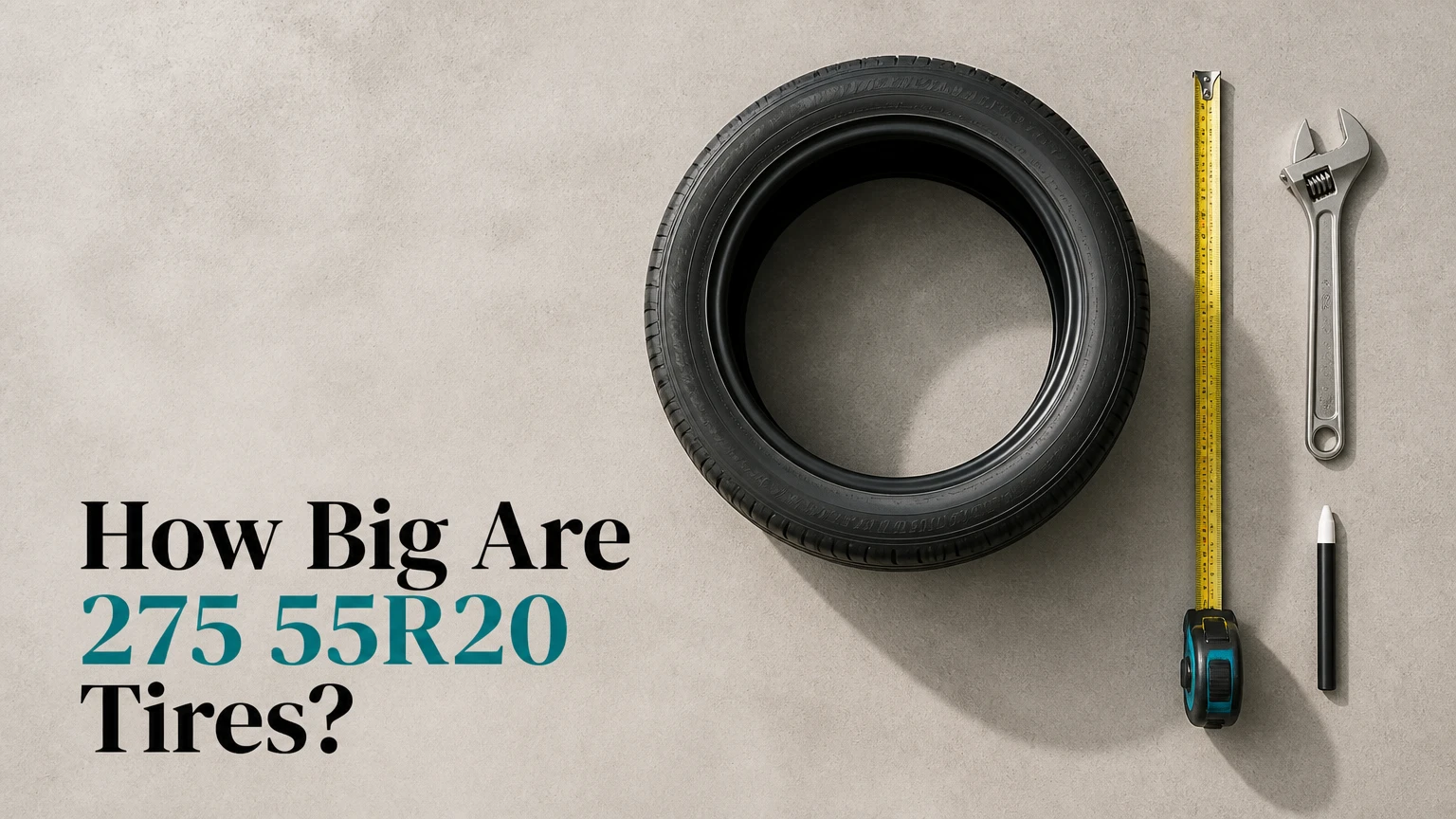
A 275/55R20 tire is approximately 31.9 inches tall, 10.8 inches wide, and built for a 20-inch wheel. Its calculated sidewall height is 5.95 inches, making it a “32-inch” tire in common truck and SUV terminology, although the measured diameter can vary slightly by brand, construction, tread design, and approved wheel width.
Key Facts at a Glance
- A 275/55R20 tire has a calculated overall diameter of 31.9 inches, or about 810.5 millimeters.
- The 275 designation represents a nominal section width of 275 millimeters, or 10.8 inches.
- The 55 aspect ratio produces a calculated sidewall height of 151.25 millimeters, or 5.95 inches.
- The R identifies radial construction, while 20 identifies a 20-inch wheel diameter.
- The calculated circumference is approximately 100.3 inches, producing about 632 revolutions per mile.
- Actual tire dimensions differ by model, load range, tread depth, and measuring conditions, so catalog specifications determine final clearance.
What Does 275/55R20 Mean?
The code 275/55R20 describes a tire’s nominal width, sidewall proportion, internal construction, and wheel diameter. The size does not directly state the tire’s exact tread width, weight, load capacity, or recommended inflation pressure.
How do you decode 275/55R20?
The 275/55R20 code breaks down into four measurements or designations:
| Marking | Meaning | Exact interpretation |
|---|---|---|
| 275 | Section width | 275 mm nominal width, approximately 10.8 in |
| 55 | Aspect ratio | Sidewall height equals 55% of 275 mm |
| R | Construction | Radial tire construction |
| 20 | Wheel diameter | Fits a 20-inch wheel bead seat |
The sidewall calculation is straightforward: 275 mm × 0.55 = 151.25 mm. Because a tire has a sidewall above and below the wheel, the overall diameter calculation is 20 inches plus two sidewall heights.
The 275 measurement is a standardized nominal section width, not a guarantee that the visible tread measures 275 millimeters. Shoulder shape, sidewall bulge, tread blocks, and the measuring wheel can make one 275/55R20 model appear wider or narrower than another.
How tall and wide is a 275/55R20 tire?
A 275/55R20 tire is nominally 10.8 inches wide and 31.9 inches tall. The sidewall measures approximately 5.95 inches from the wheel rim to the outer tread surface, and the tire occupies roughly 15.95 inches of radius from the wheel center.
| Measurement | Metric calculation | Approximate imperial value |
|---|---|---|
| Nominal section width | 275 mm | 10.83 in |
| Sidewall height | 275 × 0.55 = 151.25 mm | 5.95 in |
| Wheel diameter | 20 × 25.4 = 508 mm | 20.00 in |
| Overall diameter | 508 + 302.5 = 810.5 mm | 31.91 in |
| Circumference | 810.5 × π = 2,546 mm | 100.25 in |
| Revolutions per mile | 63,360 ÷ 100.25 | 632 rev/mi |
A tire manufacturer may list an overall diameter near 31.7, 31.9, or 32.1 inches. The difference matters when the tire is close to a suspension, fender liner, mud flap, or anti-roll-bar component.
Is 275/55R20 really a 32-inch tire?
Yes, 275/55R20 is commonly called a 32-inch tire because its calculated diameter rounds from 31.91 to 32 inches. The “32-inch” label is a convenient classification rather than a guaranteed measured dimension for every model.
A heavily lugged all-terrain or mud-terrain tire may measure differently from a highway tire in the same nominal size. Load range also affects casing stiffness and the manufacturer’s published dimensions. Use the specific tire’s technical data when planning a tight fitment, not the rounded 32-inch description.
How much clearance does 275/55R20 need?
A 275/55R20 tire needs enough clearance at the suspension, inner wheel well, fender liner, mud flap, and outer fender through the full steering and suspension range. The tire’s nominal width alone cannot determine rubbing because wheel offset, backspacing, alignment, ride height, and suspension travel change its position.
What affects 275/55R20 fitment?
The main fitment variables are:
- Wheel width: Every tire model has an approved rim-width range. A common range may be approximately 7.5-9.5 inches, but the tire manufacturer’s specification controls.
- Wheel offset: A lower offset moves the tire outward toward the fender; a higher offset moves it inward toward suspension parts.
- Suspension height: A leveling kit or lift can improve fender clearance but may create new clearance issues at the upper control arm.
- Steering angle: A tire that clears while driving straight can rub at full lock.
- Tread design: Wide shoulders and protruding side lugs increase the effective clearance requirement.
- Vehicle load: Passengers, cargo, and tongue weight compress the suspension and reduce available space.
A practical inspection requires checking both sides of the vehicle because manufacturing tolerances and alignment settings can differ slightly. Test full left and right steering, compress the suspension if possible, and inspect shiny witness marks on plastic liners or metal components.
Will 275/55R20 tires rub?
275/55R20 tires may rub on some vehicles even when the size fits another vehicle as original equipment. The most common contact points are the front mud flap, rear portion of the front wheel liner, upper control arm, and inner fender, especially with nonstandard offset wheels or aggressive all-terrain tread.
Factory applications are the safest starting point, but the door placard and owner’s manual remain the authority for a particular vehicle. Do not assume that a tire listed for a stock Chevrolet Tahoe will fit a modified Ford F-150 with different offset, control arms, and wheel-well geometry.
Which vehicles use 275/55R20 tires?
275/55R20 tires are used on selected full-size pickups and large SUVs, including certain Ford F-150, Chevrolet Silverado 1500, GMC Sierra 1500, Ram 1500, Toyota Tundra, Chevrolet Tahoe, Chevrolet Suburban, GMC Yukon, Cadillac Escalade, Ford Expedition, Lincoln Navigator, and Toyota Sequoia configurations.
| Vehicle family | Typical relevance | Fitment qualification |
|---|---|---|
| Ford F-150 | 20-inch factory wheel packages | Year, cab, axle, and trim determine size |
| Chevrolet Silverado 1500 | 20-inch road-oriented configurations | Confirm door-placard load rating |
| Ram 1500 | Selected 20-inch applications | Offset and suspension package matter |
| Toyota Tundra | Large-wheel factory configurations | Generation and trim change approved sizes |
| Chevrolet Tahoe and GMC Yukon | Full-size SUV applications | Check passenger-load and spare requirements |
| Ford Expedition | Selected large-wheel applications | Verify model year and tire-speed rating |
Vehicle compatibility is not established by diameter alone. The replacement tire must also meet or exceed the original load index, speed rating, construction type, wheel-width range, and any manufacturer-specific requirements.
Is 275/55R20 good for trucks, SUVs, and towing?
275/55R20 tires work well for many daily-driven trucks and SUVs because the 5.95-inch sidewall balances steering response with reasonable impact absorption. The size is less suitable for severe rock crawling, deep ruts, or drivers who prioritize maximum pothole protection over handling precision.
Which tread type fits your driving?
| Tire category | Typical road mix | Main strengths | Main compromises |
|---|---|---|---|
| Highway terrain, H/T | 90-100% pavement | Low noise, stable wet handling, long tread life | Limited loose-surface traction |
| All-terrain, A/T | 70-95% pavement | Gravel and snow traction, stronger shoulders | More noise, weight, and rolling resistance |
| Rugged terrain, R/T | 50-85% pavement | Aggressive appearance, mixed-surface grip | Uneven wear if alignment is poor |
| Mud terrain, M/T | 10-50% pavement | Deep mud and loose-ground traction | Noise, wet-road compromise, faster wear |
For towing, the tire’s load index and inflation table matter more than the 55 aspect ratio by itself. A shorter sidewall can reduce steering squirm, but it does not automatically increase trailer control or payload capacity. Never use tire capacity to exceed the truck’s gross axle weight rating or payload rating.
Should you choose P-metric or LT 275/55R20?
P-metric and LT 275/55R20 tires can share the same size code while having different load tables, casing construction, weight, and ride behavior. A P-metric tire often favors comfort and fuel economy, while an LT tire may provide greater load-range capacity and sidewall durability at the cost of mass and firmness.
| Construction marking | Common use | Typical trade-off | Required check |
|---|---|---|---|
| P 275/55R20 | Daily-use pickup or SUV | Softer ride, lower mass | Match placard load requirement |
| LT275/55R20 Load Range E | Heavy-duty hauling or off-road use | Stronger casing, firmer ride | Use the LT inflation table |
| XL 275/55R20 | Higher-load passenger application | More capacity, sometimes firmer ride | Confirm XL load index |
| 275/55R20 without visible prefix | Model-dependent | Construction cannot be assumed | Read full sidewall marking |
The tire sidewall and manufacturer data must identify the construction. Do not substitute an LT tire simply because its advertised capacity looks higher, since the heavier casing can change ride quality, braking response, and fuel consumption.
How does 275/55R20 compare with nearby sizes?
275/55R20 is shorter than 275/60R20 and slightly narrower than 285/55R20. The 275/60R20 adds sidewall and ride comfort, while the 285/55R20 adds approximately 10 millimeters of nominal width and a small amount of height.
| Tire size | Approx. diameter | Approx. width | Difference from 275/55R20 |
|---|---|---|---|
| 265/50R20 | 30.4 in | 10.4 in | 1.5 in shorter |
| 275/55R20 | 31.9 in | 10.8 in | Baseline |
| 275/60R20 | 33.0 in | 10.8 in | 1.1 in taller |
| 285/55R20 | 32.2 in | 11.2 in | 0.3 in taller, 0.4 in wider |
| 285/60R20 | 33.5 in | 11.2 in | 1.6 in taller, 0.4 in wider |
275/55R20 versus 275/60R20
275/60R20 is approximately 3.4% taller than 275/55R20, with a calculated diameter near 33.0 inches. At an indicated 60 mph, a vehicle calibrated for 275/55R20 could travel approximately 62.0 mph if the larger tire is installed and no recalibration occurs.
The taller tire raises the axle and body by roughly 0.55 inches, but it also reduces effective gearing by about 3.4%. Acceleration may feel slower, engine rpm may fall slightly at cruising speed, and fender clearance becomes more demanding. The 60-series tire has about 0.55 inches more sidewall, which generally improves impact cushioning.
275/55R20 versus 285/55R20
285/55R20 is approximately 0.4 inches wider and 0.3 inches taller than 275/55R20, although individual models vary. The extra width can improve flotation on loose surfaces, but it can also increase steering effort, tire mass, fuel use, and the chance of contact with suspension or fender components.
The 285 size is not a simple traction upgrade. Wheel width and offset must be compatible, and the tire may place its shoulder closer to the outer fender. The 275/55R20 generally provides the lower-risk replacement when the vehicle’s placard specifies that exact size.
What speedometer change does 275/55R20 cause?
A 275/55R20 tire changes speedometer and odometer readings only when its rolling circumference differs from the vehicle’s calibration tire. Compared with a 275/60R20, the 275/55R20 is about 3.4% smaller, so a vehicle calibrated for the taller tire would indicate approximately 60 mph while traveling near 58 mph with the smaller tire.
Use this formula:
Actual speed = indicated speed × new tire diameter ÷ calibrated tire diameter
For example, replacing a calibrated 31.9-inch tire with a 33.0-inch tire gives 60 × 33.0 ÷ 31.9, or approximately 62.1 mph. Real rolling circumference changes with inflation pressure, load, tread wear, and tire construction, so the result is an estimate rather than a laboratory correction.
How much do 275/55R20 tires cost?
A typical 275/55R20 tire costs approximately $150-$450 per tire before installation, while a complete set commonly reaches $750-$2,000 after mounting, balancing, taxes, disposal fees, and optional protection plans.
| Price tier | Tire-only price | Installed set estimate | Typical buyer |
|---|---|---|---|
| Budget | $150-$190 each | $750-$950 | Highway commuter with modest mileage |
| Mid-range | $200-$290 each | $950-$1,350 | Daily truck and mixed-weather driver |
| Premium H/T or A/T | $300-$400 each | $1,350-$1,750 | Long-distance or severe-weather user |
| Specialty LT or M/T | $350-$450+ each | $1,550-$2,000+ | Heavy hauling or dedicated off-road use |
Installation usually takes 45-90 minutes for four tires when the shop has no scheduling delay. Add time for alignment, TPMS sensor service, disposal, or a wheel that needs repair. The cheapest tire is not necessarily the lowest-cost choice if its tread life, wet braking, or casing durability does not match the vehicle’s use.
How do you verify 275/55R20 fitment before buying?
Verify the driver’s-door placard, owner’s manual, tire construction, load index, speed rating, wheel width, and physical clearance before ordering. A replacement is acceptable only when every required specification meets the vehicle’s limits, not merely when the diameter appears close.
Follow this checklist:
- Read the door placard. Record the original size, front and rear pressures, and required load index.
- Inspect the current tire. Read the complete marking, such as P275/55R20 113T or LT275/55R20 120/117Q.
- Check the wheel. Confirm a 20-inch diameter and a width approved for the selected tire model.
- Compare load capacity. Never install a tire with a lower required load index or lower axle capacity.
- Compare speed rating. Match or exceed the vehicle manufacturer’s specified rating.
- Check the spare. A different diameter can affect a four-wheel-drive or all-wheel-drive system.
- Inspect clearance. Test steering lock, suspension compression, and fender-liner contact.
- Confirm pressure instructions. Use the placard pressure for the vehicle unless a qualified tire professional provides a documented alternative.
A sidewall maximum, such as 50 or 80 psi, is not the vehicle’s normal operating pressure. The door placard specifies the pressure needed for the vehicle’s certified load and handling characteristics.
What problems can occur with 275/55R20 tires?
The most common problems are rubbing, wrong load capacity, incorrect pressure, spare-tire mismatch, uneven wear, and confusing nominal width with actual tread width. Each problem has a different remedy, so increasing tire pressure or adding a lift is not a universal fix.
- Rubbing at full lock: Check offset, mud flaps, liner position, and alignment before trimming anything.
- Harsh ride: Verify cold pressure against the placard; an LT tire at its maximum sidewall pressure can ride much harder than a P-metric tire.
- Center wear: Excessive inflation or a worn suspension component may be responsible.
- Shoulder wear: Underinflation, overload, aggressive cornering, or misalignment can accelerate shoulder damage.
- Driveline warning: Replace tires in matched sets on AWD and some 4WD systems, because circumference differences can stress the drivetrain.
- Poor wet traction: A mud-terrain tread may evacuate water less effectively than a highway tire, even at the same nominal size.
- Chain interference: A 275/55R20 tire may leave insufficient room for chains on vehicles designed around narrower factory tires.
Two practitioner rules prevent many expensive mistakes. First, measure the selected model’s published section width on its approved rim. Second, inspect the tire after installation under realistic load, because an unloaded driveway check can miss contact during braking, cornering, or trailer tongue compression.
FAQ
Is 275/55R20 the same as a 32-inch tire?
275/55R20 is commonly classified as a 32-inch tire because its calculated diameter is 31.91 inches. The actual diameter depends on the brand, tread pattern, load range, and measuring method, so one model may be slightly below or above 32 inches.
How wide is the tread on a 275/55R20 tire?
A 275/55R20 tire has a nominal section width of 275 millimeters, or 10.8 inches, but its tread width is usually narrower or otherwise different. Shoulder design and the approved measuring rim affect the published tread width, so consult the manufacturer’s specification for exact tread dimensions.
What rim width fits 275/55R20?
The correct rim width depends on the tire model, although many 275/55R20 tires approve approximately 7.5-9.5-inch wheels. The tire manufacturer’s approved rim-width range takes priority, and wheel offset must also provide suspension and fender clearance.
Is 275/55R20 good in snow?
275/55R20 can perform well in snow when paired with a severe-snow-rated all-season or three-peak mountain snowflake tire. Width alone does not determine winter performance; rubber compound, siping, tread depth, temperature, and vehicle weight have greater practical influence.
Can 275/55R20 replace 275/60R20?
275/55R20 can replace 275/60R20 only when the vehicle manufacturer, wheel clearance, load rating, and driveline requirements allow the change. The smaller tire is about 3.4% shorter, which affects speedometer readings, ground clearance, gearing, and possibly electronic stability-control calibration.
What pressure should a 275/55R20 tire use?
A 275/55R20 tire should normally be inflated to the cold pressure printed on the vehicle’s driver-door placard, often around 35-38 psi for some passenger applications. The correct value varies by vehicle, load, and construction, so the tire sidewall maximum is not a substitute for the placard.
The Bottom Line
A 275/55R20 tire is approximately 31.9 inches tall, 10.8 inches wide, and 5.95 inches from rim to tread on each side. The size fits the 32-inch tire class and suits many full-size trucks and SUVs, but exact fitment depends on the vehicle, wheel offset, load index, tire construction, and clearance. Before buying, verify the placard and the model-specific specifications rather than relying on the rounded label alone.