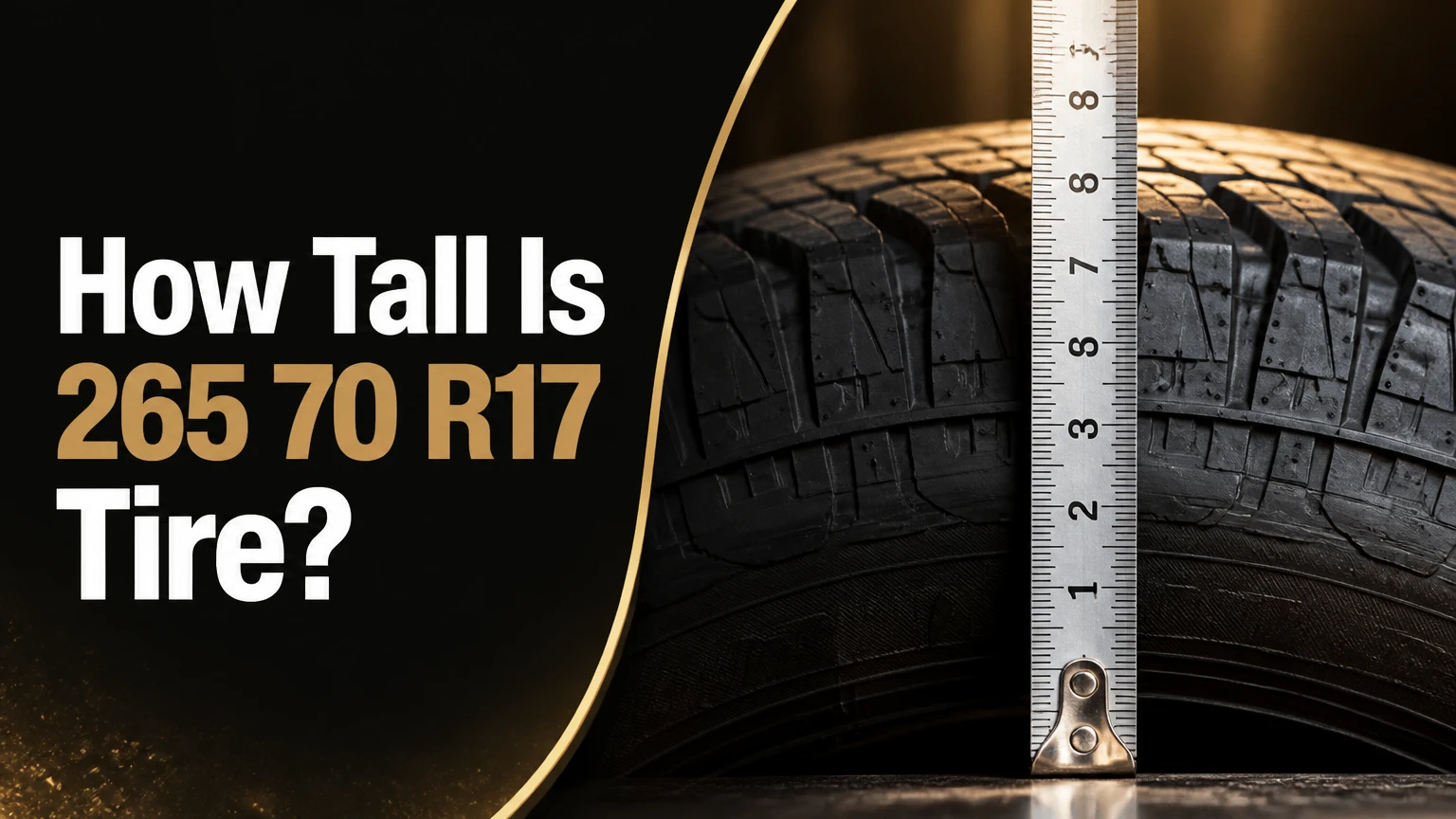
A 265/70R17 tire is approximately 31.6 inches tall, or 803 millimeters in diameter, when calculated from its nominal size. Its nominal width is 10.4 inches, and each sidewall is about 7.3 inches tall. The mounted tire can measure slightly differently depending on the brand, tread design, wheel width, inflation pressure, and load.
Key facts
A 265/70R17 tire has a calculated diameter of 31.6 inches or 803 mm.
The nominal tire width is 265 mm, or 10.4 inches.
The calculated sidewall height is 185.5 mm, or 7.30 inches.
The calculated circumference is approximately 99.3 inches, or 2,522 mm.
A 265/70R17 tire fits a 17-inch wheel, not a 16-inch or 18-inch wheel.
A 265/70R17 is commonly described as a 32-inch tire, although its calculated diameter is closer to 31.6 inches.
How tall is 265 70 r17 tire?
The nominal height of a 265/70R17 tire is 31.6 inches, based on the tire-size formula. The 265 millimeter width produces a 185.5 millimeter sidewall at a 70 percent aspect ratio, and two sidewalls added to the 17-inch wheel diameter produce a 802.6 millimeter overall diameter.
The calculation is:
- Width: 265 mm
- Sidewall: 265 × 0.70 = 185.5 mm
- Two sidewalls: 185.5 × 2 = 371 mm
- Wheel diameter: 17 × 25.4 = 431.8 mm
- Overall diameter: 371 + 431.8 = 802.8 mm
Converted to inches, 802.8 mm equals 31.61 inches. Tire manufacturers may publish a measured overall diameter that differs by several tenths of an inch, so the formula is a specification estimate rather than a guarantee of physical height.
265/70R17 dimensions at a glance
| Measurement | Metric value | Imperial value | Meaning |
|---|---|---|---|
| Overall diameter | 802.8 mm | 31.61 in | Top-to-bottom nominal height |
| Section width | 265 mm | 10.43 in | Sidewall-to-sidewall nominal width |
| Sidewall height | 185.5 mm | 7.30 in | One sidewall from wheel to tread |
| Wheel diameter | 431.8 mm | 17.00 in | Required wheel diameter |
| Circumference | 2,522 mm | 99.3 in | Calculated rolling distance per revolution |
| Revolutions per mile | Approximately 638 | Approximately 638 | Calculated unloaded value |
The circumference estimate uses diameter multiplied by pi. Actual revolutions per mile vary with load, pressure, tread depth, and the tire manufacturer’s approved measuring method.
What does 265/70R17 mean?
The 265/70R17 code identifies a tire’s nominal width, sidewall ratio, construction, and wheel diameter. The code does not identify the tire’s load rating, speed rating, tread type, winter performance, or exact measured diameter.
- 265 means a nominal section width of 265 millimeters.
- 70 means the sidewall height equals 70 percent of the nominal width.
- R means radial construction.
- 17 means the tire mounts on a 17-inch wheel.
A 265/70R17 tire is not automatically an LT tire, an all-terrain tire, or a 10-ply tire. A tire marked P265/70R17 is a passenger-metric version, while LT265/70R17 is a light-truck version with different load-carrying requirements, pressure tables, and often a heavier casing.
Why the measured tire may not equal 31.6 inches
A tire’s printed size is standardized, but the complete mounted assembly is affected by construction. A mud-terrain tire with large shoulder lugs can occupy more space than a highway tire with closely packed ribs, even when both carry the 265/70R17 designation.
Published manufacturer specifications can differ because companies measure overall diameter at a particular rim width, inflation pressure, and unloaded condition. A tire shop should use the specific brand and model’s specification sheet when clearance is tight.
Is 265/70R17 a 32-inch tire?
A 265/70R17 tire is conventionally called a 32-inch tire, but its calculated diameter is 31.6 inches. The 32-inch label is a rounded category used for comparison and vehicle fitment discussions, not the precise engineering measurement.
The difference between 31.6 and 32.0 inches is only 0.4 inch in total diameter, or about 0.2 inch in radius. That small distinction matters when a tire has very little clearance near a mud flap, upper control arm, sway-bar link, or inner fender.
A tire advertised as a “32-inch” product may also measure above or below 32 inches after mounting. Compare the manufacturer’s published overall diameter rather than relying on the marketing category.
Will 265/70R17 fit a stock vehicle?
A 265/70R17 tire fits many stock trucks and SUVs, but size alone cannot confirm fitment. Clearance depends on the vehicle’s original tire size, wheel offset, steering geometry, suspension travel, mud flaps, fender liners, alignment, and the replacement tire’s actual width.
The size is a common factory or near-factory fitment on vehicles such as some Toyota Tacoma, Toyota 4Runner, Jeep Wrangler, Chevrolet Silverado, Ford Ranger, and Nissan Frontier configurations. Those examples do not establish universal compatibility because the same model can use different wheels, axles, suspension packages, and body clearances across model years.
Check these fitment points before buying
- Read the driver-door placard. Confirm the original tire size, recommended cold pressure, and required load index.
- Verify the wheel diameter. A 265/70R17 requires a 17-inch wheel. Wheel width and offset also matter.
- Compare the original diameter. Moving from 265/65R17 to 265/70R17 adds about one inch of diameter.
- Inspect steering clearance. Check the inner sidewall, mud flap, tie-rod area, and upper control arm at full steering lock.
- Check suspension compression. A tire can clear while parked yet rub when the suspension compresses off-road.
- Test with the vehicle loaded. Passengers, cargo, towing tongue weight, and wheel articulation reduce available clearance.
- Account for tire chains. Chains require additional clearance and can make an otherwise acceptable fitment unsafe.
The safest confirmation comes from a vehicle-specific fitment database, the tire manufacturer, or a qualified tire technician who checks the exact wheel and tire combination.
What sizes compare with 265/70R17?
The closest commonly discussed alternatives are 265/65R17, 285/70R17, and 255/80R17. The 265/65R17 is shorter, the 285/70R17 is wider and taller, and the 255/80R17 is narrow with a tall sidewall.
| Tire size | Calculated diameter | Nominal width | Sidewall height | Difference from 265/70R17 |
|---|---|---|---|---|
| 265/65R17 | 30.56 in | 10.43 in | 6.73 in | 1.05 in shorter |
| 265/70R17 | 31.61 in | 10.43 in | 7.30 in | Baseline |
| 285/70R17 | 32.71 in | 11.22 in | 7.87 in | 1.10 in taller and 0.79 in wider |
| 255/80R17 | 33.06 in | 10.04 in | 8.03 in | 1.45 in taller and 0.39 in narrower |
265/70R17 versus 265/65R17
A 265/70R17 is approximately 1.05 inches taller than a 265/65R17 and raises the vehicle’s axle center about 0.53 inch. Both sizes have the same nominal width, but the 70-series tire has a taller sidewall and slightly more air volume.
The larger tire can improve ground clearance and fill the wheel opening. It can also reduce acceleration slightly, alter the speedometer, and create rubbing where the shorter size cleared. When a vehicle’s original tire is 265/65R17, the 265/70R17 speedometer effect is about 3.4 percent.
265/70R17 versus 285/70R17
A 285/70R17 is approximately 1.10 inches taller and 0.79 inch wider than a 265/70R17. Because width increases on both sides of the tire, inner suspension clearance and outer fender clearance can each change by roughly 0.4 inch before wheel-offset effects.
The 285/70R17 is often called a 33-inch tire. It may require a leveling kit, lift, different offset, liner modification, or trimming, depending on the truck. A heavier LT 285 can also increase unsprung mass and steering effort, so the size difference is not purely cosmetic.
265/70R17 versus 255/80R17
A 255/80R17 is approximately 1.45 inches taller and 0.39 inch narrower than a 265/70R17. Its narrow tread and taller sidewall can suit drivers who prioritize a narrow contact path, but the added height creates more vertical clearance risk.
The narrower size is not automatically better in mud or snow. Traction depends on compound, tread void, inflation pressure, vehicle weight, and surface conditions. A narrow tire also changes the vehicle’s load and handling characteristics, so the door-placard specification remains the controlling reference.
How does 265/70R17 affect the speedometer?
Replacing a 265/65R17 with a 265/70R17 makes the speedometer read approximately 3.4 percent slower than actual road speed, assuming the vehicle is calibrated for the original size. At an indicated 70 mph, the actual speed would be about 72.4 mph before other calibration and tire-wear effects.
The formula is:
New indicated speed = actual speed × original diameter ÷ new diameter
For 265/65R17 and 265/70R17:
- 30.56 ÷ 31.61 = 0.9668
- The indicated speed is approximately 96.7 percent of actual speed.
- The distance traveled per revolution also increases by about 3.4 percent.
Modern vehicles may calculate speed from wheel-speed sensors and use software calibration rather than a mechanical speedometer gear. A dealer-level scan tool or an aftermarket programmer may correct the reading on some vehicles, but recalibration availability varies by model and tire size.
The same change can affect shift timing, stability-control thresholds, odometer distance, parking-assist assumptions, and automatic four-wheel-drive systems. These effects are usually modest at a one-inch diameter change, but they matter more when the vehicle has different tire sizes on the front and rear axle.
Which construction and tread type should you choose?
P-metric highway tires usually provide the quietest ride and lowest weight, while LT all-terrain and mud-terrain tires add casing strength at the cost of mass, noise, rolling resistance, or ride comfort. The correct choice depends on axle loads and operating conditions rather than appearance.
| Tire category | Typical use | Typical advantages | Typical limitations |
|---|---|---|---|
| P-metric H/T | Commuting and highway travel | 35-55 lb weight, low noise, comfortable ride | Less sidewall protection on rocks |
| P-metric A/T | Mixed pavement and gravel | Moderate tread depth, daily-road comfort | Lower maximum load than many LT versions |
| LT C-range A/T | Camping, gravel, moderate trails | Stronger casing, moderate stiffness | Often 5-12 lb heavier than P-metric |
| LT E-range A/T | Heavy payloads and towing | High load capacity at approved pressure | Firm ride, greater weight, reduced efficiency |
| LT M/T | Mud and technical off-road use | Open tread, strong traction in loose soil | Noise, vibration, faster pavement wear |
A 3 Peak Mountain Snowflake marking indicates a tire passed a defined severe-snow performance test; it does not make the tire a dedicated ice tire. The BFGoodrich All-Terrain T/A KO2, Falken Wildpeak A/T3W, Michelin Defender LTX M/S, and Toyo Open Country M/T represent different tread and casing priorities, so model specifications must be compared individually.
Is an LT tire automatically better?
An LT265/70R17 is not automatically better than a P265/70R17. LT construction is useful when the vehicle regularly carries heavy loads, tows near its rating, or travels over sharp terrain, but its extra casing material can increase weight and produce a harsher ride.
The tire’s load index must meet or exceed the vehicle manufacturer’s requirement. Do not select load range E solely because “10-ply” sounds safer, since excessive stiffness can reduce comfort and grip on uneven surfaces when the tire is not carrying a corresponding load.
The U.S. Tire Manufacturers Association summarizes the operating principle directly: “The tire is the only point of contact between your vehicle and the road.” Load, pressure, temperature, tread condition, and construction all affect that contact patch.
What rim width fits a 265/70R17?
A 265/70R17 commonly fits wheels between approximately 7.0 and 8.5 inches wide, but the approved range belongs to the individual tire model. Some manufacturers publish a narrower or wider measuring-rim range, so the product specification should take priority over a generic chart.
| Wheel specification | Typical value | Fitment consequence | Verification source |
|---|---|---|---|
| Diameter | 17 inches | Required bead-seat diameter | Door placard and tire data |
| Common wheel width | 7.5 inches | Frequently used on trucks and SUVs | Wheel manufacturer |
| Broad typical range | 7.0-8.5 inches | May be approved for many models | Tire manufacturer |
| Common aftermarket width | 8.0 inches | Often balances sidewall shape and clearance | Tire specification sheet |
| Bead-seat type | Tubeless passenger or LT wheel | Must match the vehicle application | Wheel markings |
Wheel offset can matter more than a small change in rim width. A wheel that moves the tire outward may prevent upper-control-arm contact while increasing fender and mud-flap rubbing. A wheel that moves inward can create suspension contact even when the outer sidewall looks clear.
How much do 265/70R17 tires cost?
A typical 265/70R17 tire costs approximately $115-$320 or more per tire, with installation commonly adding $20-$40 per tire for mounting and balancing. Four tires therefore often total about $540-$1,440 before taxes, disposal fees, alignment, road-hazard coverage, or new tire-pressure sensors.
| Purchase level | Typical tire price | Four-tire price | Typical use |
|---|---|---|---|
| Budget highway or A/T | $115-$150 | $460-$600 | Low annual mileage, pavement |
| Mid-range A/T or H/T | $170-$240 | $680-$960 | Mixed commuting and recreation |
| Premium H/T or A/T | $250-$320+ | $1,000-$1,280+ | Long highway use or severe-weather needs |
| Mounting and balancing | $20-$40 each | $80-$160 | Shop installation |
| Four-wheel alignment | $90-$180 | $90-$180 | Recommended after suspension changes |
Typical service life ranges from 40,000-70,000 miles, but mileage is not determined by size alone. A light P-metric highway tire may outlast a heavy LT mud-terrain tire on pavement, while rotation intervals, alignment, inflation, towing, and driving temperature can change wear substantially.
Rotate according to the tire and vehicle manufacturer’s schedule, commonly every 5,000-8,000 miles. An alignment is especially valuable when inner or outer shoulder wear appears, because a taller replacement tire can expose an existing suspension or toe problem.
What causes a 265/70R17 tire to rub?
A 265/70R17 tire usually rubs because clearance is insufficient at full steering lock or suspension compression, not because the tire is defective. Common contact points include the front mud flap, plastic liner, sway-bar area, upper control arm, frame, and fender lip.
Diagnose rubbing systematically
- Rub at full lock only: Inspect the mud flap, liner, and rear edge of the wheel well.
- Rub on bumps: Check upper fender clearance and compression travel.
- Rub on the inner sidewall: Measure wheel offset and inspect suspension components.
- Rub after an alignment: Verify that the replacement tire has the same nominal width and that the steering is centered.
- Rub only while loaded: Test with passengers or cargo because the rear axle and suspension geometry have changed.
- Rub with chains: Assume the chain setup needs more clearance than the tire alone.
Do not remove a mud flap or trim metal until the exact contact point is marked. Cosmetic liner contact may be acceptable on some vehicles, but contact with a brake line, suspension link, frame, or sharp metal edge is unsafe.
A common practitioner error is checking only the front wheels while stationary. A proper inspection checks both steering directions, forward and reverse movement, suspension articulation, and the loaded condition.
What should you verify before replacing all four tires?
Verify the vehicle placard, tire load index, speed rating, wheel dimensions, drivetrain requirements, and spare-tire compatibility before ordering a 265/70R17 set. Four tires with the correct diameter but an inadequate load rating still create an unsafe installation.
Use this purchase checklist:
- Record the exact size on the door placard.
- Match or exceed the original load index.
- Match the required speed rating unless the vehicle manufacturer permits an alternative.
- Compare the replacement tire’s published overall diameter and section width.
- Confirm P-metric or LT construction against the vehicle’s intended load.
- Check whether the vehicle requires matching circumferences across driven axles.
- Confirm the spare tire can be used temporarily with the new diameter.
- Price mounting, balancing, disposal, valve stems, TPMS service, and alignment separately.
- Set cold inflation pressure from the vehicle placard, not the maximum pressure molded into the sidewall.
- Recheck torque after the manufacturer’s specified distance if the wheel maker requires it.
The sidewall maximum pressure is not the normal operating pressure. The vehicle placard specifies the pressure selected for the vehicle’s axle loads, ride, handling, and braking calibration.
FAQ
Is 265/70R17 the same as 31 inches?
No. A 265/70R17 has a calculated diameter of 31.61 inches, so it is closer to a 32-inch tire than a 31-inch tire. Actual products can measure a few tenths of an inch differently because tread depth, rim width, pressure, and construction affect the physical measurement.
Can I put 265/70R17 tires on 16-inch wheels?
No. A 265/70R17 tire requires a 17-inch wheel because the final number identifies the wheel diameter. The tire bead cannot safely seat on a 16-inch wheel, even if the tire’s width appears suitable for the vehicle.
Does a 265/70R17 improve ground clearance?
Yes, compared with a shorter tire, a 265/70R17 can increase axle and differential clearance by roughly half the difference in overall diameter. Compared with 265/65R17, the increase is approximately 0.53 inch, while clearance under the differential depends on the vehicle and tire contact point.
Are 265/70R17 tires good for snow?
They can perform well in snow when the tread compound and design are appropriate, but size alone does not determine winter traction. Look for a severe-snow 3PMSF marking, inspect the tread pattern, and consider dedicated winter tires for ice, packed snow, and consistently cold conditions.
Should all four tires have the same diameter?
Vehicles with full-time four-wheel drive or all-wheel drive generally require closely matched tire circumferences on all driven wheels. Mixing a worn tire with a new tire can create a circumference difference even when the sidewall sizes match, so follow the vehicle manufacturer’s replacement policy.
Does a 265/70R17 tire need a lift kit?
Not always. Many vehicles accept this size at stock height, but fitment depends on wheel offset, suspension design, trim package, and tire construction. A stock-height vehicle with an aggressive LT all-terrain tire may rub where a narrower highway tire in the same nominal size clears.
Conclusion
A how tall is 265 70 r17 tire search has a precise answer: the tire is approximately 31.6 inches tall, or 803 mm, by nominal calculation. Its 10.4-inch width, 7.3-inch sidewall, 17-inch wheel requirement, load rating, tread design, wheel offset, and vehicle clearance determine whether it is the right replacement. Check the door placard and the specific tire manufacturer’s dimensions before ordering.