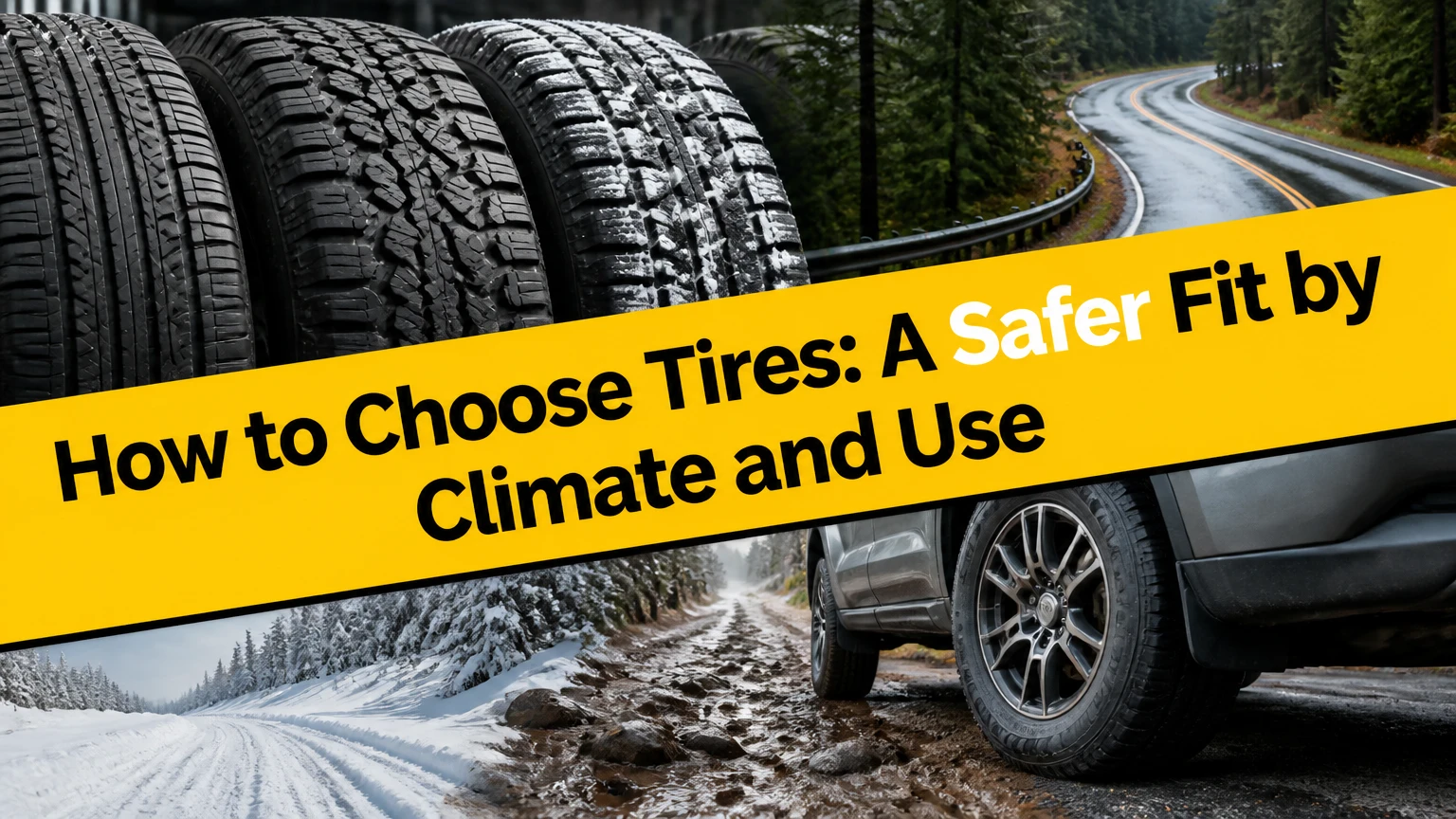
To choose tires safely, start with the vehicle manufacturer’s approved size, load index, and speed rating, then match the tire category to your climate, roads, payload, and driving habits. Compare wet braking, winter certification, treadwear warranty, age, and installed cost rather than choosing by brand name or price alone.
Key facts at a glance
The driver-door placard specifies the original tire size and the cold inflation pressure required for the vehicle.
The tire sidewall’s load index and speed rating must meet the vehicle manufacturer’s minimum requirements.
All-weather tires carry the 3-Peak Mountain Snowflake symbol, while ordinary all-season tires generally do not.
Dedicated winter tires provide better cold-weather traction below about 45°F (7°C), but they wear faster in warm conditions.
The sidewall maximum pressure is not the vehicle’s recommended operating pressure.
NHTSA recommends checking tire pressure monthly and replacing tires with serious damage, inadequate tread, or age-related deterioration.
What does a tire do?
A tire supports vehicle weight through compressed air, transfers braking and driving forces through its tread, guides the vehicle during steering, and absorbs road impacts before they reach the suspension. Rubber compounds, steel belts, textile plies, bead wires, and air pressure work as one load-bearing system.
The U.S. National Highway Traffic Safety Administration describes tires as “the only contact your vehicle has with the road.” That small contact patch determines how effectively a vehicle accelerates, stops, turns, and sheds water. Tire choice therefore changes safety margins, steering response, road noise, ride quality, and rolling resistance.
Tire performance involves trade-offs. A soft performance compound can increase dry grip but reduce tread life. A deep all-terrain tread can improve loose-surface traction but add noise and rolling resistance on pavement. A low rolling resistance tire can reduce energy consumption, although wet braking and ride quality still depend on the specific design.
What information must you collect before shopping?
Record the vehicle year, make, model, trim, drivetrain, wheel size, and current tire size. Check whether the vehicle has different front and rear sizes, a temporary spare, run-flat equipment, a tire pressure monitoring system, or a manufacturer-approved replacement option.
A tire retailer’s vehicle lookup is useful, but the door placard and owner’s manual take priority when online catalogs disagree. Modified suspension, aftermarket wheels, lift kits, and brake upgrades can invalidate a standard catalog recommendation.
Which tire type fits your driving?
The best tire type depends first on temperature and snow exposure, then on road surface, annual mileage, payload, and desired handling. Touring all-season tires fit mild climates and paved commuting, all-weather tires fit moderate winter conditions, and dedicated winter tires fit frequent ice or snow.
| Tire category | Best operating conditions | Main benefit | Main limitation | Typical installed price per tire |
|---|---|---|---|---|
| Standard all-season touring | Temperatures above 45°F, occasional light snow | Quiet ride and 55,000-85,000-mile warranties | Limited ice and deep-snow traction | $110-$220 |
| Grand touring all-season | Highway travel, dry and wet pavement | Improved stability at 65-75 mph | Less winter grip than 3PMSF tires | $140-$260 |
| All-weather | Mixed seasons, recurring light-to-moderate snow | 3PMSF snow certification without seasonal swaps | Higher noise and wear than touring all-season tires | $150-$280 |
| Dedicated winter | Frequent temperatures below 45°F, ice, packed snow | Flexible compound, dense siping, strongest winter traction | Requires storage or a second wheel set | $130-$300 |
| Summer performance | Warm pavement, enthusiastic road driving | Strong dry steering and wet-road response | Unsafe choice for snow and freezing conditions | $160-$400 |
| All-terrain | 20%-50% dirt, gravel, or trail driving | Stronger loose-surface traction and sidewalls | More noise and rolling resistance on asphalt | $180-$450 |
| Mud-terrain | Deep mud, rocks, slow-speed trail use | Open lugs clear mud and debris | Poorer wet-road braking, noise, and highway comfort | $220-$500 |
Are all-season and all-weather tires the same?
All-season and all-weather tires are different products. Ordinary all-season tires prioritize year-round convenience in moderate climates, while all-weather tires use a colder-weather compound and carry the 3PMSF symbol after meeting a standardized severe-snow traction test.
The 3PMSF mark does not mean an all-weather tire equals a dedicated winter tire on glare ice, deep snow, or prolonged sub-zero roads. It does mean the tire has demonstrated a defined level of snow traction, unlike the manufacturer-declared M+S marking found on many all-season and all-terrain tires.
Choose all-weather tires when snow occurs several times each winter but a second set is impractical. Choose winter tires when temperatures stay below freezing, roads remain icy, or emergency stopping in snow matters more than convenience.
When should you choose summer or performance tires?
Choose summer tires for warm climates and drivers who prioritize steering response, dry cornering, and wet braking over long tread life. Many summer compounds lose flexibility near freezing, so manufacturers generally prohibit their use in snow and recommend avoiding them at very low temperatures.
Ultra-high-performance tires often have lower treadwear warranties, firmer rides, and more road noise than grand touring tires. Track-focused tires are a separate category: their limited grooves and operating-temperature requirements make them poor choices for commuting in heavy rain or cold weather.
Step 1: Find the approved tire size
Find the vehicle’s tire information placard on the driver-side door jamb, door edge, fuel-filler area, or inside the owner’s manual. Copy every approved size, the recommended cold pressure, and the front-to-rear pressure difference before comparing products.
The placard is the success checkpoint. You will know the fitment information is complete when the size, pressure, seating position, and spare-tire instructions are recorded for your exact trim.
Do not use the pressure molded into the tire sidewall as the normal inflation target. That number identifies the tire’s maximum permitted pressure under specified conditions; the placard reflects the vehicle manufacturer’s handling, load, and ride calibration.
A common mistake is assuming a larger wheel automatically improves safety. Increasing wheel diameter can reduce sidewall height, increase impact damage risk, raise replacement cost, and alter speedometer accuracy unless the overall rolling diameter remains within the vehicle’s approved range.
Step 2: Decode the sidewall
Read the complete sidewall code, including size, construction, load index, speed rating, XL or SL designation, run-flat marking, and any manufacturer-specific approval. A code such as P215/65R15 95H identifies a tire 215 millimeters wide, with a sidewall height equal to 65% of its width, radial construction, a 15-inch rim fitment, a load index of 95, and an H speed rating.
| Sidewall marking | Meaning | Example value | Buying consequence |
|---|---|---|---|
| P | Passenger-car service designation | P215 | Passenger fitment, not automatically suitable for heavy commercial loads |
| 215 | Section width in millimeters | 215 mm | Changes contact width, clearance, and rolling resistance |
| 65 | Aspect ratio | 65% | Sidewall height is about 140 mm |
| R | Radial construction | R | Standard construction for modern passenger vehicles |
| 15 | Required wheel diameter | 15 in | Tire must fit a 15-inch rim |
| 95 | Load index | 690 kg per tire | Four tires provide 2,760 kg theoretical capacity before vehicle limits |
| H | Speed rating | 210 km/h, 130 mph | Must meet the vehicle’s specified minimum |
Load index is not the same as vehicle payload. The vehicle’s gross axle weight rating, gross vehicle weight rating, passengers, cargo, trailer tongue weight, and axle distribution still control safe loading.
Speed ratings are laboratory categories, not recommended travel speeds. Never select a lower rating than the placard or owner’s manual specifies without written approval from the vehicle manufacturer or a qualified tire professional.
What do XL, LT, and run-flat markings mean?
XL or extra-load tires use a higher load capacity at a specified pressure than standard-load versions of the same size. LT tires are designed for light trucks and commonly use stronger constructions, higher pressures, or different load-range conventions. A passenger tire and an LT tire with similar dimensions are not interchangeable by appearance alone.
Run-flat tires can travel a limited distance after pressure loss, often around 50 miles at a reduced speed, but the exact limit depends on the tire and manufacturer. Run-flat sidewalls can produce a firmer ride, and many punctures still require replacement rather than repair.
Step 3: Match the tire to climate
Match the tire compound to the lowest temperatures and worst precipitation your vehicle regularly encounters. Climate averages are less useful than actual driving exposure: a warm-city commuter who visits mountain snow every month needs a different solution from a driver who never leaves salted urban roads.
| Driving climate | Recommended category | Temperature or weather trigger | Avoid |
|---|---|---|---|
| Hot, dry region | Summer or touring all-season | Mostly above 45°F, no snow | Dedicated winter tires used year-round |
| Mild rain, rare frost | Touring all-season | Frost is occasional, snow is uncommon | Choosing solely by treadwear number |
| Regular snow, variable temperatures | All-weather with 3PMSF | Snow occurs several times yearly | Treating M+S as severe-snow certification |
| Frequent ice and packed snow | Dedicated winter | Repeated sub-45°F driving | Summer and UHP tires in freezing weather |
| Tropical heavy rain | Wet-focused touring or summer tire | High rainfall, warm pavement | Track-style tires with minimal grooves |
| Mixed highway and dirt roads | Highway all-terrain | Approximately 20%-50% unpaved driving | Mud-terrain tread for ordinary commuting |
Rain performance depends on groove design, compound, tread depth, and vehicle speed. A tire with 8/32-inch tread generally evacuates water more effectively than the same model near its wear bars, so replacement decisions should not rely on the original tread design alone.
Step 4: Match the tire to driving
Match tire construction and tread pattern to how the vehicle is used, not to its body style alone. A crossover used for 18,000 highway miles annually needs a different tire from the same crossover used for towing, gravel roads, or frequent mountain passes.
| Driving pattern | Priority attributes | Suitable category | Typical trade-off |
|---|---|---|---|
| 70% city, 30% highway | Wet braking, comfort, warranty | Touring all-season | Moderate winter capability |
| 80% highway | Noise, straight-line stability, wear | Grand touring | Less responsive cornering |
| Frequent mountain snow | Cold traction, 3PMSF, siping | Winter or all-weather | Seasonal cost or shorter tread life |
| Towing or heavy payload | Load index, heat control, sidewall strength | XL or LT where approved | Firmer ride and higher cost |
| Weekend trail use | Sidewall protection, stone rejection | All-terrain | More noise and fuel consumption |
| Autocross or track days | Dry grip, heat resistance, steering response | Summer performance or track tire | Rapid wear and poor cold-weather use |
A high treadwear number does not guarantee the longest real-world life. Alignment, inflation, torque, road texture, driving style, vehicle weight, and rotation intervals can change wear more than a small difference between two advertised ratings.
What should an EV owner prioritize?
An EV owner should prioritize the manufacturer’s load index, low rolling resistance, wet braking, and noise performance, rather than assuming an EV-specific label is mandatory. Battery weight may require an XL or high-load tire, but the vehicle placard determines the minimum specification.
EV-marketed tires may include acoustic foam, reinforced construction, or compounds optimized for regenerative-braking loads. Those features can reduce cabin noise or improve efficiency, but a conventional tire with the correct rating can still be appropriate when the vehicle manufacturer approves it.
Step 5: Compare total ownership cost
Compare the installed four-tire cost, expected mileage, seasonal storage, rotation, and replacement timing. A $180 tire with a 70,000-mile warranty can cost less per warranted mile than a $110 tire with a 40,000-mile warranty, although warranty mileage is not a promise of actual service life.
| Purchase level | Tire price each | Four-tire price | Typical use | Cost per advertised mile |
|---|---|---|---|---|
| Budget passenger | $70-$120 | $360-$650 installed | Low-mileage mild-climate commuting | $0.0020-$0.0030 |
| Mid-range touring | $120-$190 | $600-$950 installed | Daily city and highway driving | $0.0020-$0.0030 |
| Premium touring | $190-$280 | $900-$1,350 installed | Long highway mileage, low noise | $0.0025-$0.0040 |
| Winter set | $140-$280 | $700-$1,300 installed | Four to five winter seasons | $0.0030-$0.0060 |
| All-terrain | $190-$400 | $950-$1,850 installed | Regular dirt and gravel travel | $0.0030-$0.0060 |
Typical installation adds $20-$45 per tire for mounting and balancing, with disposal, valve stems, TPMS service, alignment, and taxes often adding another $80-$250 per vehicle. Prices vary by region, wheel size, retailer, and tire availability.
Use UTQG treadwear as a comparison within the same brand and test family, not as a universal mileage forecast. The U.S. Department of Transportation requires the rating on many passenger tires, but the number is comparative and does not directly predict how many miles a tire will last.
Step 6: Verify load and speed ratings
Verify that every replacement tire meets or exceeds the original load index and speed rating, unless the vehicle manufacturer gives a different approved specification. Confirm the tire’s load capacity at the intended pressure, especially for vans, pickups, loaded SUVs, trailers, and EVs.
The success checkpoint is a complete match between the tire invoice and the placard: size, load index, speed rating, construction, and any required run-flat or self-sealing feature. A common mistake is buying a visually similar tire with a lower load index because its width and wheel diameter match.
For towing, calculate payload before choosing a tire. Passengers, luggage, accessories, hitch hardware, and trailer tongue weight all reduce available capacity, while the tire must also remain within the vehicle’s axle and gross-weight ratings.
Step 7: Buy and install the set correctly
Buy four matching tires whenever possible, using the same model and specification on every wheel. If replacing only two tires, place the new tires on the rear axle on most vehicles, including front-wheel-drive cars, because deeper rear tread helps resist oversteer during wet-road maneuvers.
AWD vehicles can require very small circumference differences between tires. Replacing one tire on an AWD vehicle may damage the driveline or trigger control-system faults, so consult the owner’s manual before buying fewer than four.
After installation, request dynamic balancing, verify cold pressure, reset or relearn TPMS, and schedule an alignment if the old tires wore unevenly or the vehicle pulls. Rotate according to the owner’s manual, commonly every 5,000-8,000 miles, unless the tire or vehicle manufacturer specifies another interval.
How old can new tires be?
Inspect the DOT date code before accepting new tires. The final four digits identify the production week and year, so 2325 means the tire was manufactured in week 23 of 2025.
Rubber ages in storage and service, but age alone does not prove that a properly stored tire is unsafe. NHTSA advises consumers to follow the vehicle and tire manufacturer’s replacement guidance; several manufacturers recommend replacement at 10 years from manufacture, while some recommend inspection or replacement after six years in service.
Reject tires with sidewall cracking, bulges, exposed cords, impact damage, or an unexplained storage history. A tire with full tread can still require replacement when structural aging is visible.
Which tire problems require action?
Tire wear patterns can reveal pressure, alignment, suspension, or load problems, but wear diagnosis should precede replacement when possible. Installing new tires without correcting the cause can destroy the replacement set within a few thousand miles.
| Visible condition | Likely cause | Immediate check | Corrective action |
|---|---|---|---|
| Center tread worn first | Chronic overinflation | Compare cold pressure with placard | Set placard pressure and inspect wear |
| Both shoulders worn | Chronic underinflation or overload | Check pressure and vehicle load | Inflate correctly, reduce overload, inspect damage |
| One inner edge worn | Excessive camber or suspension wear | Alignment and joint inspection | Repair worn parts, then align |
| Feathered tread blocks | Incorrect toe setting | Run a hand across tread carefully | Correct toe alignment |
| Cupped or scalloped dips | Worn damper, imbalance, or bent wheel | Suspension and balance inspection | Repair suspension and rebalance |
| Cracks or bulges | Aging, impact, or internal failure | Visual and professional inspection | Replace immediately when structural damage exists |
Stop driving and obtain professional inspection after a sidewall bulge, rapid pressure loss, exposed cord, belt separation, or severe vibration. A plug-only puncture repair outside the tread’s repairable area is not a safe substitute for replacement.
What are the most common buying mistakes?
The most expensive mistakes usually involve fitment, not brand selection. A tire can have excellent reviews and still be wrong for a vehicle if its load capacity, winter rating, rim diameter, or clearance is unsuitable.
- Choosing by price alone: Compare installed cost, warranty mileage, wet traction, and seasonal requirements.
- Confusing M+S with 3PMSF: M+S indicates a tread design classification; 3PMSF indicates a standardized severe-snow traction test.
- Using the sidewall maximum pressure: Use the door placard for normal cold inflation.
- Mixing different tires on one axle: Unequal tread and construction can alter braking and stability-control behavior.
- Ignoring alignment: New tires cannot correct worn tie rods, bent wheels, or incorrect toe.
- Buying an aggressive tread for a paved commute: Mud-terrain tires often increase noise, stopping distance on wet pavement, and fuel consumption.
- Replacing one tire on AWD: Confirm the allowable circumference difference with the vehicle manufacturer.
- Assuming EV-specific means universally necessary: Confirm load and fitment first; efficiency and acoustic features are secondary decisions.
Which special situations change the choice?
Special vehicle use can override the ordinary all-season recommendation. Low annual mileage, severe winter travel, towing, modified wheels, and regional regulations each change the correct selection process.
Low-mileage vehicles
Drivers covering fewer than 5,000 miles annually should monitor age and cracking more closely than treadwear. A touring tire with a moderate warranty may be a better value than an expensive long-mileage tire that reaches its age limit first.
Towing and commercial loads
Towing increases heat, load, and braking demand. Use the vehicle’s towing guide, axle ratings, recommended pressure, and approved LT or XL specifications rather than selecting a tire solely by maximum advertised load.
Staggered fitments
Performance vehicles with wider rear tires cannot rotate front to rear. Match each axle’s exact size and observe directional or asymmetric tread mounting arrows, because incorrect orientation can reduce water evacuation.
Regional winter laws
Winter-tire and chain requirements vary by jurisdiction and road corridor. Check the transport authority for the state, province, or country where the vehicle will travel; a 3PMSF label may improve traction but does not automatically satisfy every chain-control rule.
How do you make the final tire decision?
Make the final decision by ranking safety constraints before preferences. The correct tire is the approved size with sufficient load and speed capacity, a climate-appropriate compound, suitable road manners, and a total cost that fits the vehicle’s annual use.
Use this final checklist:
- Confirm size and front-to-rear fitment from the placard.
- Match or exceed load index and speed rating.
- Select all-season, all-weather, winter, summer, or terrain construction from actual climate and roads.
- Compare wet braking, noise, rolling resistance, treadwear warranty, and road-test reviews.
- Check DOT production date and inspect every tire before installation.
- Price mounting, balancing, TPMS service, disposal, alignment, and storage.
- Install a matched set and verify pressure before leaving the shop.
FAQ
Is a higher treadwear rating always better?
A higher UTQG treadwear rating usually indicates a harder-wearing compound within a manufacturer’s comparable range, but it does not guarantee better value or longer life. Wet grip, cold traction, ride quality, alignment, inflation, vehicle weight, and driving style can outweigh a numerical difference of 100 rating points.
Can I use wider tires than the manufacturer supplied?
You can use a wider tire only when the wheel, suspension, fender clearance, load capacity, rolling diameter, and vehicle-control systems remain compatible with an approved fitment. Wider tires may increase steering effort, hydroplaning risk in standing water, road noise, and replacement cost, so width alone is not a performance upgrade.
Should tire pressure change in winter?
Cold weather lowers measured tire pressure, commonly by about 1 psi for each 10°F temperature drop. Check pressure when tires are cold and restore the door-placard value, rather than intentionally overinflating or relying on a warm reading after driving.
Are used tires safe to buy?
Used tires can be safe when their age, repair history, tread depth, wear pattern, and internal condition are verified by a qualified technician. Avoid tires with plugs in the shoulder, sidewall repairs, irregular wear, cracking, exposed cords, unknown storage, or fewer than 4/32 inch of remaining tread for ordinary wet-weather use.
How long does tire installation take?
A standard four-tire installation usually takes 45-90 minutes when the wheels, lug hardware, and TPMS sensors cooperate. Add 30-60 minutes for alignment, sensor replacement, seized hardware, directional mounting, or an AWD circumference check.
What is the best tire for a daily driver?
A grand touring all-season tire is usually the strongest daily-driver choice in a mild climate because it balances wet braking, low noise, ride comfort, and highway tread life. Drivers facing recurring snow should choose a 3PMSF all-weather tire or dedicated winter set instead.
Conclusion
How to choose tires is a fitment and risk-management decision, not a contest between logos. Start with the placard, verify size, load, and speed ratings, then match the compound to climate and the tread design to roads, payload, and mileage; finish by checking age, installation quality, pressure, and alignment.