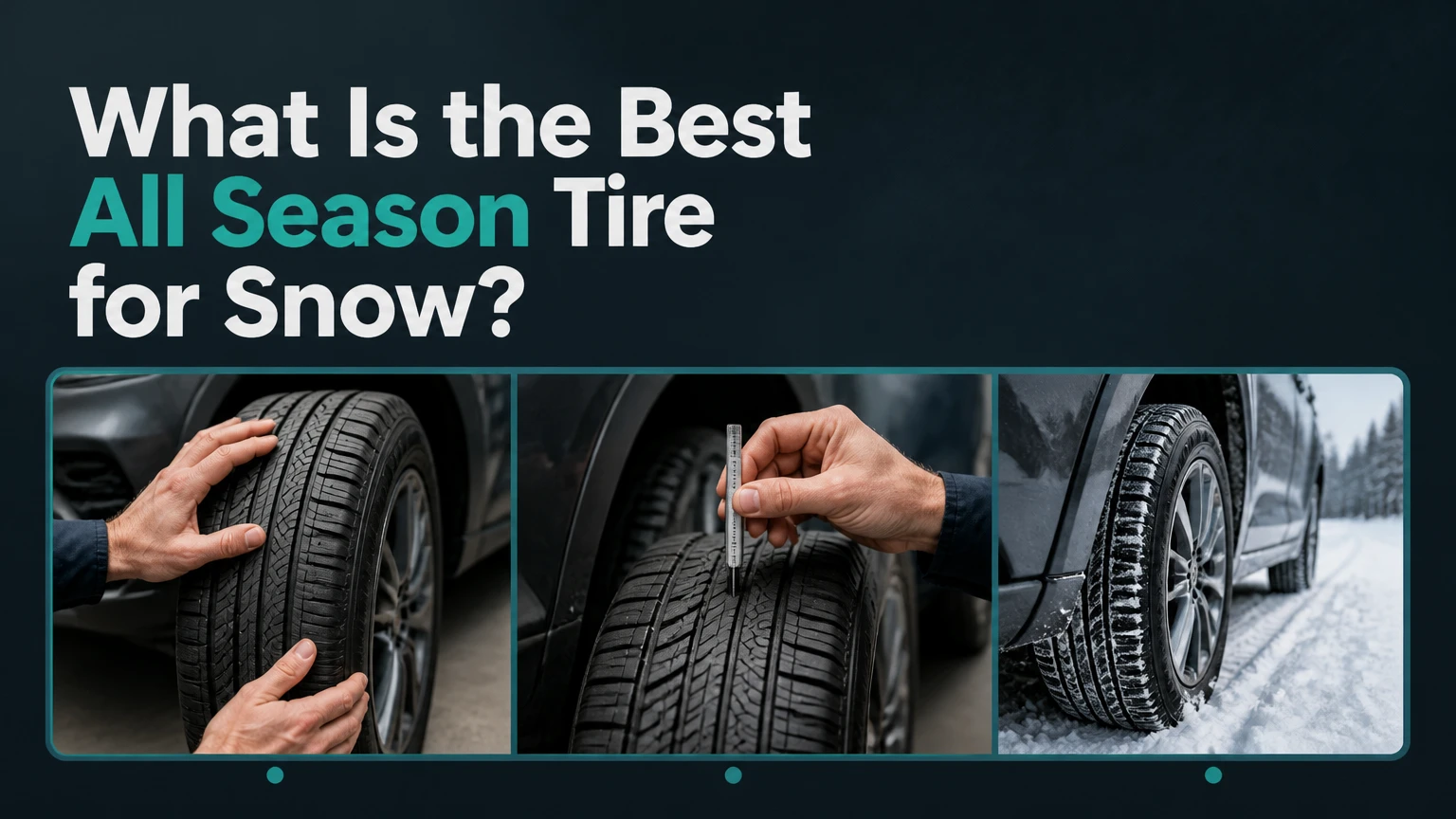
The Michelin CrossClimate 2 is the best all-season-style tire for most drivers who encounter regular snow, slush, and cold rain but want one tire year-round. For deep snow, frequent ice, mountain roads, or consistently subfreezing temperatures, a dedicated studless winter tire such as the Bridgestone Blizzak WS90 remains the safer choice.
Key facts at a glance
- The Michelin CrossClimate 2 is an all-weather tire, not a conventional M+S-only all-season tire.
- The Three-Peak Mountain Snowflake, or 3PMSF, marking identifies a tire that meets a regulated severe-snow traction standard.
- The 3PMSF symbol does not mean an all-weather tire matches a dedicated winter tire on ice braking.
- Standard all-season tires usually provide acceptable light-snow mobility, but their cold-weather braking can decline as temperatures fall.
- AWD helps a vehicle accelerate on snow, but it does not shorten braking distances; tire grip still determines stopping performance.
- Replace winter-capable tires before 5/32 inch of tread remains if snow traction matters, even though the legal wear limit is commonly 2/32 inch.
Which all-season tire is best for snow?
The Michelin CrossClimate 2 is the best overall all-weather tire for drivers who need strong snow traction without changing tires each season. Its directional tread, dense siping, severe-snow certification, and strong cold-wet behavior give it the broadest year-round capability in this category, although its ride can feel firmer and its tread pattern limits rotation options.
The recommendation applies to passenger cars, minivans, and many crossovers in places with intermittent or moderate winter weather. It does not make the Michelin CrossClimate 2 the best tire for every snow condition. A Blizzak WS90 or Continental VikingContact 8 will generally be the better tool for sustained ice, unplowed roads, deep snow, or temperatures that remain below freezing for weeks.
The most important buying distinction is the tire’s certification, not the word “all-season” in its name. In North America, the 3PMSF mark carries more winter meaning than an M+S marking alone.
What does the 3PMSF symbol mean?
The 3PMSF symbol means the tire passed a standardized snow-traction test against a reference tire under the applicable regulatory procedure. The symbol indicates severe-snow capability, but it does not provide a complete rating for ice braking, cornering, deep snow, road noise, or tread life.
M+S, or Mud and Snow, is a tread-design designation. The U.S. Tire Manufacturers Association explains that M+S markings are based on tread geometry, while the 3PMSF designation involves a defined snow-traction test. An M+S tire can therefore lack the cold compound and biting edges needed for dependable winter driving.
A 3PMSF tire is often marketed as an all-weather tire, although “all-weather” is a market category rather than a universal legal classification. The category usually combines a winter-capable compound with more open, heavily siped tread than a touring all-season tire.
M+S and 3PMSF compared
| Marking or category | Snow qualification | Typical tread design | Best use |
|---|---|---|---|
| M+S only | No standardized severe-snow certification | Moderate grooves, conventional sipes | Mild climates and occasional flurries |
| 3PMSF all-weather | Standardized severe-snow test passed | Dense sipes, open grooves, cold-capable compound | Mixed year-round weather |
| Studless winter | Winter-focused design and compound | Flexible blocks, high sipe density | Ice, packed snow, persistent cold |
| Studded winter | Winter design plus metal studs | Studs for ice bite where legal | Severe ice and mountain routes |
The 3PMSF threshold is a minimum qualification rather than a ranking. Two 3PMSF tires can differ substantially in ice performance, dry-road handling, noise, wear rate, and slush resistance.
How do all-weather tires gain snow traction?
All-weather tires gain snow traction through a cold-flexible compound, interlocking sipes, and grooves that clear slush from the contact patch. The compound preserves elasticity at low temperatures, while the tread edges compress and shear snow instead of riding over it.
Snow traction has several interacting components:
- Compound flexibility: Rubber becomes less compliant as temperature drops. A winter-oriented compound remains more flexible than a typical touring all-season compound in cold conditions.
- Siping: Narrow slits create additional biting edges. Sipes also allow tread blocks to flex and trap compacted snow.
- Void space: Wider grooves move loose snow and slush away from the footprint.
- Block stability: Reinforced tread blocks prevent excessive squirm during braking and cornering.
- Contact pressure: Tire width, vehicle weight, inflation pressure, and tread shape influence how the tire loads the road.
The “snow-on-snow” effect is real but incomplete as an explanation. Packed snow in a sipe can help the tread engage snow on the road, but ice offers little mechanical texture and often requires a dedicated winter compound with specialized microstructure.
Snow, slush, and ice are different tire problems
Loose snow rewards open grooves and edge density. Slush demands rapid water evacuation because the tire can hydroplane on a wet layer above the pavement. Polished ice is the hardest condition for all-season-style tires because it supplies little texture for tread edges to engage.
That difference explains why a CrossClimate 2 can perform impressively in snow acceleration yet still lose to a Blizzak WS90 during ice braking. Vehicle electronics cannot create friction that the tire-road interface does not have.
What are the best all-weather tires for snow?
The best all-weather tire depends on vehicle class, climate, ride priorities, and annual mileage. The Michelin CrossClimate 2 leads overall, while the Bridgestone WeatherPeak favors comfort, the General Altimax 365AW emphasizes value, and the Pirelli Scorpion WeatherActive fits many SUVs and crossovers better.
Our top picks
- Best overall: Michelin CrossClimate 2
- Best for quiet highway driving: Bridgestone WeatherPeak
- Best value-oriented choice: General Altimax 365AW
- Best for crossovers and SUVs: Pirelli Scorpion WeatherActive
- Best performance-oriented alternative: Continental ExtremeContact DWS06 Plus
- Best for severe winter: Bridgestone Blizzak WS90, a dedicated winter tire
1. Michelin CrossClimate 2: Best overall
The Michelin CrossClimate 2 is the strongest year-round snow choice for most sedan and crossover drivers who need 3PMSF certification and do not want a second winter wheel set.
Michelin uses a directional V-shaped tread with prominent grooves and a cold-weather-oriented compound. Independent comparison testing from Tire Rack has repeatedly placed the tire among the strongest all-weather performers for snow traction, wet braking, and dry-road control, although results vary by tire size and test vehicle.
The directional layout helps the CrossClimate 2 move slush and loose snow, but it creates a practical limitation: the tire can usually rotate only front-to-back on the same side. Uneven alignment wear therefore becomes more expensive because a simple diagonal cross-rotation is not available.
The ride is often firmer than a conventional touring all-season tire. That trade-off is deliberate. Large tread elements and winter-oriented edges favor traction over the soft, muted response found in tires such as the Michelin Defender2.
Choose this if: your winter includes regular snow, slush, and freezing rain, with clear pavement between storms.
Skip it if: you need maximum ice braking, a very soft ride, or a tire for heavy towing on unplowed roads.
2. Bridgestone WeatherPeak: Best for highway comfort
The Bridgestone WeatherPeak is the best fit for drivers who want a 3PMSF all-weather tire with a quieter, more compliant highway feel than aggressive directional alternatives.
The WeatherPeak uses full-depth 3D sipes and a tread design intended to retain winter edges as the tire wears. The design suits commuters who spend most miles on maintained roads and encounter slush, light snow, and cold rain rather than deep mountain snow.
Its main compromise is response. Drivers who prioritize crisp steering may prefer the CrossClimate 2, especially on dry pavement. Tire size, vehicle suspension, and inflation pressure affect perceived noise more than tread design alone, so a shop should compare the exact fitment rather than assuming every WeatherPeak application rides identically.
Choose this if: highway comfort, wet-road confidence, and year-round convenience outweigh sharp steering response.
Skip it if: your route includes frequent unplowed roads or you want the strongest snow acceleration in the category.
3. General Altimax 365AW: Best value-oriented pick
The General Altimax 365AW is a value-focused 3PMSF all-weather tire for drivers who need winter certification without paying the highest premium-tire price.
General uses extensive siping and an all-weather tread layout aimed at light-to-moderate snow, cold rain, and mixed pavement. Typical retail pricing often places the Altimax 365AW below premium competitors, but actual cost depends on size, speed rating, taxes, mounting, and regional inventory.
The tire is not a substitute for a studless winter model on ice. Its value improves when the vehicle covers moderate annual mileage and the owner wants one set of tires rather than seasonal mounting and storage.
Choose this if: purchase price matters and winter conditions are intermittent.
Skip it if: you drive fast on dry highways, carry heavy loads, or routinely face compacted snow and ice.
4. Pirelli Scorpion WeatherActive: Best for crossovers
The Pirelli Scorpion WeatherActive is the strongest category match for many crossover and SUV owners who need a 3PMSF tire with stable handling and year-round road manners.
The Scorpion WeatherActive is designed around crossover applications, including fitments with higher load requirements than common passenger-car sizes. Its tread evacuates water and slush while maintaining enough block stability for a heavier vehicle.
SUV buyers must verify more than diameter. The replacement tire should match the original load index, speed rating, overall diameter, and any vehicle-specific requirements. On an AWD vehicle, replacing only one or two tires can create circumference differences that stress the driveline.
Choose this if: you drive a crossover or midsize SUV in mixed snow and rain.
Skip it if: your pickup regularly carries maximum payload or your winter roads remain deeply snow-covered.
5. Continental ExtremeContact DWS06 Plus: Best for performance sedans
The Continental ExtremeContact DWS06 Plus is the better choice for a performance sedan that sees cold weather and occasional snow but does not need a 3PMSF severe-snow tire.
The DWS indicators refer to Dry, Wet, and Snow tread capability, but the “S” does not mean the tire has passed the 3PMSF severe-snow test. The tire prioritizes steering precision, wet grip, and dry-road stability, making it more appropriate for cold-weather rain and brief flurries than regular snow commuting.
Continental’s performance trade-off is predictable. The compound and tread focus leave less margin on packed snow and ice than an all-weather tire, particularly as temperatures fall and the surface becomes polished.
Choose this if: dry handling is the priority and snow is rare or avoidable.
Skip it if: you must drive through accumulating snow several times each winter.
Best picks by vehicle and use case
| Driver or vehicle | Recommended tire | Certification or type | Main reason |
|---|---|---|---|
| Sedan in a snowy city | Michelin CrossClimate 2 | 3PMSF all-weather | Strong snow and slush balance |
| Long-distance crossover commuter | Bridgestone WeatherPeak | 3PMSF all-weather | Comfort-focused highway behavior |
| Budget-conscious compact car | General Altimax 365AW | 3PMSF all-weather | Lower typical purchase cost |
| Midsize crossover | Pirelli Scorpion WeatherActive | 3PMSF all-weather | SUV-oriented fitments |
| Sports sedan in mild winters | Continental DWS06 Plus | M+S or manufacturer-specific marking | Dry and wet response |
| Mountain driver | Bridgestone Blizzak WS90 | Dedicated winter | Better ice and packed-snow control |
How do all-season tires compare with winter tires?
Dedicated winter tires outperform all-weather and conventional all-season tires when roads are icy, snow remains packed, or temperatures stay near or below freezing. All-weather tires win on convenience because they remain installed year-round and usually provide better dry-road wear, steering response, and warm-weather efficiency.
The practical choice depends on exposure rather than branding. A driver in Minneapolis who uses maintained roads may reasonably select a CrossClimate 2, while a driver in a rural mountain area may need winter tires even with four-wheel drive.
| Tire type | Typical winter strength | Warm-weather behavior | Seasonal burden | Suitable snow exposure |
|---|---|---|---|---|
| Touring all-season | Light snow, cold rain | Quiet, efficient, long wear | None | Occasional flurries |
| 3PMSF all-weather | Moderate snow and slush | Usable year-round, firmer ride | None | Regular urban winter |
| Studless winter | Ice, packed snow, deep snow | Faster wear and softer handling | Seasonal change required | Frequent severe winter |
| UHP all-season | Cold wet pavement, brief flurries | Sharp dry handling | None | Minimal snow |
| Studded winter | Severe ice where legal | No warm-weather use | Seasonal change and restrictions | Persistent ice |
A winter tire should generally be installed as a complete set of four. Mixing two winter tires with two conventional all-season tires can create large differences in braking and cornering grip between axles.
Is AWD enough without snow tires?
AWD is not enough to replace winter-capable tires because AWD improves acceleration but does not provide additional tire-road friction during braking. A vehicle with all-wheel drive and worn all-season tires can stop less effectively than a front-wheel-drive vehicle with four good winter tires.
AWD helps distribute engine torque among the wheels that can use it. Electronic stability control can reduce wheelspin, but neither system changes the available grip on ice. The driver still needs lower speeds, greater following distance, and tires with adequate tread.
AWD owners also face a fitment risk. Many manufacturers require four tires with closely matched circumference, and replacing only one tire may be inappropriate even when the other three appear serviceable. The vehicle manual and tire manufacturer should determine whether shaving or replacing a full set is necessary.
How much do snow-capable all-season tires cost?
A typical set of four 3PMSF all-weather tires costs approximately $600-$1,200 before installation, while a premium dedicated winter setup with wheels often costs $1,000-$2,000 or more. Wheel diameter, tire size, load rating, brand, taxes, mounting, balancing, and seasonal storage create the largest price differences.
| Purchase or service | Typical range | Common timeframe | What changes the cost |
|---|---|---|---|
| Four budget all-weather tires | $600-$800 | 1 shopping visit | 16- to 17-inch passenger sizes |
| Four premium all-weather tires | $800-$1,200 | 1 shopping visit | 18- to 20-inch sizes and premium brands |
| Four dedicated winter tires | $700-$1,300 | 1 shopping visit | Tire size and severe-winter category |
| Winter wheel set | $300-$900 | 1 purchase | Steel versus alloy wheels |
| Mount and balance | $80-$180 | 1-2 hours | Local labor rates and wheel diameter |
| Seasonal tire change | $80-$180 | Twice yearly | Mounted wheels versus tire swapping |
| Annual storage | $50-$150 | 6 months | Retailer storage program |
A second wheel set can lower seasonal labor costs over several years because technicians swap complete mounted assemblies rather than removing tires from wheels. The financial advantage depends on how long the vehicle is kept and whether winter tires are needed for safety rather than convenience.
How should you maintain all-weather tires for snow?
Maintain all-weather tires by checking cold pressure monthly, measuring tread before winter, rotating according to the tread pattern, and correcting alignment wear promptly. Snow performance declines well before the legal wear bars become flush with the tread.
Use the pressure on the driver-door placard, not the maximum pressure molded into the sidewall. Typical pressure loss is about 1 psi for each 10°F temperature drop, although the actual change depends on temperature, tire volume, and measurement conditions.
Winter maintenance checklist
- Measure tread in October or before the first storm. Use a tread-depth gauge at several points across every tire. Treat 5/32 inch as a practical replacement threshold for dependable snow performance, not as a legal minimum.
- Set cold pressure monthly. Check the tires before driving, when they have been parked for at least three hours. Restore the placard value after cold snaps.
- Rotate at the manufacturer interval. Many vehicles specify approximately 5,000-8,000 miles, but directional tires usually move front-to-back on the same side only.
- Inspect alignment wear. Feathering, cupping, or an inner shoulder worn smooth can destroy winter grip while the center tread still looks acceptable.
- Check age and damage. Replace tires with sidewall cracking, impact damage, repeated pressure loss, or age-related deterioration, regardless of remaining tread.
A directional tire cannot be casually cross-rotated. Installing it backward can compromise the intended water and slush evacuation pattern, so the rotation arrow on the sidewall must point in the direction of forward travel.
What problems should buyers avoid?
The most common mistake is treating an M+S marking as proof of winter performance. The second is buying a 3PMSF tire with insufficient remaining tread, incorrect load capacity, or a size that does not match the vehicle’s drivetrain requirements.
Watch for these failure modes:
- Only two winter-capable tires installed: Replace all four unless the vehicle and manufacturer explicitly permit another arrangement.
- Incorrect tire size: A different diameter can affect speedometer accuracy, ABS calibration, AWD systems, and clearance.
- Underinflation after a cold snap: Low pressure increases shoulder wear and steering response while reducing efficiency.
- Old tires with adequate tread: Rubber ages through heat, ultraviolet exposure, and storage; tread depth alone cannot establish tire condition.
- Assuming 3PMSF means ice mastery: Severe-snow certification does not equal dedicated winter ice performance.
- Using UHP all-seasons for regular snowfall: Performance compounds and tread patterns can leave less traction margin once snow accumulates.
A tire dealer should confirm the original equipment size, load index, speed rating, rim width, and vehicle-specific fitment before installation. EVs and heavy hybrids may also require higher load capacity because of battery mass.
When should you choose a dedicated winter tire?
Choose a dedicated winter tire when snow or ice is frequent, roads remain unplowed, temperatures stay below freezing, or missing a trip is not an acceptable option. A dedicated winter tire is especially valuable when the vehicle travels rural grades, shaded roads, mountain passes, or untreated routes.
A 3PMSF all-weather tire is sufficient for many urban drivers who can delay travel during severe storms and encounter mostly wet pavement, slush, and plowed snow. The all-weather compromise becomes less attractive as winter severity increases.
Continental VikingContact 8 and Bridgestone Blizzak WS90 are examples of studless winter tires designed around low-temperature flexibility, dense siping, and ice traction. They should be removed when sustained warm weather arrives because warm pavement accelerates wear and softens handling.
Which tire should you pick?
Choose the Michelin CrossClimate 2 if you want the strongest general-purpose all-weather answer for regular snow, slush, and cold rain. Choose the Bridgestone WeatherPeak for highway comfort, the General Altimax 365AW for a value-oriented purchase, and the Pirelli Scorpion WeatherActive for many crossover applications.
Choose the Continental ExtremeContact DWS06 Plus only when dry-road performance matters more than severe-snow capability. Choose a Bridgestone Blizzak WS90 or Continental VikingContact 8 when ice, deep snow, or sustained subfreezing weather defines your winter.
The best answer to what is the best all season tire for snow is therefore conditional but still clear: the Michelin CrossClimate 2 is the leading one-tire compromise, while a dedicated winter tire is the better safety choice for severe conditions.
Frequently asked questions
Are all-weather tires better than all-season tires in snow?
Yes, 3PMSF all-weather tires generally provide better snow traction than conventional M+S all-season tires because they combine a cold-capable compound with more winter-oriented tread features. All-weather tires still remain compromises and usually cannot match dedicated winter tires on ice, deep snow, or sustained subfreezing roads.
Can I use snow tires all year?
You can use winter tires year-round, but doing so is usually a poor practice. Warm pavement wears their softer compound faster, reduces steering precision, increases noise, and can shorten useful winter service. Remove studless winter tires when temperatures are consistently above roughly 45°F.
Is 5/32 inch enough tread for snow?
Five-thirty-seconds of an inch is a practical minimum often used by tire professionals for winter service, but it is not a universal legal requirement. Snow traction can decline below that depth because grooves hold less snow and water. Measure multiple locations because uneven wear can hide a low section.
Do wider tires perform worse in snow?
Wider tires are not automatically worse in snow, because compound, tread design, inflation, vehicle weight, and road conditions also control grip. A narrower approved winter tire can sometimes cut through loose snow more effectively, but the replacement must remain within the vehicle manufacturer’s permitted size and load specifications.
How long do all-weather tires last?
Many all-weather tires carry treadwear warranties around 50,000-60,000 miles, although real service life varies with alignment, inflation, climate, driving style, vehicle weight, and rotation. Drivers who need winter traction should replace the tire based on condition and remaining winter tread, not the warranty mileage alone.
Should I buy winter tires or all-weather tires for an AWD SUV?
Buy all-weather tires for an AWD SUV that mainly travels maintained roads with intermittent snow and slush. Buy dedicated winter tires when the SUV regularly encounters ice, unplowed roads, mountain routes, or prolonged subfreezing temperatures. AWD improves forward motion, but winter tires still govern braking and cornering grip.