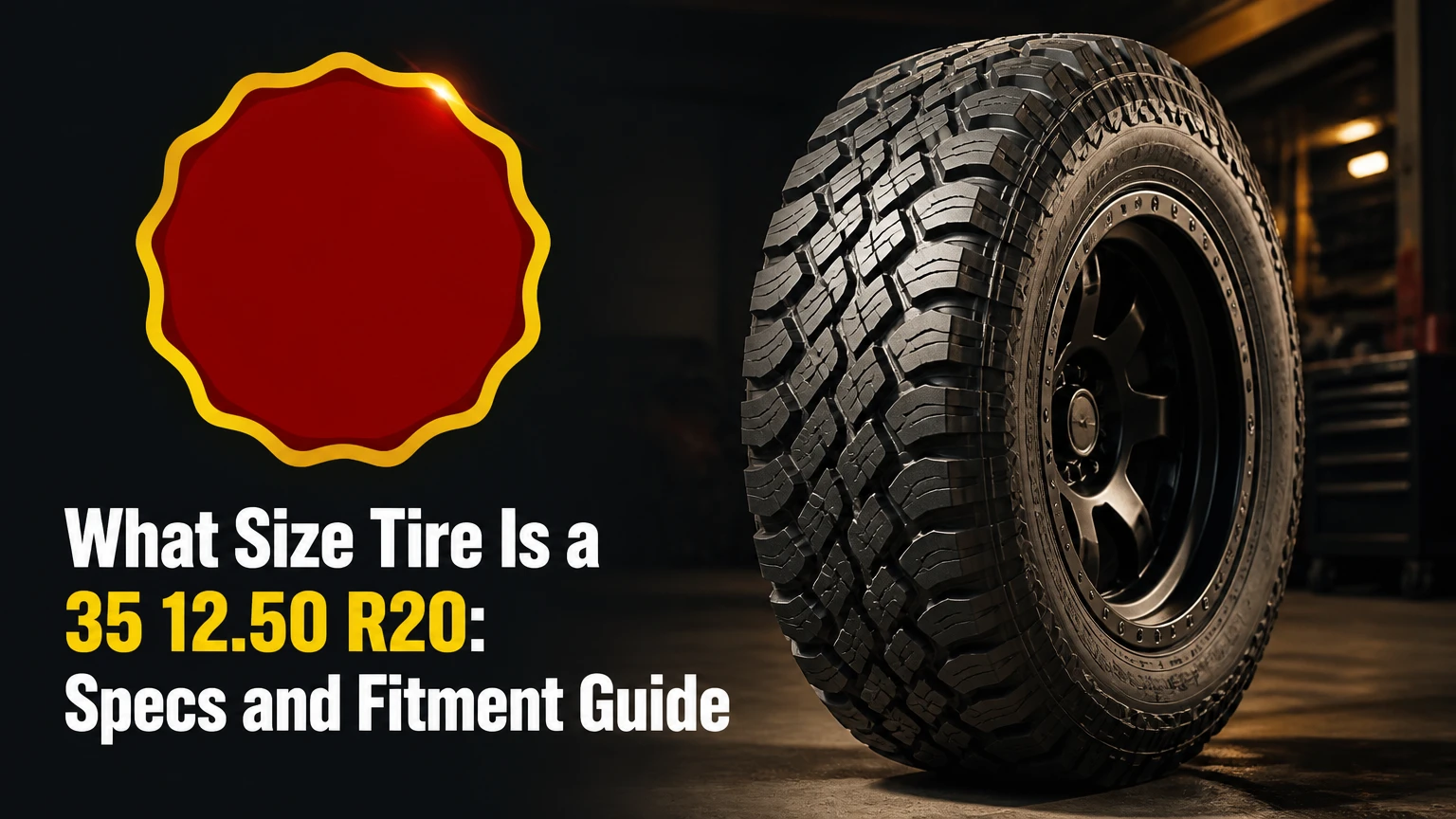
A 35 12.50 R20 tire, commonly written 35×12.50R20, is a flotation-size light-truck tire with a nominal 35-inch overall diameter, 12.50-inch section width, and radial construction that mounts on a 20-inch wheel. Its closest metric equivalents are usually 315/60R20 and 325/60R20, although neither is dimensionally identical across every brand.
Key facts at a glance
A 35×12.50R20 tire is nominally 35 inches tall and 12.50 inches wide.
The tire fits a 20-inch wheel, not a 20-inch-wide wheel.
The letter R identifies radial construction.
Its nominal unladen sidewall height is 7.5 inches.
A 315/60R20 is approximately 34.9 inches tall and 12.4 inches wide.
A 325/60R20 is approximately 35.4 inches tall and 12.8 inches wide.
Actual tire dimensions depend on brand, tread design, inflation pressure, and approved wheel width.
What does 35×12.50R20 mean?
The designation 35×12.50R20 states the tire’s approximate outside diameter, section width, construction, and wheel diameter in that order. Unlike a metric size such as 275/65R20, flotation sizing gives the main dimensions directly in inches and does not use an aspect-ratio percentage.
The four parts mean:
| Marking | Meaning | Approximate value |
|---|---|---|
| 35 | Overall tire diameter | 35 inches |
| 12.50 | Section width | 12.50 inches |
| R | Internal construction | Radial |
| 20 | Wheel diameter | 20 inches |
The 35-inch figure describes the nominal diameter from the road surface to the top of the tire when inflated, but manufacturers often publish a measured diameter below or above 35 inches. A tire sold as 35×12.50R20 may measure about 34.5-35.5 inches, depending on its casing and tread.
The 12.50-inch figure is section width, measured across the tire’s widest inflated sidewall area on the manufacturer’s specified measuring rim. It is not the same as tread width. Large shoulder lugs can make the tire appear wider than its published section width.
Goodyear’s tire-size explanation states, “The R stands for radial.” Radial cords run approximately perpendicular to the direction of travel, while belts beneath the tread stabilize the contact patch. Nearly all modern highway and off-road light-truck tires use radial construction.
How tall and wide is a 35×12.50R20 tire?
A nominal 35×12.50R20 tire is 35 inches tall and 12.50 inches wide, with approximately 7.5 inches of sidewall above the wheel. The calculation is simple, but published manufacturer measurements should control final fitment because tread lugs and casing dimensions vary.
How is the 7.5-inch sidewall calculated?
Subtract the wheel diameter from the tire diameter, then divide the result by two:
(35 inches – 20 inches) / 2 = 7.5 inches
That is the nominal sidewall height on each side of the wheel. It does not represent the exact visible rubber height on a mounted vehicle because the tire may measure 34.7 inches, compress under vehicle weight, or use a different measuring rim.
| Dimension | Nominal flotation value | Approximate metric value |
|---|---|---|
| Overall diameter | 35 inches | 889 millimeters |
| Section width | 12.50 inches | 318 millimeters |
| Wheel diameter | 20 inches | 508 millimeters |
| Sidewall height | 7.5 inches | 191 millimeters |
| Circumference | 109.96 inches | 2,793 millimeters |
A 35-inch tire usually has a larger rolling circumference than a factory 31-33-inch tire. The larger circumference reduces engine rpm at a given road speed, but it also reduces effective wheel torque and can make first gear feel taller.
Why can two 35×12.50R20 tires have different measurements?
Tire dimensions differ because manufacturers use different molds, tread depths, casing designs, measuring rims, and inflation pressures. A mud-terrain tire with large shoulder lugs may have a greater overall width than an all-terrain tire carrying the same nominal size.
A practical fitment rule is to use the tire manufacturer’s published section width, overall diameter, approved rim range, load index, and revolutions per mile, rather than relying on the size code alone.
What is the metric equivalent of 35×12.50R20?
The closest common metric equivalents are 315/60R20 and 325/60R20. A 315/60R20 is generally narrower and slightly shorter, while a 325/60R20 is generally wider and slightly taller, so the correct substitute depends on clearance, wheel width, load rating, and the specific tire model.
| Size | Approximate diameter | Approximate section width | Difference from nominal 35×12.50R20 |
|---|---|---|---|
| 315/60R20 | 34.9 inches | 12.4 inches | Slightly narrower |
| 325/60R20 | 35.4 inches | 12.8 inches | Slightly wider and taller |
| 315/65R20 | 35.6 inches | 12.4 inches | Narrower, taller sidewall |
| 35×12.50R20 | 35.0 inches nominal | 12.5 inches nominal | Reference size |
Metric tire calculations use this formula:
- Overall diameter = 20 + 2 × (section width × aspect ratio)
- For 315/60R20: 20 + 2 × (12.40 × 0.60) = about 34.9 inches
- For 325/60R20: 20 + 2 × (12.80 × 0.60) = about 35.4 inches
The metric number before the slash is millimeter width. The second number is sidewall height as a percentage of width. Therefore, 315/60R20 has a sidewall approximately 60% as tall as its 315-millimeter section width.
A metric replacement is not automatically equivalent in load capacity. A 315/60R20 passenger tire, LT tire, and commercial tire can have materially different load indexes and inflation requirements.
What wheel fits a 35×12.50R20 tire?
A 35×12.50R20 tire commonly fits an 8.5-11-inch-wide wheel, but the tire manufacturer’s approved rim range is authoritative. Many truck applications use a 9-inch or 10-inch wheel because those widths provide a stable bead seat without excessive sidewall bulge.
| Wheel specification | Typical usable range | Fitment effect |
|---|---|---|
| Wheel width | 8.5-11 inches | Controls sidewall shape and approved mounting |
| Common practical width | 9-10 inches | Balanced support for many 12.50-inch tires |
| Offset | Approximately -12 to +12 mm | Changes inner and outer clearance |
| Backspacing | Vehicle-specific | Determines control-arm and fender clearance |
| Wheel diameter | Exactly 20 inches | Required for bead seating |
Positive offset moves the wheel inward toward the suspension. Negative offset moves the wheel outward toward the fender. Neither value is universally correct because control-arm shape, spindle design, fender width, caster, and wheel backspacing differ by truck.
Use the tire company’s wheel-width range, then check the wheel’s load rating against the truck’s axle loads. A wheel that physically mounts the tire can still be unsuitable for towing or maximum payload.
Does a 12.50-inch tire fit an 8-inch factory wheel?
An 8-inch factory wheel may be approved for some 35×12.50R20 tires, but many tire models specify a wider measuring rim or a minimum width near 8.5 inches. Mounting a wide tire on a narrow rim can increase sidewall curvature, reduce steering precision, and create uneven tread loading.
Never select the wheel from the nominal tire width alone. Read the exact tire model’s technical data sheet.
Will 35×12.50R20 tires fit without a lift?
Most trucks do not provide universal clearance for 35×12.50R20 tires at factory ride height, particularly during full-lock steering or suspension compression. A leveling kit may create enough vertical clearance on some half-ton trucks, while wheel offset, caster, bumper shape, and tire brand determine whether rubbing remains.
| Vehicle situation | Typical preparation | Main clearance concern |
|---|---|---|
| Stock half-ton truck | Often insufficient | Upper control arm, liner, bumper |
| 2-2.5-inch leveling kit | Sometimes workable | Full-lock and compression rub |
| 4-inch suspension lift | Common 35-inch setup | Backspacing and fender clearance |
| 6-inch suspension lift | Usually substantial clearance | Driveline angles and tire coverage |
| Heavy-duty truck | Model-specific | Front suspension and rear wheel opening |
These ranges are typical practitioner guidance, not universal specifications. A Ford F-150, Chevrolet Silverado 1500, Ram 1500, Toyota Tundra, Ford Super Duty, and Ram HD have different wheel wells and suspension geometry.
The correct test is mechanical. Mount one tire, turn the steering from lock to lock, compress the suspension if safely possible, and inspect the liner, sway bar, upper control arm, bumper, and body mount. Check both forward and reverse steering because tire movement can differ under braking and backing.
Which rubbing points matter most?
Inner rubbing usually occurs against the upper control arm, sway bar, steering knuckle, or strut assembly. Outer rubbing usually occurs at the front bumper, rear liner, fender edge, or body mount when the suspension compresses.
Small plastic-liner contact may be corrected with controlled trimming. Metal contact, brake-line contact, and contact that occurs during suspension compression require a proper engineering solution, not simply removal of material.
Wheel spacers can create inner clearance, but they increase outer tire projection and place additional load on wheel bearings and studs. Use only correctly sized, hub-centric spacers that meet local requirements, and retorque them according to the manufacturer’s instructions.
What are the effects of installing 35-inch tires?
Installing 35-inch tires increases ground clearance and obstacle clearance, but the larger rolling radius reduces effective gearing, adds unsprung mass, and can change braking, acceleration, fuel consumption, and steering response. The outcome depends more on actual tire weight and drivetrain gearing than diameter alone.
A 35-inch tire can provide approximately 1-2 inches more differential clearance than a 31-33-inch tire, although the gain is measured at the axle and varies with tire loading. Larger sidewalls also allow lower off-road pressures, but airing down requires bead security and careful reinflation before highway driving.
Typical consequences include:
- Acceleration: slower launch if gearing is unchanged.
- Engine rpm: lower at cruising speed because the tire travels farther per revolution.
- Fuel economy: often decreases because weight, width, and rolling resistance rise.
- Braking: stopping performance can decline if tire mass and diameter increase substantially.
- Steering: heavier tires can increase steering effort and expose worn tie rods or ball joints.
- Transmission behavior: automatic transmissions may shift more often on grades.
- Clearance: improved under-axle clearance but potentially reduced body clearance at the fenders.
An expert rule of thumb is to compare revolutions per mile, not advertised diameter. A 35-inch tire theoretically turns about 576 times per mile, while a 32-inch tire turns about 631 times per mile. The actual values printed by the tire manufacturer are more useful because tread deflection changes the result.
Which tread type is best for a 35×12.50R20 tire?
All-terrain tires are usually the best choice for daily highway use, rugged-terrain tires suit drivers who want a more aggressive pattern with manageable noise, and mud-terrain tires are appropriate when deep mud, rocks, and trail durability outweigh highway comfort.
| Tire type | Typical road/off-road balance | Typical noise | Typical tread life | Best application |
|---|---|---|---|---|
| All-terrain | 70/30 road to trail | Low to moderate | 45,000-65,000 miles | Commuting and mixed surfaces |
| Rugged-terrain | 55/45 road to trail | Moderate | 35,000-55,000 miles | Aggressive daily truck |
| Mud-terrain | 20/80 road to trail | Moderate to high | 25,000-45,000 miles | Mud, rocks, and dedicated trails |
| Highway-terrain | 85/15 road to trail | Low | 50,000-70,000 miles | Towing and pavement |
The mileage figures are typical planning ranges, not guarantees. Alignment, rotation intervals, tire compound, vehicle weight, inflation, and driving surface can change tread life dramatically.
Examples include the BFGoodrich All-Terrain T/A KO3 and Toyo Open Country A/T III for all-terrain use, the Nitto Ridge Grappler for hybrid or rugged-terrain use, and the Yokohama Geolandar M/T G003 for mud-terrain applications. The best model still has to meet the vehicle’s load and speed requirements.
Mud-terrain tires are not automatically safer off-road in every condition. Their open voids clear mud effectively, but their large tread blocks can reduce wet pavement grip and ice traction. A/T tires usually provide more predictable braking and lower cabin noise for trucks driven daily.
How much do 35×12.50R20 tires cost?
A typical 35×12.50R20 tire costs approximately $300-$550, or $1,200-$2,200 for four tires, before taxes, disposal fees, alignment, and optional road-hazard coverage. Mounting and balancing four large light-truck tires commonly takes 1-1.5 hours when the shop has suitable equipment.
| Expense | Typical range | Cost driver |
|---|---|---|
| One tire | $300-$550 | Brand, casing, tread type, load range |
| Four tires | $1,200-$2,200 | Model and retailer |
| Mount and balance | $120-$240 per set | Local labor and wheel size |
| Four-wheel alignment | $100-$250 | Vehicle and suspension changes |
| Tire-pressure sensors | $40-$250 per set | Sensor type and programming |
| Leveling or lift installation | $300-$2,500 | Kit complexity and labor |
Large tires may require a heavy-duty tire machine, which can increase installation charges. A lift or leveling kit can also create follow-up costs for alignment, control arms, bump-stop adjustment, or trimming.
The heaviest 35×12.50R20 load-range-E tires can weigh more than 75 pounds each. Confirm that the shop’s tire machine, balancer, and lift can safely handle the wheel and tire assembly.
What load range should a 35×12.50R20 tire have?
The correct load range is the one that meets or exceeds the vehicle manufacturer’s original tire load capacity at the specified cold inflation pressure. Load Range E is common on LT 35×12.50R20 tires, but a heavier rating is not automatically correct if the wheel, axle, suspension, or vehicle placard specifies something else.
Check these values before purchase:
- Read the driver-door certification label for original size, load index, and cold inflation pressure.
- Compare the replacement tire’s load index with the original tire.
- Confirm that the wheel supports the intended pressure and load.
- Check the tire’s maximum load at the stated pressure.
- Preserve the vehicle’s front and rear axle load limits.
A tire marked LT35x12.50R20 121Q has a load index of 121 and a Q speed rating, but markings vary by manufacturer. Load Range E describes casing strength and pressure category; it does not replace the load index.
NHTSA advises maintaining the vehicle manufacturer’s recommended tire pressure and using replacement tires with suitable load capacity. Do not reduce pressure simply because a larger tire appears to carry the truck comfortably.
Does a 35-inch tire change the speedometer?
A 35-inch tire can make the speedometer read lower than actual speed when it replaces a smaller tire because the larger tire travels farther with each revolution. The correction amount depends on the original tire’s actual rolling circumference and the replacement tire’s measured revolutions per mile.
For example, replacing a 32-inch tire with a 35-inch tire creates a theoretical ratio of 35/32, or 1.094. If the speedometer indicated 60 mph using the original calibration, the vehicle could be traveling approximately 65.6 mph under idealized conditions. Tread deflection and vehicle electronics alter the real result.
Modern vehicles may use wheel-speed data for ABS, traction control, transmission shifting, and stability control. An electronic programmer can correct the tire-size parameter on some vehicles, but not every vehicle permits accurate recalibration through a simple handheld device.
Verify the result with a GPS speed reading or a calibrated roadside speed display. Tire pressure, tread wear, and actual rolling circumference should be measured before entering a new value.
Do 35-inch tires require different gears?
Regearing is not always required for 35-inch tires, but it becomes more valuable when the vehicle feels sluggish, hunts between transmission gears, or operates near its towing limit. The appropriate axle ratio depends on the original tire, engine torque curve, transmission ratios, payload, and intended terrain.
A common planning method is:
New axle ratio = Original axle ratio × New tire diameter / Original tire diameter
If a truck uses 3.55 gears with 32-inch tires, the theoretical equivalent for 35-inch tires is about 3.88. Available aftermarket ratios may be 3.92, 4.10, or another nearby option, depending on the axle.
The calculation is only a starting point. Regearing both axles is mandatory on four-wheel-drive vehicles, and the differential carrier, ring gear, pinion, driveshaft speed, and calibration must be compatible.
Why do 35×12.50R20 tires rub?
35×12.50R20 tires rub when their actual width or diameter exceeds available clearance during steering, suspension compression, or axle movement. The contact location identifies the likely correction: inner contact points toward wheel offset or suspension clearance, while outer contact points toward liner, bumper, fender, or body-mount clearance.
| Contact location | Common cause | Typical correction |
|---|---|---|
| Upper control arm | Wheel too far inward | Different offset or approved spacer |
| Sway bar | Positive offset or wide casing | Wheel-width and offset review |
| Front bumper | Tire moves forward at lock | Liner or bumper adjustment |
| Rear liner | Compression and caster geometry | Caster correction or trimming |
| Body mount | Large tire on GM truck | Professional body-mount modification |
| Brake hose | Inadequate clearance | Stop use and correct immediately |
If rubbing occurs only at full lock in reverse, inspect the rear portion of the front wheel well. If rubbing occurs over bumps, inspect compression clearance with the suspension loaded. A vehicle that clears on a lift can rub on the road because the suspension is unloaded during inspection.
Do not accept brake-line or structural-metal contact. Those conditions can damage safety-critical components.
Should the spare tire also be 35 inches?
A four-wheel-drive truck should carry a spare with a closely matched rolling circumference, especially if the vehicle may be driven in four-wheel drive or has a full-time all-wheel-drive system. A 31-inch spare paired with three 35-inch tires can create driveline speed differences and damage differentials, transfer cases, or viscous couplings.
A temporary mismatch may be possible for a short emergency journey in two-wheel drive, but the vehicle owner’s manual controls. Some electronic four-wheel-drive systems may disable operation when tire diameters differ beyond a programmed threshold.
Measure the spare’s actual diameter rather than assuming the size code tells the whole story. A worn 35-inch tire and a new 35-inch tire can also have different circumferences, particularly with aggressive tread depths.
What are the most common buying mistakes?
The most expensive mistakes involve treating nominal size as a complete fitment specification. A 35×12.50R20 label does not identify actual width, wheel-width approval, load capacity, wheel offset, tread noise, or vehicle clearance.
Avoid these errors:
- Choosing by diameter alone: Compare actual manufacturer dimensions and revolutions per mile.
- Ignoring wheel load rating: Match the wheel to axle load and tire pressure.
- Using excessive negative offset: Outer clearance may improve while fender rubbing worsens.
- Skipping alignment: Lift installation can alter toe, camber, and caster.
- Ignoring tire weight: Heavy tires affect braking, steering, suspension wear, and fuel use.
- Assuming a leveling kit guarantees fitment: Plastic, metal, and suspension geometry still control clearance.
- Leaving the original spare: Four-wheel-drive components may experience harmful speed differences.
- Using passenger tires for heavy towing: Verify LT construction and load index first.
One practitioner rule is to measure clearance with the truck carrying its normal cargo. Empty-bed clearance can be misleading on a pickup that regularly carries tools, a camper, or trailer tongue weight.
Which alternative size should you choose?
Choose 315/60R20 when a slightly narrower tire improves clearance, 325/60R20 when extra width and a slightly taller profile are acceptable, and 315/65R20 when narrow width with additional sidewall height matters more than matching the nominal 35-inch diameter.
| Priority | More suitable size | Reason |
|---|---|---|
| Narrower fitment | 315/60R20 | About 12.4 inches wide |
| Closest overall diameter | 315/60R20 | About 34.9 inches tall |
| Maximum visual width | 325/60R20 | About 12.8 inches wide |
| More sidewall height | 315/65R20 | About 35.6 inches tall |
| Exact flotation convention | 35×12.50R20 | Nominal 35 by 12.50 inches |
A narrower metric tire can reduce rubbing against control arms and fender edges, but it may not provide the same sidewall protection or visual stance. A wider 325/60R20 can require additional outer clearance even when its diameter appears acceptable.
Compare the specific tire’s approved wheel range and load index before treating any metric size as a direct replacement.
FAQ
Is a 35×12.50R20 tire the same as a 35-inch tire?
A 35×12.50R20 tire is marketed as a 35-inch tire, but its measured diameter may differ by several tenths of an inch. The term describes a nominal size, while the manufacturer’s technical specification gives the actual diameter, width, rim range, and revolutions per mile.
How much clearance does a 35-inch tire need?
A practical installation should provide clearance at full steering lock, full suspension compression, and reverse steering, with additional space for tread flex and mud buildup. Exact clearance cannot be reduced to one universal measurement because wheel offset and suspension geometry change the tire path.
Can I put 35×12.50R20 tires on stock 20-inch wheels?
Stock 20-inch wheels may work only when their width, offset, load rating, and tire manufacturer approval match the installation. Many factory wheels are narrower or have an offset that places the tire against suspension components or the outer fender.
Are 35×12.50R20 tires good in snow?
All-terrain 35×12.50R20 tires generally provide more predictable packed-snow and wet-road behavior than mud-terrain tires. Look for the Three-Peak Mountain Snowflake certification when severe-snow performance matters, and remember that tire width, compound, pressure, and vehicle weight also affect traction.
How often should 35-inch tires be rotated?
Many tire manufacturers and vehicle manuals recommend rotation around every 5,000-8,000 miles, with earlier inspection if the truck has altered suspension geometry or uneven wear. Directional tires may require a limited front-to-rear pattern rather than a full cross-rotation.
Is a 35×12.50R20 tire too heavy for a half-ton truck?
A 35×12.50R20 tire can be used on some half-ton trucks, but tire weight and load capacity must remain compatible with the vehicle, wheel, axle, and suspension. A heavy Load Range E tire may reduce ride comfort and acceleration even when its load rating exceeds the truck’s original specification.
Conclusion
A 35×12.50R20 tire is a nominal 35-inch-tall, 12.50-inch-wide radial tire designed for a 20-inch wheel, with approximately 7.5 inches of nominal sidewall above the rim. The closest metric options are usually 315/60R20 and 325/60R20, but actual dimensions, load rating, wheel width, offset, and truck-specific clearance determine whether the tire is a safe fit.
Title tag: what size tire is a 35 12.50 r20: Specs and Fitment Guide
Meta description: Compare 315/60R20 and 325/60R20 sizes, check 8.5-11 inch wheels, and prevent rubbing before buying 35×12.50R20 tires.