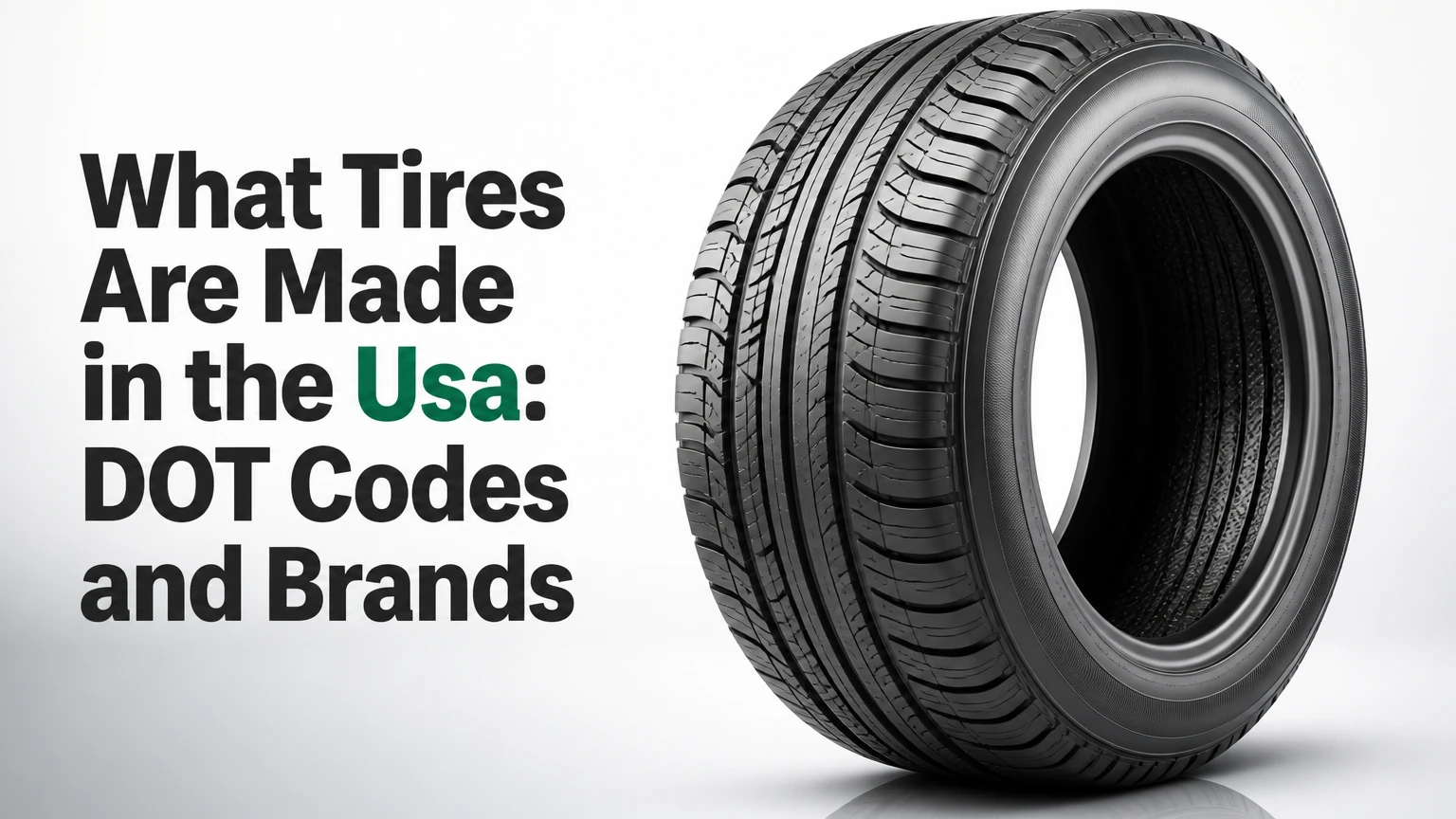
Tires made in the USA include selected models from Goodyear, Cooper, Michelin, BFGoodrich, Bridgestone, Firestone, Continental, General, Yokohama, Hankook, Toyo, and Pirelli. Manufacturing varies by model, size, and production date, so the tire’s Department of Transportation identification number, or DOT TIN, is the reliable way to verify its factory.
Key facts at a glance
A U.S.-made tire is manufactured at a plant located in the United States, regardless of the brand’s ownership country.
Goodyear, Cooper, Michelin, Bridgestone, Continental, Yokohama, Hankook, Toyo, and Pirelli operate or have operated U.S. tire plants.
A brand name does not prove manufacturing location because major brands distribute the same product line from multiple countries.
The first characters after “DOT” identify the manufacturing plant; the final four digits identify the production week and year.
The full DOT TIN may appear on only one sidewall, while the opposite side may show an abbreviated code.
U.S. production does not automatically mean superior performance; compound design, tire category, age, fitment, and testing matter more.
What does Made in USA mean for tires?
A tire qualifies as U.S.-manufactured when the finished tire is produced at a U.S. factory. The rubber, steel, textile, oils, and chemical ingredients can come from several countries, because tire manufacturing uses a global supply chain.
The Federal Trade Commission’s standard for an unqualified country-of-origin claim is “all or virtually all.” That standard applies to the product’s overall claim, while the sidewall’s “Made in USA” marking and the tire’s DOT plant identifier provide more useful purchase-level evidence.
American brand ownership is a different attribute. Goodyear is an American company, but Goodyear tires can be produced in the United States, Canada, Mexico, Chile, or other locations. Michelin is French-owned, yet Michelin manufactures many tires in American plants. Ownership and factory location answer different questions.
Which brands have U.S. roots?
Goodyear and Cooper are the principal tire brands with longstanding American corporate histories. Goodyear acquired Cooper in 2021, but Cooper-branded products remain distinct product lines with production distributed across multiple factories.
BFGoodrich and Kelly are also strongly associated with American tire history, although current ownership and manufacturing networks are broader. BFGoodrich is part of Michelin, while Kelly is associated with Goodyear. General is owned by Continental. A familiar American name therefore requires factory verification.
Which tire companies manufacture in the United States?
The following manufacturers have U.S. production facilities for some tire categories or product lines. The table identifies representative plants and commonly reported plant codes, but codes and production assignments can change, so buyers should confirm unusual or high-value purchases with the manufacturer.
| Manufacturer or brand | Representative U.S. location | Commonly reported plant code examples | Typical products |
|---|---|---|---|
| Goodyear | Lawton, Oklahoma | M6 | Passenger, SUV, light-truck tires |
| Goodyear | Danville, Virginia | MC, PT | Passenger and truck tires |
| Goodyear | Fayetteville, North Carolina | PJ, MM | Passenger and performance tires |
| Goodyear | Topeka, Kansas | MJ, JN | Passenger, SUV, and truck tires |
| Cooper | Findlay, Ohio | UP | Passenger and light-truck tires |
| Cooper | Texarkana, Arkansas | UT | Light-truck and commercial tires |
| Michelin | South Carolina facilities | M3, B6, B9 | Passenger, SUV, truck, and specialty tires |
| Michelin | Dothan, Alabama | B7 | Commercial and specialty products |
| Bridgestone or Firestone | La Vergne, Tennessee | 2C, D2, E3 | Passenger and light-truck tires |
| Bridgestone or Firestone | Aiken, South Carolina | 1C | Passenger and truck tires |
| Continental or General | Mount Vernon, Illinois | A3, 6B | Passenger and commercial tires |
| Yokohama | West Point, Mississippi | Manufacturer-specific TIN | Passenger, truck, and commercial tires |
| Hankook | Clarksville, Tennessee | Manufacturer-specific TIN | Passenger and light-truck tires |
| Toyo | White, Georgia | Manufacturer-specific TIN | Passenger, SUV, and truck tires |
| Pirelli | Rome, Georgia | Manufacturer-specific TIN | Performance, passenger, and specialty tires |
Production changes matter more than a plant list. A factory can produce several brands, and a single model can move between factories as demand, equipment, and vehicle contracts change.
Are Michelin tires made in the USA?
Some Michelin tires are made in the United States, including selected passenger, SUV, truck, and commercial products. Michelin operates major American manufacturing operations, particularly in South Carolina and Alabama, but neither the Michelin name nor a particular model name guarantees U.S. production.
Are Goodyear tires always made in America?
Goodyear tires are not always made in America. Goodyear is an American brand with U.S. factories, but its global production network means the same model family can have different country-of-origin markings by size, market, or production batch.
How do you read the DOT code on a tire?
To identify a tire’s factory, locate “DOT” on the sidewall, read the plant identifier immediately afterward, and compare that identifier with a current manufacturer or National Highway Traffic Safety Administration database. Read the entire TIN when possible because the plant code alone does not identify the tire’s model, size, or age.
A typical TIN contains these elements:
- DOT prefix: Indicates compliance with applicable U.S. tire regulations.
- Plant code: The first two characters, or a newer three-character identifier, identify the manufacturing plant.
- Manufacturer and size codes: These internal characters identify product information.
- Date code: The final four digits show the production week and year.
For example, a final date code of 2624 means the tire was manufactured in the 26th week of 2024. It does not mean the tire expires in 2026.
The complete TIN may appear on only one sidewall. The visible outer side can contain a partial TIN without the four-digit date code, so inspect the inner sidewall or ask the installer to expose the full marking.
What information does the DOT code not tell you?
The DOT code does not establish that a tire is better, safer, or made from American raw materials. It identifies regulatory and manufacturing information, not an independent performance rating.
A plant code also does not identify every production detail. A factory may produce several sizes, constructions, brands, and compounds. Match the code to the exact tire in your possession rather than relying on a retailer’s product page.
How are tires manufactured in the United States?
U.S.-manufactured tires use the same basic industrial sequence used worldwide: compound preparation, component production, green-tire assembly, curing, and inspection. The process typically takes several hours from mixing through final inspection, although plant scheduling and inventory time add substantially to the product’s total supply-chain age.
1. Mixing creates the tire compound
Natural rubber, synthetic rubber, carbon black, silica, oils, sulfur, resins, antioxidants, and other chemicals are blended in an internal mixer. The formulation controls rolling resistance, wet grip, wear, heat resistance, and flexibility.
The mixture leaves the equipment as a hot rubber compound. Engineers use different compounds for the tread, sidewall, inner liner, bead area, and belt skim because each component performs a different job.
2. Calendering and extrusion form components
Calendering presses rubber onto steel or textile cords. These coated sheets become body plies, belt packages, and other reinforcement layers.
Extrusion pushes rubber through shaped dies to form tread strips, sidewalls, inner liners, and apex components. Tread extrusion determines the starting geometry, but the final tread pattern is molded during curing.
3. Assembly produces the green tire
An assembly drum receives the inner liner, body plies, bead bundles, sidewall components, steel belts, cap plies, and tread. The uncured assembly is called a green tire because the rubber remains soft, tacky, and chemically unfinished.
Steel beads lock the tire against the wheel rim. Steel belts stabilize the tread, while textile body plies carry inflation pressure and help control sidewall flex.
4. Curing vulcanizes the rubber
A curing press places the green tire inside a heated mold and applies pressure. Heat and sulfur chemistry create cross-links between rubber molecules, turning the soft assembly into an elastic tire with its final shape.
The mold forms tread blocks, grooves, sidewall lettering, load information, and regulatory markings. Curing temperature and time vary by tire construction, size, and compound.
5. Inspection rejects defects
Finished tires pass visual and dimensional checks, uniformity and balance measurements, and, for selected products, nondestructive internal inspection such as X-ray testing. A tire can be rejected for force variation, air leaks, splice problems, bead defects, or incorrect markings.
The manufacturing process explains why country of origin is only one buying variable. The engineering specification and quality-control system determine how the finished tire behaves on a particular vehicle.
Which U.S.-made tires fit each vehicle use?
The best U.S.-manufactured tire depends first on vehicle fitment and duty cycle, then on factory location. A passenger-car tire designed for low noise is a poor substitute for a commercial light-truck tire, even when both carry a U.S. plant code.
| Vehicle use | U.S.-made candidates to verify | Typical price per tire | Main strength | Important limitation |
|---|---|---|---|---|
| Commuter sedan | Goodyear Assurance, General Altimax, selected Cooper lines | $110-$220 | Quiet all-season operation | Production country varies by size |
| Long-distance crossover | Michelin Defender family, Goodyear Assurance MaxLife | $150-$280 | Long treadwear warranties | Higher purchase price |
| Half-ton pickup | BFGoodrich, Cooper Discoverer, Goodyear Wrangler | $170-$320 | Load capacity and mixed-road traction | Aggressive tread increases noise |
| Heavy towing | LT-rated Michelin, Goodyear, Cooper, or Firestone products | $190-$380 | Stiffer carcass and heavier load rating | Firmer ride and higher rolling resistance |
| All-terrain use | BFGoodrich All-Terrain, Cooper Discoverer, selected Goodyear Wrangler products | $180-$340 | Gravel and dirt traction | Wet-road and snow performance varies |
| Commercial fleet | Michelin, Bridgestone, Goodyear, Continental products | $220-$550 | Casing durability and service support | Size and axle position limit choices |
| Budget replacement | Kelly, Douglas, selected General products | $80-$150 | Lower initial cost | U.S. production is especially inconsistent |
Model names in the table are candidate families, not guarantees. A 265/70R17 version may come from a different plant than a 225/65R17 version of a related product.
Are U.S.-made tires better than imported tires?
U.S.-made tires are not automatically better than imported tires. Performance depends on wet braking, hydroplaning resistance, snow traction, treadwear, casing construction, age, and correct vehicle application, while reputable manufacturers use comparable quality systems across their international plants.
Imported tires can offer excellent performance, and U.S.-built tires can be unsuitable when the design does not match the driver’s needs. The meaningful comparison is between two exact tire models in the same size, load index, speed rating, and service category.
A practical comparison should include independent test results, warranty terms, replacement availability, and the tire’s date code. Country of origin is a preference or sourcing criterion, not a substitute for performance evidence.
How much do U.S.-made tires cost?
Typical retail prices for U.S.-manufactured passenger tires range from about $100 to $280 per tire, while light-truck, commercial, and specialty sizes commonly range from $170 to more than $500. Installation, disposal, taxes, road-hazard coverage, and alignment can add $25-$100 per tire.
| Tire category | Typical unit price | Typical mileage warranty | Common ownership trade-off |
|---|---|---|---|
| Budget passenger | $80-$150 | 40,000-60,000 miles | Lowest entry cost, fewer refinement features |
| Standard all-season | $110-$210 | 50,000-70,000 miles | Balanced price, traction, and comfort |
| Premium touring | $160-$280 | 60,000-90,000 miles | Higher price, stronger refinement and wear potential |
| All-terrain | $180-$340 | 50,000-60,000 miles | Better dirt traction, more noise and weight |
| LT all-terrain | $220-$380 | 40,000-60,000 miles | Heavy-duty construction, firmer ride |
| Commercial truck | $300-$550 | Application-dependent | Durable casing, expensive replacement |
Warranty mileage is not a promise that every driver will reach that number. Alignment, inflation, rotation, vehicle weight, road surface, temperature, and driving style can reduce actual tread life.
Is the higher price worth paying?
The price premium can make sense when a tire lasts longer, reduces road noise, improves wet-road control, or carries a stronger workmanship warranty. It is less defensible when a driver uses a tire for short annual mileage, replaces the vehicle soon, or selects a premium model whose capabilities exceed the vehicle’s use.
Use cost per expected mile as a screening tool:
Cost per mile = installed tire cost divided by expected service miles.
A $220 tire expected to last 70,000 miles costs about $0.0031 per mile before installation. An $110 tire expected to last 35,000 miles has the same nominal cost per mile, but the premium tire may still provide better wet performance and fewer replacement appointments.
What is the difference between P-metric and LT tires?
P-metric tires are designed primarily for passenger vehicles and normal loads, while LT tires use a heavier construction for higher load demands, towing, commercial work, or sustained rough-road use. An LT tire is not automatically safer on a standard SUV because its stiffness can reduce comfort and increase weight.
| Marking or construction | Intended application | Typical pressure or load context | Ride and efficiency effect |
|---|---|---|---|
| P-metric | Cars, crossovers, light SUVs | Standard passenger loading | Softer ride and lower rolling resistance |
| Euro-metric | Cars and crossovers | Load index rather than P-metric prefix | Fitment depends on vehicle specification |
| LT-metric | Pickups, vans, heavy SUVs | Higher load ranges and inflation pressures | Firmer ride and greater weight |
| XL or Extra Load | Passenger vehicles needing added capacity | Higher load than standard equivalent | Moderate stiffness increase |
| ST specialty trailer | Trailer axles | Trailer-specific load and pressure rules | Not suitable for passenger vehicles |
Follow the vehicle placard and owner’s manual. Changing from P-metric to LT-metric can alter load capacity, pressure requirements, speedometer behavior, steering feel, braking response, and fuel consumption.
What mistakes cause buyers to misidentify U.S. tires?
The most common error is treating an American brand as proof of American manufacturing. Goodyear, Cooper, BFGoodrich, Kelly, and General all have international supply chains, while Michelin, Bridgestone, Continental, Yokohama, Hankook, Toyo, and Pirelli can produce tires in U.S. factories despite foreign ownership.
Other mistakes have practical consequences:
- Checking only the retailer listing: Inventory can change after a page is published. Inspect the physical sidewall before installation.
- Reading the wrong sidewall: The four-digit date may be on the inward-facing side. Request the complete TIN.
- Using an old code list: Plant identifiers can be reassigned or displayed differently. Confirm with the manufacturer or NHTSA.
- Confusing a U.S. distribution center with a factory: A tire shipped from an American warehouse is not necessarily U.S.-manufactured.
- Ignoring tire age: Rubber ages during storage. NHTSA requires the date code for identification, while tire manufacturers commonly recommend replacing tires around six to ten years from manufacture depending on inspection and policy.
- Choosing by patriotism alone: A U.S.-made tire with the wrong load index or winter capability remains the wrong tire.
How old can a new tire be?
A new tire should generally be inspected carefully when it is more than two or three years old, even though age alone does not create a universal federal replacement deadline. Replace tires based on cracking, damage, tread condition, service history, and manufacturer guidance; many manufacturers recommend removal at six or ten years.
Storage conditions matter. A cool, dry, shaded warehouse is less damaging than prolonged heat, sunlight, ozone exposure, or repeated load cycles.
How should you verify a tire before purchase?
Verify the tire at the exact size and SKU level, not at the brand level. Ask the seller to provide a sidewall photograph or confirm the country of origin and full DOT TIN for the specific inventory being installed.
Use this checklist:
- Confirm the vehicle’s approved size, load index, and speed rating.
- Compare the tire’s model name and version suffix with the vehicle requirement.
- Inspect the DOT prefix and complete plant identifier.
- Read the four-digit production date.
- Check for uniformity, sidewall, and bead damage before mounting.
- Confirm whether all four tires come from the same production specification.
- Obtain the manufacturer’s warranty and adjustment terms.
- Keep the invoice showing brand, model, size, and installation date.
A retailer that cannot identify the actual tire in stock cannot reliably promise U.S. production. That limitation is normal for high-volume distribution, but the buyer should make the final decision from the tire’s sidewall.
Which U.S.-made tire should you choose?
Choose a verified U.S.-manufactured tire only after selecting the correct performance category. For a commuter, prioritize wet braking, noise, warranty, and tread life; for a truck owner, prioritize load rating, casing strength, traction, and replacement availability.
| Buyer situation | Suitable starting category | Candidate brands to verify | Avoid when |
|---|---|---|---|
| 12,000 miles per year on a sedan | Standard or premium touring all-season | Goodyear, General, Michelin, Cooper | You need dedicated winter traction |
| Frequent rain and highway travel | Premium all-season touring | Michelin, Goodyear, Bridgestone, Continental | The tire lacks the required speed rating |
| Gravel roads and occasional trails | All-terrain light-truck or SUV tire | BFGoodrich, Cooper, Goodyear, Toyo | Quiet highway comfort is the top priority |
| Regular towing near vehicle limits | Correctly specified LT tire | Michelin, Goodyear, Cooper, Firestone | The vehicle placard specifies P-metric tires only |
| Lowest purchase price | Budget passenger tire with verified fitment | Kelly, Douglas, General, Cooper | You drive high annual mileage |
| Winter conditions | Three-Peak Mountain Snowflake tire | Verify model and factory separately | The product carries only an M+S marking |
The strongest practitioner rule is simple: select the tire by vehicle requirement and road condition, then use the DOT code to satisfy the country-of-origin preference. Reversing that order can produce an American-made tire that has the wrong construction, rating, or seasonal capability.
FAQ
Are all Cooper tires made in the United States?
No. Cooper tires come from several manufacturing locations, including U.S. plants and international facilities. Cooper’s American corporate history does not identify the factory for an individual tire. Check the complete DOT TIN on the sidewall, especially when buying a popular size with multiple production sources.
Are BFGoodrich tires made in America?
Some BFGoodrich tires are made in the United States, but BFGoodrich products are also manufactured in other countries. Michelin owns the brand and operates a global production network. Verify the exact model, size, date code, and plant identifier rather than assuming every All-Terrain or passenger tire is U.S.-built.
Are General tires made in the USA?
Some General tires are manufactured in the United States, including products associated with Continental’s Mount Vernon, Illinois operation. Other General tires may come from different factories. General ownership by Continental does not guarantee U.S. origin, so the DOT plant code remains the appropriate check.
Does U.S. manufacturing mean the tire uses American rubber?
No. U.S. tire plants commonly use globally sourced natural rubber, synthetic rubber, steel, textile, carbon black, silica, oils, and chemical additives. “Made in USA” primarily describes where the finished tire was manufactured, not where every raw material originated.
Can a tire made in Mexico or Canada be sold as an American tire?
A tire made in Mexico or Canada can be sold in the United States and may come from an American-owned brand, but its manufacturing origin is Mexico or Canada. Brand nationality, retailer location, and distribution location should not be confused with the factory country identified through the tire’s markings.
Should I buy four tires from the same U.S. plant?
Matching the same plant is unnecessary. Matching the same model, size, load index, speed rating, construction, and similar tread depth is more important for vehicle behavior. Four tires from different factories can be appropriate when they meet the vehicle specification and are the same approved product.