A tire usually has no fixed expiration date stamped on it, but its DOT Tire Identification Number records the week and year of manufacture. To check tire age, find the final four digits of the DOT code on the sidewall, read the first two as the production week and the last two as the year, then compare the result with the tire maker’s replacement guidance and the tire’s physical condition.
Key facts at a glance
The final four digits of a modern DOT code identify the tire’s manufacturing week and year.
A code such as 3521 means the tire was made during the 35th week of 2021.
The complete date code may appear only on the tire’s inner sidewall.
There is no universal expiration date that applies to every tire in every country.
NHTSA advises consumers to follow the tire manufacturer’s age recommendations and inspect older tires for damage.
A tire can require replacement because of cracking, bulges, air loss, impact damage, or internal deterioration before its tread is worn out.
What Does a Tire Expiration Date Actually Mean?
A tire does not normally carry a calendar expiration date like food or medicine. The relevant date is the manufacturing date, and tire age is one factor in deciding whether the tire remains safe for service.
A tire’s rubber compound changes with time because oxygen, ozone, ultraviolet radiation, heat, moisture, and mechanical stress affect the polymers and reinforcement materials. A tire that has plenty of tread can still have aged sidewalls, weakened bonding, or internal deterioration that a basic visual check cannot confirm.
The National Highway Traffic Safety Administration, or NHTSA, states, “Tires age even when they are not used.” That principle matters for spare tires, collector cars, trailers, and vehicles that spend long periods parked. Age is counted from manufacture, not from the date the tire was installed.
There is no single federally mandated six-year or ten-year expiration date for every passenger tire in the United States. Several manufacturers recommend removal at ten years from manufacture, while some vehicle manufacturers recommend replacement earlier. The owner’s manual and the tire manufacturer’s published policy control the final recommendation.
How to Check the Expiration Date on a Tire
Checking a tire’s age takes about 5-10 minutes for four tires if the date stamps are visible. You need a flashlight, a clean cloth, a phone camera, and enough room to view the inner sidewall. Do not crawl under a vehicle supported only by a jack.
Before You Start
| Item | Typical requirement | Why it matters |
|---|---|---|
| Inspection time | 5-10 minutes per vehicle | Allows all four tires and the spare to be checked |
| Tools | Flashlight, cloth, phone camera | Makes raised or recessed characters easier to read |
| Vehicle position | Parked, transmission in Park, parking brake set | Prevents movement during inspection |
| Safety equipment | Wheel chocks, jack stands if lifting | A floor jack alone is not a safe support |
| Cost | $0 for a driveway check | A tire shop may charge $0-$30 for an age inspection |
Step 1: Find the DOT Marking
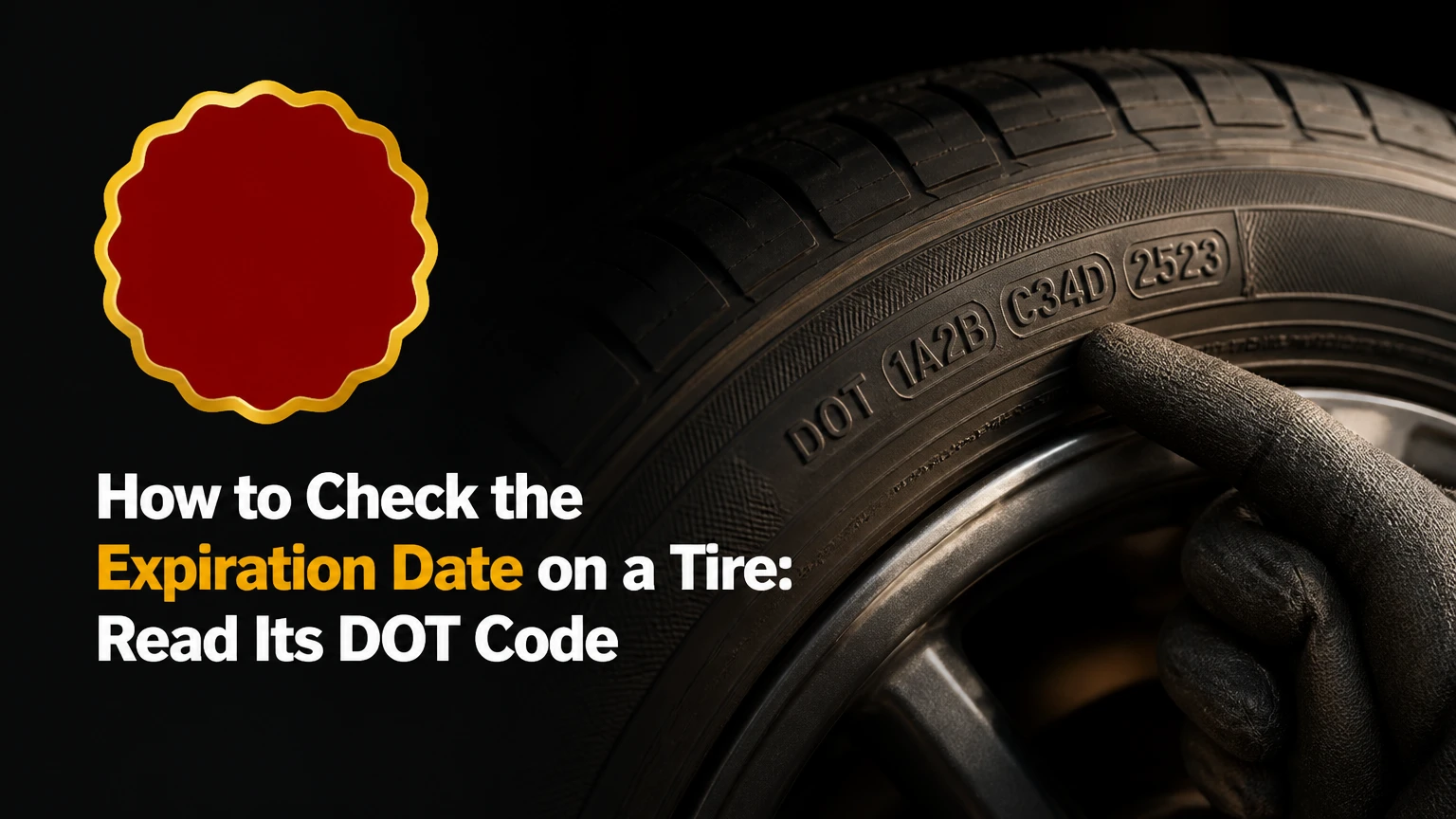
Look along the tire sidewall for the raised letters DOT. The DOT marking is followed by a Tire Identification Number containing plant, size, and production information.
The date is usually near the end of that string, but the entire marking may be difficult to distinguish from other sidewall text. Do not use the tire size, load index, speed rating, or E-mark as the age code. Those markings describe fitment or certification rather than production date.
You’ll know it worked when: you have located a sequence that begins with DOT and ends near a four-digit number.
Common mistake: reading the first two characters after DOT as the date. Those characters generally identify the manufacturing plant, not the production week.
Step 2: Inspect Both Sidewalls
Check the outward-facing sidewall first. If the DOT code ends in letters or lacks four final digits, inspect the inward-facing sidewall.
Tire manufacturers often mold the complete Tire Identification Number on one side and a shortened version on the other. A mounted wheel can hide the full code behind the suspension, brake assembly, or wheel well. A tire shop can read the inner sidewall without removing the tire, although removal may be needed if the code is heavily scuffed.
You’ll know it worked when: one sidewall shows a four-digit numeric group at the end of the DOT sequence.
Common mistake: assuming a tire is counterfeit or undated because the outer sidewall has only a partial code.
Step 3: Isolate the Final Four Digits
Find the last four digits of the complete DOT Tire Identification Number. Manufacturers commonly place the date in a rounded or rectangular molded area, although the shape and depth vary.
Ignore unrelated four-digit markings elsewhere on the sidewall. The correct date is attached to the DOT identification sequence and normally appears as a continuous group such as 1018, 3521, or 0723.
You’ll know it worked when: the four digits follow the final portion of the DOT code rather than appearing beside the size or treadwear information.
Common mistake: confusing a UTQG treadwear number, such as 500, or a load and speed marking, such as 104H, with the date code.
Step 4: Decode the Week and Year
Read the first two digits as the production week and the final two digits as the production year. For example, 3521 means the tire was manufactured in the 35th week of 2021.
The week normally ranges from 01 through 52, although some production systems can use week 53. The code identifies a manufacturing week, not the exact day. A tire marked 3521 was made roughly between late August and early September 2021.
| DOT date code | Manufacturing week | Manufacturing year | Approximate production period |
|---|---|---|---|
| 1018 | Week 10 | 2018 | March 2018 |
| 3521 | Week 35 | 2021 | August-September 2021 |
| 0723 | Week 7 | 2023 | February 2023 |
| 4924 | Week 49 | 2024 | December 2024 |
You’ll know it worked when: the first two digits fall within a plausible week range and the last two digits match the tire’s apparent age.
Common mistake: interpreting 3521 as March 5, 2021. DOT dates use week-year order, not month-day-year order.
Step 5: Record All Four Tires and the Spare
Write down the date code, tire position, brand, model, size, and visible condition. Check every tire because a replacement tire may be substantially older or newer than the other three.
Inspect the spare as well. A full-size spare may be the same age as the vehicle, while a temporary spare may have spent years in a hot trunk, underbody carrier, or engine-adjacent compartment. The spare’s tread depth does not prove that its rubber remains suitable for emergency use.
You’ll know it worked when: you have five age records for a vehicle equipped with four road tires and one spare.
Common mistake: checking one front tire and assuming the entire set shares the same manufacture week.
How Do You Read an Old Three-Digit Tire Code?
A three-digit date code identifies a tire made before 2000, but the code cannot reliably distinguish the 1980s from the 1990s. For example, 349 can represent the 34th week of 1999 or, depending on the tire’s other markings, an earlier decade.
Some pre-2000 tires have a small triangle after the three digits to indicate the 1990s, but the marking is not a practical way to establish safe service life today. Any tire with a three-digit date code is at least more than two decades old and should be removed from service.
| Date marking | Possible meaning | Current action |
|---|---|---|
| 349 | Week 34 of 1999 or an earlier decade | Replace immediately |
| 128 with triangle | Week 12 of 1998 | Replace immediately |
| 501 | Week 50 of 1991 or 1981 | Replace immediately |
| Four digits, such as 3521 | Week 35 of 2021 | Evaluate age and condition |
A three-digit code is not a normal “expiration code.” It is an obsolete production-date format. Do not attempt to preserve or use a pre-2000 tire because it has deep tread or belongs to a rarely driven classic vehicle.
How Old Is Too Old for a Tire?
A tire becomes a replacement concern at different ages depending on manufacturer policy, vehicle use, storage, climate, and condition. A practical screening rule is to arrange professional inspection after five years, treat six years as a serious replacement discussion, and never exceed the tire manufacturer’s stated maximum, commonly ten years.
These are not universal legal deadlines. Michelin, Bridgestone, Continental, Ford, BMW, and other manufacturers publish guidance that can differ by product and vehicle. NHTSA recommends following the tire maker’s age recommendation rather than applying one number to every tire.
| Tire age from manufacture | Practical decision | Required action |
|---|---|---|
| 0-4 years | Age alone usually does not determine replacement | Check pressure, tread, damage, and service history |
| 5 years | Aging deserves closer attention | Arrange at least annual professional inspection |
| 6-9 years | Higher-risk age range | Check the manufacturer’s policy and plan replacement |
| 10 years or more | Common manufacturer maximum | Replace, even if tread remains |
| Pre-2000 code | Obsolete construction age | Remove from service immediately |
A tire manufactured in week 35 of 2021 reaches five years in week 35 of 2026. Count from the production week, not the purchase date. A tire sold as “new” in 2024 may already be three years old.
Does Tread Depth Prove That a Tire Is Safe?
Tread depth does not prove that an aging tire is safe. Tread measures remaining groove depth, while age-related deterioration can affect sidewalls, belts, bead areas, and internal rubber layers.
Replace a tire when it reaches the wear bars, but do not wait for the wear bars if the tire has age-related cracking, a bulge, repeated air loss, exposed cords, puncture damage in an unrepairable area, or vibration after an impact. The United States legal tread limit is commonly 2/32 inch, but many professionals recommend replacement before that point, especially in rain.
Tread depth also fails to reveal heat history. Chronic underinflation increases sidewall flexing and heat, while overloading raises stress across the carcass. Two tires with the same DOT code can therefore have different remaining service conditions.
What Should You Look for Beyond the DOT Date?
A DOT date establishes age, but a qualified inspection is needed to assess condition. Examine the sidewalls, tread blocks, grooves, bead area, and valve stem, then have a professional inspect any suspected internal damage.
Look for these specific warning signs:
- Fine cracks across the sidewall, shoulder, or grooves, often called weather checking.
- Deep cracks that reach reinforcement material or spread around the circumference.
- Bulges, bubbles, or localized distortions after a pothole or curb impact.
- Exposed cords, cuts, punctures, or tread separation.
- Uneven wear from misalignment, worn suspension, improper inflation, or imbalance.
- Repeated pressure loss without a visible puncture.
- A rhythmic thump, steering vibration, pulling, or new road noise.
- A tread block that is lifting or separating from the casing.
A visual inspection is useful for visible defects but cannot certify internal structural integrity. Tire shops may use pressure testing, close inspection after demounting, and construction knowledge, but no driveway method can reliably measure all chemical or internal aging.
When Should You Stop Driving Immediately?
Stop driving and install the spare or request roadside assistance when a tire has a bulge, exposed cord, rapid pressure loss, major sidewall cut, separated tread, or severe vibration. Driving even a short distance can turn a repairable issue into a carcass failure.
A tire with shallow surface checking but no deep cracks still requires professional assessment, particularly when the DOT code is older than five years. Do not apply tire dressing to conceal cracks. Silicone and petroleum-based products can obscure inspection findings and may damage some rubber compounds.
What If the DOT Date Code Is Missing or Unreadable?
A missing date on the outward sidewall does not mean the tire lacks a date. Inspect the opposite side, clean the molded area with a damp cloth, and use angled light to reveal low-relief characters. Do not sand, scrape, or use solvents on the sidewall.
If curb damage has erased the code, a tire dealer can often identify the tire model and inspect the opposite side. The dealer may need to demount the tire to verify the complete number. Do not infer the damaged tire’s age from a neighboring tire because tires bought as a pair can still have different production weeks.
| Problem | Likely explanation | Best response |
|---|---|---|
| DOT appears, but no four digits | Full code is on the inner sidewall | Inspect the opposite side |
| Letters follow the visible code | Outer sidewall has a shortened TIN | Find the full TIN inside |
| Digits are faint | Molded characters are low relief or dirty | Clean gently and use a flashlight |
| Code is scuffed away | Curb or chemical damage removed markings | Ask a tire dealer to inspect or demount |
| Tires have different dates | Mixed inventory or one replacement tire | Record every tire separately |
| No readable code anywhere | Severe damage, unusual market, or altered tire | Do not rely on age assumptions; consult a dealer |
Imported tires may use regional labeling systems alongside or instead of markings familiar to a United States buyer. The European E-mark, for example, indicates type approval and is not a substitute for the DOT date. A tire dealer in the country where the tire is sold can interpret market-specific markings.
Which Factors Accelerate Tire Aging?
Heat, ultraviolet exposure, ozone, underinflation, overloading, and long storage periods can increase deterioration, but the effect cannot be converted into a dependable formula such as “one hot year equals two normal years.” Tire construction, compound, climate, pressure, and storage conditions all change the result.
Storage is not automatically safer than driving. A tire stored in a cool, dark, dry room away from electric motors and chemicals may age more slowly than a mounted tire exposed to sun and heat. Conversely, a spare stored in a hot, poorly ventilated compartment can deteriorate despite never rotating.
Follow these storage controls:
- Keep tires indoors between approximately 32°F and 77°F when practical.
- Keep them away from direct sunlight, ozone-producing electric motors, solvents, fuels, and lubricants.
- Store clean, dry tires vertically if mounted, or stack unmounted tires no higher than recommended by the manufacturer.
- Maintain correct inflation on mounted tires and avoid prolonged vehicle loading on a flat tire.
- Use opaque covers for spare tires exposed to sunlight, while allowing trapped moisture to escape.
These measures slow environmental damage. They do not reset the DOT age or extend a manufacturer’s maximum service recommendation.
Does a New Tire Have an Expiration Date Before Installation?
A newly purchased tire can already be several years old because the DOT date records manufacture rather than retail sale. A tire is not automatically defective because it sat in inventory, but its age should be disclosed and considered before purchase.
Ask the seller for the DOT date on each tire, especially when buying clearance stock, online tires, or a used vehicle. A typical consumer may reasonably prefer recently manufactured tires, but there is no universal rule that a two-year-old properly stored tire is unsafe.
For a four-tire replacement, typical United States retail pricing is approximately $450-$1,200, including mounting and balancing, depending on size, brand, performance rating, and vehicle. Run-flat, truck, performance, and specialty tires can cost more. Tire age becomes a negotiating factor on a used vehicle when replacement is likely within the ownership period.
How Do Recommendations Differ by Vehicle and Use?
Daily commuters commonly wear tread before age becomes the deciding factor, but high mileage does not eliminate the need to inspect sidewalls and pressure history. Weekend cars, motorcycles, trailers, and classic vehicles often need more age-focused monitoring because their tires may remain visually unworn.
| Use case | Main age risk | Practical inspection rule | Replacement focus |
|---|---|---|---|
| Daily commuter | Heat, mileage, underinflation | Check monthly and at rotation | Tread, wear pattern, age |
| Weekend or classic car | Long storage and low mileage | Inspect before every extended trip | Age, cracking, flat spotting |
| Motorcycle | High load and small contact patch | Inspect before every ride | Age, profile, sidewall damage |
| Trailer or motorhome | Long parking and static load | Inspect before seasonal travel | Age, weather checking, load rating |
| Used-car purchase | Mixed tire inventory | Check all four tires and spare | Near-term replacement cost |
Motorhome and trailer tires deserve particular caution because sidewalls can remain heavily loaded while vehicles sit for months. Motorcycle riders should treat a new-looking but old tire conservatively because steering response and grip depend heavily on compound condition.
Common Mistakes That Produce the Wrong Answer
The most common error is reading the wrong number. Sidewalls contain many codes, and only the final four digits of the complete DOT sequence identify the manufacture week and year on modern tires.
Other mistakes include:
- Checking only one sidewall: the full TIN may face inward.
- Using the purchase date: service age begins at manufacture, not checkout.
- Trusting tread depth alone: hidden deterioration can exist above the wear bars.
- Ignoring the spare: a stored tire still accumulates calendar age.
- Confusing plant codes with dates: letters and the first characters after DOT are not the week-year code.
- Treating six years as a universal law: six years is a common manufacturer or vehicle recommendation, not one global legal cutoff.
- Continuing after visible damage: a bulge or exposed cord requires replacement, regardless of DOT age.
A useful practitioner rule is to photograph each DOT code during a seasonal tire change. The record makes mismatched tires, warranty questions, and future replacement planning easier.
How Should You Decide Whether to Replace the Tire?
Replace a tire when any immediate safety defect exists, when the tire reaches its manufacturer’s maximum age, or when a professional inspection finds structural deterioration. If the tire is five years old or older, arrange an annual inspection even when tread depth remains acceptable.
Use this decision sequence:
- Immediate defect present: stop driving and replace or obtain professional assistance.
- Three-digit pre-2000 date: replace immediately.
- Four-digit code at ten years or beyond: replace according to the common manufacturer maximum.
- Six to nine years old: check the tire maker’s policy, vehicle manual, climate, storage, and condition.
- Five years old: begin annual professional inspections.
- Under five years with no damage: maintain pressure, monitor tread, and inspect regularly.
The tire manufacturer’s technical guidance is more specific than a generic internet cutoff because it accounts for the tire’s construction and intended use. Vehicle manufacturers may also specify a shorter limit for a particular model, spare, or high-load application.
FAQ
Can I Find the Tire Date Without Removing the Wheel?
Often, yes. Turn the steering wheel to expose the front tire’s inner sidewall, then use a flashlight and phone camera. Rear tires may require access behind the wheel or inspection from underneath, but never place any part of your body under a vehicle supported only by a jack.
Is a Tire Made in 2021 Unsafe in 2025?
Not automatically. A 2021 tire is four years old in 2025, so age alone usually does not require replacement, provided the tire has been stored and used correctly, has adequate tread, holds pressure, and has no cracking, bulges, separation, or impact damage. Follow the specific manufacturer’s policy.
How Often Should I Check My Tire Age?
Record tire age when tires are installed, then review all DOT codes at least once per year. Check physical condition monthly and before long trips. Rotate tires according to the vehicle manual, often around 5,000-8,000 miles, and use that service as a convenient age and condition checkpoint.
Do Spare Tires Expire if They Have Never Been Used?
Yes. A spare tire ages from its manufacturing week even when it has never touched pavement. Heat inside a trunk or underbody carrier can increase deterioration. Check the spare’s DOT code, pressure, cracks, valve condition, and load rating before relying on it during a breakdown.
Can a Tire Shop Tell How Old a Tire Is?
A tire shop can usually read the complete Tire Identification Number, inspect both sidewalls, and identify damage that is difficult to see at home. If the code is missing or scuffed, a technician may need to demount the tire. A shop cannot reverse chemical aging or guarantee an old tire’s remaining life.
What Should I Do With Old Tires?
Do not place discarded tires in ordinary household trash unless local rules specifically allow it. Tire retailers, municipal recycling centers, and licensed tire haulers commonly accept used tires, sometimes for a small fee. Keep removed tires away from children, standing water, and ignition sources until disposal.
The Bottom Line
To check the expiration date on a tire, find the final four digits of the DOT code, decode them as production week and year, and inspect every tire plus the spare. No universal expiration date applies to all tires, so combine the DOT age with manufacturer guidance, tread, pressure history, cracking, bulges, heat exposure, and professional inspection. Replace any tire with serious damage, any pre-2000 tire, and any tire that reaches the manufacturer’s maximum age.