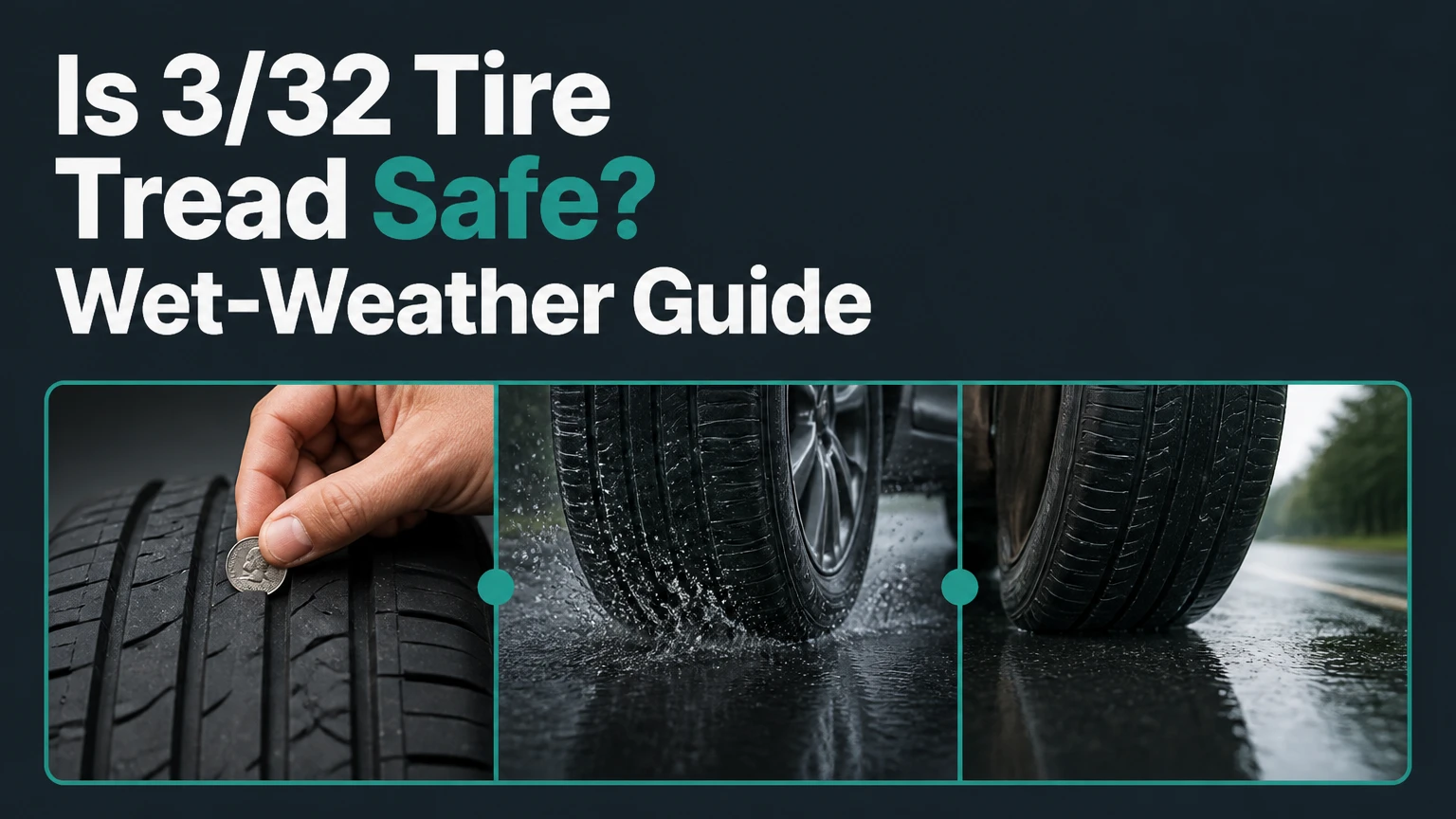
A tire with 3/32-inch tread is generally not a safe long-term choice, especially for rain, highway speeds, or snow. Although 3/32 inch is above the common 2/32-inch replacement limit for passenger tires in the United States, the tire has little reserve for water evacuation, winter traction, uneven wear, or sudden weather changes.
Key Facts at a Glance
- 3/32-inch tread is usually legal for passenger tires in many U.S. locations, but legal does not mean advisable.
- Most new passenger tires measure about 10/32 to 12/32 inch, although some performance tires begin below or above that range.
- A 4/32-inch reading is a common wet-weather replacement planning point, while 5/32 inch is a more useful winter minimum.
- Tread depth must be measured at the lowest worn location, including inner, center, and outer grooves.
- A quarter or penny test can screen for low tread, but neither test precisely confirms 3/32 inch.
- Replacement timing depends on weather, tire age, cracking, uneven wear, vehicle type, speed, and available tread across all tires.
Is 3/32 Tire Tread Safe?
A 3/32-inch passenger tire is marginal for dry, low-speed driving and unsuitable for dependable wet-weather or winter performance. Drivers may be able to reach a tire shop carefully, but treating 3/32 inch as a normal service-life target leaves little margin when water, cold temperatures, heavy loads, or uneven wear reduce traction further.
The distinction between legal minimum and safe operating condition matters. In the United States, 2/32 inch is widely used as the point at which a passenger tire is worn out, but states can define inspection and enforcement rules differently. Tire manufacturers and safety organizations commonly advise replacing tires before that threshold because wet braking and hydroplaning resistance decline before the grooves are legally bald.
NHTSA describes tires as “the only thing that connects your vehicle to the road.” That connection depends on rubber compound, inflation pressure, construction, temperature, road surface, and remaining tread. A 3/32 reading does not automatically mean the tire will fail today, but it does mean the tire should be scheduled for replacement rather than estimated for another season.
What Does 3/32 Inch Mean on a Tire?
Tread depth is the distance from the top of the tread blocks to the floor of a primary groove, measured in thirty-seconds of an inch. Three thirty-seconds equals approximately 0.094 inch, or 2.4 millimeters.
The amount of rubber already used depends on the tire’s original design. A tire that began at 10/32 inch has lost about 70% of its measured tread depth at 3/32 inch, while a tire that began at 12/32 inch has lost 75%. Those percentages describe depth, not a precise percentage of usable mileage, because wear rates change as tires age and wear patterns develop.
| Tread reading | Approximate millimeters | Typical meaning for passenger vehicles |
|---|---|---|
| 10/32-12/32 in | 7.9-9.5 mm | Common new-tire range |
| 6/32-8/32 in | 4.8-6.4 mm | Usable reserve for everyday driving |
| 4/32-5/32 in | 3.2-4.0 mm | Plan replacement, especially for rain or snow |
| 3/32 in | 2.4 mm | Marginal; replace soon |
| 2/32 in or less | 1.6 mm or less | Common passenger-tire replacement limit |
Why Does Low Tread Reduce Wet-Weather Safety?
Low tread reduces wet-weather safety because shallower grooves provide less volume and less edge depth for moving water away from the contact patch. The tire does not need to be completely bald to lose wet grip, because braking and steering performance can deteriorate while visible grooves remain.
A moving tire must push water out of the narrow area where rubber meets pavement. Groove geometry, speed, inflation pressure, vehicle weight, road texture, water depth, and tire design all affect the result. At 3/32 inch, a tire may still evacuate water on ordinary damp pavement, but standing water and worn road surfaces create a much smaller safety margin.
Hydroplaning does not begin at one universal speed or one exact tread depth. A 3/32 tire can hydroplane at a lower speed than a deeper tire under the same conditions, but no responsible inspection can promise that a particular tire will remain attached to the road at a stated speed. Drivers should slow substantially in heavy rain and avoid cruise control over pooled water regardless of tread depth.
Does 3/32 Tread Add 80 Feet to Wet Stopping Distance?
No universal 80-foot or 100-foot penalty applies to every 3/32-inch tire. Wet stopping distance varies with tire model, vehicle brakes, ABS calibration, speed, pavement, water depth, temperature, and test method, so a single number would falsely imply laboratory precision.
The reliable conclusion is directional: worn tires generally have less wet traction and less hydroplaning resistance than comparable new tires. A driver traveling 60 mph has far less time to respond than one traveling 35 mph, and a heavy SUV on a wet highway demands more energy dissipation than a compact car at urban speed.
An important practitioner rule is to treat water depth and speed as multipliers, not isolated risks. A 3/32 tire on a lightly wet road at moderate speed may feel normal, while the same tire crossing a puddle during a 70-mph rainstorm may lose steering authority quickly.
How Should You Measure 3/32-Inch Tread?
Use a tread-depth gauge and record the lowest reading at several points around each tire. A gauge is more reliable than a coin test, and the lowest groove matters because one worn shoulder can make the tire unsafe even when the center tread appears acceptable.
Follow these steps:
- Park on level ground and engage the parking brake. Turn the steering wheel to expose the front-tire grooves, then inspect the rear tires by moving the vehicle as needed.
- Check the entire circumference. Look for primary grooves, embedded objects, exposed cords, bulges, cuts, cracks, and wear bars before measuring.
- Place the gauge probe in a groove. Keep the gauge base flat on the tread blocks, not on a wear indicator or raised tread feature.
- Measure three lateral positions. Record the inner edge, center, and outer edge of each tire.
- Repeat at multiple circumferential locations. Four points around the tire can reveal a localized bald patch or cupping.
- Write down the lowest result. Use that number for the replacement decision, not the average of better readings.
The tread-wear indicators molded into many passenger tires sit at approximately 2/32 inch. They show that the tire has reached a common replacement threshold, not that the tire remains fully safe above the bars.
Can a Penny or Quarter Confirm 3/32 Tread?
A penny or quarter cannot precisely confirm a 3/32-inch reading. The penny test can suggest that tread is near or below the common 2/32-inch benchmark, while a quarter test can indicate tread near 4/32 inch, but lighting, angle, groove shape, and coin position affect the result.
Use a gauge when the decision involves a purchase, inspection, long trip, winter driving, or an AWD vehicle. A basic manual gauge usually costs about $5-$15, and a digital gauge commonly costs about $15-$35. Measure all four tires because axle-to-axle differences often matter more than one isolated measurement.
Which Tread Depth Is Safe for Rain and Snow?
For ordinary rain, 4/32 inch is a sensible point to plan replacement, while 5/32 inch or more provides a better reserve for snow and slush. These are practical maintenance thresholds, not universal laws, and the tire’s age, design, inflation, and condition still control the final decision.
| Tread depth | Rain performance | Snow performance | Recommended action |
|---|---|---|---|
| 8/32-12/32 in | Strong groove reserve | Stronger snow evacuation and edges | Continue inspections |
| 6/32-7/32 in | Generally serviceable | Usable, with reduced reserve | Monitor wear and pressure |
| 4/32-5/32 in | Replacement planning point | Limited, especially in slush | Replace before severe weather |
| 3/32 in | Marginal during heavy rain | Poor reserve for snow and slush | Replace promptly |
| 2/32 in or less | High loss-of-traction risk | Inadequate for dependable winter use | Remove from service |
Consumer Reports and Tire Rack have both popularized the 4/32-inch wet-weather planning threshold, while winter-tire specialists often recommend replacing conventional tires around 5/32 or 6/32 inch when snow traction matters. The thresholds differ because wet-road safety and snow grip require different tread features.
Tread depth alone also cannot create winter-tire performance. Winter tires use softer cold-weather compounds, high sipe density, and tread patterns designed for packed snow. A 3/32-inch all-season tire is not a substitute for a properly maintained winter tire.
Is 3/32 Tread Legal in the United States?
Three thirty-seconds of an inch is above the common 2/32-inch passenger-tire limit, but legality depends on jurisdiction, tire position, vehicle category, and inspection rules. A legal reading can still fail a safety inspection if the tire has exposed cords, severe cracking, a bulge, prohibited damage, or unsafe uneven wear.
Federal commercial rules are stricter in specific applications. Under 49 CFR 393.75, commercial motor vehicles generally require at least 4/32 inch in the major grooves of front tires and at least 2/32 inch in other positions, subject to the regulation’s wording and vehicle circumstances. Fleet operators should follow the rule, state requirements, and their company’s maintenance policy rather than apply passenger-car assumptions.
Legal status answers whether a tire may pass a minimum rule. It does not answer whether the tire is suitable for a 500-mile trip, mountain snow, a loaded trailer, or high-speed rain.
Can You Drive Temporarily on 3/32 Tread?
A short trip to a tire shop may be reasonable when the tire has no damage, the weather is dry, the route is slow, and the driver reduces speed. Continuing normal highway use, delaying through a rainy season, or starting a winter season on 3/32-inch tires is a poor risk trade-off.
| Driving situation | 3/32-inch risk level | Practical decision |
|---|---|---|
| Dry city streets, 25-40 mph | Lower but not zero | Drive only as needed for replacement |
| Highway commute, 55-75 mph | High exposure to water and emergency braking | Replace before regular commuting |
| Heavy rain or standing water | High hydroplaning exposure | Avoid driving; arrange replacement |
| Snow, slush, or freezing rain | Very poor traction reserve | Replace before travel |
| Hot, dry climate with no forecast rain | Temporary delay may be possible | Inspect daily and schedule replacement |
| Loaded SUV, van, or trailer | Greater load and braking demands | Replace before carrying the load |
Climate can change the urgency, but it does not convert worn tread into new tread. In an arid region, a driver might safely delay a few days under carefully controlled conditions, yet a sudden storm, underinflation, or a long highway trip can remove that margin.
If driving is unavoidable, verify cold inflation pressure, remove unnecessary speed, increase following distance, avoid abrupt steering, and stop if the tire develops vibration, noise, a bulge, or visible structural damage.
How Much Life Remains at 3/32 Tread?
No dependable mileage estimate can be calculated from a 3/32-inch measurement alone. Typical remaining mileage may range from a few hundred miles to several thousand miles, depending on alignment, tire compound, rotation history, vehicle weight, climate, and the driver’s acceleration and braking habits.
A tire that loses 1/32 inch every 5,000 miles cannot be assumed to continue at that rate. Heat cycles, low pressure, shoulder wear, and the final thin tread block can change the wear rate. Measuring every 1,000 miles or at each oil change is more useful than relying on a calendar estimate.
| Variable | Typical effect on remaining life | Inspection consequence |
|---|---|---|
| Highway commuting | Adds heat and high-speed wet exposure | Replace before the rainy season |
| Correct inflation | Reduces irregular shoulder wear | Check pressure monthly and before trips |
| Misalignment | Can consume one shoulder quickly | Inspect alignment and suspension |
| Soft performance compound | Often wears faster | Use the tire model’s warranty guidance |
| Heavy SUV or frequent towing | Raises load and heat | Replace earlier than a light sedan |
| Cold, dry storage | Slows use but does not reverse aging | Check DOT age and sidewalls |
Tread depth is only one measurement. A tire with 3/32 inch and severe sidewall cracking needs immediate removal, while an undamaged tire at 4/32 inch may be a better temporary candidate.
Should You Replace One Tire, Two Tires, or Four?
Replace the number of tires required to preserve safe matching, and follow the vehicle and tire manufacturer’s guidance for allowable tread-depth differences. On many two-wheel-drive vehicles, replacing a pair is preferable when one tire is damaged or significantly more worn; on AWD vehicles, even small circumference differences can create drivetrain stress.
Install the deeper-tread pair on the rear axle when replacing two tires on a vehicle where the manufacturer permits that configuration. Michelin and other tire manufacturers warn that placing better tires on the front can make the rear axle lose grip first during wet cornering, producing difficult-to-correct oversteer.
AWD systems vary. Some manufacturers specify a maximum tread-depth difference, often expressed as a fraction of an inch or a circumference measurement, rather than a universal 3/32 rule. Confirm the owner’s manual or dealer specification before buying one tire. A tire shop may measure circumference or recommend a shaved replacement tire when the model and manufacturer permit it.
| Replacement condition | Common configuration | Required check |
|---|---|---|
| One punctured tire, three nearly new | One tire may be possible | Match model, size, and tread closely |
| One tire at 3/32, same axle at 5/32 | Replace two often preferred | Verify axle and manufacturer guidance |
| AWD tire set with mixed wear | Two or four may be required | Check maximum circumference difference |
| Four tires at 3/32 | Replace all four | Inspect alignment before installation |
| Uneven inner-edge wear | Replace affected tire or pair | Perform alignment and suspension inspection |
A new tire next to a heavily worn tire can have a different rolling circumference even when both share the same nominal size. That difference may affect handling, ABS, traction control, and AWD coupling.
What Other Problems Make a 3/32 Tire Unsafe?
A tire can be unsafe before reaching 2/32 inch because structural damage, age-related cracking, heat, or uneven wear may compromise it. Tread depth cannot detect every failure mode.
Inspect for:
- Sidewall bulges, which can indicate internal cord damage.
- Deep cuts, punctures, or repairs outside approved tread areas.
- Cracks between tread blocks or around the sidewall.
- Exposed belts or cords.
- Cupping, scalloping, or diagonal wear from suspension problems.
- Inner-edge wear hidden from a casual outside inspection.
- A DOT date code indicating substantial age.
- Repeated pressure loss from a valve, wheel, or puncture.
The DOT code identifies the week and year of manufacture. For example, “2322” means the tire was manufactured in the 23rd week of 2022. Tire manufacturers differ in their age recommendations, but many advise detailed inspection after five years and replacement around ten years from manufacture regardless of remaining tread. Follow the tire maker’s specific policy.
An expert inspection should also check tire pressure when cold. Underinflation concentrates heat and shoulder wear, while overinflation reduces the size of the contact patch and can worsen center wear.
What Does Replacement Usually Cost?
Typical passenger-vehicle replacement costs range from about $100-$250 per tire for common sedan and crossover sizes, with premium, run-flat, truck, and specialty tires often costing more. Mounting, balancing, disposal, taxes, alignment, and road-hazard coverage can add approximately $20-$60 per tire or a separate service charge.
| Vehicle and tire category | Typical tire price | Typical installed set |
|---|---|---|
| Compact sedan, standard all-season | $80-$150 each | $380-$700 for four |
| Midsize sedan or crossover | $110-$220 each | $520-$1,000 for four |
| Light truck or large SUV | $150-$300 each | $700-$1,350 for four |
| Performance or run-flat tire | $180-$400 each | $850-$1,800 for four |
These are typical U.S. retail ranges, not guaranteed quotes. Tire size, speed rating, load index, brand, local labor, promotions, and disposal fees can change the total substantially.
Budget for an alignment when wear is uneven. Replacing tires without correcting toe or camber problems can return a new set to 3/32-inch wear on one shoulder much sooner than expected.
What Should Different Drivers Do at 3/32?
Most drivers should schedule replacement promptly at 3/32 inch, but the immediate risk differs by environment and use. A dry-climate driver making a short local trip has more temporary margin than a winter driver, highway commuter, or commercial operator.
- Daily highway commuter: Replace before regular high-speed travel, particularly during the wet season.
- Rain-prone climate driver: Replace promptly because standing water and repeated wet braking consume the available margin.
- Snow-belt driver: Replace before winter; 3/32 inch provides inadequate reserve for snow, slush, and cold-weather grip.
- Desert-climate driver: A brief dry-weather delay may be manageable, but inspect for heat cracking and keep the replacement appointment.
- AWD owner: Measure all tires and consult the owner’s manual before replacing fewer than four.
- Fleet operator: Apply 49 CFR 393.75 where relevant, plus state and company requirements; front commercial tires commonly require 4/32 inch.
- Trailer or heavily loaded vehicle owner: Replace earlier because load, heat, and braking demand increase the consequence of lost traction.
Common Mistakes When Evaluating 3/32 Tires
The most damaging mistake is treating the legal limit as a target. The second is measuring only the visible center tread, which can hide dangerous inner-edge wear caused by alignment or suspension faults.
Mistake 1: Measuring One Groove
A single center reading can conceal an inner shoulder at 2/32 inch. Measure inner, center, and outer positions at several points around every tire.
Mistake 2: Trusting a Coin Test for a Purchase
Coins provide a rough screen, not a defensible measurement. Use a $5-$35 tread gauge when deciding whether to replace or when comparing AWD tires.
Mistake 3: Ignoring Inflation Pressure
Pressure should be checked cold against the vehicle placard, not the maximum pressure molded into the sidewall. The placard value is the vehicle manufacturer’s operating recommendation.
Mistake 4: Replacing Tires Without Fixing Wear Causes
Alignment, worn tie rods, bent wheels, weak shocks, and incorrect pressure can create rapid uneven wear. Diagnose the cause before installing replacement tires.
Mistake 5: Assuming No Exposed Cord Means Safe
A tire can lose wet traction, develop internal damage, or suffer sidewall cracking without exposing cord. Visible cord is an emergency warning, not the first point at which risk begins.
FAQ
Can I pass inspection with 3/32-inch tires?
Possibly, because many passenger-tire rules use 2/32 inch as a minimum, but inspection standards vary by state and tire condition. A tire with 3/32 inch can still fail because of exposed cords, bulges, major cuts, severe cracking, unsafe uneven wear, or a commercial-vehicle position requiring 4/32 inch.
Is 4/32-inch tread enough for winter?
Four thirty-seconds is generally a replacement-planning point, not a strong winter target. Drivers who regularly encounter snow should consider replacing conventional tires around 5/32-6/32 inch and should use properly rated winter tires when temperatures and road conditions justify them.
Does tire brand change whether 3/32 is safe?
Yes, tire design changes wet braking, groove volume, compound behavior, and hydroplaning resistance. A premium touring tire and a worn performance tire with the same measured depth may not perform identically, but neither should be treated as having the wet-weather reserve of a new tire.
How often should I check tread depth?
Check tread depth at least monthly, before long trips, and whenever pressure loss, vibration, noise, or steering changes occur. Measure sooner if the vehicle has uneven wear, recent alignment work, frequent towing, aggressive driving, or tires older than five years.
Can rotating tires make 3/32-inch tread safe again?
Rotation can equalize future wear, but it cannot restore lost tread or reverse rubber aging. Rotate only according to the tire and vehicle manufacturer’s pattern, and replace tires that have already reached 3/32 inch when wet or winter conditions are expected.
Should I buy used tires with 3/32-inch tread?
Used tires at 3/32 inch usually offer poor value because their remaining wet-weather reserve is small and their age, storage history, repairs, and internal condition may be unknown. A used tire should have substantially more tread, a documented history, matching specifications, and a professional inspection.
The Bottom Line
Is 3/32 tire tread safe? It is above the common passenger-vehicle legal minimum in many U.S. jurisdictions, but it is not a prudent long-term safety threshold. Replace 3/32-inch tires promptly, especially before rain, snow, highway travel, heavy loading, or an AWD trip, and inspect all tires for age, damage, inflation problems, and uneven wear before fitting the replacement set.