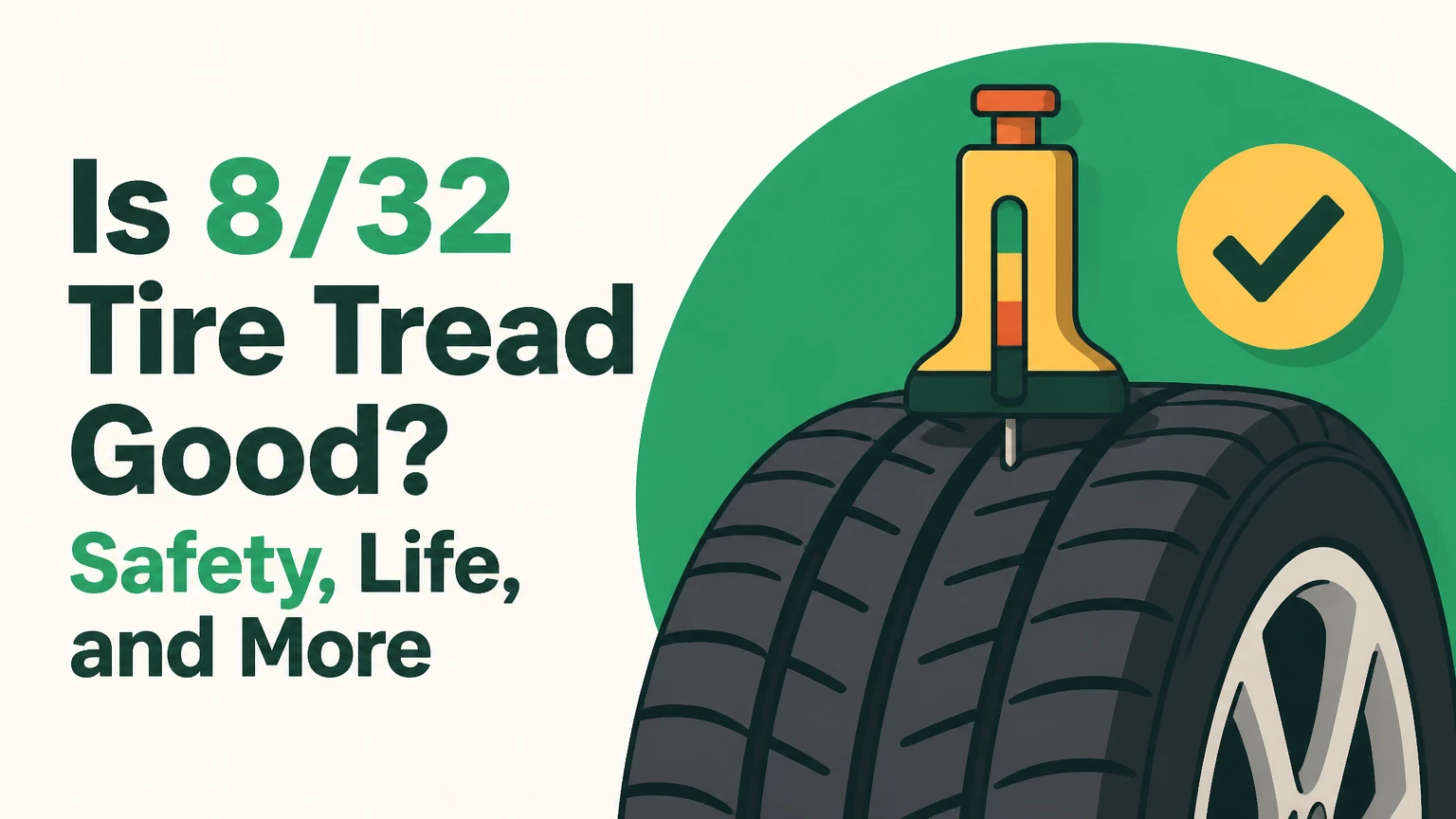
Yes, 8/32-inch tire tread is generally very good for a passenger vehicle and is well above the common 2/32-inch legal replacement threshold in the United States. A tire measuring 8/32 inch usually has substantial usable tread remaining, but safety also depends on age, cracking, punctures, inflation, alignment, tire type, and whether all grooves measure similarly.
Key Facts at a Glance
- 8/32 inch equals 6.35 millimeters of tread depth.
- Most new passenger tires measure approximately 10/32 to 12/32 inch, although original depth varies by model and purpose.
- An 8/32-inch measurement is excellent for ordinary rain and dry-road driving when the tire has no structural or age-related defects.
- The 8/32 reading does not prove that 75% of the tire’s total service life remains, because tires wear at different rates and begin with different tread depths.
- The lowest measurement across the tread controls the safety assessment, not the best-looking outer shoulder.
- A used 8/32-inch tire still requires a DOT age check, damage inspection, and price comparison.
What Does 8/32-Inch Tread Mean?
An 8/32-inch reading means the distance from the bottom of a main tread groove to the top of the tread is eight thirty-seconds of an inch, or about 6.35 mm. Tire shops measure this depth with a tread-depth gauge, usually at several points across each tire.
The number describes remaining rubber in the grooves. It does not describe the tire’s complete condition, traction percentage, or exact mileage remaining. A 2021 touring tire with even 8/32-inch tread may be a better purchase than a newer tire with 6/32 inch, but a cracked, heat-damaged, or improperly repaired tire should not be selected solely because its tread is deep.
Michelin gives the familiar consumer warning, “If you can see the top of Lincoln’s head, it’s time to replace your tires,” referring to the United States penny test. A tread gauge is more accurate, particularly when the difference between 4/32 and 5/32 inch affects a purchase decision.
Is 8/32 Close to New?
8/32 inch is close to new for some passenger tires, but the answer depends on the tire’s original molded depth. A tire that began at 10/32 inch has lost 2/32 inch. A tire that began at 12/32 inch has lost 4/32 inch, so the same reading represents a different portion of its usable tread.
| Original tread depth | Current depth | Tread removed | Approximate usable tread remaining to 2/32 |
|---|---|---|---|
| 10/32 inch | 8/32 inch | 2/32 inch | 75% |
| 11/32 inch | 8/32 inch | 3/32 inch | 67% |
| 12/32 inch | 8/32 inch | 4/32 inch | 60% |
| 14/32 inch | 8/32 inch | 6/32 inch | 50% |
The percentages above use a simple calculation from the original depth to 2/32 inch. They are not manufacturer-tested service-life percentages. Tread wear is affected by alignment, inflation, axle load, road surface, driving style, climate, tire compound, and rotation frequency.
Is 8/32 Tire Tread Good for Rain and Highway Driving?
8/32 tire tread is very good for rain and highway driving when the tread is even, the rubber is flexible, and the tire is correctly inflated. Deep grooves provide more void space for moving water away from the contact patch, but hydroplaning also depends on speed, water depth, tire width, inflation pressure, road texture, and tire design.
The National Highway Traffic Safety Administration identifies tires as the vehicle’s connection with the road, which explains why tread depth cannot be evaluated separately from pressure and condition. A tire with 8/32 inch can still lose wet performance if it has hardened from age, carries too much pressure, or has severe shoulder wear.
At highway speeds, reduce speed in standing water even with excellent tread. Tread cannot guarantee grip when water depth exceeds the tire’s drainage capacity.
What Changes as Tread Wears?
Wet and snow performance generally declines as grooves become shallower, although the rate differs by tire model. The 2/32-inch threshold is a legal replacement benchmark in many U.S. jurisdictions, not a promise that the tire performs like new until that point.
| Measured tread depth | Typical condition | Rain guidance | Snow guidance | Practical action |
|---|---|---|---|---|
| 10/32-12/32 inch | New range for many tires | Strong water evacuation | Strong groove depth | Maintain pressure and rotate |
| 8/32 inch | Very good | Suitable for normal wet roads | Good reserve for many all-season tires | Inspect and monitor normally |
| 6/32 inch | Usable | Usually adequate with sound rubber | Reduced bite in packed snow | Check monthly in winter climates |
| 4/32 inch | Planning point | Less wet-weather margin | Often weak for serious snow | Plan replacement, especially before wet season |
| 3/32 inch | Low reserve | Noticeably reduced margin | Poor snow performance | Replace soon |
| 2/32 inch or less | Worn to common legal limit | High replacement urgency | Inadequate for dependable snow traction | Replace immediately |
The 4/32-inch recommendation is a practical maintenance threshold used by many tire professionals for wet or winter conditions. It is not a universal legal limit, and local regulations can differ.
How Much Life Is Left at 8/32?
A typical 8/32-inch passenger tire may have tens of thousands of miles of tread use remaining, but no responsible estimate can be based on tread depth alone. A rough calculation uses the tire’s original depth, the planned replacement depth, and its observed wear rate.
Use this formula:
Estimated remaining miles = current usable tread ÷ observed tread wear per mile
For a simplified estimate based on a 10/32-inch tire, replacing at 2/32 inch, 8/32 inch represents 6/8 of the usable tread. That equals 75% of the theoretical usable tread, not necessarily 75% of the tire’s calendar life or warranty mileage.
| Tire scenario | Starting depth | Planned replacement | Theoretical usable tread at 8/32 | Typical interpretation |
|---|---|---|---|---|
| Touring sedan tire | 10/32 inch | 2/32 inch | 75% remaining | Often substantial mileage remains |
| SUV all-season tire | 12/32 inch | 4/32 inch | 50% remaining | Replace earlier in wet or snowy regions |
| Performance tire | 10/32 inch | 3/32 inch | 71% remaining | Compound may wear faster than touring rubber |
| Winter tire | 12/32 inch | 6/32 inch for snow planning | 33% remaining | Snow capability may decline before legal wear |
A warranty does not produce a guaranteed mileage conversion. A 60,000-mile treadwear warranty applies only under its terms and does not mean a tire with 8/32 inch automatically has a specific number of miles left. To estimate your own wear rate, record tread depth now and again after 5,000 miles.
Why Is the Lowest Measurement the Important One?
The lowest measurement determines the tire’s effective tread condition because a worn section can lose water evacuation and structural margin before the rest of the tread looks healthy. Measure the center grooves and both shoulders on every tire, then compare the readings across the axle.
A common professional check takes three readings across the tread and at least two locations around the circumference. A tire reading 8/32 inch on the outer shoulder but 3/32 inch on the inner shoulder should be treated as a 3/32-inch tire, not an 8/32-inch tire.
How Do You Measure 8/32-Inch Tread?
Measure 8/32-inch tread with a tread-depth gauge for a numeric result, then inspect the wear bars and tread pattern for confirmation. The process takes about 5-10 minutes for four tires and costs nothing with a borrowed gauge or roughly $5-$15 for a basic mechanical gauge.
Step 1: Check the Cold Tire
Park on level ground and measure when the tires are cool. Do not measure immediately after a long highway trip because heat changes tire pressure and can make inspection less consistent.
Step 2: Measure Three Across-Tread Positions
Place the gauge probe in a main groove, avoiding the raised tread-wear indicator. Measure the inner shoulder, center groove, and outer shoulder.
Step 3: Repeat Around Each Tire
Take at least three circumferential readings on each tire. Record the lowest number, not the average, and look for a repeating pattern that suggests alignment or inflation problems.
Step 4: Inspect the Wear Bars and Sidewalls
Tread-wear indicators sit at approximately 2/32 inch in many passenger tires. Examine the sidewalls for bulges, cuts, cracking, exposed cords, and date markings.
Step 5: Use Coin Tests Only as Screening Tools
The penny test can indicate that tread is near the common 2/32-inch replacement point. The quarter test gives a rough 4/32-inch screening point, but neither test identifies uneven wear, age, internal damage, or the exact 8/32-inch measurement.
| Inspection method | Approximate threshold | What it can tell you | What it cannot tell you |
|---|---|---|---|
| Tread-depth gauge | Exact 1/32 increments | Numeric groove depth | Internal belt damage |
| Penny test | About 2/32 inch | Very low tread screening | Accurate 4/32-8/32 measurement |
| Quarter test | About 4/32 inch | Wet-weather planning estimate | Tire age or casing condition |
| Wear bars | About 2/32 inch | Near-limit groove wear | Remaining snow performance |
Should You Buy Used Tires With 8/32 Tread?
A used tire with 8/32-inch tread can be a reasonable purchase only when its age, condition, history, specifications, and price have been verified. Tread depth is attractive because it is easy to measure, but it does not reveal curb impacts, run-flat damage, repairs, heat exposure, or long-term storage.
A used 8/32-inch tire should meet all of these checks:
- Confirm the DOT date code. The final four digits show the week and year of manufacture. For example, 2323 means the 23rd week of 2023.
- Check the complete tread. Measure all grooves and both shoulders, not only the most convenient location.
- Inspect for cracking. Reject sidewall weather cracking, bead damage, bulges, exposed cords, and irregular lumps.
- Ask about repairs. A properly installed internal plug-patch repair may be acceptable in the repairable tread area, but shoulder and sidewall repairs are unsafe.
- Match specifications. Load index, speed rating, size, construction, and seasonal category must suit the vehicle.
- Compare total cost. Mounting, balancing, disposal, shipping, and a short warranty can reduce the apparent savings.
Tire manufacturers commonly advise inspection after five years of service and replacement around ten years from manufacture, although recommendations differ by brand and market. A six-year cutoff is a conservative buying rule, not a universal law. A tire’s storage history and visible condition still matter.
| Used-tire factor | Acceptable example | Reject or investigate example | Why it matters |
|---|---|---|---|
| Manufacture date | DOT 1824 | DOT 3417 with cracking | Rubber ages even when tread remains |
| Tread consistency | 8/32, 8/32, 7/32 across grooves | 8/32 outside, 3/32 inside | Lowest area controls performance |
| Repair location | Center tread plug-patch | Shoulder plug or sidewall repair | Flexing can compromise the repair |
| Size and rating | 225/55R17, load and speed match | Lower load index than vehicle requirement | Capacity may be inadequate |
| Purchase price | $80 tire plus $25 installation | $75 tire plus $60 shipping and fees | Apparent savings may disappear |
Is 8/32 Enough for Winter or Snow?
8/32-inch tread is usually enough to begin a winter season on a sound all-season tire, but it does not make an all-season tire equivalent to a winter tire. Snow traction depends on groove depth, sipe density, rubber compound, temperature, axle load, and the tire’s three-peak mountain snowflake certification.
For drivers in areas with frequent deep snow, 6/32 inch is a useful personal replacement-planning point because snow tires need additional groove depth to retain snow-biting ability. Drivers in mild climates may prioritize wet braking and rubber age instead.
An 8/32-inch summer performance tire is a poor winter choice despite its depth. Summer compounds can become hard at low temperatures, while a winter tire remains more flexible and uses a tread pattern designed for snow and ice.
Can You Replace Only One Tire at 8/32?
Replacing one tire depends on drivetrain, tire wear difference, manufacturer instructions, and the remaining tires’ condition. Front-wheel-drive vehicles often tolerate one replacement more readily than all-wheel-drive vehicles, but the replacement tire still needs to match the axle’s size, type, load index, and speed rating.
AWD systems can be sensitive to rolling-circumference differences. Some manufacturers specify a maximum tread-depth difference as low as 2/32 inch, while others provide a different limit. The vehicle owner’s manual and tire manufacturer should control the decision.
| Vehicle situation | 8/32 replacement question | Practical decision |
|---|---|---|
| Two-wheel drive, other axle at 7/32 | One tire differs by 1/32 | Usually pair-match on the axle |
| Two-wheel drive, other tires at 4/32 | One tire differs by 4/32 | Replace in pairs or evaluate all four |
| AWD, other tires at 7/32 | One tire differs by 1/32 | Check manufacturer tolerance |
| AWD, other tires at 4/32 | One tire differs by 4/32 | Ask a dealer or tire specialist before fitting |
| Same model unavailable | Exact replacement discontinued | Compare circumference and approved alternatives |
Tire shaving can reduce a replacement tire to match the others, but it should be performed only by a qualified tire shop after confirming that the tire model and casing are suitable. Installing a new 10/32-inch tire beside three 4/32-inch tires can be more problematic than using a correctly matched used tire.
What Causes an 8/32-Inch Tire to Wear Unevenly?
Uneven wear usually points to inflation, alignment, suspension, rotation, or balancing problems rather than normal tread aging. A single depth reading can hide the fault, so a cross-tread measurement pattern provides more useful evidence.
| Wear pattern | Likely cause | Confirming check | Corrective action |
|---|---|---|---|
| Center tread lower than shoulders | Overinflation | Compare cold pressure with door placard | Set placard pressure and inspect tire |
| Both shoulders lower | Underinflation or overload | Check pressure and vehicle load | Inflate correctly and check load |
| One inner edge lower | Excessive camber or toe | Alignment measurement | Repair suspension and align vehicle |
| Cupped or scalloped blocks | Worn damper, imbalance, or misalignment | Bounce, balance, and suspension check | Correct mechanical fault |
| Diagonal feathering | Toe misalignment | Run hand across blocks | Perform alignment |
| One tire rapidly losing depth | Brake drag, alignment, or damaged tire | Compare axle temperatures and readings | Diagnose before replacing |
Expert inspection rule: never approve a tire from one showroom measurement. A tire with 8/32 inch on the outside edge may already require replacement if the inside edge has reached the wear bars.
A second rule concerns vibration. Tread depth does not explain a new vibration, pull, thump, or air-pressure loss. Those symptoms require a mechanical inspection even when the gauge shows 8/32 inch.
How Does 8/32 Compare With New, 6/32, and 4/32?
8/32 inch is materially better than 4/32 inch for wet-weather reserve, but the comparison depends on the tire category and intended conditions. New tires provide the design’s original groove geometry, while worn tires gradually lose drainage and, in winter tires, snow-biting capability.
| Tread depth | Best interpretation | Main limitation | Replacement planning |
|---|---|---|---|
| New, 10/32-12/32 | Original tread condition | Highest purchase cost | No tread-based action |
| 8/32 | Strong remaining depth | Does not prove good age or condition | Keep if inspections pass |
| 6/32 | Moderate remaining depth | Less snow reserve | Monitor in winter climates |
| 4/32 | Reduced wet and snow margin | More planning urgency | Replace before severe weather |
| 2/32 | Common legal limit in the U.S. | Very little safety reserve | Replace immediately |
The best comparison is not “8/32 equals a certain percentage.” Compare the actual starting depth, measured wear rate, tire age, and your replacement threshold. That method prevents a 12/32-inch truck tire from being incorrectly judged identical to a 10/32-inch touring tire.
When Should You Replace an 8/32-Inch Tire?
Replace an 8/32-inch tire immediately when it has a sidewall bulge, exposed cord, severe cracking, unsafe repair, repeated pressure loss, or damage from a puncture or impact. Replace or professionally evaluate it when wear is uneven, the tire is near the manufacturer’s age recommendation, or the tire no longer matches the vehicle’s required specifications.
Keep monitoring an 8/32-inch tire when the tread is even, the DOT date is reasonable, the sidewall is sound, inflation is stable, and the tire matches the other tires on the vehicle. Check pressure monthly and before long trips, using the vehicle placard rather than the maximum pressure molded into the sidewall.
A lease-return vehicle with 8/32 inch typically has more tread than a 4/32-inch return requirement, but lease companies can also assess damage, mismatched tires, warning lights, and sidewall condition. Contract language controls.
What Is 8/32 Tread Not Good Enough For?
8/32-inch tread is not enough to compensate for a defective tire, an unsuitable tire category, severe winter conditions, or a large AWD tread mismatch. Depth cannot restore traction lost through hardened rubber, incorrect load rating, poor inflation, or damaged internal belts.
That limitation matters because tread depth is the easiest tire attribute to advertise. It is also the easiest one to overvalue.
Frequently Asked Questions
Is 8/32 tread good on a used tire?
8/32 tread is a strong reading on a used tire, provided the tire is relatively fresh, undamaged, evenly worn, correctly sized, and fairly priced. Check the four-digit DOT date, inspect both sidewalls and the inner shoulder, verify repairs, and compare the tire’s load and speed ratings with the vehicle placard.
How long does 8/32 tread last?
The mileage remaining at 8/32 depends on the original tread depth and the tire’s observed wear rate. A typical passenger tire may have substantial mileage left, but a precise estimate requires two measurements separated by known mileage. Warranty mileage alone cannot convert 8/32 inch into a guaranteed lifespan.
Is 8/32 good for a lease return?
8/32 inch is usually comfortably above common 4/32-inch lease-return tread requirements. Lease agreements vary, and inspectors may also reject tires for sidewall damage, different tire types, low pressure, missing matching equipment, or a warning light. Check the return guide before scheduling the inspection.
Can an 8/32 tire be mixed with a 6/32 tire?
A 2/32-inch difference may be acceptable on some two-wheel-drive vehicles, but axle placement, tire model, size, and manufacturer instructions matter. AWD and four-wheel-drive vehicles can have stricter limits. Ask a tire professional before mixing, especially when the tires differ in rolling circumference.
Does 8/32 tread pass a tire inspection?
An 8/32-inch reading generally passes the tread-depth portion of an inspection, but inspectors also check age, sidewall condition, exposed cords, bulges, punctures, repairs, pressure, and uneven wear. Legal requirements vary by jurisdiction, so tread depth alone does not guarantee approval.
The Bottom Line
Is 8/32 tire tread good? Yes, 8/32 inch is generally very good and provides a substantial safety margin for normal dry and wet driving. Keep the tire when its age, rubber condition, pressure, alignment, tread uniformity, and vehicle compatibility also pass inspection. For a used tire, verify the DOT date and damage history before treating 8/32 inch as a bargain.