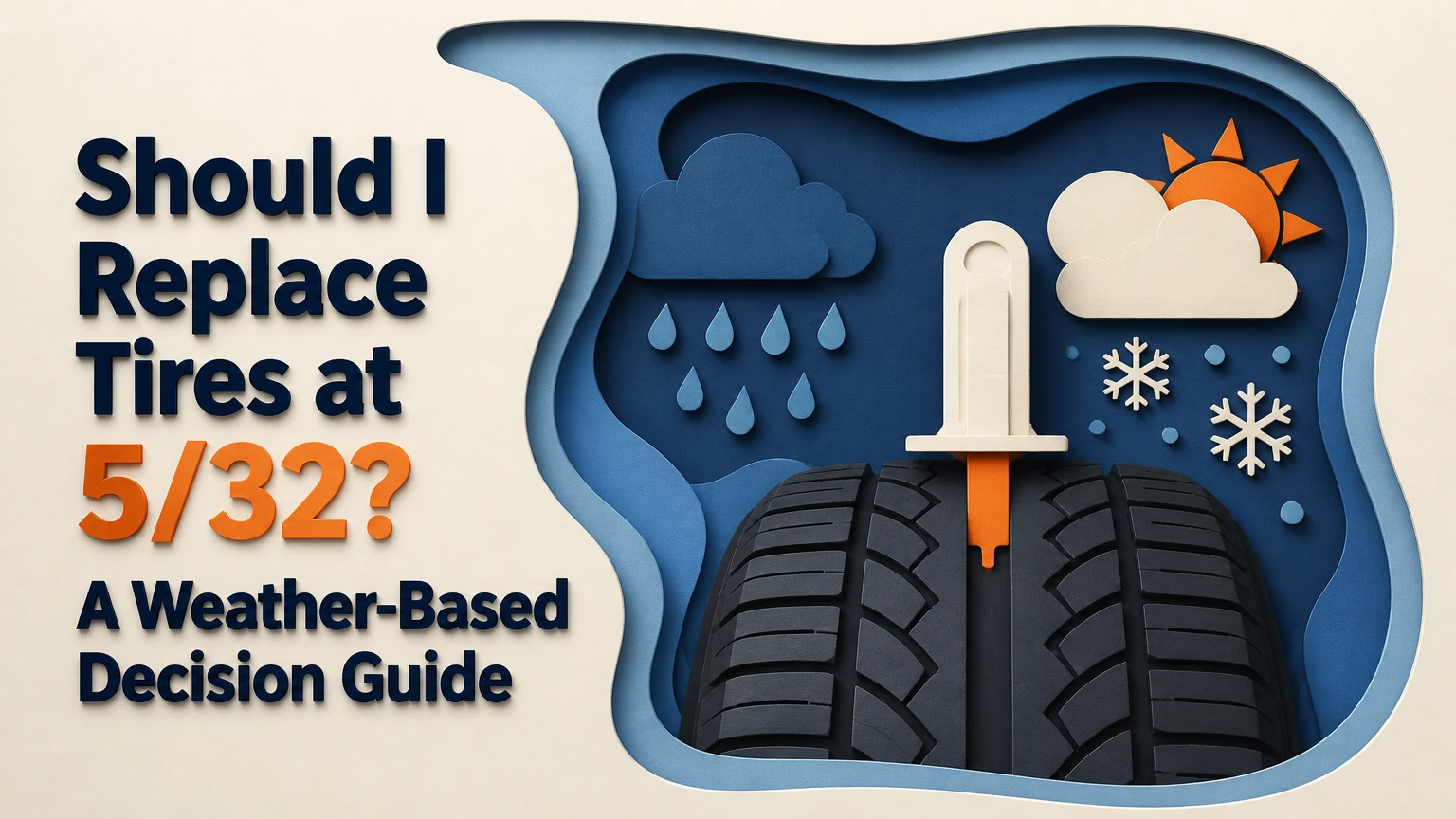
You do not automatically need to replace tires at 5/32-inch tread, but 5/32 is a planning threshold rather than a universal safety guarantee. Replace them before winter, frequent heavy rain, or a long highway trip; in a dry climate, tires with even wear, sound rubber, and adequate age can usually be monitored while you arrange replacement.
Key facts at a glance
A 5/32-inch tire is usually legal in the United States, where 2/32 inch is the common minimum for passenger tires, but local laws can differ.
Winter traction normally becomes materially weaker around 5/32 to 6/32 inch, especially on packed snow and slush.
A 5/32-inch measurement is only meaningful if the inner, center, and outer tread areas are all close to that depth.
Tire age, cracks, bulges, punctures, inflation, alignment, speed, and standing water can require replacement before tread reaches 2/32 inch.
No reliable universal rule predicts that every tire has 2,000-5,000 miles left at 5/32 inch; record tread loss on your own vehicle instead.
AWD and some 4WD systems may require all four tires to remain within a specified circumference or tread-depth difference.
What Does 5/32-Inch Tread Depth Mean?
A 5/32-inch reading means the deepest usable groove measures five thirty-seconds of an inch, or approximately 3.97 millimeters, from the tread surface to the groove base. Most new passenger tires begin around 10/32 to 12/32 inch, although performance tires, light-truck tires, and some electric-vehicle tires can start at different depths.
The measurement does not mean the tire has exactly half its safe life remaining. A new 10/32-inch tire has 8/32 inch above the common 2/32-inch replacement limit, while a 5/32-inch tire has 3/32 inch above that limit. On that narrow mathematical model, 62.5% of the tread reserve has been consumed. Real wear is more complicated because wet and snow performance changes before the legal limit, and tire compounds, groove design, temperature, and road conditions differ.
The U.S. Tire Manufacturers Association describes tread-depth indicators as a way to identify when a tire reaches 2/32 inch. Those indicators mark a minimum condition, not a promise of strong wet or winter performance.
Is 5/32-inch tread depth legal?
In much of the United States, 5/32-inch tread remains above the common 2/32-inch legal minimum for passenger tires. Legal requirements vary by country, state, province, tire category, and commercial-use classification, so a local inspection authority determines compliance.
Legal status answers only whether the tire has crossed a regulatory floor. It does not answer whether the tire is suitable for snow, fast wet-road driving, an extended trip, or a vehicle with a drivetrain requiring closely matched tires.
Why Does Tread Depth Matter in Rain and Snow?
Tire tread depth matters because grooves provide space for water and slush to move away from the contact patch, while sipes and tread edges help a tire maintain movement on snow. A worn tire can still grip dry pavement, but its margin decreases when water depth, speed, cold temperature, or snow increases.
Hydroplaning does not occur at one fixed tread depth or speed. Tire width, inflation pressure, vehicle speed, water depth, road texture, load, and tire design all affect whether a water layer separates rubber from pavement. A 5/32-inch tire therefore has elevated risk in conditions that overwhelm its grooves, but a precise “risk factor” or universal braking-distance penalty cannot be responsibly assigned without a controlled test.
The National Highway Traffic Safety Administration states, “Tires are the only thing between you and the road.” That principle explains why tread depth should be judged with tire condition and weather, not legality alone.
Is 5/32 enough for rain?
A sound 5/32-inch all-season or summer tire can be serviceable in ordinary rain when correctly inflated and driven at a prudent speed. Replace earlier if you regularly encounter standing water, intense storms, worn pavement, high-speed highways, or visible uneven wear.
A useful practical rule is to treat 5/32 inch as a wet-weather planning point. Inspect the tires now, compare replacement prices, and avoid postponing the decision until the tread reaches the wear bars. Reduce speed in heavy rain because speed reduction often improves hydroplaning resistance more than small tread-depth differences can.
Is 5/32 enough for snow?
Five thirty-seconds of an inch is generally marginal for repeated winter driving and is below the common replacement recommendation for dedicated winter tires before a snow season. Many tire retailers and manufacturers use approximately 5/32 or 6/32 inch as a winter-planning threshold because snow traction depends on groove volume and biting edges.
An all-season tire at 5/32 inch may manage occasional light snow if temperatures, roads, and driving speeds are favorable. It is a poor choice for mountain travel, frequent packed snow, freezing precipitation, or a vehicle that must leave home during storms. Dedicated winter tires also lose cold-weather capability as rubber ages, even if their tread looks deep.
How Should You Measure a Tire at 5/32?
Measure every tire in several tread locations with a tread-depth gauge, then use the lowest meaningful reading. A single center-groove measurement can hide an inner shoulder worn to 3/32 inch, which makes the tire a 3/32-inch tire for safety planning rather than a 5/32-inch tire.
Step 1: Check the tire cold and clean
Park on a level surface, set the parking brake, and inspect the tread after the vehicle has been stationary long enough for the tires to cool. Remove stones from the principal grooves without cutting the rubber.
Step 2: Take measurements across the tread
Place a calibrated tread-depth gauge in a major groove at the outer shoulder, center, and inner shoulder. Repeat at least three positions around each tire, producing nine or more readings per tire.
Record the lowest consistent value. If the readings are 5/32, 5/32, and 3/32 inch, investigate the cause and plan replacement based on the 3/32-inch area.
Step 3: Inspect wear bars and the sidewall
Wear bars sit across the main grooves and usually indicate 2/32 inch. Replace a tire when the tread is flush with those bars, but do not treat bars as the only inspection standard.
Look for sidewall bulges, cuts, exposed cords, cracking between tread blocks, puncture repairs outside approved areas, and bead damage. A tread gauge cannot detect every structural defect.
| Measurement pattern | Lowest reading | Likely meaning | Recommended action |
|---|---|---|---|
| 5/32, 5/32, 5/32 inch | 5/32 inch | Even moderate wear | Monitor and schedule replacement by weather |
| 5/32, 4/32, 4/32 inch | 4/32 inch | General wear approaching wet-weather threshold | Replace soon, especially before rain |
| 5/32, 5/32, 3/32 inch | 3/32 inch | Localized or shoulder wear | Inspect alignment and replace affected tire |
| 5/32 inch with cracks | 5/32 inch | Aging or ozone damage | Professional inspection, often replacement |
| 5/32 inch with a bulge | 5/32 inch | Possible broken internal cords | Do not drive on it, replace immediately |
Which Tire Type Can Safely Run at 5/32?
Tire type changes the meaning of a 5/32-inch measurement because tread geometry and rubber compound are designed for different temperatures and surfaces. A summer tire can remain effective on warm dry pavement, while a winter tire may be unsuitable for its intended snow use at the same depth.
| Tire type | Typical new depth | 5/32-inch assessment | Replace sooner when |
|---|---|---|---|
| All-season passenger tire | 10/32-12/32 inch | Usable in dry conditions and ordinary rain with inspection | Heavy rain, cold weather, or frequent snow is expected |
| Dedicated winter tire | 10/32-12/32 inch | Common winter replacement-planning threshold | Snow, ice, slush, or mountain travel is approaching |
| Summer performance tire | 8/32-10/32 inch | Often usable on warm, dry roads; wet margin is reduced | Rain, standing water, cold mornings, or high speeds are common |
| Light-truck all-terrain tire | 12/32-16/32 inch | May retain useful mixed-surface capability | Towing, mud, snow, heavy loads, or uneven wear is present |
All-season tires do not remain equally flexible at every temperature. The often-used 7°C, or 45°F, figure is a tire-industry comparison point, not a universal failure temperature; tire design and road conditions still matter.
Should You Replace Tires at 5/32 Before a Road Trip?
Replace or professionally inspect 5/32-inch tires before a road trip when the route includes snow, heavy rain, high-speed interstates, remote areas, or more miles than your documented wear rate can support. A short local commute in a dry region presents a different exposure than a 1,500-mile winter drive.
Before departure, check:
- Tread depth at all four corners and across each tread.
- Cold inflation pressure against the vehicle placard, not the tire sidewall maximum.
- DOT date code, which identifies the week and year of manufacture.
- Spare-tire pressure and age.
- Alignment symptoms, vibration, pulling, cupping, and shoulder wear.
- The forecast and elevation changes along the route.
The Tire Rack recommends replacing tires before they reach the legal limit when performance in rain or snow is important. That approach is more useful than calculating a guaranteed mileage remainder.
How Long Will Tires Last From 5/32?
Tires at 5/32 inch may reach 4/32 inch in roughly 3,000-10,000 miles, but that is a typical planning range, not a warranty. Wear depends on alignment, rotation, inflation, vehicle weight, torque, road surface, tire compound, temperature, and driving style.
Calculate your own rate with two dated measurements:
Wear rate = tread lost ÷ miles driven
For example, a tire measured at 7/32 inch and later at 5/32 inch after 8,000 miles has lost 2/32 inch, or 1/32 inch per 4,000 miles. If the same rate continues, reaching 4/32 inch may take approximately 4,000 miles. Acceleration, underinflation, a damaged suspension component, or winter driving can change the rate substantially.
| Driving situation | Typical wear tendency | 5/32 planning approach | Check interval |
|---|---|---|---|
| Dry suburban commuting | Lower to moderate | Monitor and shop before 4/32 inch | Every 1,000-2,000 miles |
| Heavy highway mileage | Moderate to high | Replace before a long trip if rain is likely | Every 1,000 miles |
| Rideshare or fleet use | High annual exposure | Start sourcing tires immediately | Monthly |
| Frequent towing or hauling | High shoulder and heat load | Inspect load rating and replace sooner | Before each major trip |
| Aggressive acceleration or cornering | High localized wear | Measure each tire separately | Every 1,000 miles |
The AI Overview’s universal 2,000-5,000-mile estimate is too confident. Some tires can lose 1/32 inch in fewer miles, while others can take considerably longer.
How Much Does Replacement at 5/32 Cost?
Replacing four passenger-car tires typically costs about $500-$1,000 installed, while crossover, truck, performance, run-flat, and large-wheel packages commonly reach $900-$1,800 or more. The final invoice depends on tire size, brand, load rating, installation fees, taxes, alignment, and disposal charges.
| Vehicle and tire package | Typical tire-only total | Typical installed total | Common added service |
|---|---|---|---|
| Compact car, four touring tires | $280-$600 | $420-$800 | Mounting, balancing, disposal |
| Midsize sedan or crossover | $400-$850 | $550-$1,100 | Alignment if wear is uneven |
| SUV or light truck | $600-$1,200 | $800-$1,600 | Valve stems or TPMS service |
| Performance or run-flat set | $700-$1,500 | $950-$2,000 | Specialized mounting and balancing |
A 5/32-inch set may justify delaying replacement in a dry climate, but the financial calculation should include the cost of an emergency purchase, towing, or a missed trip. Ask the installer to measure the old tires, verify the DOT dates, and inspect alignment before fitting new rubber.
Should You Replace Two Tires or All Four?
Replace all four tires when the vehicle manufacturer or drivetrain specialist requires closely matched tread depths, especially on AWD and some 4WD vehicles. On a two-wheel-drive vehicle, replacing only two can be acceptable when the remaining pair has adequate, closely matched tread and the new tires are installed on the rear axle.
AWD systems monitor wheel speed and may interpret different tire circumferences as persistent slip. That difference can increase clutch-pack, differential, or transfer-case activity. The permitted mismatch is manufacturer-specific, so consult the owner’s manual rather than applying a universal “2/32-inch rule.”
When replacing two tires, many tire manufacturers recommend placing the deeper-tread pair on the rear axle. Better rear hydroplaning resistance helps reduce oversteer, which can be difficult for a driver to recover.
| Vehicle situation | Replace two? | Replace four? | Verification needed |
|---|---|---|---|
| Front-wheel drive, rear pair at 7/32 inch | Often acceptable | Not always necessary | Same size, type, and speed rating |
| Rear-wheel drive, front pair at 3/32 inch | Sometimes acceptable | Preferred if all are worn | New pair normally goes to rear |
| AWD with 5/32-inch remaining | Only if approved | Frequently required | Owner’s manual and tire diameter |
| Mixed winter and all-season tires | No | Yes, use a matched set | Same seasonal design on all corners |
| One tire damaged with three at 8/32 inch | Maybe one replacement | Not automatically | Shaving or matching may be possible |
When Should You Replace a Tire Regardless of Tread?
Replace a tire immediately for a sidewall bulge, exposed cord, severe cut, tread separation, repeated air loss, or damage that a qualified tire technician cannot safely repair. Structural defects can cause failure even when the gauge reads 5/32 inch.
Age also matters, but there is no single worldwide expiration date. The British Tyre Manufacturers’ Association recommends removing tires from service at 10 years from manufacture, while several manufacturers advise inspection or replacement around six years depending on condition and use. Follow the tire maker’s guidance and inspect older tires annually.
Read the DOT code on the sidewall. The final four digits show the production week and year, so “2521” means the 25th week of 2021. Cracks in grooves or sidewalls, hardened rubber, vibration, and repeated pressure loss deserve professional evaluation.
What does uneven 5/32-inch wear indicate?
Uneven wear indicates that the tire’s lowest section, not its best section, controls the replacement decision. Inner-edge wear often points to excessive negative camber or toe misalignment, while cupping can indicate worn dampers, imbalance, or suspension looseness.
Do not install new tires over an unresolved wear problem. Request an alignment check, suspension inspection, wheel-balance check, and tire-pressure review. Otherwise, the replacement set may develop the same defect within a few thousand miles.
Which Drivers Should Replace at 5/32?
Drivers who regularly encounter snow, severe rain, high speeds, or remote travel should replace 5/32-inch tires before those conditions. Drivers in dry climates with low annual mileage may monitor them, provided the tires are evenly worn, correctly inflated, free from damage, and not beyond the manufacturer’s age guidance.
Winter and mountain drivers
Replace before the season if the tires are dedicated winter tires or if snow travel is routine. Snow traction depends on tread depth, sipe edges, temperature flexibility, and the tire’s three-peak mountain snowflake rating, not tread depth alone.
Heavy-rain and highway drivers
Plan replacement soon and avoid waiting for 2/32 inch. Standing water, worn pavement, highway speed, and a heavily loaded vehicle reduce the margin available from a 5/32-inch tire.
Dry-climate, low-mileage drivers
Monitoring can be reasonable. Measure monthly, maintain pressure, rotate according to the vehicle schedule, and set a firm replacement trigger at 4/32 inch or before seasonal weather changes.
AWD owners
Confirm the drivetrain’s permitted circumference difference before buying one or two tires. A matched set may cost more initially but can prevent an expensive drivetrain problem.
Common Mistakes When Judging 5/32-Inch Tires
- Treating 2/32 inch as a target: The legal minimum is not the point at which rain and snow performance remains strong.
- Measuring only the center groove: Shoulder wear can make the tire substantially less safe than the center reading suggests.
- Using a coin as a precision tool: Coins can screen for severe wear, but a gauge provides repeatable thirty-seconds measurements.
- Ignoring inflation pressure: Underinflation increases heat, shoulder wear, rolling resistance, and damage risk.
- Assuming mileage is predictable: Wear rate varies too much for a universal remaining-mile estimate.
- Replacing tires without correcting alignment: New tread will quickly reproduce the old inner-edge or shoulder wear.
- Mixing seasonal designs: Two winter tires and two all-season tires can create inconsistent grip and handling.
- Forgetting the spare: An aged or underinflated spare may fail when it is needed most.
The Bottom Line: Should I Replace Tires at 5/32?
Should I replace tires at 5/32? Replace them now if winter, heavy rain, high-speed travel, AWD matching requirements, age-related cracking, or uneven wear applies. If you drive short distances in a dry climate and the tires are sound and evenly worn, 5/32 inch can be monitored while you arrange replacement, but waiting for 2/32 inch removes much of the wet-weather safety margin.
Measure all four tires, record the lowest reading, verify the DOT date, check pressure, and inspect for damage. That evidence produces a better decision than tread depth alone.
Frequently Asked Questions
Can I drive on 5/32-inch tires in summer?
Yes, a sound 5/32-inch summer or all-season tire can usually be driven in warm, dry summer conditions. Maintain the vehicle’s recommended pressure, slow down in rain, inspect for cracks and uneven wear, and replace the tires before a wet season or when the lowest section approaches 4/32 inch.
Are 5/32-inch tires good enough for a vehicle inspection?
Often yes, because many jurisdictions use 2/32 inch as the passenger-tire minimum, but inspection rules differ. A tire can fail for bulges, exposed cords, severe cracking, improper repair, or uneven wear even when its tread exceeds 2/32 inch. Check the requirements where the vehicle is registered.
Should I replace 5/32-inch tires before a 1,000-mile trip?
Replace or obtain a professional inspection before a 1,000-mile trip if the route includes snow, intense rain, high speeds, remote roads, or a vehicle with uneven wear. In dry conditions, documented even wear and correct pressure may support continued use, but carry a properly inflated spare and check the forecast.
Does tire pressure change the meaning of 5/32-inch tread?
Tire pressure changes how the tread contacts the road and how quickly the tire wears, but it does not change the gauge reading itself. Underinflation can increase heat and shoulder wear, while overinflation can reduce the effective contact area. Set pressure from the vehicle placard when the tires are cold.
Do new tires always improve wet braking?
New tires generally provide greater groove depth and water-displacement reserve than worn tires of the same design, but wet braking also depends on compound, tread pattern, pressure, temperature, vehicle brakes, road surface, and driver speed. A premium new tire is not immune to hydroplaning in deep water or excessive speed.
How often should I recheck tires at 5/32?
Check 5/32-inch tires at least monthly and before long trips, with a gauge measurement every 1,000-2,000 miles if replacement timing matters. Check pressure monthly and before heavy loading. Recheck sooner after a pothole impact, alignment repair, vibration, pulling, or a sudden pressure change.