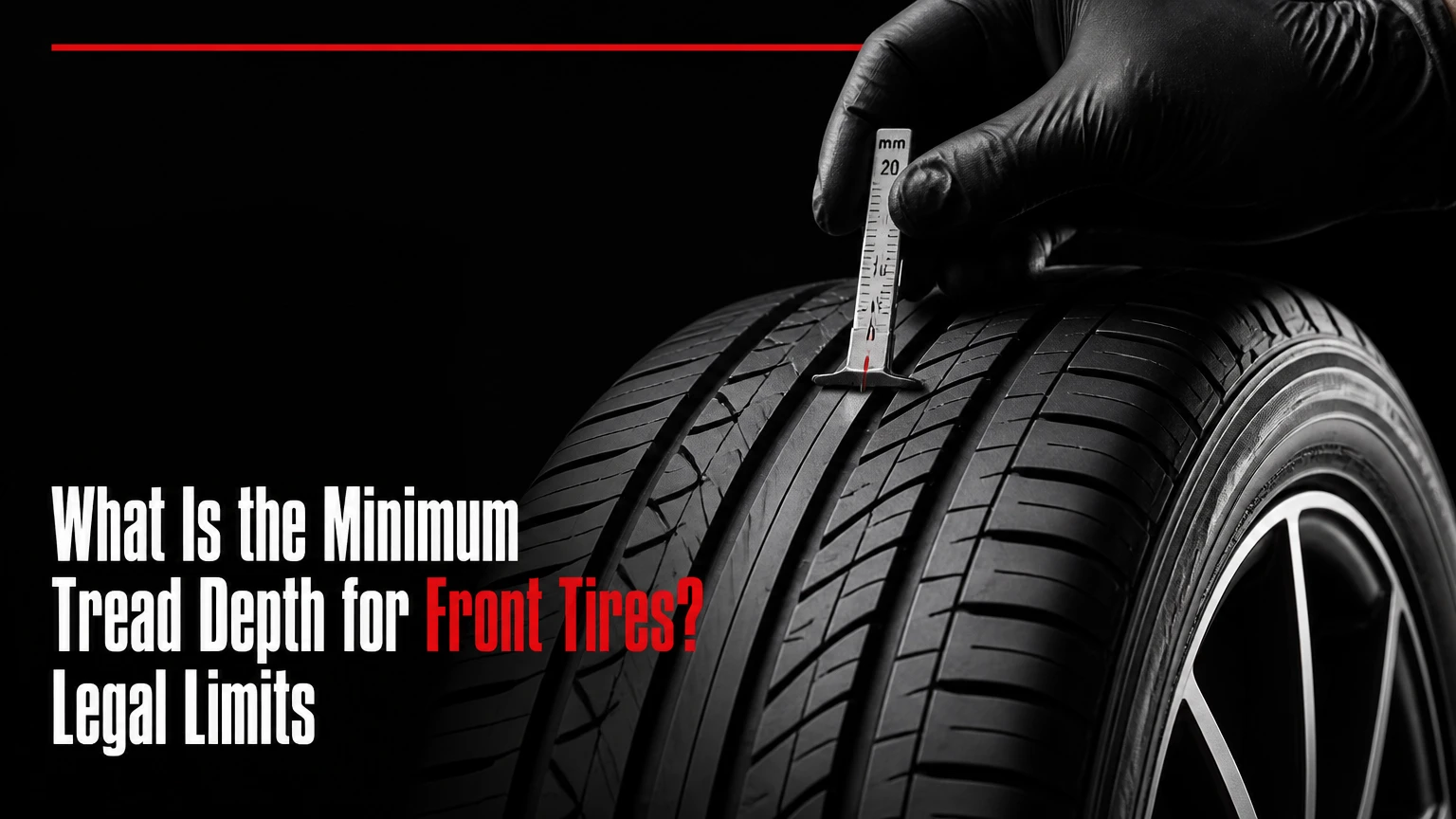
For a standard passenger vehicle in the United States, the minimum legal tread depth for front tires is generally 2/32 inch, or 1.6 mm, measured in the major grooves. Commercial vehicles under Federal Motor Carrier Safety Administration rules need at least 4/32 inch, or 3.2 mm, on steering-axle tires. For rain, snow, and highway safety, replacing passenger tires at 4/32 inch provides a larger safety margin than waiting for the legal limit.
Key Facts at a Glance
2/32 inch (1.6 mm) is the common US legal minimum for passenger-car tires.
4/32 inch (3.2 mm) is the FMCSA minimum for tires on a commercial vehicle’s steering axle.
A tire can be legal at 3/32 inch but provide less wet-weather margin than a tire at 4/32 inch.
Tread depth must be checked across the inner, center, and outer portions of each front tire.
A molded tread-wear indicator becomes flush with the tread at approximately 2/32 inch.
Snow tires commonly lose meaningful snow traction before reaching 2/32 inch, so replacement planning often begins around 5/32 inch.
What Does Tread Depth Measure?
Tire tread depth is the distance from the top of the tread rubber to the bottom of a major groove, normally reported in thirty-seconds of an inch or millimeters. The measurement excludes shallow sipes, decorative channels, and raised tread-wear indicators. A proper reading identifies the tire’s remaining usable groove depth, not the apparent height of an isolated tread block.
Most new passenger tires begin with approximately 10/32-12/32 inch, or 8-9.5 mm, of tread. Performance tires may start nearer 8/32 inch, while many winter tires begin at 10/32-13/32 inch. The manufacturer’s design determines the original depth, so remaining tread should be compared with the tire’s wear indicators and service guidance rather than an assumed new-tire number.
A tread-wear indicator is a raised bridge molded into the longitudinal grooves. When surrounding rubber wears flush with that bridge, the tire is near 2/32 inch in that groove. Wear bars are useful for a quick warning, but they do not replace a gauge because tires can be below the limit in one area while another area still appears acceptable.
Why Does Front-Tire Tread Matter?
Front-tire tread matters because the front axle normally provides steering, much of the braking force, and the first contact with standing water. When grooves become shallow, water evacuation becomes less effective, and the front tires can lose contact with the road before the driver can steer or brake normally.
Grooves do not create most of a road tire’s dry-pavement grip. Their primary role is channeling water away from the contact patch. Michelin’s tire-maintenance guidance describes tread depth as an important factor in maintaining wet-road performance, while the National Highway Traffic Safety Administration identifies worn tires as a safety concern because reduced tread can impair traction.
Front-tire failure also produces a more immediate control problem than comparable rear-tire wear. A rear tire with poor wet grip can cause oversteer, but a front tire that loses contact may prevent the vehicle from following steering input. That difference explains why steering-axle tires receive stricter commercial rules.
What Is the Legal Minimum Tread Depth for Front Tires?
The legal minimum for front tires depends on the vehicle category and location. In the United States, 2/32 inch is the widely used legal threshold for ordinary passenger vehicles, while FMCSA regulations require at least 4/32 inch in the principal grooves of tires on a commercial motor vehicle’s steering axle.
The phrase “across the globe” is inaccurate as a legal summary. Tire laws are set by countries, states, provinces, inspection authorities, and vehicle classifications; the European Union does not impose one universal passenger-tire tread rule that replaces every national rule. The United Kingdom, for example, generally requires at least 1.6 mm across the central three-quarters of the tread and around the full circumference, while other jurisdictions use different wording or thresholds.
| Vehicle or jurisdiction example | Minimum or inspection threshold | Equivalent | Important qualification |
|---|---|---|---|
| US passenger vehicle, common standard | 2/32 inch | 1.6 mm | State inspection and enforcement details can vary |
| US commercial steer axle, FMCSA | 4/32 inch | 3.2 mm | Applies to principal grooves on steering-axle tires |
| United Kingdom passenger vehicle | 1.6 mm | About 2/32 inch | Applies across the central 75% and full circumference |
| Winter replacement planning | 4/32-5/32 inch | 3.2-4.0 mm | Safety guidance, not a universal legal limit |
| Typical new passenger tire | 10/32-12/32 inch | 8-9.5 mm | Original depth varies by tire model |
A legal minimum is a failure threshold, not a recommended target. It answers whether a tire may pass a basic legal inspection, but it does not guarantee adequate wet braking, snow traction, or resistance to hydroplaning in every vehicle and weather condition.
Are Commercial Front Tires Held to a Different Standard?
Commercial front tires are held to a different standard in the United States. Under 49 CFR §393.75, a tire on a commercial motor vehicle’s front wheels must generally have at least 4/32 inch of tread when measured in a major groove, excluding tie bars, wear indicators, and irregular tread features.
The FMCSA standard applies to the steering axle because steering control depends directly on those tires. A commercial operator should verify the exact vehicle classification, tire position, and applicable federal or state rule before relying on a general passenger-car answer. A pickup used privately is not automatically subject to every commercial-motor-carrier requirement.
For fleet management, replacing steer tires at 5/32 inch rather than waiting for 4/32 inch creates inspection and weather margin. That is a preventive operating policy, not the legal minimum.
Is 4/32 Better Than 2/32 for Passenger Vehicles?
Four thirty-seconds of an inch is a safer replacement planning point than 2/32 inch for drivers who regularly encounter rain, snow, slush, or high-speed highways. Two thirty-seconds is commonly the legal floor, but 4/32 leaves twice the measured groove depth remaining and provides more channel volume for water.
The benefit is not a simple promise of a specific percentage improvement. Wet grip depends on tread pattern, rubber compound, inflation, temperature, speed, road texture, and vehicle weight. A worn touring tire and a worn winter tire at the same measured depth may perform differently.
| Remaining tread | Legal status for typical US passenger car | Wet-weather interpretation | Recommended action |
|---|---|---|---|
| 8/32-12/32 inch | Well above minimum | Typical new-tire range | Maintain pressure and inspect monthly |
| 6/32 inch | Above minimum | Generally substantial groove depth | Monitor normal wear |
| 5/32 inch | Above minimum | Useful margin before severe weather | Plan replacement if winter is approaching |
| 4/32 inch | Above minimum | Common proactive rain or winter-planning point | Schedule replacement, especially for highway use |
| 3/32 inch | Usually above minimum | Reduced wet-weather reserve | Replace soon; avoid postponing in rainy climates |
| 2/32 inch or less | At or below common legal floor | Tread-wear indicators may be flush | Replace immediately and avoid unnecessary driving |
NHTSA and tire manufacturers caution that tread depth is only one part of tire condition. A tire at 5/32 inch with a sidewall bulge is unsafe, while a tire at 3/32 inch with no visible damage still has less wet-weather margin than a new tire.
How Do You Measure Front-Tire Tread Depth?
Measure each front tire in at least three width positions and several circumferential locations, using a calibrated tread-depth gauge in the deepest major grooves. The process normally takes 5-10 minutes for both tires, and the lowest valid reading matters more than the average.
Step 1: Prepare the Vehicle
Park on level ground, apply the parking brake, and switch off the vehicle. Turn the steering wheel to expose the front tread, but do not place any part of your body beneath the vehicle. If the tire must be removed for an inner-edge inspection, use proper lifting equipment and never rely on a jack alone.
Step 2: Select the Correct Groove
Find a continuous longitudinal groove that runs around the tire. Avoid the raised wear bar, shoulder sipes, small rain channels, and tread features that do not represent the principal groove depth.
Step 3: Take Gauge Readings
Place the gauge’s flat base on the tread blocks and push the probe into the groove. Take readings near the inner shoulder, center, and outer shoulder, then repeat at two or three positions around the circumference.
A practical recording pattern is:
| Tire position | Inner tread | Center tread | Outer tread | Lowest reading |
|---|---|---|---|---|
| Left front, location 1 | 5/32 | 6/32 | 5/32 | 5/32 |
| Left front, location 2 | 4/32 | 5/32 | 5/32 | 4/32 |
| Right front, location 1 | 6/32 | 6/32 | 5/32 | 5/32 |
| Right front, location 2 | 5/32 | 6/32 | 5/32 | 5/32 |
The lowest reading in the example is 4/32 inch on the left front tire. That tire is not at the common passenger-car legal minimum, but the uneven result justifies an alignment and suspension inspection.
Step 4: Compare the Results
Compare both tires, not only the more visible outer shoulders. A tire with one inner-edge reading at 2/32 inch should not be treated as a 5/32-inch tire because the center tread remains deeper. Inspection authorities and tire professionals evaluate the worn area that creates the safety or compliance concern.
Step 5: Inspect Damage and Age
Check for cuts, punctures, sidewall bulges, exposed cords, cracking, embedded objects, and unusual vibration. Find the DOT date code on the sidewall; the final four digits identify the manufacturing week and year, such as 2522 for the 25th week of 2022.
Can You Use a Penny to Check Front-Tire Tread?
A US penny can screen for approximately 2/32 inch, but it cannot provide an exact tread-depth measurement. Insert the penny with Lincoln’s head facing downward into a major groove; if the top of his head remains visible, the tread is near or below the common legal limit.
The penny test has practical limits. Lighting, viewing angle, groove shape, coin wear, and irregular wear can change the result. The test also misses a low inner shoulder if the driver checks only the outermost visible groove.
Use a dedicated gauge when the result is close to the threshold, when buying a used vehicle, before a long trip, or when wear is uneven. A gauge costing roughly $5-$20 gives a numerical result in 32nds of an inch or millimeters and is more useful for tracking wear over time.
Do not confuse the penny test with the US quarter test. A quarter is often used as a rough 4/32-inch screening tool, but neither coin establishes legal compliance in every jurisdiction.
How Does Weather Change the Replacement Decision?
Rain and snow justify replacing passenger tires before 2/32 inch because shallow grooves reduce the margin for water evacuation and snow engagement. Drivers in wet climates should commonly plan around 4/32 inch, while winter-tire users may choose 5/32 inch before the snow season begins.
Winter traction depends on more than depth. A winter tire’s softer compound can harden with age, and its sipes can lose effectiveness as the tread wears. A tire with 4/32 inch may remain serviceable on wet pavement but provide substantially less grip in deep snow than the same model at 8/32 inch.
| Driving condition | Practical planning point | Main reason | Decision |
|---|---|---|---|
| Dry urban driving | 3/32-4/32 inch | Lower standing-water exposure | Arrange replacement before 2/32 inch |
| Frequent heavy rain | 4/32 inch | More water-channel capacity | Replace or schedule promptly |
| Highway driving above 60 mph | 4/32 inch | Greater speed and water-wedge risk | Avoid waiting for the legal floor |
| Regular snow and slush | 5/32 inch | Better snow packing and evacuation | Replace before winter travel |
| Occasional light snow | 4/32 inch | Moderate seasonal reserve | Inspect before the season |
| Commercial steer operation | 5/32 inch policy point | Inspection and operational reserve | Replace before reaching 4/32 inch |
These figures are practical maintenance thresholds, not universal laws. The tire manufacturer’s severe-weather guidance, local regulations, and the vehicle’s drive system can change the appropriate decision.
What Causes Uneven Front-Tire Wear?
Uneven front-tire wear usually indicates incorrect inflation, alignment error, worn suspension components, or tire imbalance rather than normal tread aging. Measuring only the center of the tire can hide a dangerous shoulder that has already reached 2/32 inch.
| Wear pattern | Typical appearance | Likely cause | Required check |
|---|---|---|---|
| Center wear | Center ribs lower than shoulders | Chronic overinflation | Check cold pressure against door-jamb specification |
| Both shoulder wear | Inner and outer edges worn | Underinflation or overloading | Check pressure, load, and valve leakage |
| One shoulder wear | One edge substantially lower | Camber or toe misalignment | Obtain a four-wheel alignment |
| Feathering | Ribs feel sharp in one direction | Incorrect toe setting | Inspect alignment and steering components |
| Cupping | Repeating scallops or dips | Damaged damper, imbalance, or looseness | Inspect struts, wheel balance, and joints |
| Patch wear | Isolated bald areas | Locked braking or tire imbalance | Inspect brakes, balance, and tire construction |
A front tire that reaches 2/32 inch on one shoulder has reached a replacement concern even if the opposite shoulder measures 5/32 inch. Replacing the tire without correcting the cause often produces the same pattern on the replacement.
An important practitioner rule is to measure after correcting pressure, but not to erase the evidence first. Photographing the tread pattern before service can help an alignment technician identify whether toe, camber, or suspension movement caused the wear.
Should You Replace One Front Tire or Two?
Replace front tires in pairs whenever possible, with the matching pair installed on the same axle. Replacing one tire creates different tread depths and potentially different rolling circumferences, which can affect cornering balance, braking behavior, and stability-control intervention.
The exception involves drivetrain and manufacturer requirements. On many all-wheel-drive vehicles, replacing one tire may create a circumference difference large enough to stress the center differential or clutch pack; the owner’s manual may require replacing four tires or matching the new tire’s diameter through shaving.
If one tire is damaged and the other is nearly new, a tire professional may determine that a single replacement is acceptable after comparing model, size, load index, speed rating, and measured circumference. The replacement should normally match the other tire on the axle.
Install the tires with greater remaining tread on the rear axle when a pair is replaced, unless the vehicle manufacturer specifies another arrangement. Tire manufacturers including Michelin and Bridgestone commonly give this guidance because rear grip helps resist oversteer on wet roads.
Can a Tire Be Unsafe Above the Legal Minimum?
A tire can be unsafe above the legal minimum because tread depth does not detect aging, structural damage, improper inflation, or internal separation. A 4/32-inch tire with a sidewall bulge, exposed cord, severe cracking, or repeated air loss requires immediate professional evaluation.
Inspect the sidewalls and tread for:
- Bulges, bubbles, cuts, or exposed reinforcement
- Cracks between tread blocks or in the sidewall
- Nails, screws, or punctures near the shoulder
- Vibration, pulling, thumping, or rhythmic noise
- A sudden pressure loss or repeated TPMS warning
- Tread separation, belt distortion, or a raised section
- DOT age that conflicts with the tire maker’s service guidance
Chronological age is a separate issue from tread depth. Many manufacturers recommend professional inspection after five years in service and replacement around ten years from manufacture, while some brands or vehicle makers specify shorter intervals. The date code alone does not prove a tire is unsafe, but an older tire deserves closer inspection because rubber and internal components age even when mileage is low.
TPMS also has a limited role. The system warns about inflation pressure, not tread depth, alignment, cracking, or wet-road grip. Correct pressure improves tire performance but cannot restore worn rubber.
How Much Does Front-Tire Replacement Cost?
Typical US passenger-car replacement costs are about $120-$350 per tire, excluding premium specialty sizes, mounting, balancing, taxes, and disposal fees. A pair commonly totals $280-$750 after installation, while SUV, electric-vehicle, performance, and light-truck tires can cost $250-$550 each.
| Replacement category | Typical tire price | Typical installed pair | Typical service time |
|---|---|---|---|
| Compact all-season tire | $90-$160 | $220-$380 | 45-75 minutes |
| Mid-size touring tire | $120-$220 | $280-$500 | 45-75 minutes |
| Premium performance tire | $180-$350 | $400-$750 | 60-90 minutes |
| SUV or crossover tire | $160-$300 | $360-$650 | 60-90 minutes |
| Light-truck or commercial steer tire | $250-$550 | $550-$1,150 | 75-120 minutes |
Alignment may add approximately $80-$180, and disposal fees commonly add $5-$25 per tire. An alignment is especially worthwhile when the old tires show one-sided wear, feathering, or cupping.
The cheapest tire is not always the lowest-cost choice. A tire with a longer mileage warranty may cost more initially but reduce replacement frequency, while an inexpensive tire with poor wet performance creates a safety trade-off that tread-depth measurements alone cannot evaluate.
What Should You Do if the Front Tires Are at 2/32 Inch?
Replace passenger-vehicle front tires promptly when a gauge records 2/32 inch or less in a major groove, especially before rain, snow, or highway travel. If the tire is below the legal limit, has a flush wear bar, or shows damage, avoid treating remaining tread in another area as permission to continue driving.
Use this decision sequence:
- Measure both front tires with a gauge.
- Record inner, center, and outer readings.
- Check the rear tires for comparable wear.
- Inspect sidewalls, tread damage, and tire age.
- Confirm the vehicle’s size, load index, speed rating, and drivetrain requirements.
- Replace in axle pairs when practical.
- Correct alignment, pressure, balance, or suspension faults causing the wear.
- Verify local inspection and commercial-vehicle rules.
A short drive to a tire shop may be reasonable for a tire that is evenly worn and otherwise undamaged, but a tire with exposed cords, a bulge, rapid air loss, or severe separation symptoms should be replaced or transported without driving.
Frequently Asked Questions
Is 3/32 inch tread depth safe for driving?
A passenger tire at 3/32 inch is usually above the common 2/32-inch legal floor, but it has less wet-weather reserve than a tire at 4/32 inch or more. Replace it soon if the vehicle faces frequent rain, highway speeds, snow, or long-distance travel. Inspect for uneven wear because the lowest section controls the decision.
Does front-wheel drive require deeper front-tire tread?
Front-wheel drive does not create a separate universal legal tread-depth limit, but front tires often wear faster because they steer, transmit engine torque, and provide much of the braking force. Rotate tires according to the vehicle manufacturer’s schedule, check pressure monthly, and measure all four tires rather than assuming the rear tires match.
Can I drive in rain with 2/32 inch tires?
Driving in rain with 2/32-inch tires is a poor safety choice even where that depth meets the legal minimum. Shallow grooves provide less water-evacuation capacity, and speed, standing water, tire inflation, and road texture can increase hydroplaning risk. Replace the tires before heavy rain or use a professional inspection to assess immediate risk.
Does tire rotation prevent uneven tread wear?
Tire rotation can reduce normal position-related wear, but it cannot correct poor alignment, underinflation, worn suspension parts, or a bent wheel. Follow the rotation pattern and interval in the owner’s manual. If one front shoulder is already below the limit, rotate only after a technician identifies and corrects the underlying cause.
Are wear bars the same as 2/32 inch?
Tread-wear bars are molded indicators positioned at approximately the common 2/32-inch service limit, but they are not a precision measurement. A tire can have isolated low spots, shoulder wear, or damage that a wear bar does not reveal. Use a gauge across several points when the tire is near replacement depth.
What is the minimum tread depth for front tires in Canada?
Canadian requirements vary by province, vehicle type, and inspection program, so no single national answer covers every front tire. Many passenger-tire safety recommendations use 1.5-1.6 mm as a minimum reference, while commercial and winter requirements may differ. Check the provincial inspection authority and the tire manufacturer’s guidance before relying on a measurement.
The Bottom Line
For a standard US passenger vehicle, the answer to what is the minimum tread depth for front tires is generally 2/32 inch, or 1.6 mm, in the major grooves. For commercial steering-axle tires governed by FMCSA rules, the minimum is 4/32 inch, or 3.2 mm. Passenger-car drivers should usually plan replacement at 4/32 inch for rain and highway use, and around 5/32 inch before demanding snow conditions. Always use the lowest reading across the tire, inspect for age and damage, and verify the law where the vehicle is registered.