Replace passenger-vehicle tires when they reach the tire maker’s maximum age, when tread reaches the legal limit, or whenever damage, cracking, vibration, or pressure loss makes the tire unsafe. Tire manufacturers commonly advise annual professional inspections after five years and replacement by 10 years from manufacture, but some vehicles and climates justify replacement sooner.
Key Facts at a Glance
- The final four digits of a tire’s DOT code identify its production week and year.
- A DOT code ending in 2319 means the tire was manufactured in week 23 of 2019.
- Ten years from the manufacture date is a widely used maximum service limit from major tire manufacturers, not a universal legal expiration date.
- Five years is a common point for annual professional tire inspections, especially when tires remain in service.
- Tread at or below 2/32 inch, or 1.6 mm, generally meets the common U.S. replacement threshold, while 4/32 inch, or 3.2 mm, offers more wet-weather reserve.
- A bulge, exposed cord, deep sidewall cut, sudden vibration, or repeated pressure loss requires prompt inspection and may require immediate replacement.
When Should Tires Be Replaced Because of Age?
Tires should generally be replaced at 10 years from their manufacture date, even when tread remains, because rubber, bonding layers, and casing materials deteriorate with time. Tire makers such as Michelin and Continental publish guidance around this limit, while Ford, Toyota, and other automakers may recommend inspection or replacement earlier for particular vehicles or operating conditions.
Age is only one replacement trigger. A seven-year-old tire with sidewall cracking may be more dangerous than a nine-year-old tire stored correctly and inspected regularly, while a two-year-old tire with a severe impact bulge must be removed immediately. The final decision requires age, condition, tread depth, inflation history, load, speed, and vehicle specifications together.
The Tire Industry Association advises consumers to have tires inspected by a qualified professional when age or condition is uncertain. NHTSA describes tires as “the only part of your vehicle that touches the road,” a useful safety principle because tire failure removes the vehicle’s primary contact with the pavement.
Is the 10-Year Rule Universal?
The 10-year rule is a strong manufacturer safety limit, but it is not a single worldwide law. In the United States, tire age alone is not generally prohibited at exactly 10 years in every state; vehicle regulations may instead address tread depth, exposed cord, damage, and roadworthiness.
Manufacturer policies differ. Michelin recommends replacing tires that have been in service for 10 years or more from their date of manufacture, even if they appear usable. Continental gives similar age guidance, while some vehicle manufacturers recommend replacement around six years under specified conditions. The vehicle owner’s manual and tire manufacturer’s technical guidance control when they are more restrictive than general advice.
A tire may also reach its practical limit before 10 years because of heat, ultraviolet exposure, ozone, overloading, underinflation, or long periods parked in one position.
How Does Tire Aging Damage the Structure?
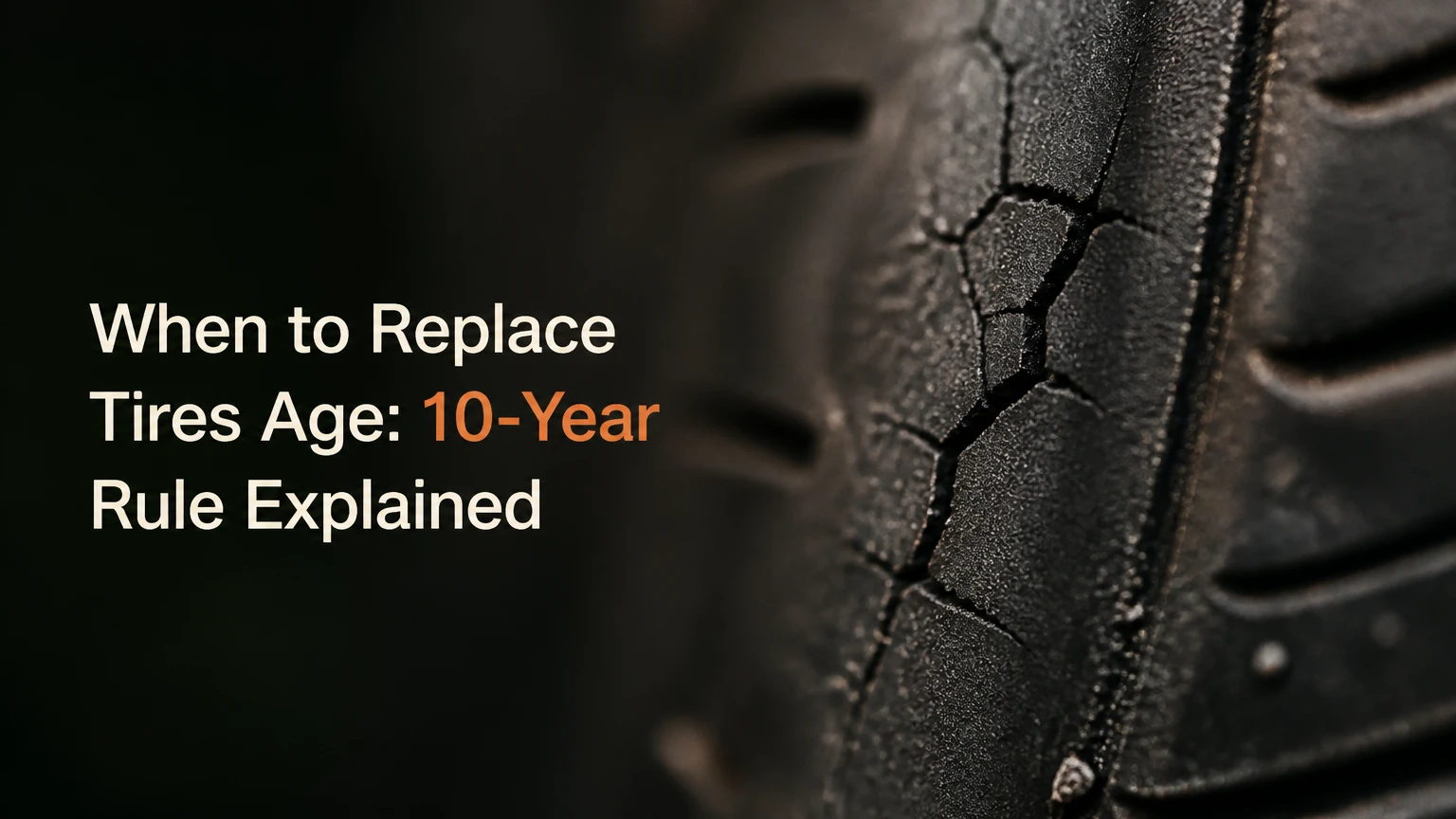
Tire aging is thermo-oxidative degradation: oxygen, heat, ozone, and repeated flexing alter rubber compounds and bonding materials. The process can reduce elasticity, increase cracking, weaken the interface between rubber and steel belts, and raise the chance of separation under load.
The visible tread compound is only one layer. A modern radial tire contains tread rubber, undertread, steel belts, textile plies, sidewalls, bead wire, innerliner, and bonding compounds. A tire can retain a deep tread pattern while internal materials lose resilience.
What Accelerates Tire Aging?
The following conditions shorten the safe service interval:
| Aging factor | Typical exposure | Why it matters | Practical response |
|---|---|---|---|
| High ambient heat | 90°F to 110°F climates | Raises rubber temperature and oxidation rate | Check pressure monthly and inspect annually after year five |
| Underinflation | 5-10 psi below placard pressure | Increases sidewall flexing and heat buildup | Inflate cold tires to the door-jamb specification |
| Direct sunlight | Several hours daily | Ultraviolet radiation degrades exposed rubber | Park indoors or use vehicle shading |
| Ozone and pollution | Dense urban or coastal air | Promotes surface cracking and weather checking | Inspect sidewalls and grooves for fine cracks |
| Long-term storage | Months without movement | Allows pressure loss, flat spotting, and unnoticed aging | Store cool, dry, covered, and inflated to manufacturer guidance |
| Heavy loading | Near or above rated capacity | Increases casing stress and operating temperature | Stay below the tire and vehicle load ratings |
Heat is often more consequential than calendar age because tire temperature rises with underinflation, heavy loads, high speed, and hot pavement. Parking a vehicle indoors reduces ultraviolet exposure, but it does not stop chemical aging inside the tire.
How Do You Check a Tire’s Manufacture Date?
Read the final four digits of the DOT Tire Identification Number on the sidewall. The first two digits indicate the production week, and the last two digits identify the production year, so code 3522 means week 35 of 2022.
Follow this inspection sequence:
- Find the DOT marking. Look on both sidewalls for a code beginning with “DOT.” The complete date code may appear only on the out-facing or in-facing sidewall.
- Locate the final four digits. The date is commonly enclosed in an oval or rounded marking, although formatting varies by manufacturer.
- Decode the week. Digits 01 through 52 identify the production week. A code such as 0821 means the eighth week of 2021.
- Decode the year. The last two digits identify the year in the 2000s for current tires.
- Calculate the age. Count from the production week, not from the installation date or purchase date.
- Record every tire. Tires fitted to one vehicle can have different manufacture dates, especially after partial replacement.
- Check the spare. A spare can be older than the four tires on the road and may be unsafe despite never being used.
A three-digit DOT date code indicates a tire made before 2000. That tire is far beyond the normal service window and should not be placed into service. Some date codes are difficult to read because dirt, brake dust, or wheel position hides the full identification number; a tire shop can inspect the inner sidewall safely.
How Much Tread Is Safe?
Replace a tire at or below 2/32 inch, or 1.6 mm, because that is the common U.S. legal minimum for usable tread, although local rules vary. Many tire professionals recommend replacement around 4/32 inch, or 3.2 mm, when wet-road braking and hydroplaning resistance matter.
Tread-depth measurements should be taken in multiple grooves and at several points around the tire. Uneven readings indicate alignment, suspension, inflation, or rotation problems rather than simple age.
| Tread measurement | Equivalent metric | Decision meaning | Recommended action |
|---|---|---|---|
| 8/32 inch | 6.4 mm | Typical new all-season tread | Monitor pressure and wear pattern |
| 6/32 inch | 4.8 mm | Usable tread with reserve | Continue inspections and rotate as specified |
| 4/32 inch | 3.2 mm | Reduced wet-weather reserve | Plan replacement, especially before rainy seasons |
| 2/32 inch | 1.6 mm | Common legal minimum in the U.S. | Replace immediately and verify local law |
| Below 2/32 inch | Below 1.6 mm | Insufficient tread | Do not continue normal road use |
Tread-wear indicator bars molded into the grooves provide a quick check. Replacement is due when the tread becomes level with those bars, but a tread gauge gives a more precise reading and reveals uneven wear that visual inspection misses.
Why Does Good Tread Not Prove Safety?
Good tread does not prove that an old tire is safe because tread depth measures remaining rubber, not the condition of the casing, belt bonds, innerliner, or sidewall. A low-mileage vehicle can age out before it wears out, particularly when it sits outdoors in a hot climate.
A tire with 8/32 inch of tread may still show circumferential cracks, hardened rubber, or internal separation. Conversely, a younger tire at 3/32 inch may have no age-related cracking but still lack adequate wet traction. Age and tread are separate measurements, and both must pass.
Which Tire-Aging Symptoms Require Immediate Action?
A bulge, exposed cord, deep sidewall cut, belt separation, sudden vibration, or repeated air loss requires immediate professional inspection and usually removal from service. Surface discoloration alone is not enough to diagnose failure, but cracking in grooves or sidewalls becomes more significant as cracks deepen, spread, or expose underlying material.
| Symptom | Likely issue | Can ordinary repair fix it? | Safe response |
|---|---|---|---|
| Sidewall bulge | Internal casing or cord damage | No | Install the spare if safe and replace the tire |
| Exposed steel or textile cord | Structural rubber loss | No | Stop driving except to reach a safe location |
| Deep sidewall cut | Casing damage | Usually no | Obtain professional inspection and replacement |
| Tread separation or raised section | Belt or bond failure | No | Stop using the tire and replace it |
| Fine superficial weather checking | Age or ozone exposure | No permanent repair | Have a tire professional assess depth and spread |
| Nail in repairable tread area | Local puncture | Sometimes | Use a proper internal patch-plug repair |
| Steering-wheel vibration | Balance, separation, wheel, or suspension problem | Not by tire repair alone | Stop at a shop for diagnosis |
Tire dressing products can darken rubber and hide early cracking, but they cannot restore lost elasticity or repair a weakened casing. A shop should remove the tire from the wheel when internal damage is suspected because an external inspection cannot reveal every separation.
Should You Replace Two Tires or All Four?
Replace all four tires when age, tread, or damage affects all four, and follow the owner’s manual for AWD vehicles. Replacing only two can be appropriate when two tires are substantially newer and the vehicle manufacturer permits it, but the newer pair is commonly installed on the rear axle for stability.
The rear axle placement rule applies even on front-wheel-drive vehicles because deeper rear tread helps resist oversteer on wet roads. However, some vehicles require matching tire sizes, tread patterns, or rolling circumferences at all four corners.
AWD systems can be sensitive to tread-depth differences. A small circumference mismatch may keep differentials or electronically controlled couplings compensating continuously, increasing heat and wear. Subaru, Audi, BMW, Mercedes-Benz, and other manufacturers publish model-specific limits, so the manual takes precedence over generic advice.
| Replacement situation | Typical decision | Main technical constraint | Required check |
|---|---|---|---|
| One tire punctured, four tires under 2 years old | Repair or replace one | Puncture location and tread match | Tire shop inspection |
| One tire damaged, matching axle has 5/32 inch | Replace one or two | Tread-depth difference | Vehicle and tire-maker guidance |
| Two front tires worn, rear tires at 5/32 inch | Replace two | Newer tires generally go on rear | Verify size and rotation direction |
| AWD vehicle with 4/32 inch difference | Often replace four | Driveline circumference tolerance | Owner’s manual or dealer specification |
| All four tires older than 8-10 years | Replace four | Age applies to each casing | Check spare and TPMS service |
Do not mix tire types casually. Load index, speed rating, size, construction, seasonal category, and approved fitment must match the vehicle’s requirements.
What Does Age-Based Tire Replacement Cost?
Typical installed replacement costs range from $500-$900 for four compact-car tires and $900-$1,500 or more for truck tires, before unusual vehicle requirements. The final invoice can include mounting, balancing, disposal, sales tax, valve stems, TPMS service, alignment, road-hazard coverage, and specialty installation.
These are typical U.S. consumer ranges, not fixed prices. Run-flat tires, EV-approved tires, commercial van tires, low-profile sizes, and regional labor rates can raise the total.
| Vehicle category | Typical tire price each | Typical four-tire installed price | Common added charge |
|---|---|---|---|
| Compact car or sedan | $100-$220 | $500-$900 | Alignment: $90-$180 |
| Crossover or midsize SUV | $150-$300 | $700-$1,200 | TPMS service: $5-$25 per wheel |
| Full-size truck or van | $200-$400+ | $900-$1,500+ | Disposal: $5-$15 per tire |
| Performance car or EV | $250-$500+ | $1,100-$2,200+ | Run-flat or EV fitment premium |
| Temporary spare replacement | $120-$300 | $150-$350 installed | Vehicle-specific wheel and tire |
A tire quote should state the exact size, load index, speed rating, manufacture date, installation services, warranty terms, and out-the-door total. The cheapest tire is a poor value if it has the wrong load rating or cannot meet the vehicle’s wet-weather and winter requirements.
Which Replacement Tire Should You Choose?
Choose a tire that matches the vehicle placard, climate, season, load, and driving priorities before comparing brand prestige. Premium tires often offer stronger wet braking, lower rolling resistance, or longer tread warranties, while mid-range tires can meet daily commuting needs at lower purchase cost; budget tires require closer attention to independent test results and warranty support.
| Replacement tier | Typical price each | Suitable use | Main trade-off |
|---|---|---|---|
| Premium touring | $170-$350 | Frequent highway driving and wet climates | Higher initial cost |
| Mid-range all-season | $120-$240 | Daily commuting and mixed urban use | Usually less refinement or warranty mileage |
| Budget all-season | $80-$150 | Low-mileage vehicles with modest demands | Variable wet grip, noise, and tread life |
| All-weather | $150-$300 | Drivers needing winter certification without two sets | Higher cost and rolling resistance |
| Dedicated winter | $130-$300 | Snow and ice conditions | Requires seasonal storage and changeovers |
Tire labels do not replace fitment checks. Verify the placard size, load index, speed rating, XL or reinforced construction, run-flat requirement, and whether the vehicle needs a sealant-compatible or EV-rated design.
An honest limitation matters: a tire’s brand and tread warranty cannot guarantee a 10-year structural life. Warranty mileage describes expected tread wear under stated conditions, not permission to operate an aged casing indefinitely.
How Often Should Tires Be Inspected?
Inspect tire pressure monthly and before long trips, then arrange a professional inspection at least annually after the tires reach five years. Professional inspection should include the inner sidewall, bead, tread depth, irregular wear, repair history, valve stem, wheel condition, and signs of separation.
The five-year point is a practical inspection milestone cited by major tire manufacturers, not a guarantee that every tire is safe until that date. Tires exposed to heat, heavy loads, ozone, or long storage deserve earlier assessment.
Use the vehicle’s cold-pressure placard, normally found on the driver-door jamb or fuel-door area, rather than the maximum pressure molded into the sidewall. The sidewall value is commonly the tire’s maximum rated inflation pressure, not the vehicle’s operating target.
Can Unused or Spare Tires Age Out?
Unused tires can age out because oxidation and chemical changes continue while a tire sits on a vehicle, in a trunk, or in a warehouse. A spare tire requires the same DOT-date check as a road tire, and a tire stored for years is not automatically equivalent to a newly manufactured tire.
Retail buyers should request the DOT date before installation, especially for clearance inventory, uncommon sizes, trailer tires, and seasonal tires. A tire manufactured 18-24 months earlier is not necessarily defective when stored correctly, but the buyer should receive appropriate remaining service life and warranty information.
Store loose tires in a cool, dry, dark location away from electric motors, solvents, fuels, and ozone-producing equipment. Keep them upright or follow the manufacturer’s storage guidance, and inspect pressure before fitting a stored tire.
How Do Climate and Driving Habits Change the Timetable?
Hot climates, strong sunlight, coastal ozone, heavy loads, and long periods of inactivity can justify replacement closer to six years than 10 years when cracking or deterioration appears. High-mileage drivers usually reach the tread limit first, while low-mileage drivers often reach the age limit first.
| Driver situation | Earlier risk | Checks to prioritize | Practical planning |
|---|---|---|---|
| Phoenix or Las Vegas commuter | Heat and UV exposure | Sidewalls, pressure, cracks | Inspect yearly after year four |
| Coastal California or Florida vehicle | Ozone, humidity, sunlight | Weather checking and valve stems | Store indoors where possible |
| Remote worker driving 3,000 miles yearly | Calendar aging | DOT date and annual inspection | Budget for age-based replacement |
| Highway commuter driving 25,000 miles yearly | Tread and heat cycles | Depth, alignment, pressure | Expect wear-based replacement first |
| Seasonal vehicle or classic car | Storage and flat spotting | Casing, pressure, spare | Inspect before every extended trip |
| Towing or heavy-load use | Heat and load stress | Load rating, inflation, sidewalls | Replace at the vehicle maker’s conservative interval |
Drivers should not adopt a fixed six-year replacement date without checking condition and manufacturer guidance. Six years is an earlier planning benchmark for some vehicles and environments, not a universal expiration rule.
Common Mistakes That Cause Unsafe Tire Decisions
- Using installation date as tire age: A tire installed in 2024 may have been made in 2021. Use the DOT manufacture date.
- Checking only the outward sidewall: The complete date code may face inward. Ask a shop to inspect it rather than removing a wheel yourself.
- Inflating to the sidewall maximum: Use the vehicle placard pressure for normal operation.
- Replacing only the visibly worn tire: The other tires may have age, damage, or tread mismatch that changes the safe replacement plan.
- Ignoring alignment after uneven wear: A new tire will wear rapidly if toe, camber, suspension, or steering components remain faulty.
- Treating tire shine as protection: Some solvent-based products can damage rubber or conceal cracks; they do not reverse oxidation.
- Forgetting the spare: A 12-year-old spare can fail when needed most.
- Assuming TPMS proves tire health: TPMS normally reports pressure, not tread depth, internal separation, age, or sidewall cracking.
The most useful practitioner rule is to record each tire’s DOT code, tread depth, pressure, and installation position at every seasonal service. A simple log reveals whether a tire is aging, wearing unevenly, or losing pressure gradually.
Frequently Asked Questions
Do tires last longer if the car is driven every day?
Daily use does not stop tire aging, although regular movement can reduce flat spotting and expose pressure problems sooner. Heat cycles, mileage, inflation, load, sunlight, and storage conditions all affect service life. A frequently driven tire may wear out first, while a lightly driven tire may reach its age limit with substantial tread remaining.
How old can tires be when purchased as new?
A tire can be sold as new after warehouse storage, but buyers should check the DOT date and ask how it was stored. A tire that is 12-24 months old may be serviceable when properly stored, yet it provides less remaining age window than a recently manufactured tire. Avoid unverified old stock.
Are visible sidewall cracks always dangerous?
Visible sidewall cracks are a reason for professional inspection, but shallow surface weather checking does not reveal the full condition by itself. Cracks that widen, run through grooves, reach cords, appear inside the sidewall, or accompany bulges and pressure loss require replacement. Do not fill cracks with dressing or sealant.
Can a tire shop determine age without the DOT code?
A tire shop can inspect condition, measure tread, and identify some production markings, but the complete DOT date code is the authoritative manufacture-date reference. If the code is on the inner sidewall, the shop may need to raise the vehicle or remove the wheel to read it accurately.
Should winter tires be replaced by age or tread?
Winter tires should be replaced by both age and winter-specific tread performance. Snow traction can decline before the legal minimum, and many winter tires become less effective as rubber hardens. Check the DOT date, tread depth, cracking, stud condition where applicable, and the manufacturer’s winter-service guidance before each season.
What should I do if one AWD tire fails?
Do not automatically install one new AWD tire. Compare the replacement tire’s rolling circumference and tread depth with the other three, then follow the vehicle manufacturer’s allowable difference. The correct solution may be one tire, two tires, shaving a replacement tire to match, or replacing all four.
The Bottom Line
The answer to when to replace tires age is usually no later than 10 years from the DOT manufacture date, with annual professional inspections beginning around year five and earlier replacement when heat, cracking, damage, tread loss, or vehicle-specific guidance demands it. Read every tire’s DOT code, measure tread, inspect the casing, verify pressure and fitment, and include the spare in the decision. Age alone is not the only risk, but good tread cannot cancel an aged or damaged structure.