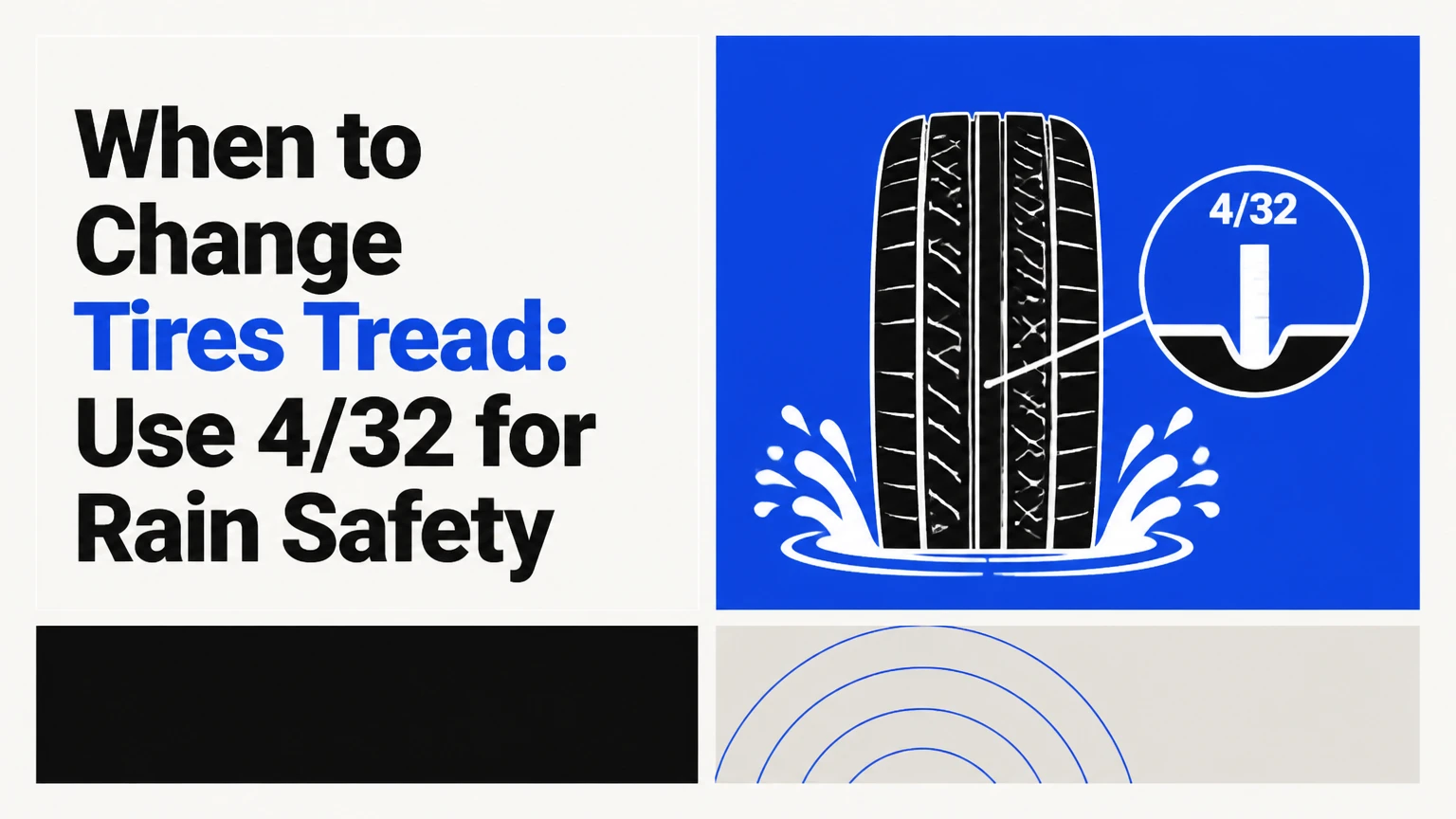
Replace tires when tread reaches 2⁄32 inch (1.6 mm), wear bars become flush, or the tire has a bulge, exposed cords, deep crack, or unsafe puncture. Plan replacement earlier, around 4⁄32 inch in wet climates and 6⁄32 inch for demanding snow use, because legal minimum tread is not the same as strong wet or winter traction.
Key Facts at a Glance
- A tire at 2⁄32 inch (1.6 mm) has reached the common legal replacement limit in the United States, but local rules can differ.
- A 4⁄32-inch reading is a practical wet-weather planning threshold, not a universal legal limit.
- Tire age matters even when tread remains: read the four-digit DOT date code and follow the tire maker’s inspection or replacement guidance.
- Any sidewall bulge, exposed cord, air leak from damage, or deep structural crack requires immediate professional assessment.
- Measure tread in several grooves and locations; one deep reading can hide shoulder wear or a dangerous low spot.
- Tire pressure, wheel alignment, suspension condition, temperature, road surface, and tire compound all affect service life and grip.
When to Change Tires Tread
Tire tread should be changed immediately at 2⁄32 inch (1.6 mm), when tread-wear indicators are level with the surrounding ribs, or when structural damage appears. Drivers should schedule replacement before that point if wet braking has deteriorated, tread is near 4⁄32 inch, wear is uneven, or the tire is aging beyond the manufacturer’s recommended service period.
The 2⁄32-inch figure is a useful safety boundary, not a target for planning. The U.S. Tire Manufacturers Association identifies 2⁄32 inch as the point at which replacement is needed, while state and national laws may use different wording or enforcement rules. A tire shop should inspect tires that have reached this depth, particularly before a rainy or snowy season.
Tread depth is only one decision variable. A five-year-old tire with 5⁄32 inch remaining may be less trustworthy than a newer tire with 4⁄32 inch if it has cracking, poor inflation history, or severe shoulder wear.
Why Is 4⁄32 Inches a Better Planning Point?
Four-thirty-seconds of an inch, or about 3.2 mm, is a sensible replacement-planning point for frequent rain driving because water evacuation and wet braking capability decline before the legal limit. The exact performance change varies by tire design, vehicle, speed, temperature, and road surface, so 4⁄32 inch is guidance rather than a universal law.
A quarter test can provide a quick warning: place a U.S. quarter upside down in a main groove. If the top of Washington’s head is visible, tread is near or below 4⁄32 inch. The test is not precise enough for a final decision because groove shape, coin position, and viewing angle affect the result.
The expert rule is simple: use 2⁄32 inch as the hard replacement boundary, 4⁄32 inch as a wet-weather planning boundary, and a tread-depth gauge for an actual measurement.
How Does Tire Tread Create Grip?
Tire tread creates grip through rubber contact, tread blocks, sipes, and grooves that manage water, snow, and surface deformation. Grooves give displaced water a path away from the contact patch, while sipes create biting edges that help on wet, icy, or snowy surfaces.
A tire does not hydroplane solely because its tread reaches one specific depth. Hydroplaning risk also rises with speed, standing-water depth, tire inflation, vehicle weight, road texture, and tire width. Deeper grooves generally provide more water-storage and evacuation capacity, but tread pattern and rubber compound remain important.
Summer tires, all-season tires, winter tires, and all-terrain tires use different compounds and patterns. A winter tire can retain useful snow grip at a depth where an all-season tire performs differently, while a performance tire’s soft compound may lose handling quality before its grooves approach the legal limit.
What Happens as Tread Wears?
As tread wears, the available groove volume decreases and the tread blocks lose some ability to channel water. Braking distance on wet pavement can increase, and steering response may become less predictable when water, slush, or loose gravel separates the tire from the road.
The effect is not perfectly linear. Tire construction, compound, temperature, and roadway texture change the result, which is why a single tread-depth number cannot predict every stopping distance.
How Can You Measure Tread at Home?
Measure tire tread with a tread-depth gauge at the deepest part of the main grooves, avoiding wear bars, then repeat at the inner, center, and outer portions of every tire. The process takes about 10 minutes and requires a gauge costing typically $5-$20; the lowest reading and the largest left-to-right difference matter most.
Step 1: Park and Inspect the Tire
Park on level ground, engage the parking brake, and turn the steering wheel for access to the front tires. Inspect the sidewall and tread for nails, cuts, bulges, cracking, exposed cords, or objects lodged in grooves.
Do not rely on a visual inspection alone. A tire can look acceptable from outside while its inner shoulder is nearly bald because of alignment or camber problems.
Step 2: Use a Tread-Depth Gauge
Insert the gauge probe into a main groove, not on top of a raised wear bar. Take readings at least three points across the tread and at four positions around each tire, producing a minimum of 12 readings per tire.
Record the lowest result. A tire measuring 5⁄32 inch in the center and 2⁄32 inch on the inner shoulder requires attention based on the shoulder, not the average.
Step 3: Confirm With Wear Bars
Find the raised bars across the main grooves. When the tread surface becomes level with these bars, the tire is approximately at 2⁄32 inch and should be replaced.
Wear bars cannot identify all unsafe conditions. They do not measure age, sidewall deterioration, internal damage, or a localized bald patch outside the indicator groove.
Step 4: Use Coin Tests Only as Screening Tools
A penny test can flag a tire near the 2⁄32-inch threshold: insert a Lincoln penny upside down into a groove, and replace the tire if the top of Lincoln’s head is fully visible. A quarter test flags a tire around 4⁄32 inch when Washington’s head becomes visible.
Coin tests are convenient but imprecise. A gauge is the correct tool for deciding whether a tire has 5⁄32, 4⁄32, or 3⁄32 inch remaining.
How Does Tire Age Change the Decision?
Tire age changes the replacement decision because rubber compounds oxidize, harden, and develop cracks over time, even when tread depth appears adequate. Read the DOT date code on the sidewall, and arrange a professional inspection as tires approach six years from manufacture; many manufacturers advise removal by ten years at the latest.
The final four digits identify the production week and year. For example, “2224” means the tire was manufactured in the 22nd week of 2024. The code may appear on only one sidewall, so the vehicle may need to be moved to see it.
There is no universal rule that every tire must be discarded exactly at six years or exactly at ten years. Michelin, Continental, Bridgestone, vehicle manufacturers, climate, storage conditions, and tire condition can produce different recommendations. Heat, sunlight, ozone, underinflation, and long periods of inactivity accelerate aging.
Age and Tread Decision Table
| Tire condition | Typical action | Reason | Inspection timing |
|---|---|---|---|
| Under 5 years, no damage, above 5⁄32 inch | Continue monitoring | Tread and rubber may remain serviceable | Every month |
| 5-6 years, above 4⁄32 inch | Schedule professional inspection | Age-related cracking can begin | At each service |
| 6-9 years, adequate tread | Replace or obtain tire-maker approval | Aging risk becomes more significant | Before long trips |
| 10 years from manufacture | Replace | Common maximum manufacturer guidance | Do not defer |
| Any age with bulge or exposed cord | Replace immediately | Structural integrity is compromised | Do not drive on it |
Which Tire Damage Requires Immediate Replacement?
A tire with a sidewall bulge, exposed cord, deep sidewall cut, major crack, repeated air loss, or separated tread requires immediate replacement or professional inspection. Structural damage cannot be made safe by adding air, applying sealant, or installing a plug.
A repair may be possible for a small puncture in the central tread area when the tire has not been driven underinflated and the injury meets recognized repair limits. The U.S. Tire Manufacturers Association generally limits safe puncture repair to the tread area and recommends internal inspection after removal from the wheel.
Do not repair sidewall punctures. Do not continue using a tire with vibration, a thumping sound, visible belt material, or tread separation after striking a pothole.
What Do Different Wear Patterns Mean?
Uneven tread wear usually indicates an inflation, alignment, suspension, rotation, or wheel-balance problem, so replacing the tire without fixing the cause can destroy the replacement. Inspect the pattern across the entire tread, then correct the vehicle condition before installing new rubber.
| Wear pattern | Visible or tactile sign | Likely cause | Required response |
|---|---|---|---|
| Center wear | Center rib lower than shoulders | Chronic overinflation | Set pressure from door placard; inspect tire |
| Both-edge wear | Inner and outer shoulders low | Chronic underinflation | Check leaks, load, and inflation |
| One-edge wear | One shoulder worn sharply | Camber or alignment issue | Alignment and suspension inspection |
| Feathering | Blocks smooth one direction, rough opposite | Toe misalignment | Correct toe setting |
| Cupping | Repeating scalloped depressions | Worn shocks, imbalance, or looseness | Suspension and balance inspection |
| Patch wear | Isolated bald area | Locked braking or severe imbalance | Replace if structural damage exists |
Cold tire pressure should match the vehicle manufacturer’s door-jamb placard, not the maximum pressure molded into the sidewall. Check pressure monthly and before long trips, because a 10-degree Fahrenheit temperature change typically alters pressure by about 1 psi.
How Do Tire Types Compare?
Tire type changes expected mileage, seasonal performance, noise, and cost, but no category has a guaranteed lifespan. Annual mileage, acceleration, cornering, alignment, road roughness, climate, vehicle weight, and tire rotation can move actual life far outside typical ranges.
| Tire category | Typical tread life | Typical price per tire | Best operating condition |
|---|---|---|---|
| Touring all-season | 50,000-80,000 miles | $100-$220 | Mixed temperatures and highway use |
| Summer performance | 20,000-40,000 miles | $150-$350 | Warm roads and dry or wet handling |
| Winter snow | 30,000-50,000 miles | $120-$280 | Cold roads, snow, and ice |
| All-terrain SUV or truck | 35,000-65,000 miles | $160-$350 | Gravel, trails, and mixed pavement |
UTQG treadwear ratings can help compare many passenger tires sold in the United States, but the number is comparative rather than a mileage guarantee. A tire marked 600 does not promise 60,000 miles, and UTQG ratings do not fully describe snow traction, wet braking, ride comfort, or age resistance.
How Many Tires Should You Replace?
Replace all four tires when tread depths differ substantially, the vehicle has all-wheel drive, or the vehicle manufacturer requires closely matched rolling circumferences. Replace tires in axle pairs when only two are needed, and normally install the tires with deeper tread on the rear axle unless the vehicle maker specifies another arrangement.
A new tire can have 10⁄32 inch of tread while a worn companion has 4⁄32 inch. That difference changes rolling circumference and available traction. On some AWD systems, mismatched tire diameters can increase driveline stress or trigger control-system faults.
Before buying one tire, ask the tire manufacturer or vehicle dealer whether shaving a replacement tire to match the others is permitted. Never mix tire sizes, speed ratings, load indexes, or seasonal designs without confirming compatibility.
When Should Seasonal Tires Be Changed?
Change from winter tires when local temperatures remain consistently above about 7°C (45°F), and install winter tires before persistent cold, snow, or ice arrives. Winter rubber becomes softer and wears faster on warm pavement, while all-season and summer tires lose flexibility as temperatures fall.
The 7°C point is a practical industry guideline, not a universal legal trigger. Calendar timing depends on location: a driver in Minneapolis may change earlier than a driver in Vancouver, while mountain roads may require winter equipment after valley temperatures rise.
Look for the Three-Peak Mountain Snowflake symbol, or 3PMSF, when selecting a severe-snow tire. The M+S marking alone does not indicate the same standardized severe-snow performance.
What Should You Do If Replacement Is Delayed?
If replacement is delayed, reduce speed, avoid standing water, check pressure, minimize heavy loads, and arrange service as soon as possible; these steps do not restore worn-tire traction. Do not take a tire at or below 2⁄32 inch on a highway trip, through heavy rain, or onto snow-covered roads.
A temporary spare is a limited-distance solution governed by its sidewall instructions, often with a maximum speed near 50 mph. A tire-sealant kit cannot repair sidewall damage and may interfere with TPMS sensors or professional inspection.
A tire shop should inspect the tire before any long journey when tread is under 4⁄32 inch, the vehicle pulls, steering vibrates, or pressure falls repeatedly.
What Must Be Done After Replacement?
After replacement, install the correct size, load index, speed rating, and seasonal design; inflate to placard pressure; torque wheel fasteners to the vehicle specification; and reset or relearn the TPMS. Check alignment when wear was uneven or the vehicle struck a pothole.
| Post-installation check | Typical specification or timing | Why it matters |
|---|---|---|
| Wheel-nut torque | Vehicle-specific, commonly 80-120 lb-ft | Prevents loosening or rotor damage |
| TPMS relearn | Immediately after installation | Confirms pressure warnings operate |
| Pressure check | Cold, at placard value | Establishes correct contact patch |
| Lug recheck | After 25-50 miles if shop advises | Detects seating changes |
| Rotation | Commonly every 5,000-8,000 miles | Limits uneven wear |
The first 50 miles are a useful observation period. Check for vibration, pulling, noise, pressure loss, and steering changes, then return to the installer if any symptom appears.
Frequently Asked Questions
Is 3⁄32 inch tread safe to drive on?
A tire with 3⁄32 inch remaining may be legal in many jurisdictions, but it has little reserve for heavy rain and should be scheduled for replacement. Drivers who regularly encounter rain, snow, high speeds, or long highway trips should not treat 3⁄32 inch as a comfortable service target.
How often should tire tread be checked?
Check tire tread and pressure once a month and before long trips. Inspect more often after pothole impacts, curb strikes, extended storage, unusual vibration, or a warning from the TPMS. Measure all four tires because front-wheel-drive vehicles often wear their front tires faster.
Can old tires be safe if they have deep tread?
Deep tread does not prove that an old tire is safe. Rubber can harden and crack internally or externally, and age-related deterioration may reduce grip or structural strength. Read the DOT date code, inspect sidewalls and grooves, and follow the tire manufacturer’s age guidance.
Are used tires worth buying?
Used tires can reduce upfront cost, but their history, internal damage, age, heat exposure, and repair record may be unknown. Avoid any used tire with less than 5⁄32 inch of tread, uneven wear, sidewall damage, a questionable date code, or a puncture repair that a qualified installer cannot verify.
Does tire pressure affect tread life?
Incorrect pressure directly affects tread wear and handling. Overinflation commonly accelerates center wear, while underinflation increases shoulder wear, heat buildup, rolling resistance, and the risk of internal damage. Use the placard pressure when the tire is cold, not the sidewall maximum.
The Bottom Line
Change tires when tread reaches 2⁄32 inch, wear bars are flush, or structural damage appears. For safer planning, replace closer to 4⁄32 inch before a wet season and around 6⁄32 inch when reliable snow traction matters, while age, pressure, alignment, tire type, and climate remain part of the decision. When asking when to change tires tread, use the lowest measured depth and the tire’s condition, not an average appearance, as the final guide.